
In Memory of Eva Gore-Booth and Con Markiewicz is W.B. Yeats’s elegy for two sisters from Lissadell, Co. Sligo. Eva Gore-Booth, a poet and campaigner for working women, died in 1926. Constance Markievicz, a 1916 rebel and the first woman elected to the British parliament, died in 1927. Yeats dated the poem October 1927. It holds up a golden memory of the two girls, regrets the political lives they chose, then turns its anger on time itself. Below are the full public-domain text from the 1933 Macmillan edition, a plain guide to its meaning, the real story of the sisters, and notes for Leaving Cert Higher Level English in 2027 and 2028.
Two girls in silk kimonos, the evening light, the tall windows of a big house in Sligo. Yeats carried that picture for more than thirty years. He first stayed at Lissadell in late November 1894, a young poet among the daughters of the house.
By October 1927 both sisters were dead, and he wrote this poem. It’s one of 13 Yeats poems on the Higher Level English course for June 2027 and June 2028. For the full list, see my guide to the Yeats Leaving Cert poems for 2027 and 2028.
Jump to:
- The poem at a glance
- The full poem
- Who were Eva Gore-Booth and Con Markievicz?
- Yeats at Lissadell
- What happens in the poem
- Themes
- Imagery, tone and structure
- Yeats and the sisters’ politics
- Exam notes: key quotes and what to discuss
- In Memory of Eva Gore-Booth FAQ
- More Yeats reading
The poem at a glance
- Poet: W.B. Yeats (1865 to 1939).
- Written: Yeats dated it October 1927, under the last line. Con had died on 15 July 1927; Eva on 30 June 1926.
- Published: first in The Winding Stair (1929), then as the opening poem of The Winding Stair and Other Poems (London: Macmillan, 1933).
- Form: 32 short rhymed lines in two verse paragraphs, one of 20 lines and one of 12.
- Exam: Higher Level only. It’s poem 9 of the 13 Yeats poems in circular 0021/2025 for June 2027 and in circular 0024/2026 for June 2028. It is not on the Ordinary Level list.
The full poem
This is the text as printed in The Winding Stair and Other Poems (London: Macmillan, 1933), pages 1 and 2, checked line by line against scans of the December 1933 reprint on the Internet Archive. Yeats died in 1939, so his poems are out of copyright in Ireland and the EU.
In Memory of Eva Gore-Booth and Con Markiewicz
The light of evening, Lissadell,
Great windows open to the south,
Two girls in silk kimonos, both
Beautiful, one a gazelle.
But a raving autumn shears
Blossom from the summer’s wreath;
The older is condemned to death,
Pardoned, drags out lonely years
Conspiring among the ignorant.
I know not what the younger dreams—
Some vague Utopia—and she seems,
When withered old and skeleton-gaunt,
An image of such politics.
Many a time I think to seek
One or the other out and speak
Of that old Georgian mansion, mix
Pictures of the mind, recall
That table and the talk of youth,
Two girls in silk kimonos, both
Beautiful, one a gazelle.
Dear shadows, now you know it all,
All the folly of a fight
With a common wrong or right.
The innocent and the beautiful
Have no enemy but time;
Arise and bid me strike a match
And strike another till time catch;
Should the conflagration climb,
Run till all the sages know.
We the great gazebo built,
They convicted us of guilt;
Bid me strike a match and blow.
October 1927
I’ve closed up the printer’s space before each semicolon and set the first word in ordinary type, not small capitals. Everything else, including Yeats’s two dashes, is as printed. Anthologies can differ slightly, so learn the version in your class text.
Who were Eva Gore-Booth and Con Markievicz?
Their parents were Sir Henry Gore-Booth, landowner and Arctic explorer, and Georgina, his wife, and the girls grew up at Lissadell in north Sligo. The Gore-Booths were descended from seventeenth-century planters and were among the county’s leading landowners. In the famine year of 1879 they helped distribute relief, the Dictionary of Irish Biography notes.
Constance, the eldest of three daughters, was born in London on 4 February 1868 and brought to Lissadell as a baby. Eva, the second, was born at Lissadell on 22 May 1870. The two were close all their lives.
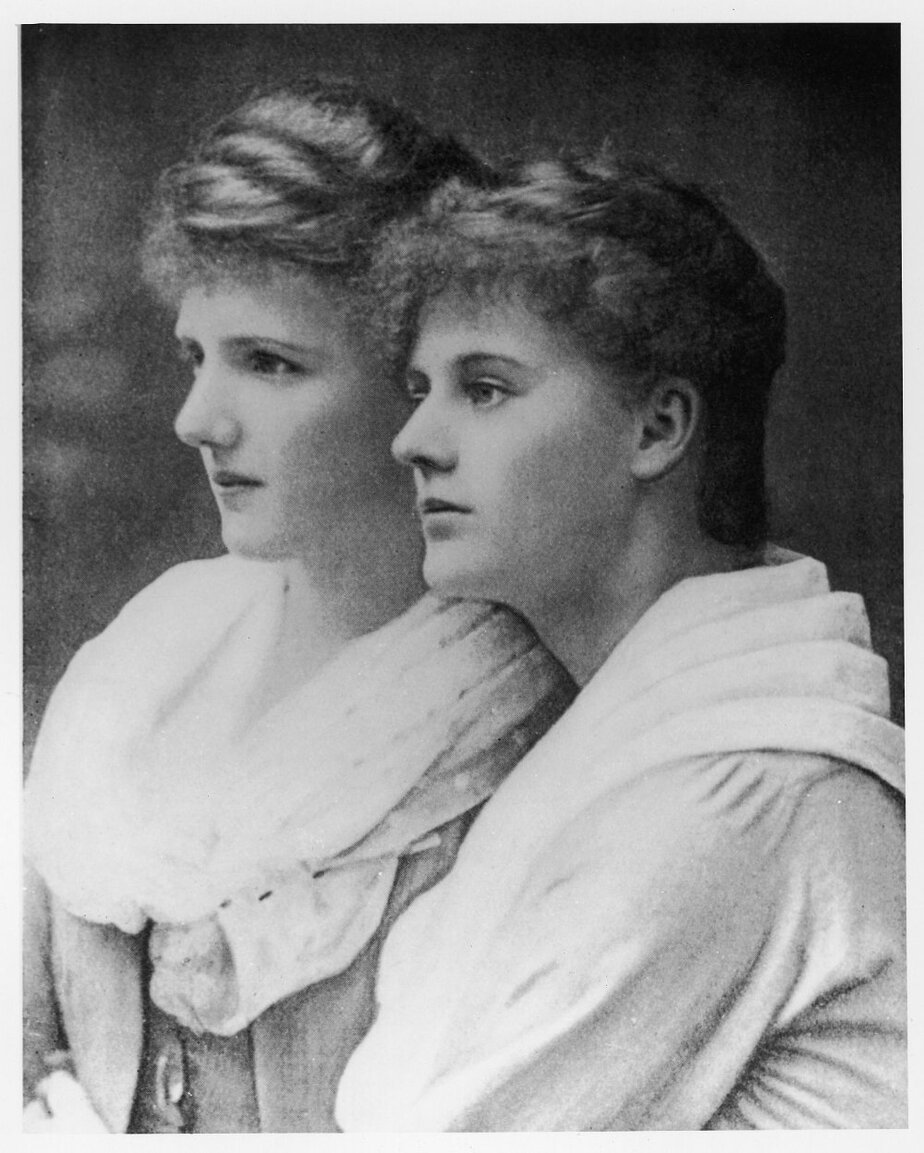
Eva and Constance Gore-Booth as young women. Photographer unknown. Public domain, via Wikimedia Commons
Constance Markievicz (1868 to 1927)
Constance trained as a painter at the Slade School in London from 1893 and in Paris from 1898. In Paris she met a Polish count, Casimir Dunin-Markievicz, and they married in London in 1900; their daughter, Maeve, was born in 1901.
From about 1908 she threw herself into nationalist politics. She joined Sinn Féin (roughly shin FAYN, “ourselves”, often translated “we ourselves”) and Inghinidhe na hÉireann, the Daughters of Ireland, and in 1909 she helped found Fianna Éireann (FEE-uh-nuh AY-run), a republican youth movement. During the 1913 Lockout she ran soup kitchens at Liberty Hall and in the slums, and she became the Irish Citizen Army’s honorary treasurer.
At Easter 1916 she was second in command of a Citizen Army unit at St Stephen’s Green, which was forced back into the Royal College of Surgeons and surrendered after a week. She was sentenced to death, but the sentence was commuted because she was a woman, and she was let out in June 1917 under a general amnesty. So the poem’s “condemned to death, / Pardoned” is a poet’s shorthand: strictly, a commuted sentence and an amnesty.
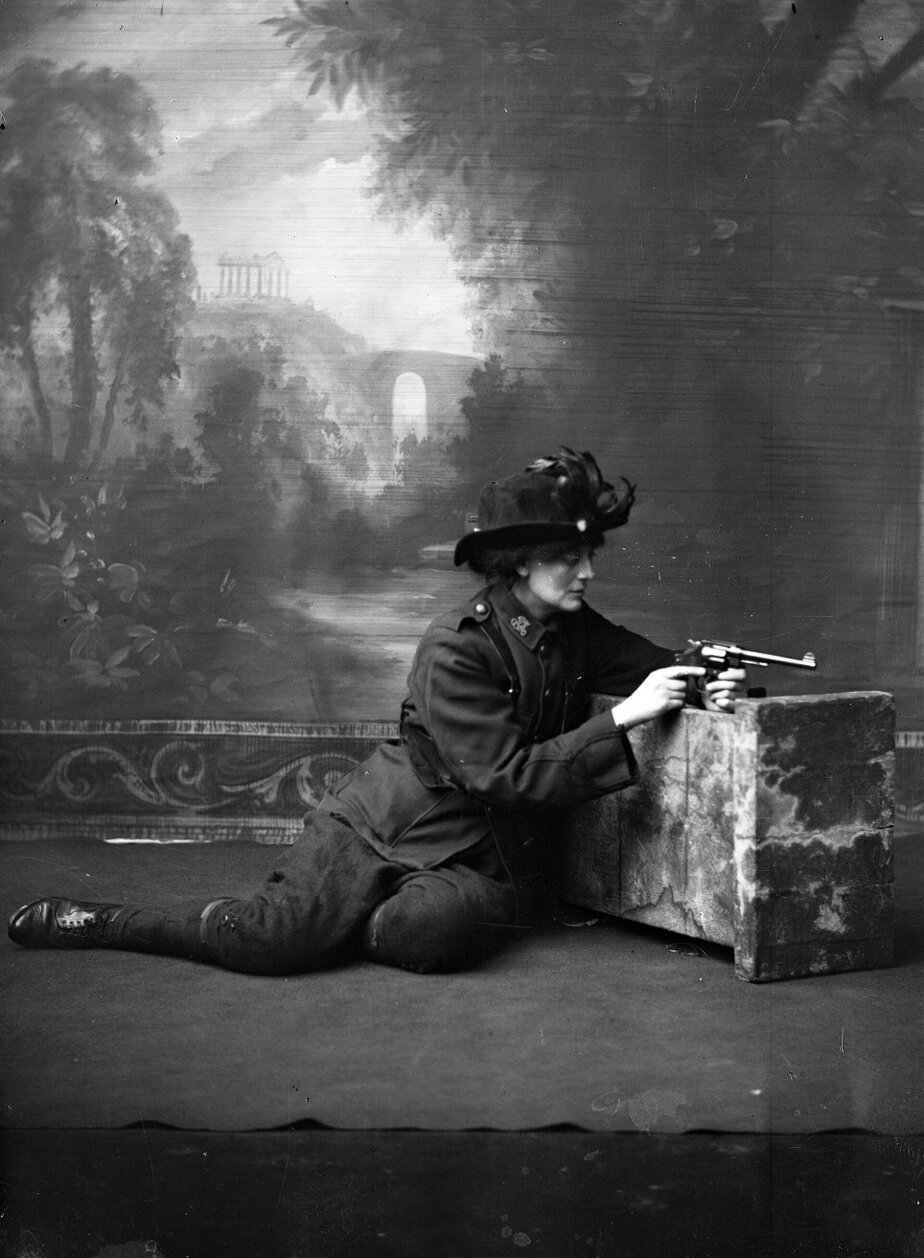
Constance Markievicz in uniform, a studio portrait from about 1915. National Library of Ireland, public domain, via Wikimedia Commons
At the 1918 general election she won Dublin’s St Patrick’s division for Sinn Féin while in prison, becoming the first woman elected to the British parliament. Like the other Sinn Féin members, she stayed away from Westminster. In 1919 the first Dáil (DOYL in English, closer to DAWL in Irish), the assembly set up in Dublin by the Sinn Féin members, made her minister for labour.
She opposed the Anglo-Irish Treaty of 1921 and in 1926 joined the new Fianna Fáil (FEE-uh-nuh FOYL in English, closer to FAWL in Irish) party. She won a seat for Dublin South in June 1927, but her health was failing. She died in a public ward of Sir Patrick Dun’s Hospital in Dublin on 15 July 1927 and was buried at Glasnevin.
Eva Gore-Booth (1870 to 1926)
Eva was the quieter sister, drawn early to poetry and mysticism. In 1896, in Italy, she got to know Esther Roper, a suffrage campaigner from Manchester, and by 1897 the two women had set up home together in Manchester. They stayed together for the rest of Eva’s life.
Her first book, Poems, came out in 1898, and Yeats welcomed it warmly. Her best-known poem, The Little Waves of Breffny, followed in 1904. But most of her energy went into organising working women. From 1900 she was co-secretary of the women’s trade union council for Manchester and Salford, and she championed barmaids, flower sellers, women acrobats and the pit-brow women who worked at the coal mines. In 1901 she and Roper gathered some 30,000 signatures for a suffrage petition.
Poor health took the couple to London in 1913. During the First World War she worked for peace and against conscription, and supported conscientious objectors. After the Rising she hurried to Dublin to campaign for her sister’s life, and she was in court for the trial of Roger Casement. She died of cancer in Hampstead on 30 June 1926, aged 56, and is buried there, with Esther Roper beside her.
Yeats at Lissadell
The National Inventory of Architectural Heritage dates Lissadell House to 1830 to 1835. It’s a severe Greek Revival house of grey limestone, designed by Francis Goodwin, with a curved central bow on its south front facing terraced lawns. So Yeats’s “Great windows open to the south” is accurate, and his “old Georgian mansion” was about sixty years old when he first saw it.
That first visit came in late November 1894, the first of several, as the scholar PJ Mathews of University College Dublin explained in The Irish Times in 2010. The young poet loved the family’s hospitality and their curious, unconventional household, and he spent much of his time with Constance and Eva. Lissadell was already in his verse: in The Man who Dreamed of Faeryland, from the group of early poems he called The Rose and dated 1893, a man “wandered by the sands of Lissadell”.
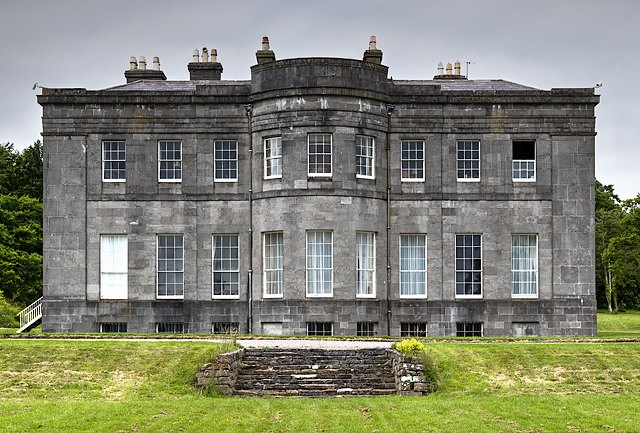
The south front of Lissadell House, Co. Sligo. Photo: Mike Searle, CC BY-SA 2.0, via Wikimedia Commons
What happens in the poem
Lines 1 to 4: the golden picture
The poem opens with a still image, almost a photograph: evening light, the house, two lovely girls in silk. There’s no main verb, so nothing happens. Time stands still. “One a gazelle” suggests grace and speed, and a wild thing that is easily startled. The poem never says which sister it means.
Lines 5 to 13: what became of them
Then the season turns. A “raving autumn”, a madman with shears, cuts the blossom from summer’s wreath. “The older”, Con, is condemned to death and spared, then spends “lonely years / Conspiring among the ignorant”: Yeats’s harsh verdict on her political life among Dublin’s poor.
“The younger”, Eva, dreams of “Some vague Utopia”, and Yeats doesn’t even know what it is. In her last years she seems to him “withered old and skeleton-gaunt”, a picture of the politics he distrusts. She was 56 when she died, after a long illness, so “old” is the poet’s exaggeration.
Lines 14 to 20: the wish to talk
Yeats says he often thinks of seeking one sister out to talk about the house and their young days. The verb is “think”: the visit never happens. Then the first picture comes back word for word. The stanza ends where it began, as if memory keeps returning to the one moment that time can’t touch.
Lines 21 to 32: speaking to the dead
“Dear shadows” are the sisters’ ghosts. Now that they are dead, Yeats says, they understand the “folly” of fighting for or against “a common wrong or right”, ordinary political causes. Then comes the poem’s central idea: “The innocent and the beautiful / Have no enemy but time”.
So he asks them to rise and urge him to strike match after match until time itself catches fire, and if the blaze spreads, to run and tell the wise. The last lines widen to “We”: “We the great gazebo built, / They convicted us of guilt”. The poem ends with the call to strike a match and blow, a wish to burn away the time that destroyed them.
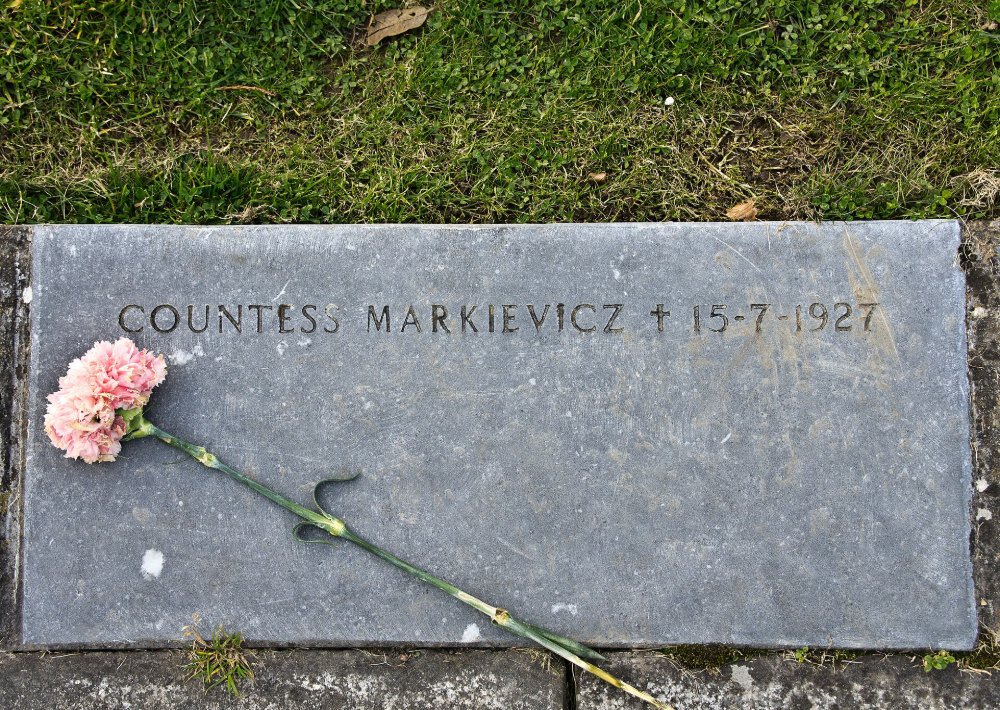
The grave of Countess Markievicz at Glasnevin Cemetery, Dublin. Photo: William Murphy, CC BY-SA 2.0, via Wikimedia Commons
Themes
Time as the enemy. The poem says it outright: innocence and beauty have “no enemy but time”. Autumn’s shears, the “withered” body and the attack on time with matches all build on that idea.
Youth, beauty and age. The silk kimonos and the gazelle stand against “skeleton-gaunt”. Yeats mourns lost beauty, as he does in The Wild Swans at Coole and Among School Children.
Politics and its cost. In the poem, politics wastes the sisters’ beauty and promise. That is Yeats’s judgment (more on it below).
The big house and its world. Lissadell, the “old Georgian mansion”, stands for a cultured, privileged world that Yeats valued, and the poem mourns it along with the sisters.
Memory and regret. The repeated opening, the visit he never makes and the tender “Dear shadows” make this a personal elegy as well as an argument.
Imagery, tone and structure
- The opening tableau: light, windows, silk and a gazelle, a list of images with no verb. It feels like a painting or a photograph.
- The seasons: summer’s blossom and wreath for youth, a “raving autumn” with shears for the violence and decline that followed.
- The shadows: the dead sisters, addressed directly and affectionately.
- Fire: the match, the “conflagration” and the final “blow”. Yeats imagines setting time itself alight. “Blow” most likely means fanning the flame.
- The gazebo: a garden summer house built for the view. Readers disagree. PJ Mathews reads it as Yeats’s image for Anglo-Irish achievement, which in his view the sisters’ politics undermined. It can also be read as self-mockery: a gazebo is a pretty but useless building, and “We” may take in Yeats, the sisters and their whole class. “They convicted us of guilt” is just as open: “they” could be the new Ireland, the revolutionaries, or history.
- Rhyme: both stanzas are built from quatrains rhymed ABBA (Lissadell and gazelle, shears and years, seek and speak), many of them slant rhymes, such as south and both, or ignorant and gaunt.
- Rhythm: short four-beat lines, mostly of seven or eight syllables (“All the folly of a fight”), quick and urgent in the second stanza.
- Repetition: lines 3 and 4 return as lines 19 and 20, and “strike a match” recurs in the second stanza.
- Tone: nostalgic, then disapproving, then wistful, then tender, and at the end defiant.
Yeats and the sisters’ politics
The poem is one man’s view. Yeats admired the sisters as he first knew them and treats their later politics as a waste of that promise, brushing aside Con’s republican and labour work and Eva’s decades of campaigning.
Plenty of people saw them very differently, then and now: Con as a 1916 combatant, the first woman elected to Westminster and a minister in the first Dáil; Eva as a poet, trade unionist, suffragist and pacifist. Seen that way, the poem’s verdict can look unfair. Then again, Yeats calls their struggle “folly” while saying “We” built the gazebo, so he may share the blame.
He had written about Con before. In Easter, 1916 he says “That woman’s days were spent / In ignorant good-will”, before remembering how sweet her voice was when she was young. In On a Political Prisoner (1921) he recalls seeing her “ride / Under Ben Bulben to the meet”. The pattern is the same: the bright girl of Sligo set against the political woman.
Exam notes: key quotes and what to discuss
Key quotes to learn:
- “Two girls in silk kimonos, both / Beautiful, one a gazelle”: the ideal memory, repeated.
- “But a raving autumn shears / Blossom from the summer’s wreath”: the turn from youth to ruin.
- “Conspiring among the ignorant”: Yeats’s harsh view of Con’s politics.
- “Some vague Utopia”: his view of Eva’s ideals.
- “withered old and skeleton-gaunt”: age and illness.
- “Dear shadows, now you know it all”: tenderness for the dead.
- “The innocent and the beautiful / Have no enemy but time”: the central idea.
- “We the great gazebo built, / They convicted us of guilt”: the most debated lines.
What a good answer could discuss:
- Yeats’s mixed feelings: love and admiration for the girls, disapproval of the women, and some self-criticism in “folly” and “We”.
- Personal and public: a private elegy that is also about Irish history, class and revolution.
- Time: how the poem freezes, loses and finally attacks time.
- Craft: the refrain, the ABBA rhymes, the short lines and the change of pace in stanza two.
Good pairings from the course: Easter, 1916 (Con in the Rising), September 1913 (Yeats on politics before the Rising), The Wild Swans at Coole (time, change and another big house), The Stare’s Nest by My Window (the Civil War years) and Politics, a late poem that sets public affairs against private longing. For the Sligo landscape, read Under Ben Bulben; for the Rising itself, see my guide to the Easter Rising.
This is an unofficial study guide; check details with your teacher.
In Memory of Eva Gore-Booth FAQ
What is In Memory of Eva Gore-Booth and Con Markiewicz about?
It’s Yeats’s elegy for two sisters he knew at Lissadell in Sligo. He remembers them as beautiful girls, regrets the political lives they led, and ends by blaming time, not the sisters, for what was lost.
Who is the gazelle in the poem?
Yeats doesn’t say. Many readers take it to be Eva, the quieter and more delicate sister, but the line works as a picture of either girl.
What does the gazebo mean?
A summer house built for the view. It may stand for Anglo-Irish achievement (PJ Mathews’s reading) or be a pretty folly, making the line partly self-mocking. Back either reading up from the text.
When did Yeats write the poem?
He dated it October 1927, about three months after Con Markievicz died on 15 July 1927. Eva had died the year before, on 30 June 1926.
Is it on the Leaving Cert in 2027 and 2028?
Yes, at Higher Level, as one of 13 prescribed Yeats poems for June 2027 (circular 0021/2025) and June 2028 (circular 0024/2026). It isn’t on the Ordinary Level list.
Why does Yeats spell it Markiewicz?
Markiewicz is the Polish spelling of her husband’s name. In Ireland her name is usually spelled Markievicz, the form the Dictionary of Irish Biography uses.
Love this? Save it to your Pinterest board for later.
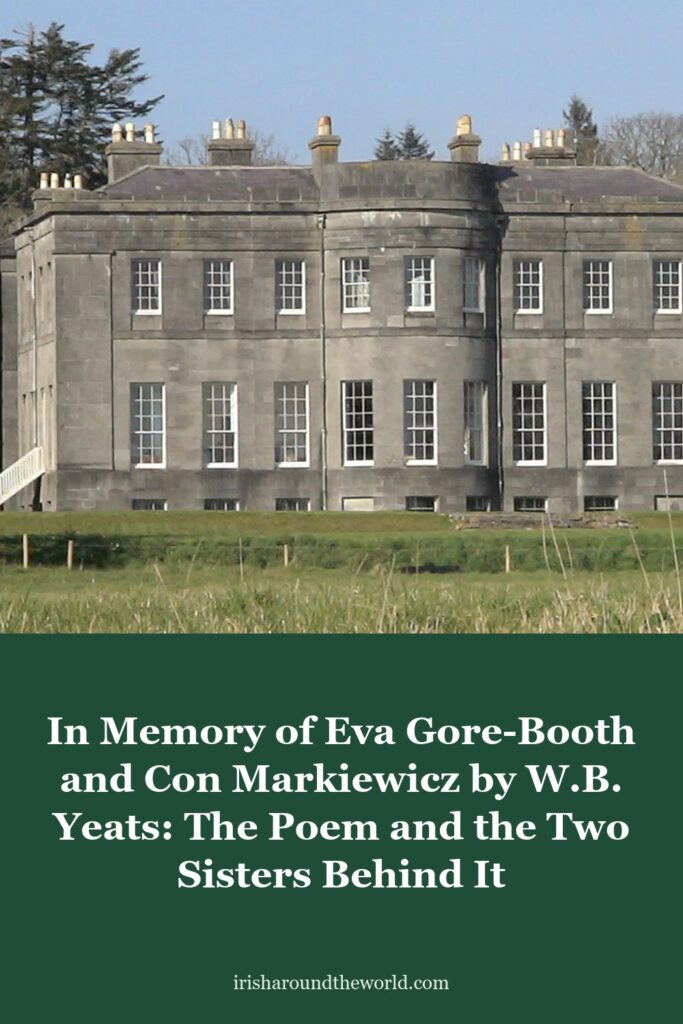
Pin image: Lissadell House, Co. Sligo. Photo: Nigel Aspdin, CC BY-SA 3.0, via Wikimedia Commons
A little bit of Ireland in your inbox every Friday ☘️
The free Weekly Dose of Irish: an Irish joke, a Celtic symbol, an Irish fact, a poem and the week’s best articles in one short email. Join 9,600+ readers.
Free. One short email every Friday. Unsubscribe any time.
More Yeats reading
- Yeats Leaving Cert Poems 2027 and 2028: All 13 Poems, With Notes
- Easter, 1916 by W.B. Yeats: Meaning and Analysis
- The Wild Swans at Coole by W.B. Yeats: Meaning and Analysis
- September 1913 by W.B. Yeats: Meaning and Analysis
- Under Ben Bulben by W.B. Yeats: The Poem That Wrote His Own Epitaph
- Among School Children by W.B. Yeats: Meaning and Analysis
- The Easter Rising: The 1916 Rebellion That Failed, Then Changed Ireland
- Famous Irish Poets: The Greatest of All Time, in Order
Featured image: Lissadell House, Co. Sligo. Photo: Nigel Aspdin, CC BY-SA 3.0, via Wikimedia Commons.