Here are the St Patrick’s Day facts most people get wrong. Saint Patrick wasn’t Irish: he was born in Roman Britain. His colour was blue before green. The shamrock story was first written down in the 1720s. The first recorded celebration in what is now the US was in St Augustine, Florida, in 1600. Irish pubs were shut by law on the day from 1924 to 1960.
St Patrick’s Day is the one day of the year when the whole world decides it’s a bit Irish. We exported ourselves everywhere, so the party travels too.
The trouble is that most St Patrick’s Day facts online are copied from each other, and a good few are wrong. Patrick wasn’t Irish, for a start.
So here are 30 facts I’ve checked against proper sources, from the Dictionary of Irish Biography to the US Census Bureau. Every number has a year on it.
Jump to:
- Saint Patrick the man
- The day and the parades
- Green, the shamrock and symbols
- St Patrick’s Day around the world
- St Patrick’s Day statistics: numbers and spending
- St Patrick’s Day facts for kids
- St Patrick’s Day myths to forget
- St Patrick’s Day FAQ
- More St Patrick’s Day reading
Saint Patrick the man
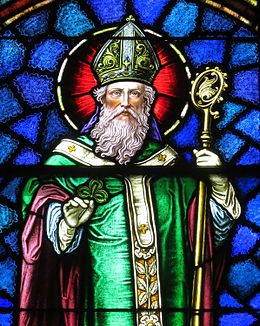
A stained-glass Patrick with his shamrock. The bearded bishop look came along in the 17th century.
Almost everything we know about the real Patrick comes from two short texts he wrote himself. The rest is legend. For the longer version, read the real story behind St Patrick’s Day.
1. Saint Patrick was not Irish
Patrick was born in Roman Britain, into a Christian family. The family lived near a place he called Bannavem Taburniae, and nobody knows where that was.
The Royal Irish Academy’s Dictionary of Irish Biography (DIB) lists guesses from Hadrian’s Wall to the Severn valley. He wasn’t English either. England didn’t exist yet.
2. He was kidnapped by Irish raiders at 16
Patrick says he was taken to Ireland at 16, along with “many thousands of people”. He spent six years in captivity, minding animals. He escaped after a dream, travelled about 200 miles to a ship and got home.
Years later he came back by choice, after a vision in which he heard “the voice of the Irish”. That’s all from his Confessio, as summarised in the DIB.
3. Only two of his writings survive
Patrick left us two short Latin texts: the Confessio and a letter to the soldiers of a British ruler called Coroticus. Everything else was written by other people, centuries later. The earliest Lives came in the seventh century, from Muirchú and Tírechán.
You can read the Confessio yourself at confessio.ie, a Royal Irish Academy project.
4. He probably spoke three languages
Patrick wrote in Latin, and he apologises in the Confessio for how rough his Latin was. According to the DIB, his home language was probably British, an early form of Welsh. He picked up Old Irish during his six years as a slave. That last one came in handy for a missionary.
5. He was not the first bishop sent to Ireland
That honour goes to Palladius. A writer of the time, Prosper of Aquitaine, records that Pope Celestine sent Palladius in 431 “to the Irish believing in Christ”.
So there were already Christians in Ireland before Patrick got going. The DIB points this out, and it rather spoils the idea of one man converting a whole island.
6. Nobody knows the year he died
You’ll often read that Patrick died on 17 March 461. The Irish annals actually give two traditions, around 460 and around 493, and the DIB leans towards the 490s.
A seventh-century tradition says he died at Saul, Co. Down, and was buried nearby at Downpatrick. The DIB notes that no other place has ever claimed his grave, not even Armagh, his main church.
7. He was never formally canonised
Patrick has no paperwork. Church historians date Rome’s first formal canonisation to 993, about five centuries after his death. Like most early Irish saints, Patrick was made a saint by local tradition and popular devotion instead. His feast has been in the Roman calendar since 1632, as you’ll see below. Nobody in Rome seems one bit bothered.
The day and the parades
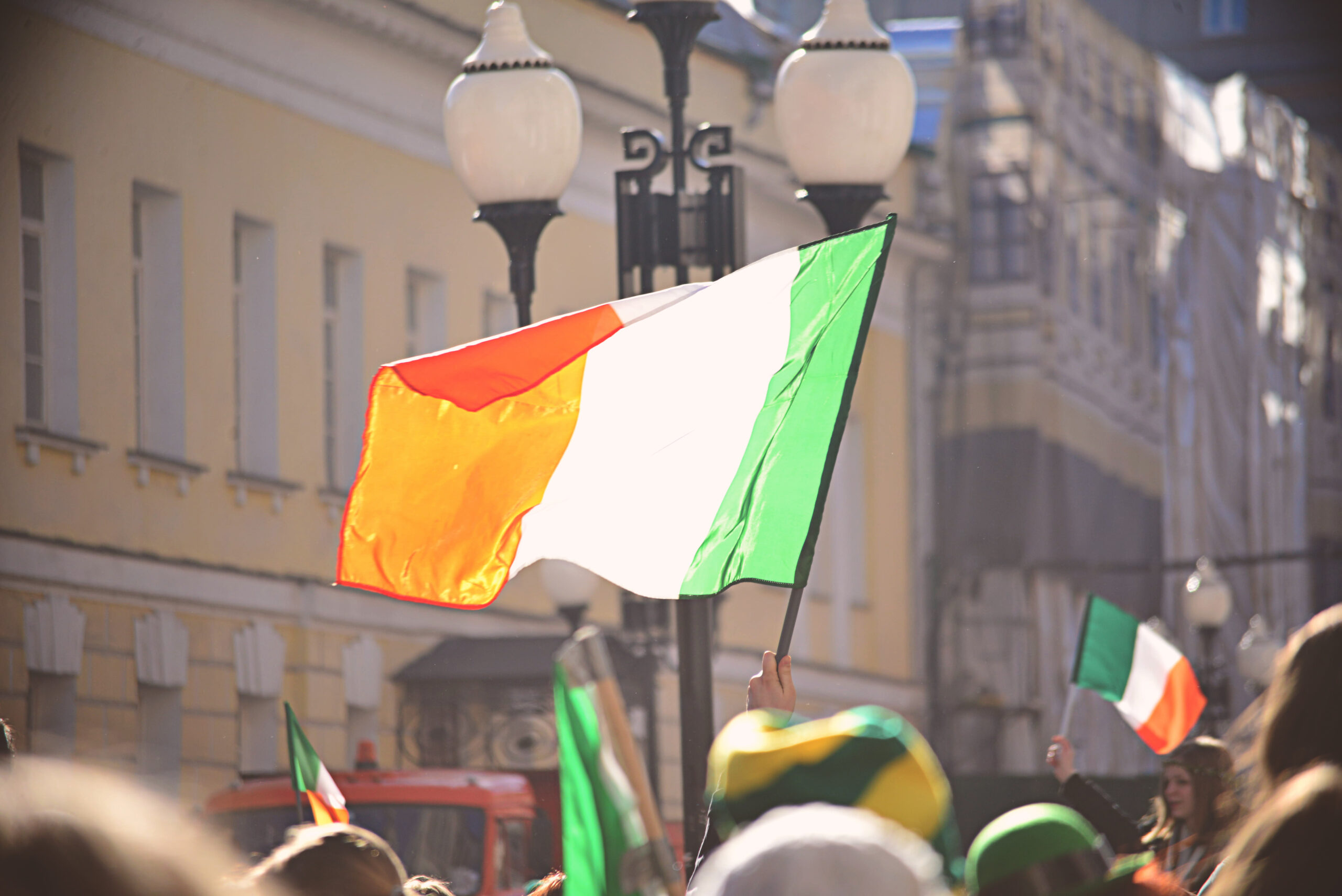
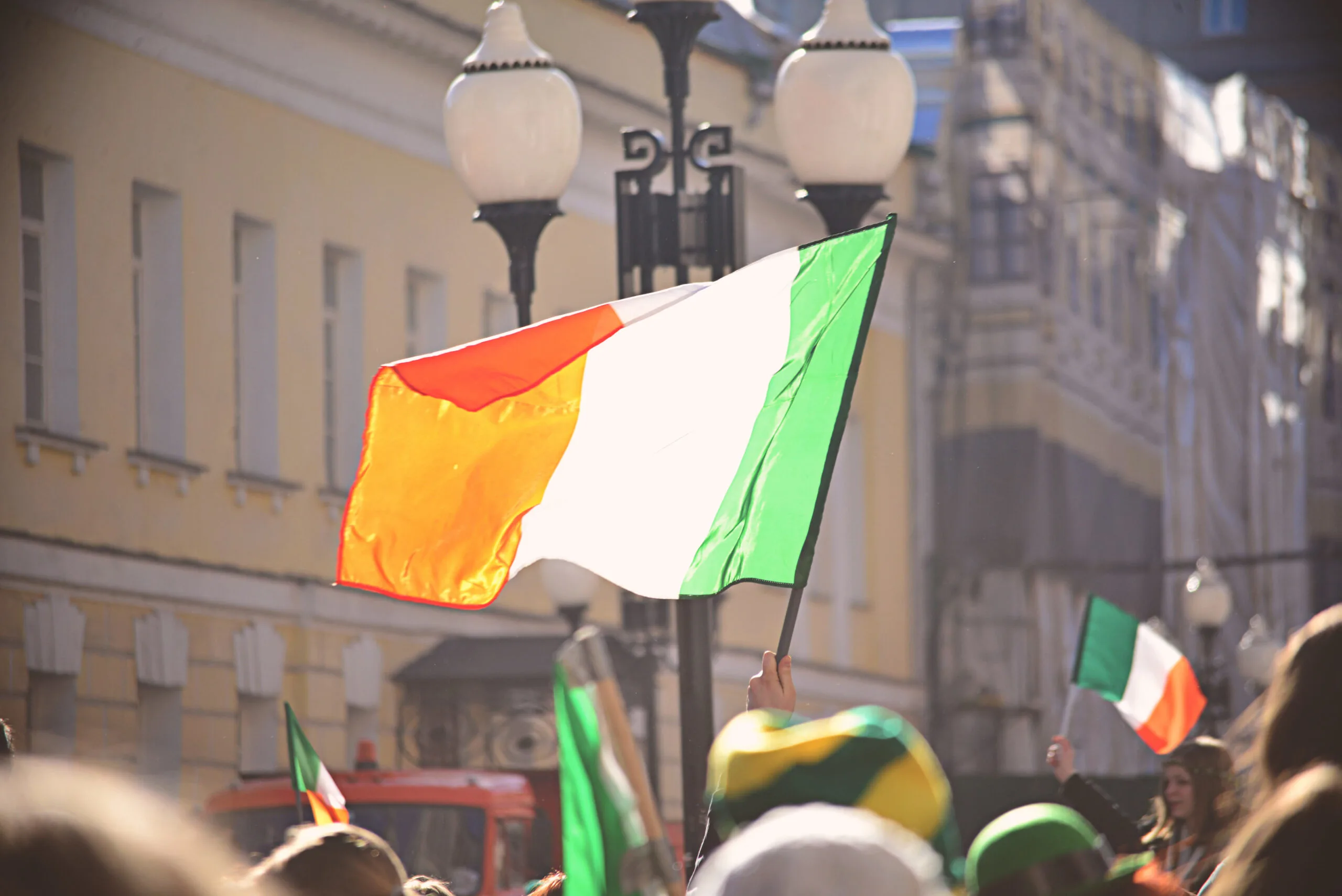
Tricolours in the air at a St Patrick’s Day parade.
Parades, bank holidays, closed pubs and a lightning strike. The day has a stranger history than the man.
8. Why 17 March?
The date is the traditional day of Patrick’s death, not his birth. The DIB says Muirchú first named it in the seventh century, and it reached European church calendars in the eighth.
The feast entered the Roman breviary in 1631 and the Roman calendar in 1632. Luke Wadding, a Waterford Franciscan working in Rome, is usually credited with pushing for it.
9. The first recorded celebration in the US was in Florida
Historian J. Michael Francis of the University of South Florida found Spanish records of a St Patrick’s feast in St Augustine in 1600, in a gunpowder spending log.
In March 1601, residents processed through the streets in the saint’s honour. Patrick was even protector of the town’s maize fields. Writing for PBS in 2018, Francis said the Irish parish priest, Ricardo Artur, was likely responsible.
10. Boston’s 1737 “parade” was actually a dinner
Plenty of websites say Boston held the first parade in 1737. It was actually the founding of the Charitable Irish Society, set up to help struggling Irish immigrants.
The society says a St Patrick’s Day dinner, always on 17 March, has been its tradition since 1737. A fine tradition, but a dinner, not a parade. I’d still take the dinner.
11. New York’s parade dates from 1762
Irish soldiers in the British Army marched in New York on 17 March 1762, 14 years before the Declaration of Independence. The parade’s organisers say the 69th Regiment has led it since about 1851.
Their biggest year was 2002, with an estimated 300,000 marchers and three million spectators. The US Census Bureau still calls 1762 the world’s first parade, which St Augustine would dispute.
12. Montreal has paraded since 1824
One of the oldest St Patrick’s Day parades in North America is in Montreal. CBC News called the 2014 parade the 191st, which puts the first in 1824. It’s run by the United Irish Societies of Montreal.
That 2014 parade had 18 floats, 16 bands and about 2,500 people marching.
13. It became a holiday in Ireland in 1903
St Patrick’s Day became a bank holiday in Ireland in 1903. Many websites credit the MP James O’Mara with the law. According to the DIB, the bill was William Redmond’s, and O’Mara seconded it.
O’Mara also had nothing to do with closing the pubs, whatever you’ve read. That came in 1924.
14. Irish pubs were shut on the day for over 30 years
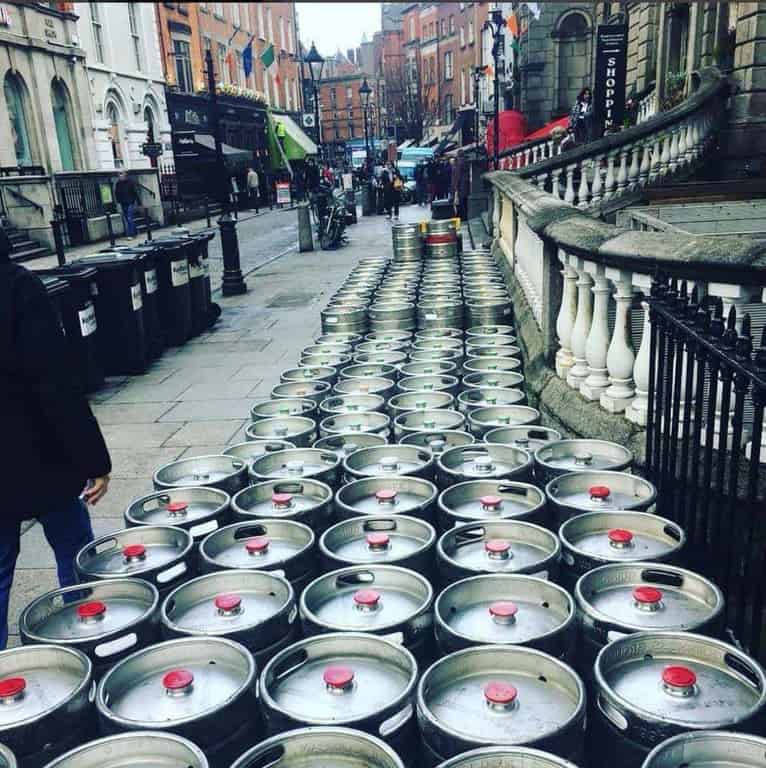
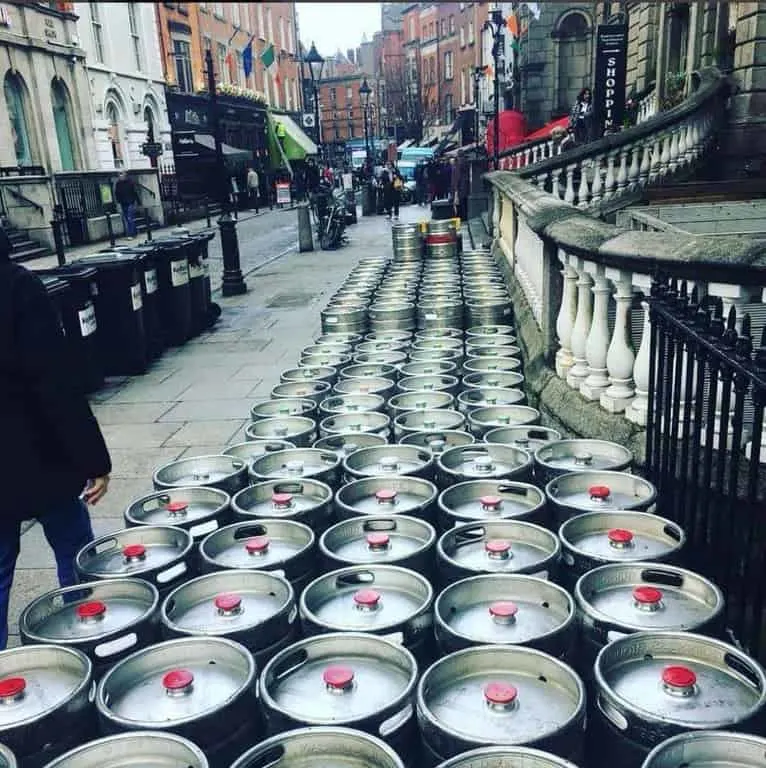
Kegs lined up outside a pub before St Patrick’s Day. Times have changed.
The Intoxicating Liquor Act 1924 made it illegal to sell drink on Christmas Day, Good Friday and St Patrick’s Day. Hotel guests could still get a drink with a meal. The 1927 Act kept the ban.
The Intoxicating Liquor Act 1960 let pubs open on the day again, with short hours. All three acts are on the Irish Statute Book. So the day was dry from 1925 to 1960, not “until the 1970s” as you’ll often read.
15. In 2008 the Church moved St Patrick’s Day
In 2008, 17 March fell in Holy Week, so the Irish bishops moved the religious feast to Saturday 15 March. The parades and the bank holiday stayed on the 17th.
The Associated Press reported that it was the first change since 1940. The next clash isn’t expected until 2160, so you have time to plan.
16. Lightning struck 30 pilgrims on St Patrick’s Day 1113
Croagh Patrick in Co. Mayo is Ireland’s holy mountain, climbed by pilgrims for centuries. According to the Annals of Loch Cé, cited in the DIB, lightning struck 30 pilgrims on the mountain on St Patrick’s Day in 1113. Worth remembering if you’re ever tempted to climb it in a thunderstorm.
17. The world’s shortest parade: from Co. Cork to Arkansas

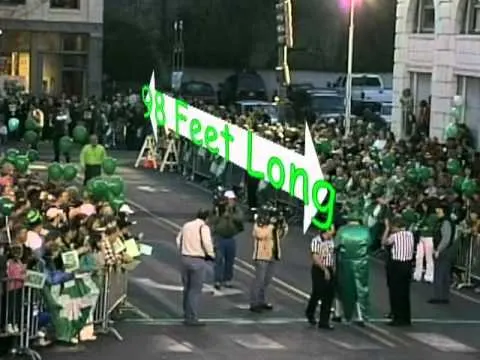
The 98-foot parade route in Hot Springs, Arkansas.
As a Cork man, I’m proud of this one. Dripsey, Co. Cork ran a parade of just 25 yards, between the Weigh Inn and the Lee Valley Inn. It started in 1999 and was validated by Guinness World Records.
The Irish Times reported in 2008 that it was called off after one of the two pubs closed.
Since then, Hot Springs, Arkansas has claimed the title with a 98-foot route, though Little Compton, Rhode Island disputes it. I’d love to see Hot Springs one of these years.
18. Dublin’s parade draws about half a million people
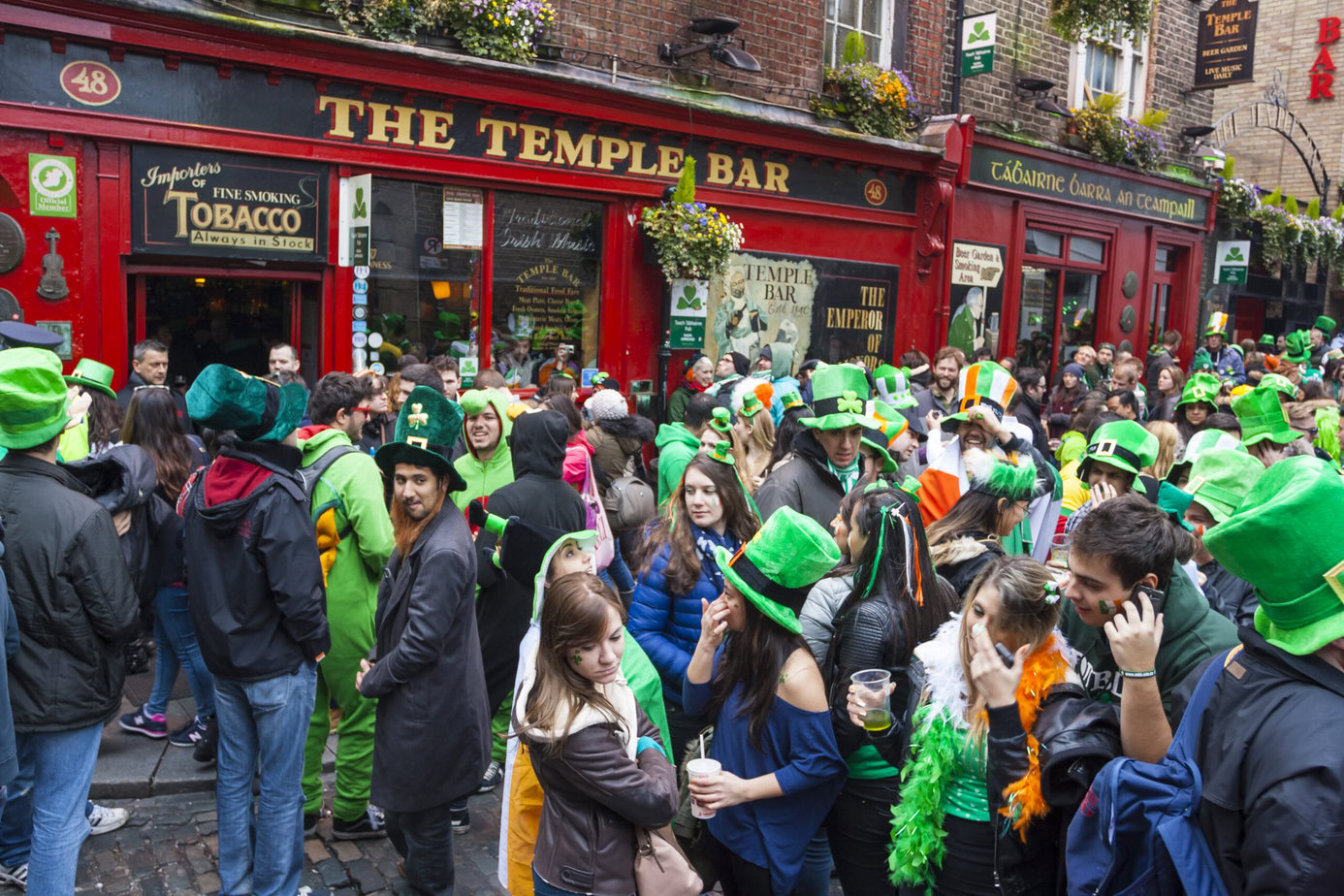
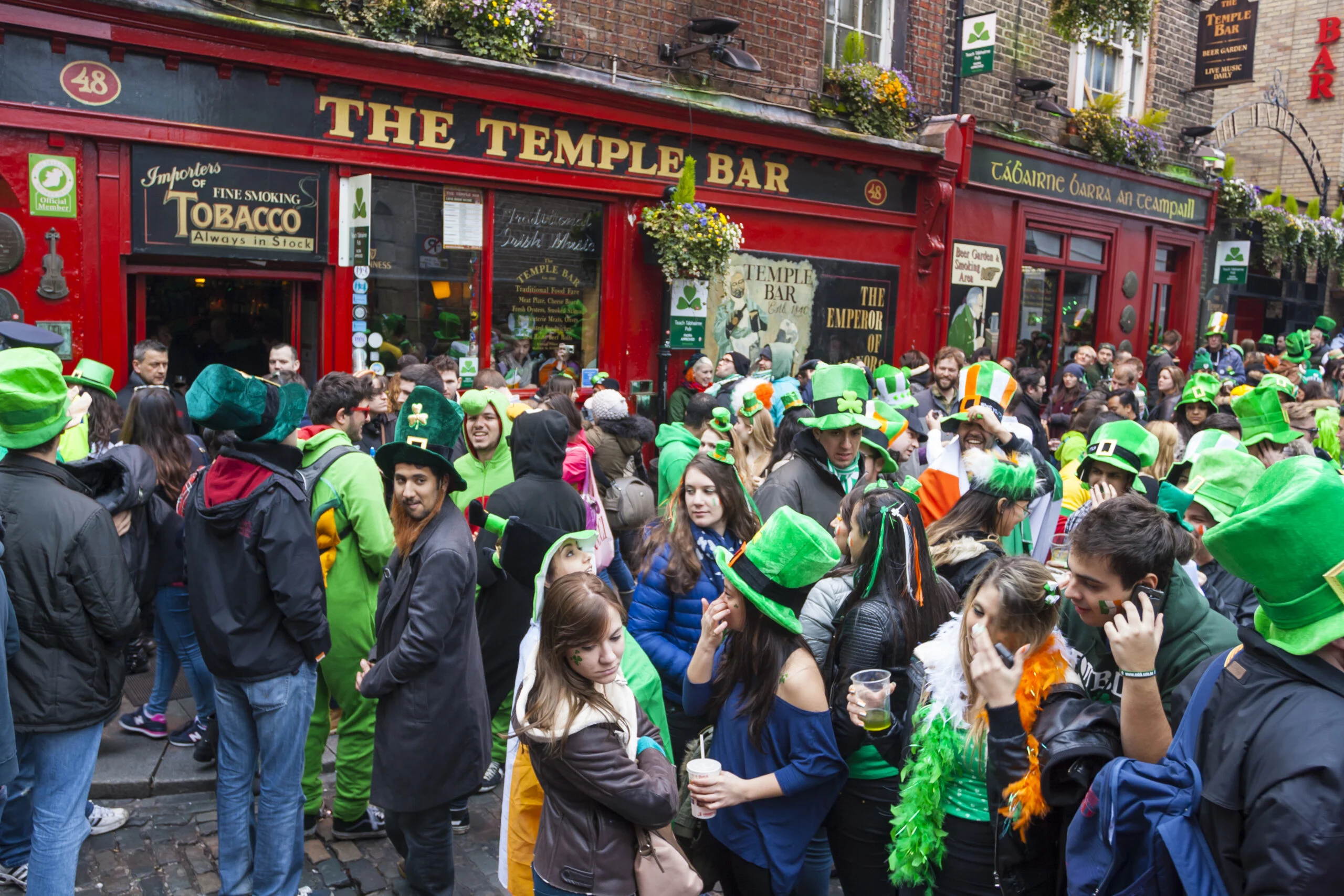
Outside The Temple Bar in Dublin on St Patrick’s Day.
St Patrick’s Festival in Dublin expected about 500,000 people along the 2025 parade route, including about 100,000 visitors.
The 2026 parade was billed with 12 large floats and over 3,000 participants, with Vogue Williams as Grand Marshal. The “over a million people” you’ll see quoted online is an old number with no current source.
Green, the shamrock and symbols
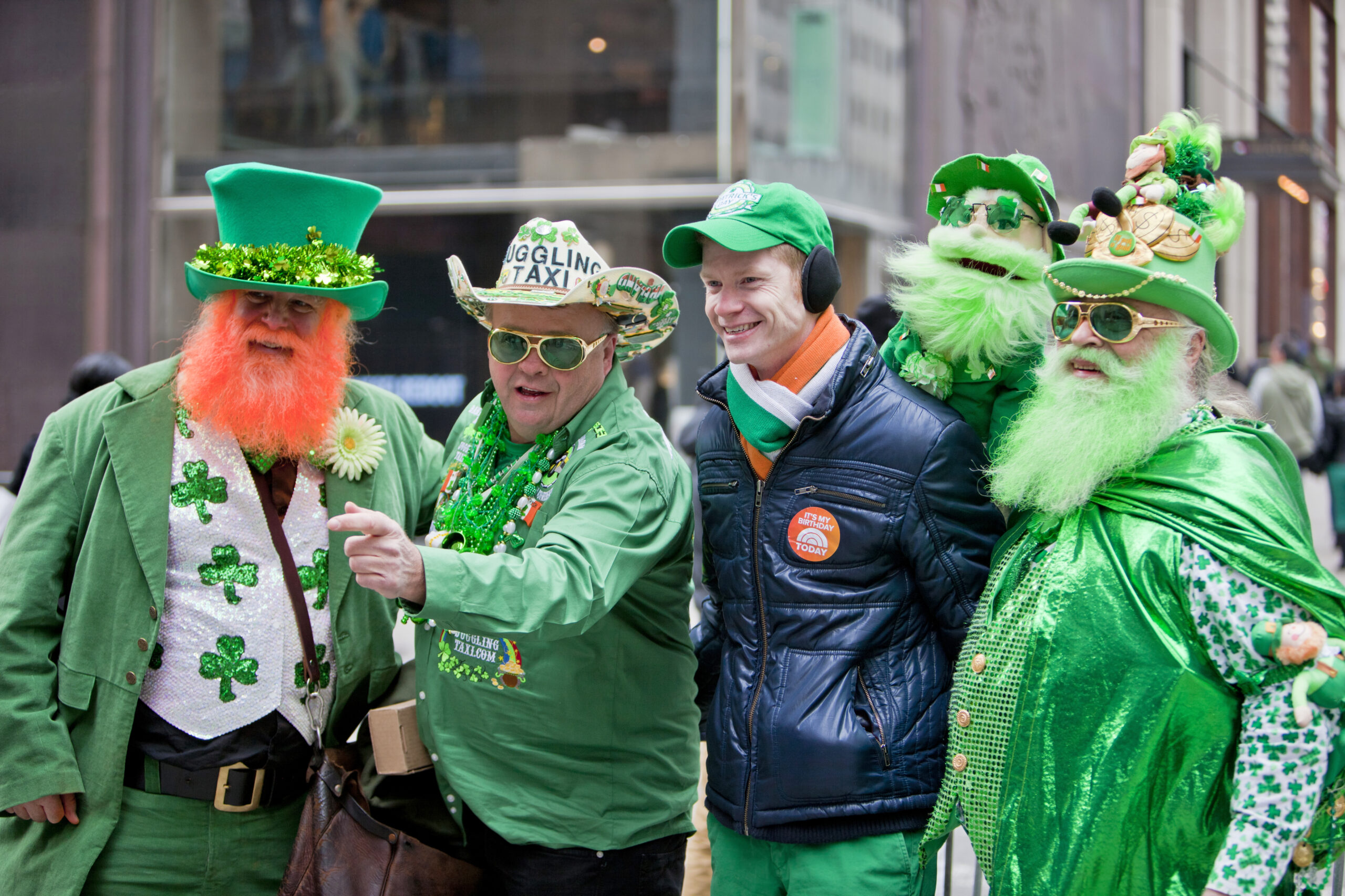
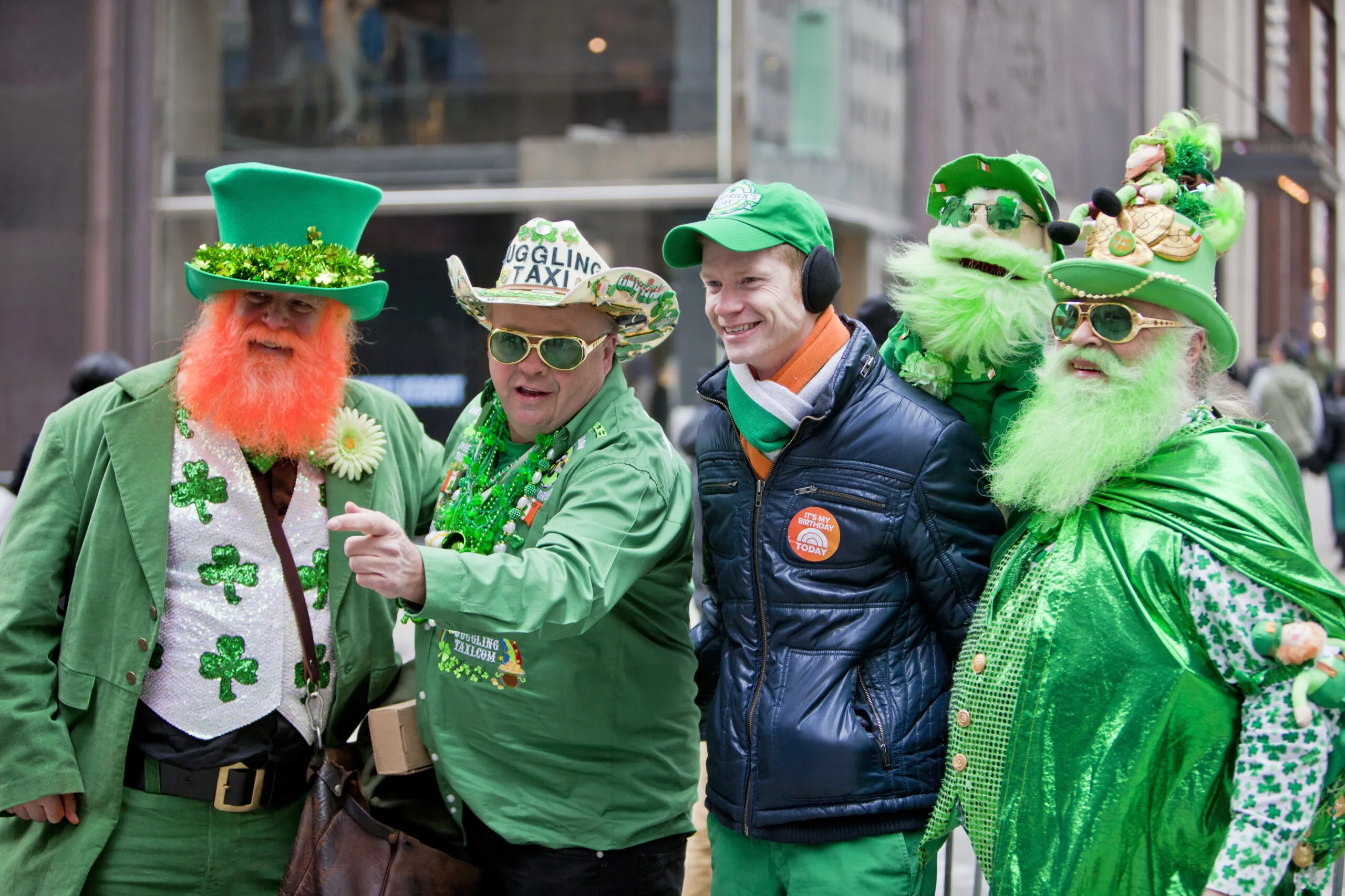
Some people take the green very seriously.
Green, shamrocks and leprechaun hats feel ancient. Most of them are younger than you’d think.
19. St Patrick’s colour used to be blue
The Order of St Patrick, an honour for the Anglo-Irish nobility, was founded in 1783. It chose a sky blue, still known as St Patrick’s blue.
Blue is on the state arms of Ireland today too: a gold harp on a blue background. So if anyone gives you grief for wearing blue on the 17th, history is on your side.
20. Green and the “Emerald Isle” came from the 1790s
Green’s link with Irish nationalism grew in the 1790s, when the United Irishmen took it up. According to the DIB, Belfast doctor William Drennan was first to call Ireland “the emerald isle”. It was in his 1795 poem “Erin”, which opens “When Erin first rose”.
Some websites say Irish soldiers wore green uniforms on 17 March 1798, and that’s where the name came from. There’s no good evidence for that.
21. The shamrock and Trinity story came about 1,200 years later
Patrick never mentions the shamrock in his own writings. The earliest written reference to him explaining the Trinity with a shamrock dates to the 1720s, in a botany book by Caleb Threlkeld. The DIB gives the date as 1727.
The picture of Patrick as a bearded bishop holding a trefoil dates from the 17th century, and the DIB calls it unhistorical. I’ve written more on the shamrock as a symbol.
22. A shamrock is not a four-leaf clover
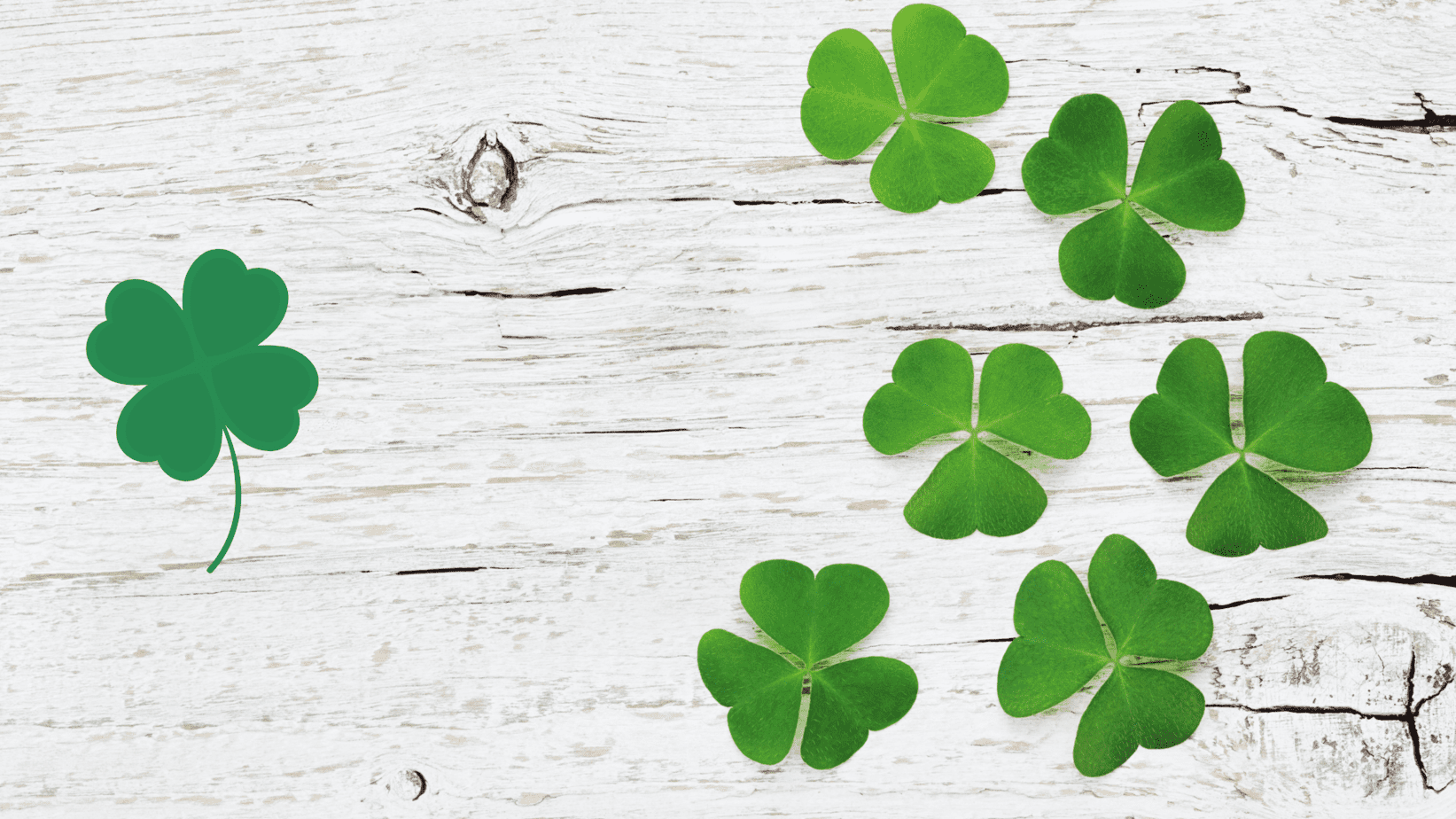
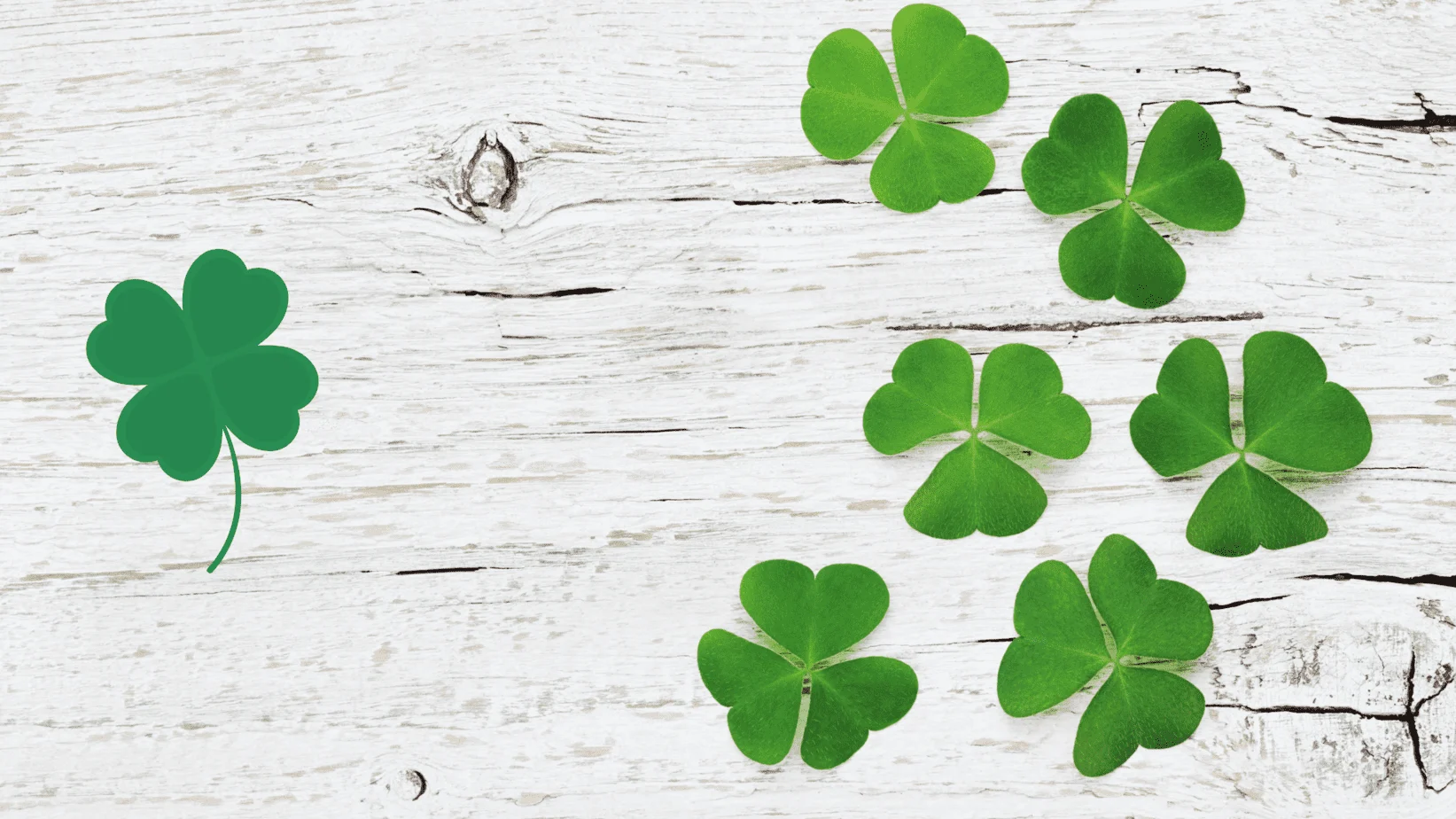
Three leaves for a shamrock, four for a lucky clover.
A shamrock has three leaves. A four-leaf clover is a lucky rarity with nothing to do with Patrick. Which plant is the real shamrock? Nathaniel Colgan surveyed the question in 1893, and lesser clover and white clover are still the usual candidates.
And the harp, not the shamrock, is the official emblem of the Irish State.
23. The shamrock goes to the White House and the Irish Guards
The White House shamrock started in 1952, when Irish ambassador John Hearne sent a box to President Truman. In 1953, the Irish Times reports, it came in a cut-glass bowl supplied free by Waterford Glass.
In Britain, the Irish Guards get shamrock every St Patrick’s Day too. The BBC says Queen Alexandra began that ceremony in 1901, and a senior female royal has usually carried it out since.
St Patrick’s Day around the world
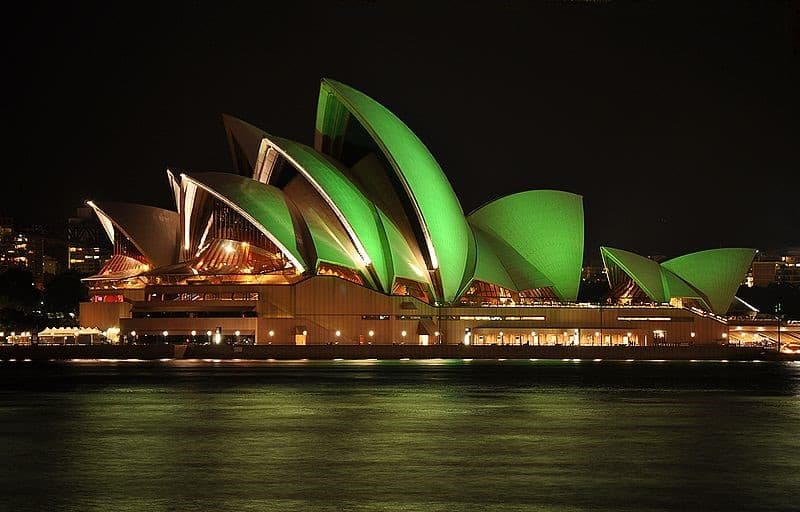
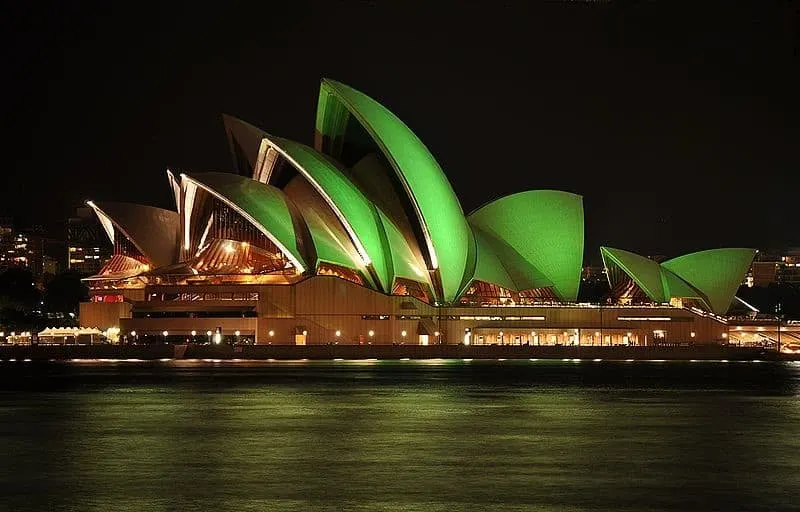
The Sydney Opera House lit green for St Patrick’s Day.
The Irish left home in their millions, and the party went with them. Here’s how far it has spread.
24. Chicago has dyed its river green since 1962
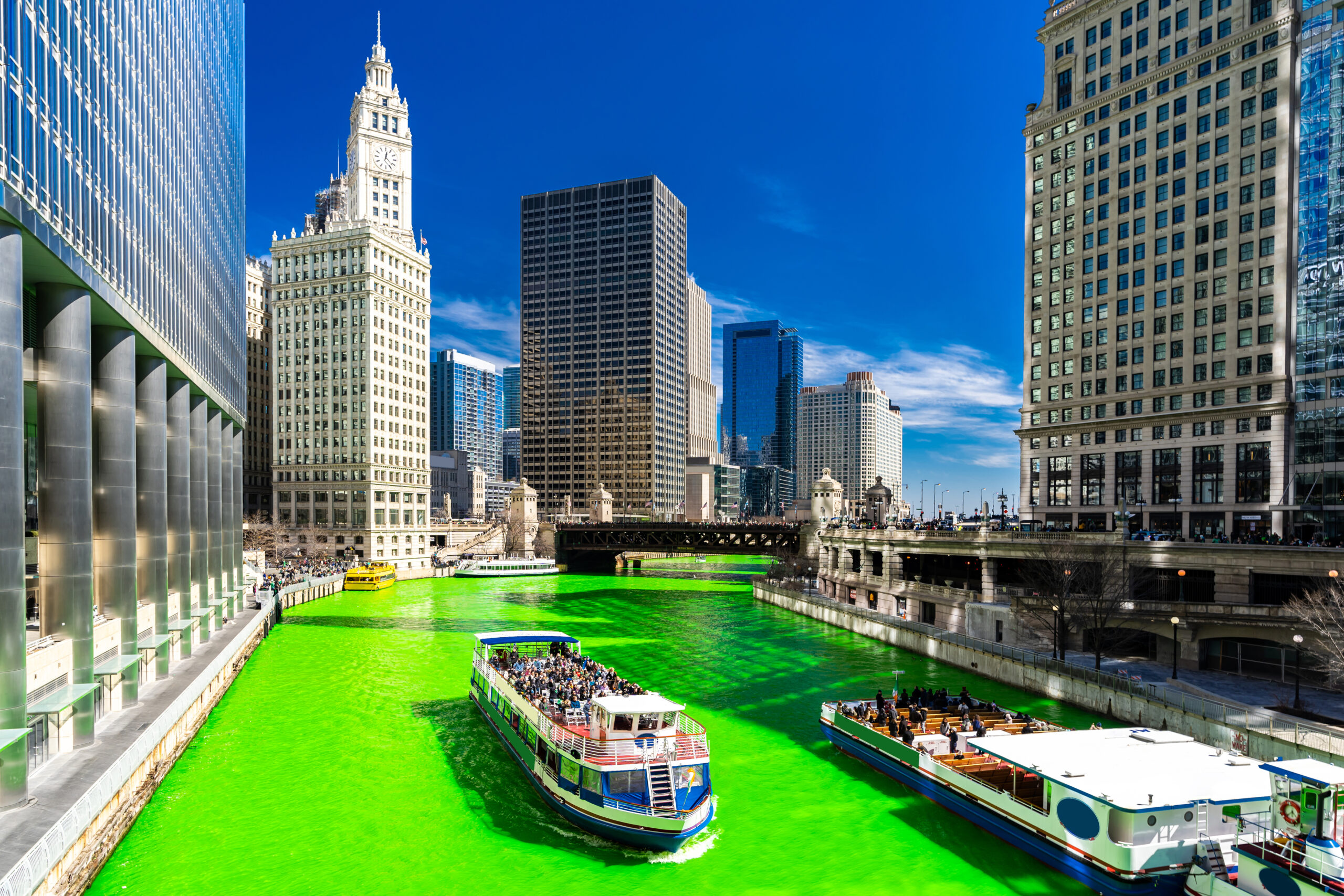
Tour boats on the green Chicago River, with the Wrigley Building behind.
The idea came from Stephen Bailey of the plumbers’ union in 1961. Plumbers used a dye to trace illegal discharges, and it turned the water green. The Christian Science Monitor reported in 2009 that the first year used 100 pounds of dye.
The Monitor reported about 40 pounds of what the parade committee calls a vegetable-based dye, with a secret formula. It’s orange as a powder.
25. Montserrat’s holiday isn’t only about Ireland
The Caribbean island of Montserrat, a British Overseas Territory, has a public holiday on St Patrick’s Day. It’s nicknamed the Emerald Isle of the Caribbean.
The day also remembers a thwarted uprising by enslaved Africans in 1768. The Montserrat Tourism Division says it closes a festival of the island’s African and Irish heritage that runs for about ten days.
26. Hundreds of landmarks go green
Tourism Ireland’s Global Greening lights up famous buildings worldwide each St Patrick’s Day. Its 2026 list included the Leaning Tower of Pisa, the Empire State Building, Niagara Falls and Auckland’s Sky Tower.
Some picks are wonderfully random, like a ski jump in Innsbruck. Travel trade site Travel Extra reported more than 400 sites in 2026.
27. St Patrick’s Day has been celebrated in space
On 17 March 2013, astronaut Chris Hadfield, commander of the International Space Station, tweeted a photo of himself wearing green. He also recorded himself singing “Danny Boy” for the Irish everywhere, as the Irish Times reported.
For the story behind the song, see my page on Danny Boy and St Patrick’s Day.
St Patrick’s Day statistics: numbers and spending
Every number here has a year and a source. If a figure online has neither, be suspicious.
28. 32.4 million Americans claim Irish ancestry
The US Census Bureau’s March 2026 release, based on 2024 survey data, says 32.4 million US residents claimed Irish ancestry. That’s 9.5% of the country. Another 116,641 US residents were born in Ireland.
Ireland’s population was about 5.46 million in April 2025, says the CSO. That’s nearly six Irish Americans for every person in Ireland. Cook County, Illinois, home to Chicago, has the most of any county: 436,577.
29. Americans planned to spend a record $7.7 billion in 2026
The National Retail Federation surveys Americans about St Patrick’s Day every year. Its 2026 survey found 60% planned to celebrate, spending a record $47.45 each on average, up from $43.64 in 2025.
Total spending was projected at $7.7 billion. That’s a lot of green hats. Smaller totals quoted as current are from earlier years.
30. Irish roots run well beyond America
Irish was the third most common ancestry in Australia’s 2021 Census, claimed by 9.5% of people, according to the Australian Bureau of Statistics.
Worldwide, Ireland’s Department of Foreign Affairs puts people with Irish heritage at about 70 million. That’s an estimate, not a count. The “100 million” you’ll see online has no source I could find.
St Patrick’s Day facts for kids
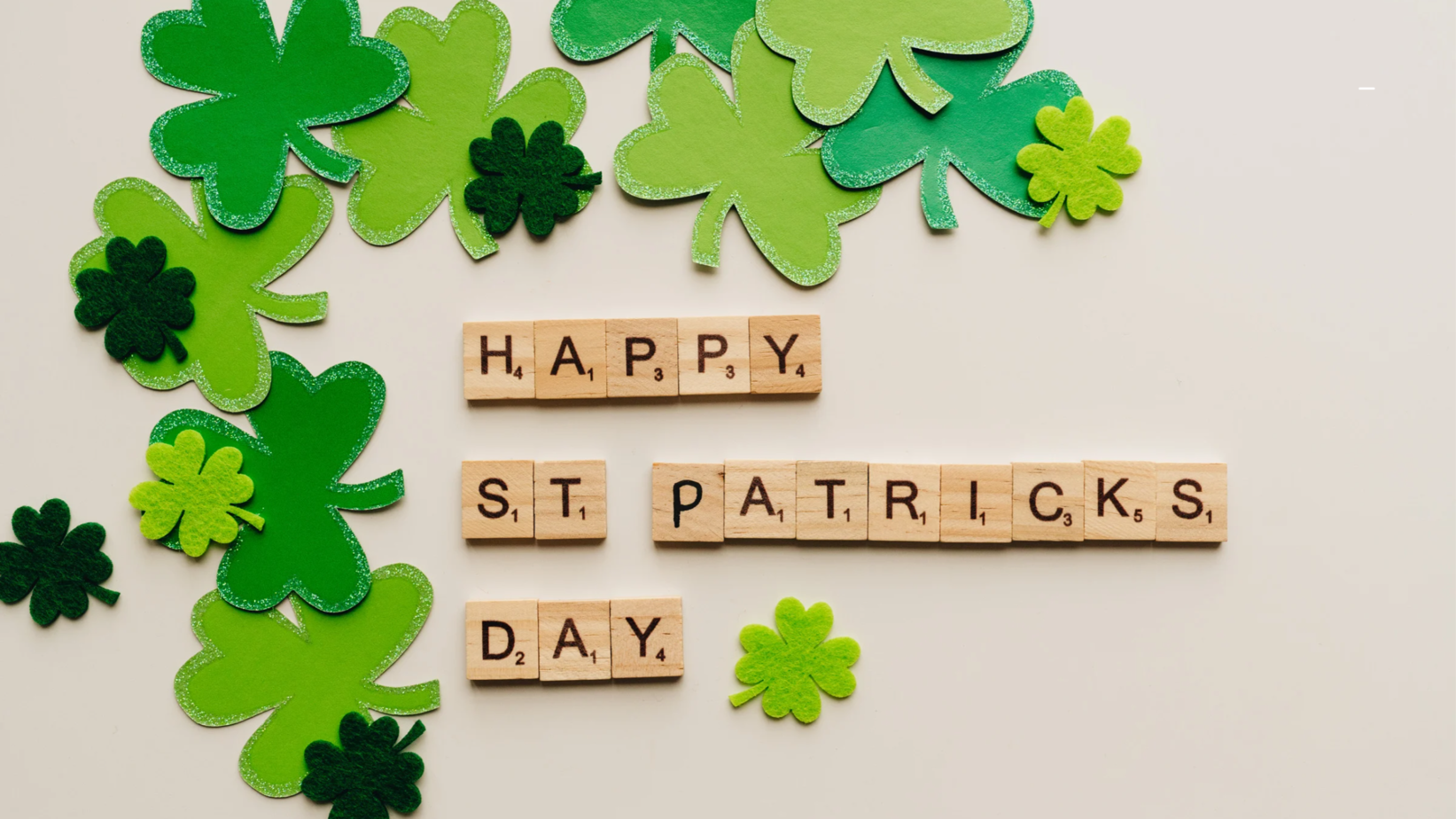
Spot the four-leaf clovers. Patrick would not approve.
The short version for the classroom. Every one is true.
- Saint Patrick was born in Britain, not Ireland.
- Raiders kidnapped him at 16, and he minded animals in Ireland for six years.
- 17 March is the day he is believed to have died, not his birthday.
- St Patrick’s colour used to be blue.
- A shamrock has three leaves, not four.
- Chicago’s river dye is orange until it hits the water.
- There were never any snakes in Ireland to chase away.
- An astronaut once celebrated St Patrick’s Day in space.
St Patrick’s Day myths to forget
These come up every March. None of them hold up.
Myth: Patrick drove the snakes out of Ireland
There were no snakes to drive out. Nigel Monaghan of the National Museum of Ireland told National Geographic there has never been any suggestion of snakes in Ireland. The DIB says the story first appears in the 12th century, about 700 years after Patrick.
Myth: His real name was Maewyn Succat
No early source supports it, and the DIB doesn’t mention it. Seventh-century writers gave him other names, like Succetus and Sochet, but never “Maewyn”. He called himself Patricius.
Myth: It’s St Patty’s Day
Patty is short for Patricia. Patrick’s Irish name is Pádraig, so the nickname is Paddy. Every March, Irish people abroad politely grind their teeth at “Patty”.
Myth: Corned beef and cabbage is the traditional Irish dinner
In Ireland it’s bacon and cabbage. Corned beef is Irish-American. National Geographic reported in 2019 that Irish immigrants bought cheap corned beef from Jewish butchers. When I asked on my Facebook page what everyone eats on St Patrick’s Day, over 500 people answered Guinness. Fair enough.
Myth: 13 million pints of Guinness are drunk on the day
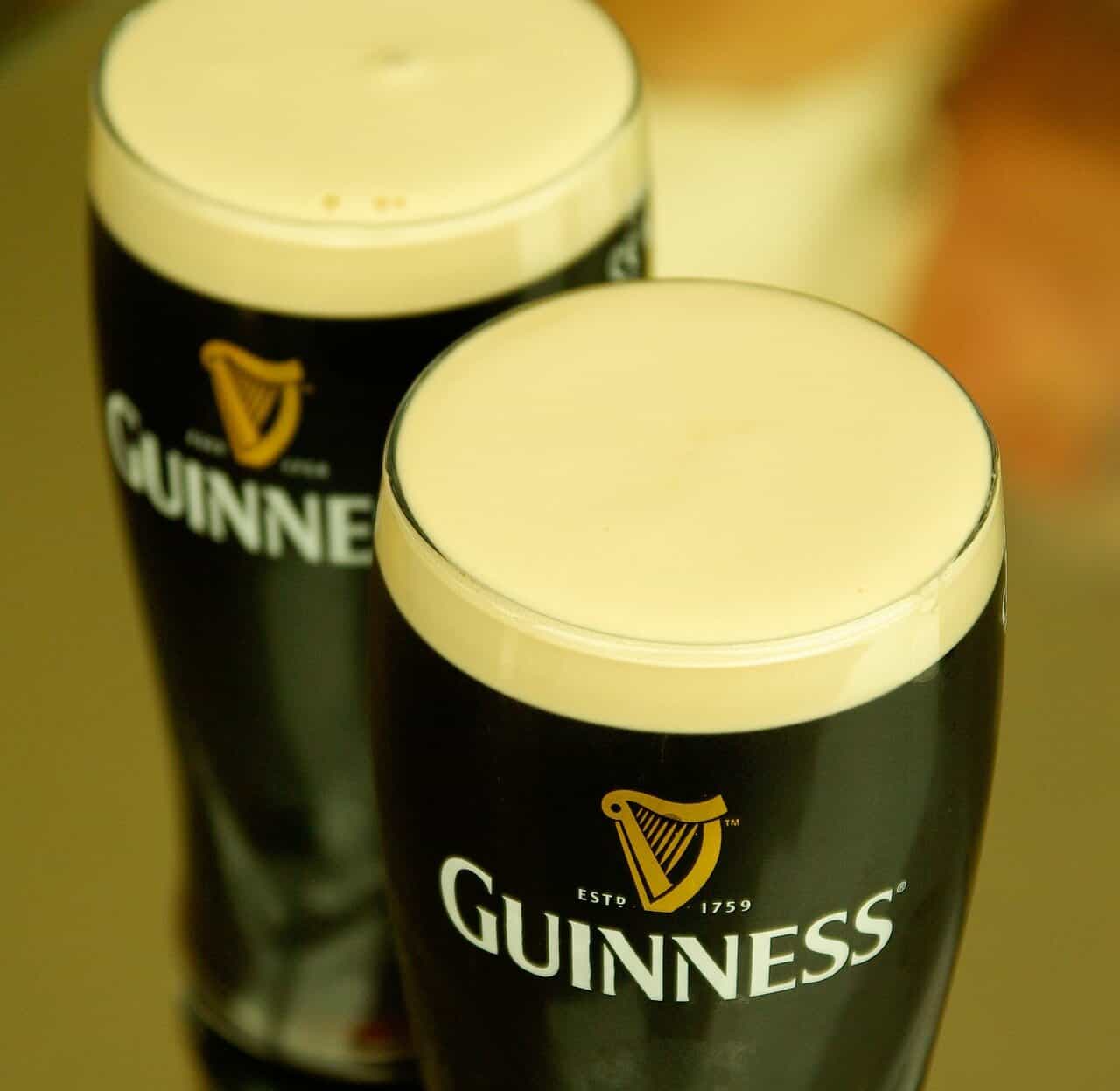
Two pints of the black stuff. Nobody is counting, apparently.
This number is on nearly every St Patrick’s Day page, including older versions of this one. National Geographic gave it for 2017 in a 2019 article, without naming a source. I couldn’t find Guinness’s owner, Diageo, publishing a current figure. Enjoy your pint, but don’t quote the number.
St Patrick’s Day FAQ
Was St Patrick Irish?
No. He was born in Roman Britain, probably in the fifth century, and was brought to Ireland as a slave at 16. He later came back as a missionary bishop.
Why do we celebrate St Patrick’s Day?
It marks 17 March, the traditional date of Patrick’s death. It became a bank holiday in Ireland in 1903, and emigrants carried it around the world.
Why do people wear green on St Patrick’s Day?
Green became Ireland’s colour in the 1790s, helped along by the shamrock. Before that, St Patrick’s colour was blue.
How many people celebrate St Patrick’s Day?
Nobody counts it worldwide. In the US, 60% of adults planned to celebrate in 2026, according to the National Retail Federation. In Dublin, about 500,000 people were expected along the 2025 parade route.
Where was the first St Patrick’s Day parade?
The first recorded procession was in St Augustine, Florida, in 1601, then a Spanish colony. New York’s first parade was in 1762. Boston’s 1737 event was a dinner, not a parade.
Is St Patrick’s Day a public holiday?
Yes, in Ireland since 1903, and it’s a bank holiday in Northern Ireland and a public holiday on Montserrat. In the US it isn’t a federal holiday, though Congress made March Irish-American Heritage Month in 1991.
More St Patrick’s Day reading
- The Best St Patrick’s Day Jokes
- St Patrick’s Day Blessings
- Top 10 Irish Toasts
- Irish Sayings and What They Mean
- May the Road Rise Up to Meet You: Meaning
- Irish Inventions That Changed the World
- The St Patrick Snakes Legend: Ireland Never Had Any. So Where Did the Story Come From?
Love this? Save it to your Pinterest board for later.
A little bit of Ireland in your inbox every Friday ☘️
The free Weekly Dose of Irish: an Irish joke, a Celtic symbol, an Irish fact, a poem and the week’s best articles in one short email. Join 9,600+ readers.
Free. One short email every Friday. Unsubscribe any time.
KENNY THOMPSON
Friday 18th of March 2022
Even though I was born & Bred in TOXTETH in Liverpool my mother was a McCormack from CORK, S-Ireland. My Father was Born near GLASGOW, Scotland. I was born in ENGLAND & moved out to WALES 50 years ago. Does this make me A MUTT??? On my FOUR journeys to KENTUCKY, USA the locals there think it is an amazing story as most of them have similar backgrounds. Having said all that, I really am proud of my heritage. And in remembrance of my mother, every week I get a copy of an Irish Newspaper called IRELANDS OWN, it takes me right back to the days when I was little in Liverpool & the stories that my MAMA used to tell me of her IRISH upbringing & the HOOLIES that she had on ST PATRICKS DAY & so did we in LIVERPOOL. IF you are IRISH & reading this why not subscribe to IRELANDS OWN newspaper, I guarantee YOU will just love it!!! Kenny Thompson.
Tom Eustace
Saturday 21st of March 2020
I understood from my youth in Ireland - that the 4 leaf clover represents the 4 provinces in Ireland. Munster - Leinster - Ulster & Connaught.
John Powell
Sunday 6th of March 2022
@Tom Eustace,
Hi Tom,
I hate to be a killjoy but it is Connacht.
John
Richard McCreery
Sunday 8th of March 2020
Mexico celebrates St. Patrick’s Day because of when The Irish joined the Mexican army in the Mexican/American war. The reason why the Irish joined was because the US Army majority was Protestant, and the Catholic servicemen felt marginalized and reminded of their experience under Protestant British rule in Ireland, so they fled to Catholic confines of Mexico.
Gregorio Calleja
Sunday 8th of March 2020
The first St. Patrick's Parade in the US was not in Boston. It was in 1600 in St.Augustine, Florida. An Irish priest living in Puerto Rico by the name of Fr. Richard Arthur arrived to St. Augustine. He started the devotion to St. Patrick and the first St, Patrick's Day was in 1600. The following year there was the first St. Patrick's Parade that included fireworks as can be demonstrated in the bill of expenses found by some American scholar in the Archives of Indes in Seville, Spain. This priest changed his name to Ricardo Arturo (Spanish translation of Richar Arthur). Interestingly St. Patrick was name the patron of corn (maize) growers. I am including a link of Senator Nelson (Florida) where he announced to the US Senate. https://youtu.be/ME7EHE5e4UY
Irish Around The World
Sunday 8th of March 2020
Wow didn't know that. Thanks very much for sharing. I will take a look at the video.
S Daniels
Thursday 14th of March 2019
Thank you so much for your articles! I enjoy every one!
Irish Around The World
Thursday 14th of March 2019
Glad you enjoy them! Thanks for commenting! :)