
The Green Man symbol is a carved face made of leaves, or with leaves pouring from its mouth. Most are in medieval churches across Europe, from the 1100s on. He is not an ancient Celtic god. The name comes from a 1939 article, and nobody knows what the carvers meant. Ireland has very few, and even the one usually named, at St Canice’s in Kilkenny, is poorly documented.
As part of my ongoing series on Celtic symbols, the Green Man is one I had been looking forward to writing about for quite some time.
When I first wrote this page, I called him an ancient Celtic symbol of rebirth. Most websites still do. So I went back to the sources, and the real story is better.
What is the Green Man?
The Green Man is a human face made of leaves, or with leaves growing out of it. Shoots often spill from the mouth, nose, ears or even the eyes.
Art historians call them foliate heads or foliate masks. “Green Man” is the popular name, and a young one.
- Two types (the scholarly way). Imogen Corrigan, in a University of Birmingham master’s thesis, splits them into “disgorgers”, with foliage pouring from the face, and “transformers”, heads turning into leaf.
- Three types (the popular way). Many books and websites list the foliate head, the disgorging head and the “bloodsucker” head. That scheme comes from Mike Harding’s popular 1998 book, not from scholars.


A stone Green Man boss from Dore Abbey, Herefordshire, no longer in position, with traces of its original paint. Photo: Simon Garbutt.
The name only dates from 1939
No medieval source calls him the Green Man.
The name comes from Lady Raglan (born Julia Hamilton). In March 1939 she published “The ‘Green Man’ in Church Architecture” in the journal Folklore. She had been studying a leafy face in her local church at Llangwm, Monmouthshire.
Her big idea was that three things were really one: the leafy church faces, the Jack-in-the-Green of English May Day, and the Green Man on pub signs. All three, she argued, were a pagan fertility spirit surviving in disguise.
The words “green man” are older, going back at least to the 1550s. But they meant leaf-clad men in pageants and plays, a kind of wild man. Nobody is known to have called a church foliate head a Green Man before Lady Raglan.
Where the leafy faces come from
A face in the leaves is far older than any church.
- Roman leaf masks appear from the 2nd century AD, at places like Trier in Germany and Baalbek in Lebanon (Corrigan).
- The Mildenhall Great Dish, 4th-century silver in the British Museum, centres on a sea god, usually read as Oceanus, with a seaweed beard.
- The first Christian example is usually given as the 4th-century tomb of St Abre, in the church of Saint-Hilaire-le-Grand in Poitiers, France.
In England, Corrigan dates the first church examples to the early 12th century. They peaked in Gothic churches between the 13th and 15th centuries. Her conclusion: there is no single origin you can trace.
Famous Green Men you can visit
| Where | Date | What to look for |
|---|---|---|
| Southwell Minster chapter house, Nottinghamshire | About 1288 to 1300 | Ten Green Men. One has hops sprouting from one side of its mouth and strawberry leaves from the other. |
| Rosslyn Chapel, Midlothian, Scotland | Founded 1446, built over the following decades | Over 100 Green Men, inside and out. The chapel says the best is in the Lady Chapel, jutting from a boss. |
| Rochester Cathedral, Kent | 13th century, plus 1840 copies | Medieval bosses in the north quire aisle, and painted copies at the crossing. |
| Bamberg Cathedral, Germany | Early 13th century | A foliate head on the corbel under the Bamberg Horseman. |
| La Trinité, Vendôme, France | About 1487 to 1539 | A Green Man on a misericord, the ledge under a choir seat. |
My old post called Rochester’s painted boss medieval. The cathedral says the crossing bosses were made in 1840 under the architect Lewis Cottingham, copying its 13th-century Green Men.


A painted Green Man boss at Rochester Cathedral’s crossing, made in 1840 after the cathedral’s medieval originals. Photo: Akoliasnikoff, CC BY-SA 3.0.


A 1970s etching of a late medieval misericord at La Trinité, Vendôme, France. Etching: Simon Garbutt.
Aren’t they just lovely!? Haha. Next time you’re in an old church, be sure to look up.
Green Men in Ireland
The honest answer: not many. Ireland has nothing like the numbers in England or France.
St Canice’s Cathedral, Kilkenny
A photo on Wikimedia Commons, captioned on Wikipedia as a 13th-century Green Man at St Canice’s, is the only Irish example I found pictured.
I couldn’t confirm it, or its date, from the cathedral or any heritage body. If you visit, ask a guide.
St Mary’s Cathedral, Limerick
Its misericords, from 1480 to 1500, are unique in Ireland. The cathedral’s list of their carvings has no Green Man.
A green man in Irish folk tales
The Schools’ Collection on Dúchas (1937 to 1939) has tales of a “green man”, unrelated to the carvings. In one from Ballinree, near Nenagh, an enchanted king beats “King Arthur from Ireland” at cards, for his head.
To keep it, Arthur must find the green man’s house in no man’s land. An Arthur, a green man and a forfeited head sounds like the Green Knight. A fun echo, nothing more.
Green Man meaning: what did the carvings mean?
Nobody knows for sure. The carvers didn’t leave notes. The main readings:
- Sin and the fallen world. Kathleen Basford wrote the first full study, The Green Man (1978). She read the often grim faces as sin or the fallen world.
- Death and resurrection. Corrigan concludes the faces should be read in a positive way, probably tied to resurrection after death. Rosslyn Chapel reads its own as rebirth.
- The legend of Seth. In the 13th-century Golden Legend, seeds planted in dead Adam’s mouth grow into the wood of the Cross.
- A Christian image from the start. Corrigan notes early examples on fonts and in chancels, and reads some alongside baptism and the Eucharist.
- A warning. Southwell’s own fact sheet links its hop-and-strawberry face to the Letter of James, chapter 3, on one mouth giving both sweet and bitter.
My old post said the Church adopted a Celtic symbol. Most scholars, including the historian Ronald Hutton and Corrigan, reject that. Corrigan says the faces are not smuggled-in pagan images. As far as the evidence goes, the medieval Green Man was church decoration from the start.
I still like my old thought, though. The “man” seems subservient to the “green”, as if nature is a stronger force than we realise. That’s my reading, mind, not the carvers’.
Why people call the Green Man Celtic or pagan
Lady Raglan’s theory fed a 20th-century belief in pagan survival. In the 1930s Margaret Murray read sheela-na-gigs as a pagan goddess. In 1975 Anne Ross went further, reading Green Men and sheela-na-gigs alike as pagan gods.
From the late 1970s, scholars took the idea apart. Hutton concludes the church faces, the May Day Jack and the pub sign were unrelated, and none was a pagan god.
Not everyone thinks the case is closed. Stephen Winick of the Library of Congress argues people linked leafy faces and leaf-clad “green men” long before Lady Raglan.
Jack-in-the-Green and the pub sign
Roy Judge’s study, The Jack-in-the-Green (1979), found the Jack first recorded in London in the late 18th century. It was a chimney sweeps’ May Day figure: a man inside a frame of greenery, collecting money.
The pagan reading came later, from Victorian writers and above all Frazer’s The Golden Bough (1890).
As for pubs, Brandon Centerwall (1997) traced the Green Man sign to the medieval Wild Man of the woods. Oddly, he still thought Lady Raglan’s name for the carvings was right.
The Green Knight
Sir Gawain and the Green Knight is a late 14th-century poem, surviving in a single British Library manuscript from about 1400. A green giant rides into King Arthur’s hall and offers a beheading game. Linking him to the church carvings is a modern idea.
The modern Green Man
Carvers kept making them after the Middle Ages, as this 17th-century one shows.
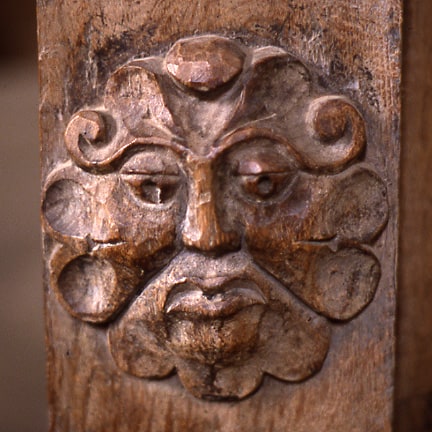

A small foliate mask carved on Dore Abbey’s 17th-century wooden screen, Herefordshire. Photo: Simon Garbutt.
From the 1980s he became an environmental symbol, says the Library of Congress Folklife blog. Modern Pagans adopted him as a nature god. The Green Man Festival in Wales drew about 25,000 people in 2018.
A Green Man of oak, ivy and hawthorn even appeared on King Charles III’s coronation invitation in 2023.
On a lighter note, It’s Always Sunny in Philadelphia kept popping up in my research. Charlie wears a full green bodysuit, his “Green Man” outfit, time and time again. Very entertaining show if you haven’t seen it.
Is there any Celtic link?
Some art historians see a likeness in Iron Age La Tène metalwork, where small faces peer from curling plant ornament. It’s a resemblance only, with no unbroken chain to medieval churches.
Is the Green Man Cernunnos?
No. Cernunnos is an antlered god, not a leafy face.
His name survives on only one inscription, and even that is damaged. It’s on the Pillar of the Boatmen, a Gaulish monument from Paris, made under the emperor Tiberius (AD 14 to 37).
The antlered figure on the Gundestrup cauldron, found in Denmark in 1891, is often compared to him.
No early Irish text names Cernunnos. For the gods Ireland did have, see my guide to Celtic gods.
Ireland’s green spring: May Day and Bealtaine
Bealtaine, 1 May, marked the start of summer, when cattle went out to pasture. Cormac’s Glossary, from around 900, is the first text to mention Bealtaine. Britannica notes cattle were driven between two bonfires to protect them from disease.
Dúchas’s May Day material records the customs:
- The May Bush, usually whitethorn, decorated with flowers and ribbons on May Eve. The Royal Irish Academy’s Atlas of the Irish Rural Landscape says it was most common in Leinster.
- A primrose-hung branch at Kilmacrennan, Co. Donegal, recorded in the Schools’ Collection, to stop witches stealing the year’s milk.
As far as these sources show, the Irish decorated bushes and houses, not people. Some places paraded a dressed doll, the May Baby, but I found no Irish Jack-in-the-Green.
For Bealtaine’s opposite feast, see how the Irish invented Halloween.
A carved cousin: the sheela-na-gig
Ireland’s best-known odd carving is the sheela-na-gig, an exhibitionist female figure. The country has more surviving ones than anywhere else, well over 100 by most counts.
Some scholars read them as a warning against lust. In Ireland, though, many sit on castles and tower houses, and may have been meant to ward off evil.
Green Man symbol meaning: jewellery and tattoos
On jewellery, wall plaques and tattoos, the Green Man today usually stands for:
- Nature and the environment, a meaning from the 1980s
- Rebirth and spring, echoing the resurrection readings
- A nature god, for modern Pagans
Those meanings are modern. If a seller calls it an ancient Celtic god, that’s marketing. For a tattoo, give it room, or the fine leaf detail will blur.
Green Man FAQ
What does the Green Man symbolise?
Today, nature, spring and rebirth. Nobody knows what the medieval carvers meant. Scholars suggest sin, resurrection or a warning.
Is the Green Man Celtic or pagan?
Not as far as the evidence goes. The carvings are medieval church decoration, and most scholars reject the pagan god idea.
Is the Green Man in Celtic mythology?
No. As far as I could find, no early Irish or Welsh tale has a leafy-faced god. The Green Man of mythology books is a 20th-century idea, built on Lady Raglan’s 1939 article.
Are there Green Men in Ireland?
Very few that can be confirmed. One is reported at St Canice’s Cathedral, Kilkenny, but even that is poorly documented.
What’s the difference between the Green Man and Jack-in-the-Green?
The Green Man is a medieval church carving. Jack-in-the-Green is a late 18th-century London May Day figure. Lady Raglan linked them, but they’re separate traditions.
More Celtic symbols and Irish folklore
- Celtic Symbols and Their Meanings
- Celtic Gods
- Druid Symbols
- The Celtic Tree of Life
- Irish Mythological Creatures
- How the Irish Invented Halloween
What else do you know about the Green Man? Have you spotted one in an Irish church? Tell me in the comments below.
Stephen
A little bit of Ireland in your inbox every Friday ☘️
The free Weekly Dose of Irish: an Irish joke, a Celtic symbol, an Irish fact, a poem and the week’s best articles in one short email. Join 9,600+ readers.
Free. One short email every Friday. Unsubscribe any time.
Donna Kohler
Wednesday 29th of June 2022
In 2018 I found a wooden shelf, green man beast lion and am trying to find information about it. I purchased it at an antique shop in Haarlem, the Netherlands. It is a very special wood carved piece and would be happy to send a photo if you are interested.
Nick Day
Monday 20th of September 2021
You have missed the point about the Green Man and Christianity. Christ said "I am the true vine and my Father is the vine grower. He removes every branch in me that bears no fruit. Every branch that bears fruit he prunes to make it bear more fruit. You have already been cleansed by the word that I have spoken to you. Live in me as I live in you. Just as the branch cannot bear fruit by itself unless it lives in the vine, neither can you unless you live in me. I am the vine, you are the branches. Those who live in me and I in them bear much fruit, because apart from me you can do nothing. Whoever does not live in me is thrown away like a branch and withers; such branches are gathered, thrown into the fire, and burned. If you live in me, and my words live in you, ask for whatever you wish, and it will be done for you." (John15). The Green Man in Churches means the Word of God from Jesus the true vine.
Cheyenne Johnson
Saturday 10th of October 2020
The Legend of the Greenman shall never end for the Greenman is amongst us today alive and greening.
Green Mann
Tuesday 9th of June 2020
Re: JoAnn Green Stephens May 15, 2020 at 7:09 pm
Yeah, Nah, got nuttin to do with your name and/or relatives….sorry. Protector of the forest… that’s it…sorry
JoAnn Green Stephens
Friday 15th of May 2020
Interesting. My birth name is Green and so far I have found 3 Green or Greene lines in my family. Some say there is an association between the name and the green man. I didn't know the image was so prolific. JoAnn Green Stephens