
The triquetra, or trinity knot, is three interlaced loops drawn as one unbroken line. Its name is Latin for “three-cornered”. It appears in Irish and Anglo-Saxon art from the 7th century, including the Book of Kells, and later on Viking runestones and coins. The original triquetra meaning is unknown. Christians read it as the Holy Trinity. Land, sea and sky is a modern pagan reading.
Ah, the triquetra. It has to be one of my favourite Celtic symbols, and the Celtic trinity knot is everywhere. You’ve seen it on Claddagh rings, gravestones, tattoos and the cover of the Book of Shadows in Charmed.
A lot of what’s written about it online is guesswork in a nice font, though. “5,000 years old”. “The oldest spiritual symbol in the world”. None of that holds up.
So this is the honest version: where the triquetra really turns up, and when each of its meanings began.
Jump to:
- What is the triquetra symbol?
- Triquetra vs trinity knot
- Where the triquetra comes from
- Triquetra meaning: what it stands for
- The triquetra with a circle
- Trinity knot jewellery
- Triquetra tattoo meaning
- The triquetra in popular culture
- Triquetra vs triskele, Celtic knot and Dara knot
- Triquetra FAQ
- More Celtic symbols
What is the triquetra symbol?
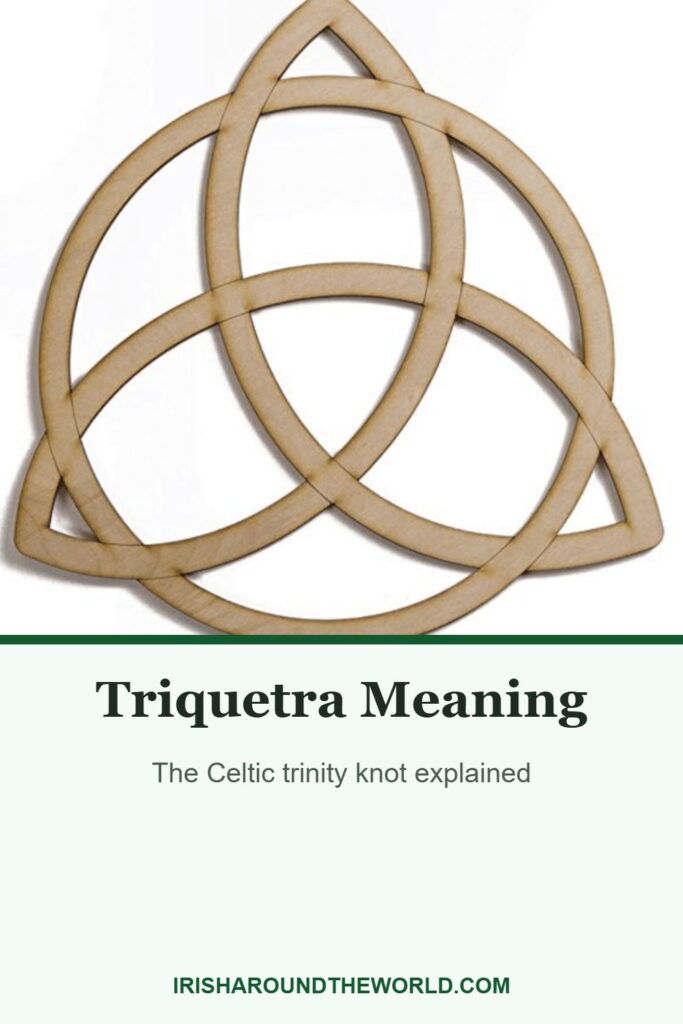
The triquetra is three pointed loops. One points up, and the other two point down to the left and right. In the classic Celtic version, the loops weave over and under each other.
Follow the line with your finger and you’ll never find an end. It’s one continuous cord. When the loops weave over and under, mathematicians call the shape a trefoil knot, the simplest true knot.
The Irish antiquarian George Petrie put it nicely in The Ecclesiastical Architecture of Ireland (1845). He described it as a figure formed “by the ingenious interlacing of a single cord or line”.
Triquetra vs trinity knot: what’s in a name?
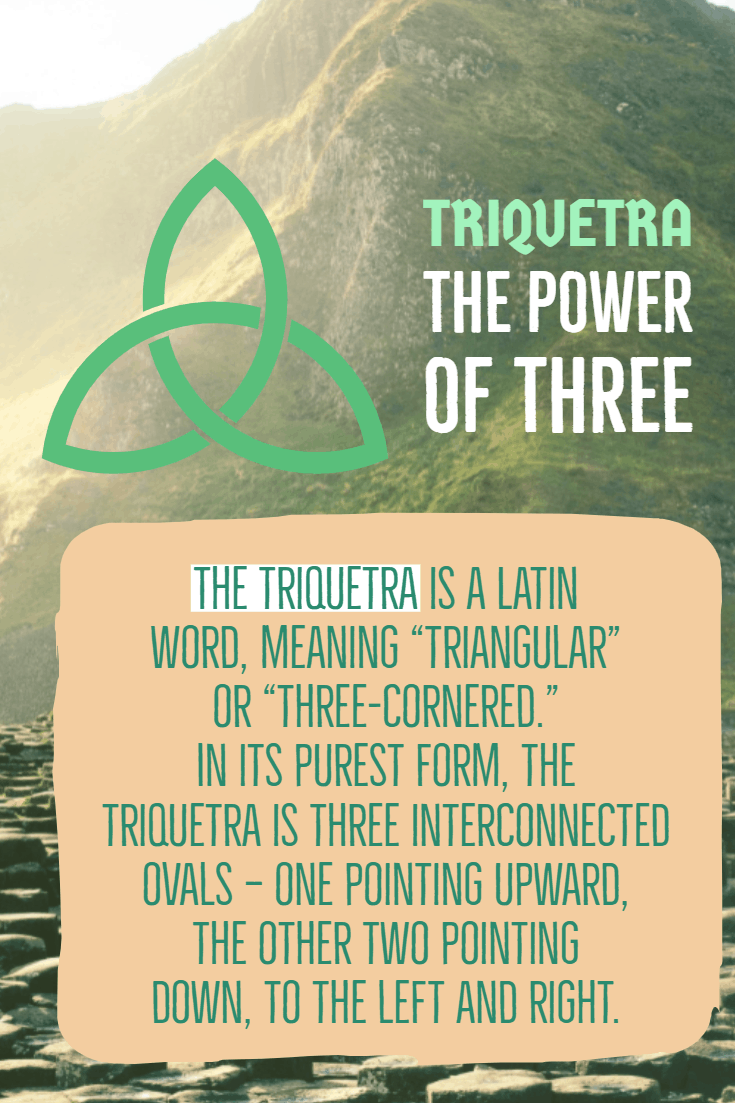
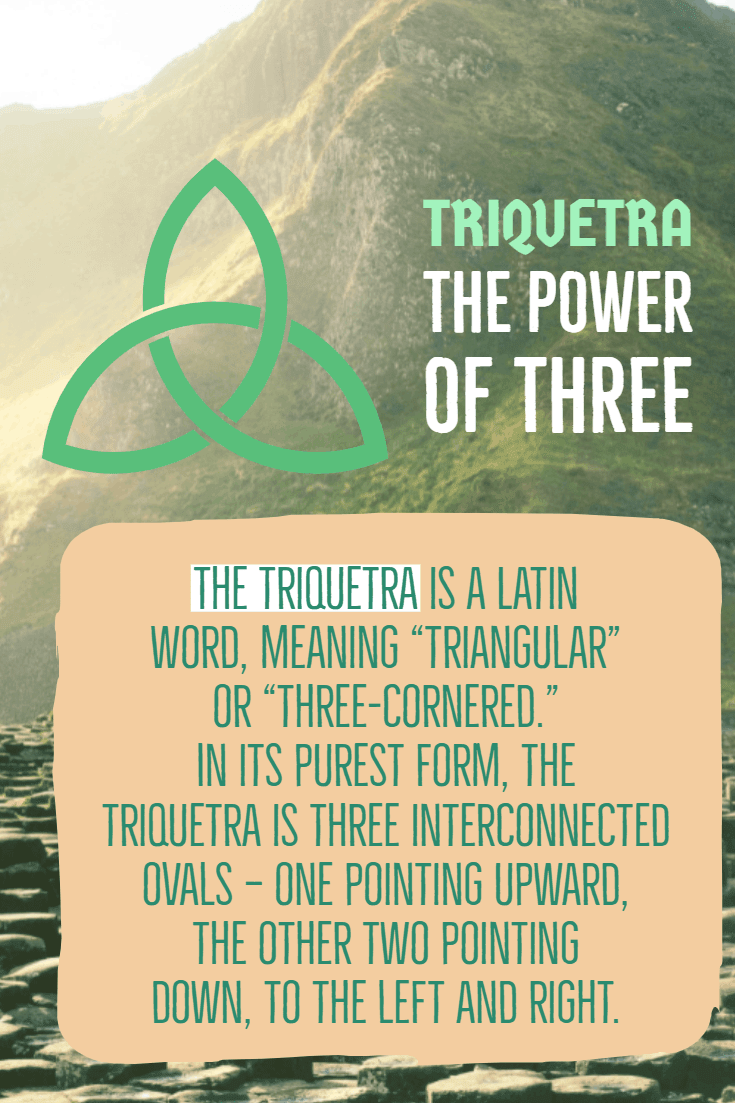
Triquetra comes from the Latin for three-cornered.
“Triquetra” comes from the Latin triquetrus, meaning “three-cornered”. Older writers used it loosely for all sorts of three-cornered shapes. Today it means this knot.
“Trinity knot” is the everyday name in Ireland, especially in jewellery shops. It comes from the Christian reading of the symbol, which I’ll get to below.
So what’s the difference between a triquetra and a trinity knot? In practice, none. They’re two names for the same knot.
Where does the triquetra come from?
This is where most pages go wrong. You’ll read that the triquetra was carved on tombs thousands of years old. That’s the triple spiral at Newgrange, which is a different symbol. I’ll explain the difference further down.
Three-cornered designs before Christian Ireland
Three-armed designs do go back a long way. Three-armed whirls, called triskeles, appear on silver coins of Lycia, in what is now south-west Turkey, from about 500 BC.
Be careful with this one, though. Those are pinwheels, closer to the triskele than to the woven knot. Cousins, not twins.
The triquetra in Irish and Anglo-Saxon art
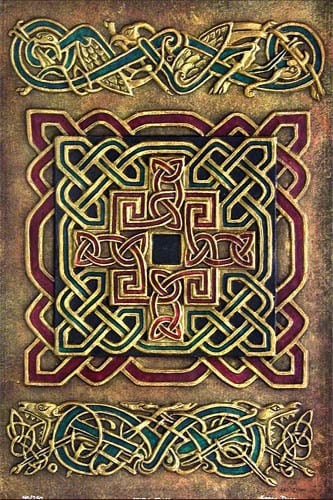
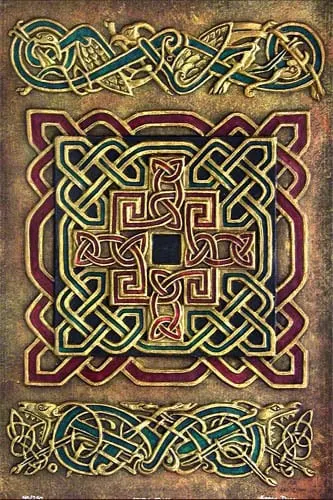
Knotwork in the Book of Kells style, the tradition the triquetra belongs to.
The woven triquetra we know belongs to Insular art. That’s the shared style of Ireland and Anglo-Saxon Britain, from the 7th century on.
According to Britannica, Irish monks brought spirals and trumpet patterns to northern England from 635. Interlace, including animals knotted round each other, was more of an Anglo-Saxon speciality. Mediterranean art added a third strand.
So “Celtic knots” aren’t purely Celtic. They’re a joint Irish and English production, with a nod to the Mediterranean. Don’t tell the lads in the pub.
The great books of the style are the Book of Durrow (second half of the 7th century), the Lindisfarne Gospels (c. 700) and the Book of Kells (c. 800).
The triquetra turns up in illuminated manuscripts like Kells and in metalwork. It’s also on early Christian high crosses and slabs.
The Book of Kells holds the four Gospels in Latin, on 340 leaves of calfskin. Trinity College Dublin says it was probably begun on Iona and finished at Kells, Co. Meath, after Viking raids. Henry Jones, who became Bishop of Meath in 1661, passed it to Trinity soon after.
Across the water, the 7th or 8th century frith stool at Hexham Abbey has triquetra knots on its arms. The knot is also a minor but recurring design on Anglo-Saxon silver pennies called sceattas, struck between about 710 and 760.
The triquetra in Viking Scandinavia
The Vikings liked it too. The Viking kings Anlaf and Regnald struck it on coins in the 10th century, as Petrie and Romilly Allen both noted.
The Funbo runestone (U 937) was carved in Uppland, Sweden, in the 11th century. Its runes run inside a serpent that circles a triquetra. One runic scholar, Lise Gjedssø Bertelsen, calls it a high-status motif. The stone now stands in the park of Uppsala University.
In Norway, Harald Hardrada ruled as sole king from 1047 to 1066. According to the University of Oslo’s coin cabinet, his pennies carried a triquetra on the front.
So is the triquetra Celtic or Norse?
Both, and Anglo-Saxon too. The woven form is earliest and most common in the Insular art of Ireland and Britain. The Vikings used it on stones and coins a few centuries later. Nobody owns it.
Triquetra meaning: what does it stand for?
Truth is, nobody knows what the monks and metalworkers who made the early triquetras meant by them. They didn’t write it down. Even the experts have only ever guessed.
Every meaning below was added later. Some go back nearly two centuries, others only a few decades. All are real meanings, as long as you know which is which.
The Holy Trinity: the classic trinity knot meaning
For most Irish people, the trinity knot means one thing. The Father, the Son and the Holy Spirit: three persons in one God. Three loops, one line: a neat picture of a hard idea.
The reading is older in print than you might think, but younger than the knot. George Petrie wrote in 1845 that it seemed to have been used as a symbol of the Trinity.
The idea spread in the Celtic Revival of the 19th century, when Irish art and design were rediscovered. Today it is widely used as a Trinity symbol in Christian art, church design and religious jewellery.
Not everyone agreed. J. Romilly Allen studied the carved stones in The Early Christian Monuments of Scotland (1903). Apart from carvings at Meigle in Scotland and Llanfrynach in Wales, he said, the triquetra was purely ornamental.
There was “not the least foundation” for the Trinity theory, he wrote. If it ever meant anything, he thought it was probably pagan, a sun sign related to the triskele.
The first carvers may not have meant it, but it has long been the Irish meaning, and for believers it fits. Ireland’s other famous three-in-one, the shamrock, has its own Trinity story.
Ireland’s love of threes
Triquetra: the power of three.
You’ll often read that “the Celts believed everything came in threes”. That’s too strong. But early Irish writers did love a three.
The Triads of Ireland is a collection of about 256 Old Irish sayings, most of them grouped in threes. It’s usually dated to the 9th century, and Kuno Meyer published it in 1906.
Cormac’s Glossary, also 9th century, gives the goddess Brigid two sisters: Brigid the healer and Brigid the smith. The war goddesses come in three as well, the Morrígna.
None of these texts mentions the triquetra. They show why the knot feels at home in Ireland, not what it meant.
Land, sea and sky
Land, sea and sky is a genuine early Irish way of describing the whole world. The scholar Liam Mac Mathúna traced it through early Irish writing in the journal Celtica in 1999.
Linking that triad to the triquetra is modern, though. Celtic Reconstructionist pagans, who try to rebuild pre-Christian Irish religion, use the knot for it today.
Maiden, mother and crone
On Wiccan and New Age sites, the three loops stand for the Triple Goddess at three stages of a woman’s life.
The Triple Goddess as most people know her owes a lot to Robert Graves’s book The White Goddess (1948). It’s a 20th-century idea, not an ancient Celtic one. Some jewellery sellers present it as the “original” pagan meaning. There’s no evidence for it.
Protection
Some people wear the triquetra for protection. That’s a modern use too. Some modern Wiccan writers list it as a protective sign.
Love, family and eternity
The line never breaks, so it’s easy to see why couples choose it. In jewellery it often stands for love, unity and a bond with no end.
People also read it as past, present and future, or body, mind and spirit. They’re personal meanings rather than historical ones, and none the worse for it.
The triquetra with a circle
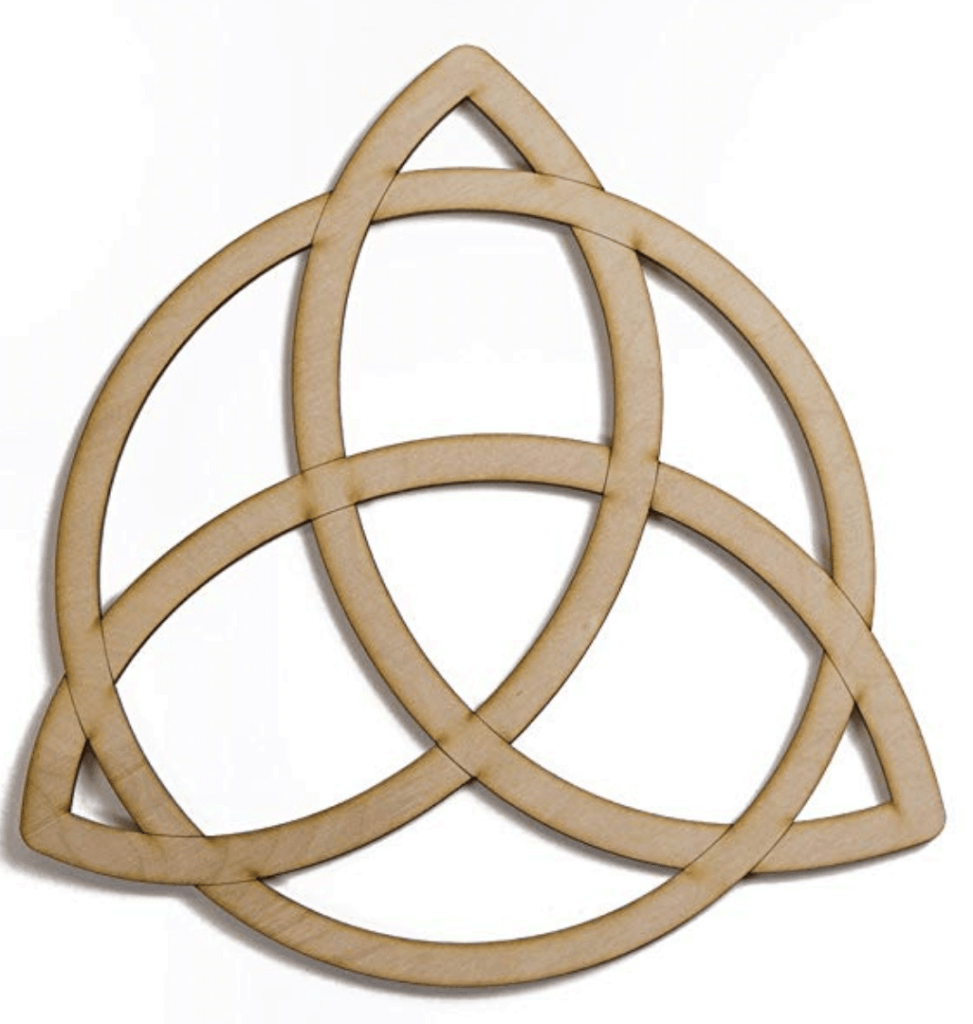
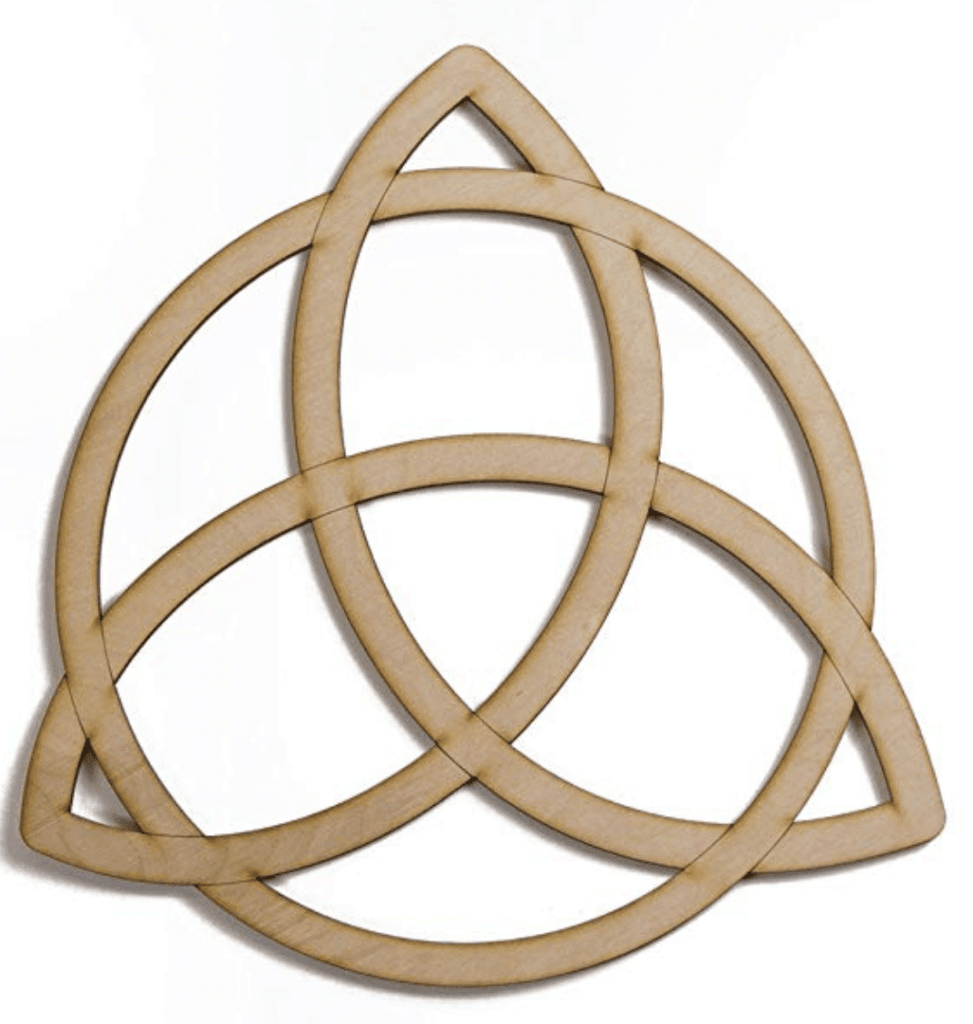
A trinity knot with a circle woven through it.
Many trinity knots have a circle woven through the loops. Most early medieval triquetras have no circle. The circled version is the one modern jewellers, and Charmed, made familiar.
Today it’s usually read as eternity, or as the unity that holds the three parts together. Christians may see God’s eternal love in it. Others see the circle of life.
Trinity knot jewellery
Walk into a jeweller anywhere in Ireland and you’ll find trinity knots. Pendants, earrings, cufflinks and, above all, rings.
Trinity knots are among the most common designs in Irish jewellery, including Claddagh and wedding rings. To my eye, a trinity knot band is a lovely choice for a couple who want an Irish touch without the full Claddagh.
For couples the three loops can mean love, honour and protect, or two people and their faith. Pick the one that fits.
Triquetra tattoo meaning
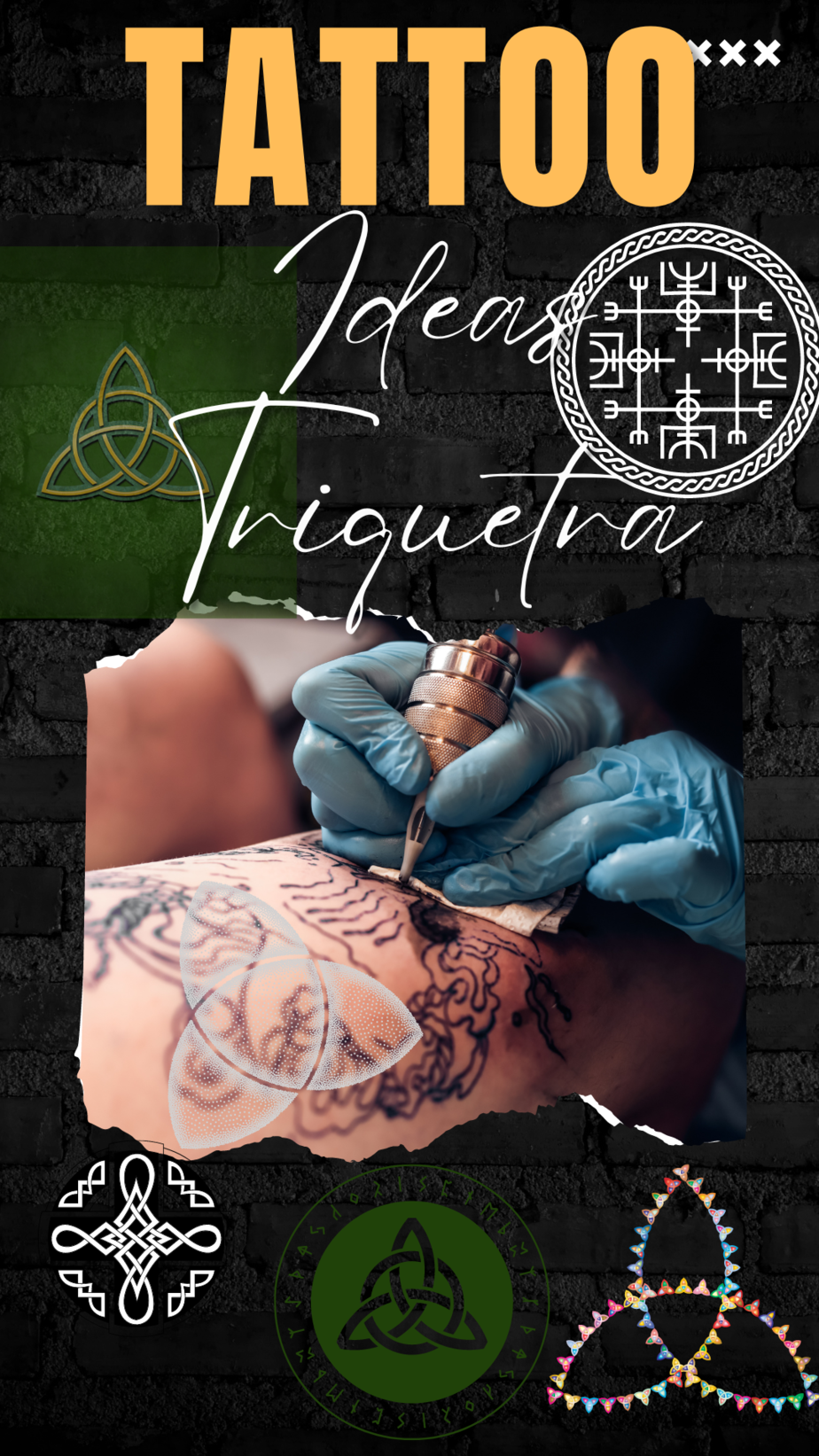
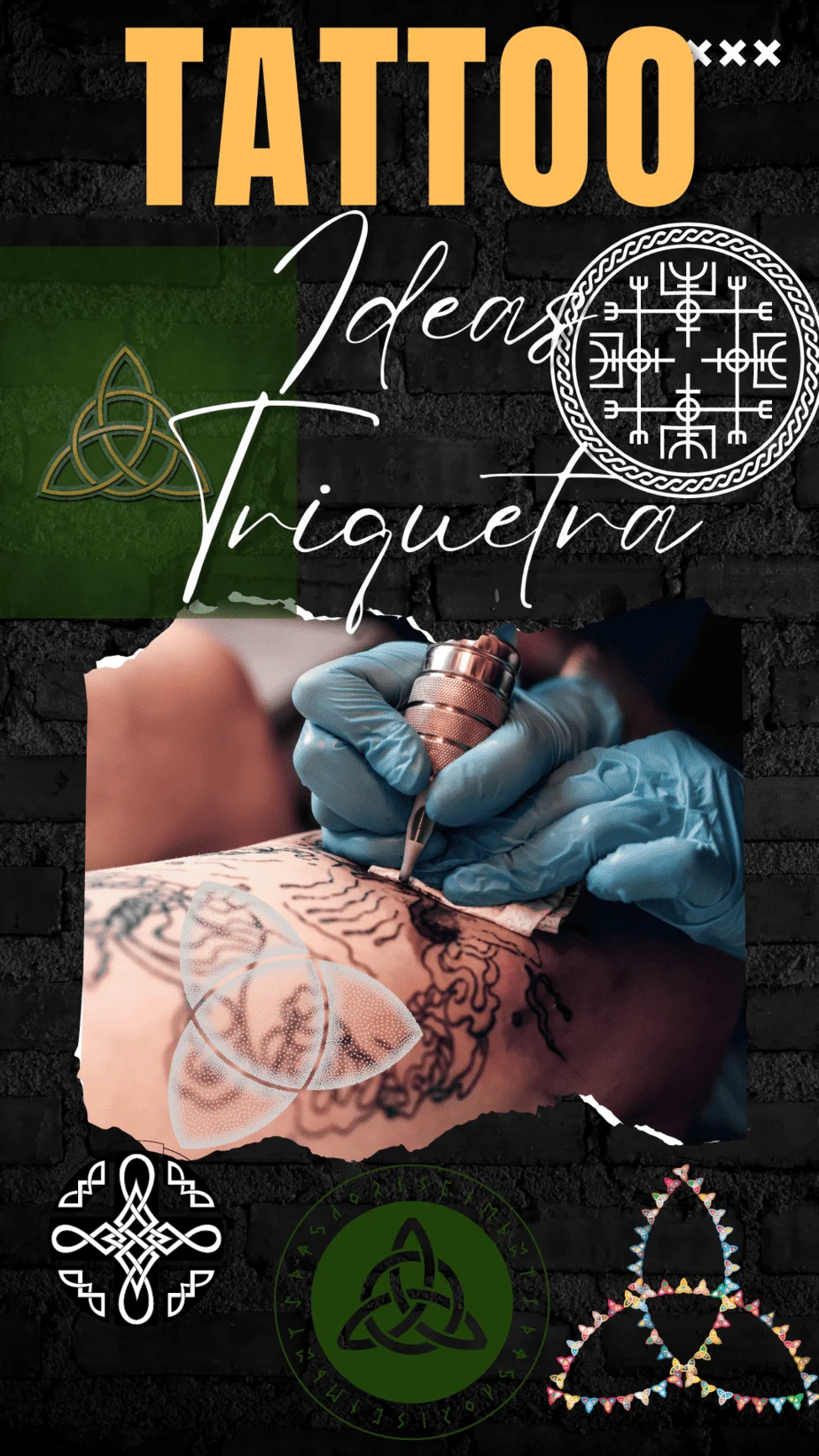
Some triquetra tattoo ideas. The compass-like design at the top right is an Icelandic Vegvísir, not a Celtic symbol.
The triquetra is one of the most popular Celtic tattoos. It’s simple, it looks good small, and you can pour your own meaning into it.
These are the meanings people choose most often:
- Faith: the Holy Trinity, Father, Son and Holy Spirit.
- Family: father, mother and child, or three children.
- Time: past, present and future.
- Life: life, death and rebirth.
- Love: a promise to love, honour and protect.
- Heritage: a quiet nod to Irish roots.
And some design ideas to bring to your artist:
- Plain: three clean loops, good for very small tattoos.
- Interlaced: the loops pass over and under. Pick an artist who knows knotwork.
- With a circle: the Charmed look, often read as eternity.
- Personal touches: a heart, initials or dates tucked inside the loops.
Small triquetras suit the wrist, the ankle or the back of the neck. If you want the over-and-under weave, go a little bigger so it stays clear over the years.
One word of warning about tattoo collages, including ours above. Not every symbol in them is Celtic. The compass-like one is a Vegvísir, an Icelandic stave. The four-way knot at the bottom left isn’t a triquetra either. Check what you’re getting before it goes on for life.
In the end, it’s your skin. Whether you’re Christian, pagan or somewhere in between, no one else can dictate what it should mean to you.
The triquetra in popular culture
Charmed
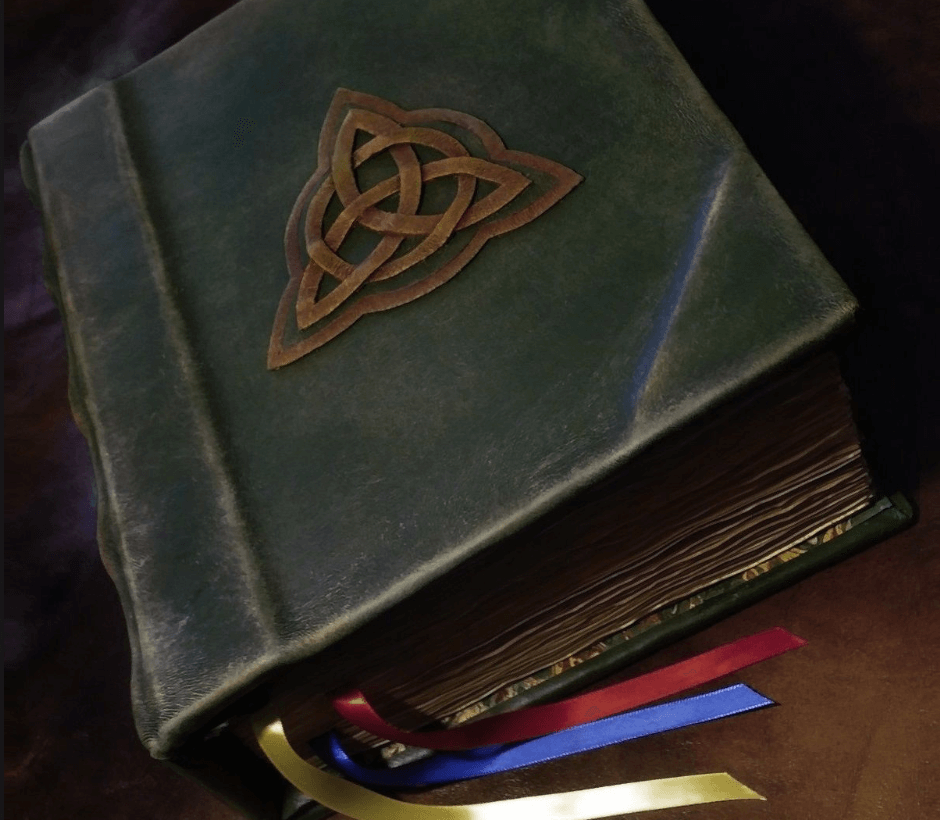
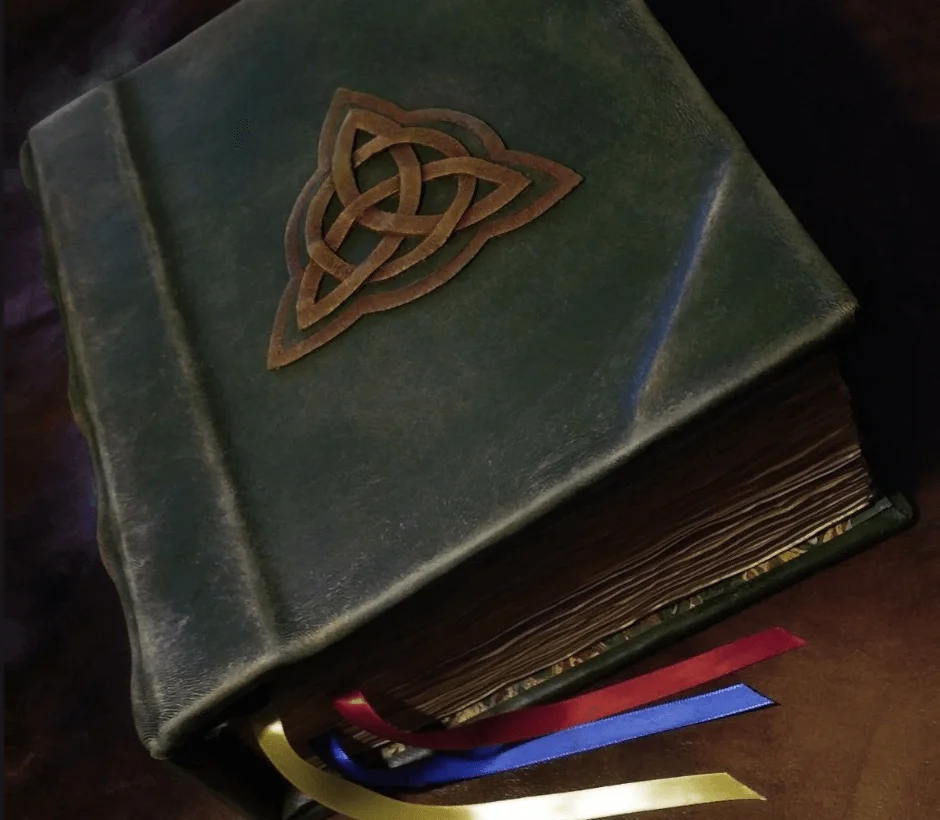
The Book of Shadows from Charmed, with its triquetra.
For anyone who watched TV between 1998 and 2006, the triquetra means Charmed. The circled triquetra on the Halliwell sisters’ Book of Shadows stood for the “Power of Three”.
It was in the opening credits for all eight seasons. When the sisters’ bond broke in the 2000 episode “Power Outage”, the symbol split apart. The CW brought it back for the 2018 reboot.
Led Zeppelin IV
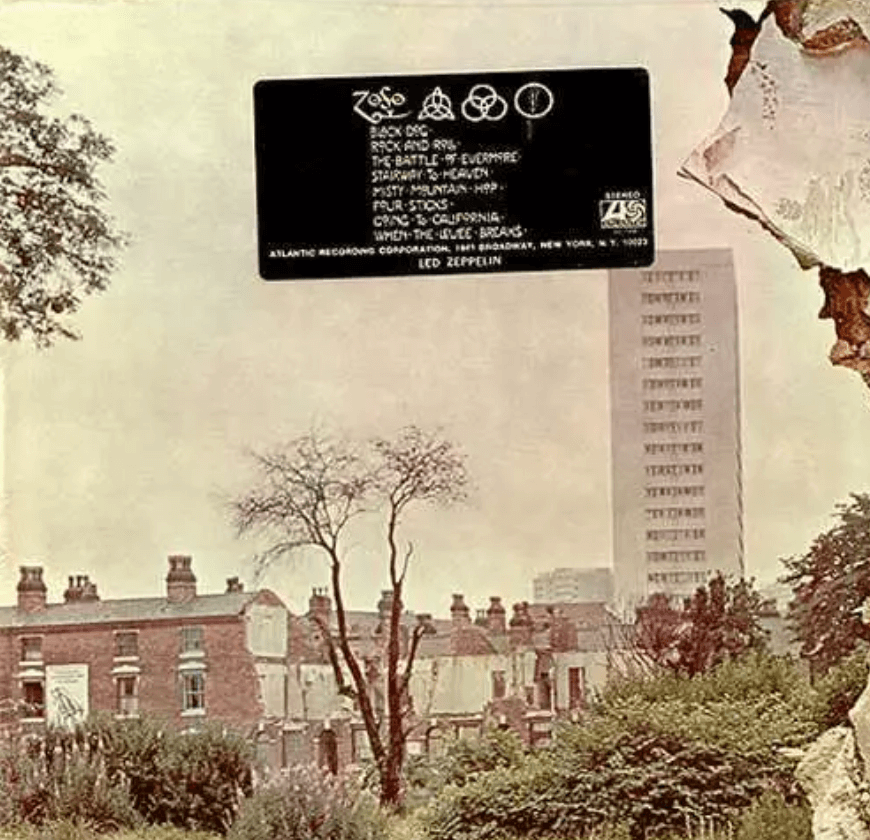
Led Zeppelin IV (1971): John Paul Jones’s symbol is a triquetra over a circle.
On Led Zeppelin’s fourth album (1971), each member chose a symbol for the sleeve. Bass player John Paul Jones picked a triquetra over a circle from the German designer Rudolf Koch’s Book of Signs (1930). It’s usually said to stand for a person who is both confident and competent.
John Bonham’s three interlocking rings came from the same book.
The Walking Dead
Michonne’s katana in The Walking Dead has a triquetra on its hilt. Prop master John Sanders has said he chose it as a triple goddess symbol (USA Today, 2014).
Thor and Dark
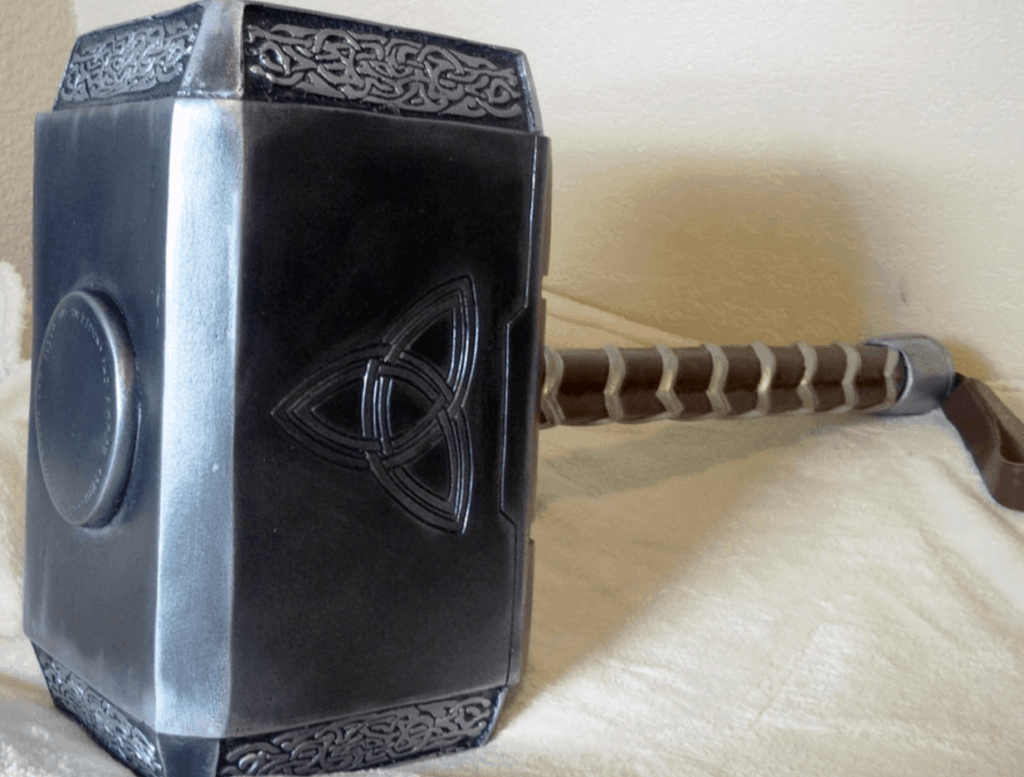
A replica of Mjölnir as seen in Marvel’s Thor, triquetra on the side.
In Marvel’s Thor (2011), a triquetra sits on the side of Mjölnir, Thor’s hammer. In the German Netflix series Dark (2017), the triquetra marks the show’s time loop. It appears on a cave door and on the Emerald Tablet.
Triquetra vs triskele, Celtic knot and Dara knot
The triquetra gets mixed up with its neighbours all the time.
| Symbol | Shape | How old |
|---|---|---|
| Triquetra (trinity knot) | Three interlaced loops, one line | Insular art from the 7th century; Viking-age stones and coins |
| Triple spiral (often called a triskele) | Three spirals or legs whirling from a centre | Newgrange, c. 3200 BC |
| Celtic knot | The whole family of interlace designs | Insular art from the 7th century |
| Dara knot | Four-way interlace said to look like oak roots | Modern design name |
| Valknut | Three interlocking triangles | 8th to 10th century Scandinavian picture stones; modern name |
The triple spiral, often called a triskele, is the one people confuse most. Ireland’s most famous triple spiral is carved in the back recess of the chamber at Newgrange, Co. Meath. Newgrange was built around 3200 BC, which makes it older than the Pyramids.
That’s long before anyone in Ireland spoke a Celtic language. Read more in my guide to the triskele.
“Celtic knot” is the umbrella name for all that interlace. The triquetra is one of many. I cover the main ones in my post on Celtic knots and their meanings.
The Dara knot is a four-way design meant to look like the roots of an oak. Its name comes from dair, the Irish for oak (doire means an oak wood).
It has no early medieval record as a named symbol, so treat it as modern. My Dara knot guide has the full story.
Triquetra FAQ
Is the triquetra Celtic or Norse?
Both. The woven triquetra is earliest and most common in Irish and Anglo-Saxon art of the 7th to 9th centuries, including the Book of Kells. The Vikings used it on runestones and coins in the 10th and 11th centuries.
Is the triquetra a Christian symbol?
It appears in early Christian Gospel books and on high crosses, and it is widely used for the Holy Trinity today. Whether its first makers meant the Trinity is unknown. One of the earliest printed statements of that reading is George Petrie’s, in 1845.
Is the triquetra pagan or evil? Is it OK to wear?
There’s nothing evil about it. It sits in Christian Gospel books, and modern pagans use it too. Anyone can wear it, for faith, family, heritage or simply because it looks well.
What does an upside-down trinity knot mean?
I’ve had a request for this one, so here goes. There’s no documented reversed meaning. Turn it over and it’s the same knot pointing the other way, not a sign of anything sinister.
How old is the triquetra?
The woven form dates from the 7th century, so roughly 1,300 to 1,400 years old. Simpler three-armed whirls on coins go back to about 500 BC. The “5,000 years old” claim belongs to Newgrange’s triple spiral.
More Celtic symbols
- Celtic Symbols and Their Meanings
- Celtic Knots and Their Meanings
- The Triskele (Triskelion): The Celtic Triple Spiral
- The Celtic Tree of Life Symbol
- St Brigid’s Cross: Meaning and How to Make One
- The Shamrock: Ireland’s Symbol of St Patrick’s Day
- The Awen: Another Celtic Symbol of Three
Love this? Save it to your Pinterest board for later.
A little bit of Ireland in your inbox every Friday ☘️
The free Weekly Dose of Irish: an Irish joke, a Celtic symbol, an Irish fact, a poem and the week’s best articles in one short email. Join 9,600+ readers.
Free. One short email every Friday. Unsubscribe any time.
Sandy
Sunday 3rd of July 2022
You said that Father, Son, and Holy Spirit are "elements". This is not true. The 3 Persons of the Godhead are Spirit and they are One. God is alive He is not an element. It's all there in the Holy Bible over and over. It's always a good thing to learn. 🙂
Annwfyn
Tuesday 28th of June 2022
The Inverted Triquetra is a Feminine symbol rather then a Masculine symbol (being a downward triangle rather the upward triangle) and it has been suggested that while the upward aligns to the Christian holy trinity (father, son, holy ghost), downward aligns to the goddess triads (that evolved into the modern maiden, mother, crone).
The Irish Jewelry Company
Tuesday 22nd of September 2020
Wonderful post about the Celtic trinity knot. I particularly like to wear trinity knot jewelry.
Sandy
Sunday 3rd of July 2022
2 Also, Billions of people, (including yours truly); alive and passed on can testify God is alive.
There are 3 symbols that pertain to God. The white Dove 🕊 represents the Holy Spirit, The fish drawn with two lines was the symbol for the 1st century Church of Jesus Christ; it was a secret way they could safely show each other that they were a Christian without saying a word during times of persecution.
And last, but not least the cross ✝️ which signifies the finished Work of Christ on the cross; his Sacrifice for the world.
The triquetra has never been a true symbol of anything about God. It is a Witchcraft symbol though. Celtic knots are used a lot in Celtic witchcraft and and by Traditional witches as well.
The Triquetra has been used in spells and other workings of witches for hundreds of years. It's a trick of the modern witch in fact, to con Christians into using this witches symbol for quite a while now.
The Christian who doesn't know is easily fooled unfortunately. It began with the Catholic church. Look it up.
It's always good to learn something new. 🙂
Jan
Wednesday 26th of August 2020
It doesn't make a difference which way the point is facing. It represents the Trinity, Power of 3. Anyone who makes it out to be something evil or wrong is incorrect.
Irish Around The World
Thursday 15th of August 2019
Thank you Wendy for the comment. The main upside down trinity knot meaning is that it represents the opposite of all the attributes the right-side-up trinity knot stands for.
This could be interpreted as the opposite. Instead of moving from life, death to rebirth it would now mean the reverse moving from rebirth to death.
Other interpretations could be upending of the Truth (such as in an upside-down cross) and a symbol of the beast.
But all that said it could have no additional meaning and not be taken to mean anything different just because of the way it is displayed.