“On an apple-ripe September morning” is the first line of Patrick Kavanagh’s poem usually called Threshing Morning. It also turns up in his 1948 novel Tarry Flynn. A young farmer walks across the fields to a neighbour’s threshing, half working and half dreaming. Here’s what the poem is about, where to read it in full, and where to find Kavanagh country today.
Since completing my top 100 Irish poems list, I have been looking for other Irish poems to include. I came across this lovely gem of an Irish poem by Patrick Kavanagh.
I always enjoy his poetry as he just has a way of describing the scene in such a vivid way.
You may have read a few of his other poems, like Stony Grey Soil or Spraying the Potatoes.
This one is a September poem through and through. It’s about a threshing day on a small farm in Co. Monaghan.
Kavanagh died in 1967, so this poem is still in copyright and I won’t print it here. Instead, here’s the story behind it and where to read it in full.

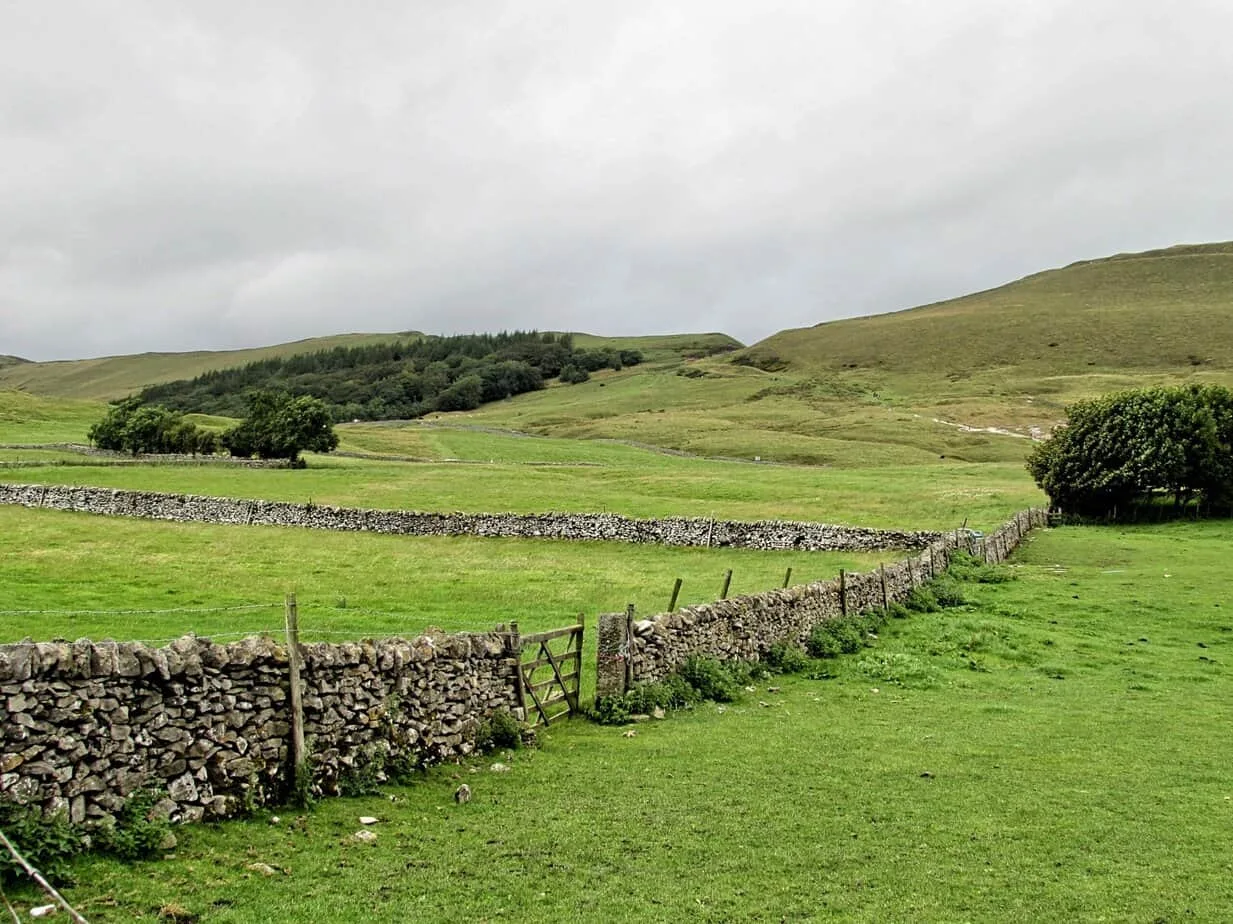
Green fields and stone walls
What is the poem called?
The line people search for is the first line, not the title. It’s usually known as Threshing Morning, which is also how the Kavanagh Trust files its drafts. Older editions sometimes just mark it as from Tarry Flynn.
Antoinette Quinn, Kavanagh’s editor and biographer, included it in her edition of his Collected Poems (2004).
The poem and Tarry Flynn
The poem appears near the end of Kavanagh’s novel Tarry Flynn, first published by the Pilot Press in London in 1948.
Tarry is a young farmer in Drumnay, a made-up townland that is really Kavanagh’s own Monaghan in disguise.
The poem is older than the book, though. A draft survives from 1934. A fuller version appeared on 27 September 1943 as A Reverie of Poor Piers. That was in City Commentary, his Irish Press column as Piers Plowman.
The Kavanagh Trust has published that 1943 version as A Reverie of Poor Piers. It notes the poem is repeated in Tarry Flynn and in Collected Poems.
The Trust has also published a 1934 notebook draft of part of the poem, marked unpublished: Threshing Morning (2). In that draft the girl is Kitty, not Mary.
An earlier version of this page said the poem was first published in 1956. It was in print by 1943, so I’ve fixed that.
On an apple-ripe September morning: what the poem is about
It’s an early autumn morning in Co. Monaghan. A young man walks across the fields to a neighbour’s farm, where the threshing mill has arrived.
His family owes the neighbours a day’s work from last year. Today he’s paying it back, and he’s looking forward to the company more than the work.
On the way his mind wanders. He thinks back to scrapes he got into as a boy. Then he looks ahead to the day at the mill and the chat.
When he reaches the yard, the plain walk has turned into something close to holy.
How I read it
Reflecting is certainly something that I think Kavanagh did a lot of. This poem is a good example.
Nothing much happens. A lad walks to a neighbour’s farm. That’s it.
But the mood is one of plenty. Ripe apples, a harvest in, a full day of company ahead. Under that runs a sense of time passing. He’s young, the morning won’t last, and he seems to know it.
Then the ending lifts a few small Monaghan fields into something close to sacred. That’s Kavanagh all over.
Threshing day in Ireland
Threshing knocks the grain free of the straw. It was once done by hand with a flail. Then came the mill.
The threshing mill went from farm to farm, and on threshing day the neighbours turned up to work it. Each farm helped the next and got the help back. The Irish word for this is meitheal, which Ó Dónaill’s dictionary defines as a working party.
The whole poem is a meitheal, seen through one young lad’s eyes. A haggard, by the way, is a rickyard where the stacks were kept.
In the Schools’ Collection of the 1930s, children wrote dozens of pieces called things like Our Threshing Day. You can read them free on dúchas.ie.
Threshing festivals today
The Moynalty Steam Threshing Festival near Kells, Co. Meath, is held each August. The 51st festival took place on Sunday 9 August 2026.
Closer to my own part of the world, Ballydehob in West Cork lists vintage and old-time threshing on the first weekend of each October. Check the site for each year’s dates before you go.
Who was Patrick Kavanagh?
Patrick Kavanagh was born on 21 October 1904 in Mucker, in the parish of Inniskeen, Co. Monaghan. His father was a cobbler with a small farm.
He left Kednaminsha National School in 1916 and worked the family land. The Kavanagh Centre says he lived his first 35 years on that small farm.
In 1931 he walked to Dublin to meet AE, the poet George Russell, who had printed his early poems.
His first collection, Ploughman and Other Poems, came out in 1936. The Great Hunger (1942) is a long, bleak poem about a farmer’s narrow life. A Soul for Sale followed in 1947, then Tarry Flynn in 1948.
The Dublin years
He moved to Dublin in 1939. He scraped a living from journalism, including a gossip column and film reviews for the Irish Press, and later work for The Standard.
In 1952 he and his brother Peter ran Kavanagh’s Weekly, which lasted 13 issues.
The Grand Canal
In 1955 he was diagnosed with lung cancer and had a lung removed. He recovered on the banks of the Grand Canal in Dublin. The Kavanagh Trust calls it a sort of personal and poetic renewal, and the canal bank sonnets came out of it.
Today a bronze Kavanagh sits on a bench by the canal near Baggot Street Bridge.
On Raglan Road
On Raglan Road was written in 1946, about Hilda Moriarty, a young medical student he loved without luck.
It’s sung to the air The Dawning of the Day. The story goes that Kavanagh gave it to Luke Kelly in The Bailey pub.
His last years
He married Katherine Barry Moloney in April 1967. Later that year he fell ill in Dundalk, where a stage version of Tarry Flynn was on. He died in Dublin on 30 November 1967 and is buried at home in Inniskeen.
He showed that small rural detail was fit for poetry, and that opened the door for later poets, Seamus Heaney above all.
Visiting the Patrick Kavanagh Centre in Inniskeen
The Patrick Kavanagh Centre is in St Mary’s, the old church where he was baptised. He’s buried in the churchyard beside it.
Here’s what the Centre’s website listed on 2 October 2026:
- Hours: Monday to Friday 10am to 5pm (box office closes 4.15pm), Saturday 11am to 4pm. Closed on bank holidays.
- Prices: adults €10, under-7s free. A family ticket is €30, for four or more people with at least two children.
- Tours: guided tours are €15 each, for groups of five or more. Book in advance.
- Contact: Inniskeen, Co. Monaghan, A91 KT20. Phone +353 42 937 8560.
There’s a Poetry Jukebox by the River Fane that plays 12 Kavanagh poems. Two are read by the man himself.
There’s also a Kavanagh Trail by coach, out to his homeplace at Mucker. It’s €20 each and needs at least 10 people.
Things change, so check the website before you travel.
Where to read Threshing Morning in full
Buy the book. You get plenty of his other poems with it too.
- Collected Poems, edited by Antoinette Quinn (Allen Lane 2004, later Penguin Modern Classics).
- Tarry Flynn, the novel. The poem comes near the end.
Threshing Morning FAQ
What is the real title of “On an apple-ripe September morning”?
Usually Threshing Morning. An earlier version appeared in the Irish Press in 1943 as A Reverie of Poor Piers.
What is Threshing Morning about?
A young farmer walks to a neighbour’s threshing to pay back a day’s work. He’s half working and half dreaming.
Which book is Threshing Morning in?
Antoinette Quinn’s edition of Kavanagh’s Collected Poems (2004), and his novel Tarry Flynn (1948).
What is a meitheal?
A working party of neighbours who help each other at busy times like the harvest. A threshing day was the classic example.
Can I visit Patrick Kavanagh’s home place?
Yes. The Centre’s guided coach tour of the Kavanagh Trail takes in the Kavanagh homestead at Mucker. It needs at least 10 people and must be booked ahead.
More Irish poetry reading
- On Raglan Road by Patrick Kavanagh
- Ireland’s Top 100 Irish Poems
- 10 Best Irish Poets
- Seamus Heaney Poems
- Irish Quotes
- Facts About Ireland
A little bit of Ireland in your inbox every Friday ☘️
The free Weekly Dose of Irish: an Irish joke, a Celtic symbol, an Irish fact, a poem and the week’s best articles in one short email. Join 9,600+ readers.
Free. One short email every Friday. Unsubscribe any time.