Hurling: quick facts
- What: a field game played with a wooden stick (a hurley, or camán) and a small leather ball (a sliotar).
- Teams: 15 players a side. The women’s game is called camogie.
- Scoring: over the bar is one point; under the bar into the net is a goal, worth three.
- History: the GAA says it has been played in Ireland for at least 3,000 years, and it features in the legends of Cú Chulainn.
- Recognition: hurling and camogie were added to UNESCO’s list of intangible cultural heritage in 2018.
- The big day: the All-Ireland final at Croke Park, Dublin, which holds about 82,000 people. Every player is an amateur.
Imagine hockey, lacrosse and baseball at full speed, with the ball in the air at head height, and no one getting paid. That’s hurling. It is one of the oldest field games in the world and one of the fastest, and the best players are teachers, farmers and accountants who play for their home county.
Here are some of the best goals of the last decade, from the GAA’s own channel.
How hurling works
Players can strike the sliotar on the ground or in the air, catch it in their hand, or carry it on the flat end of the hurley. You can’t take more than four steps with the ball in your hand, so players balance or bounce it on the stick as they run. The goalposts look like rugby posts with a soccer net underneath: over the bar is a point, into the net is a goal, worth three points.
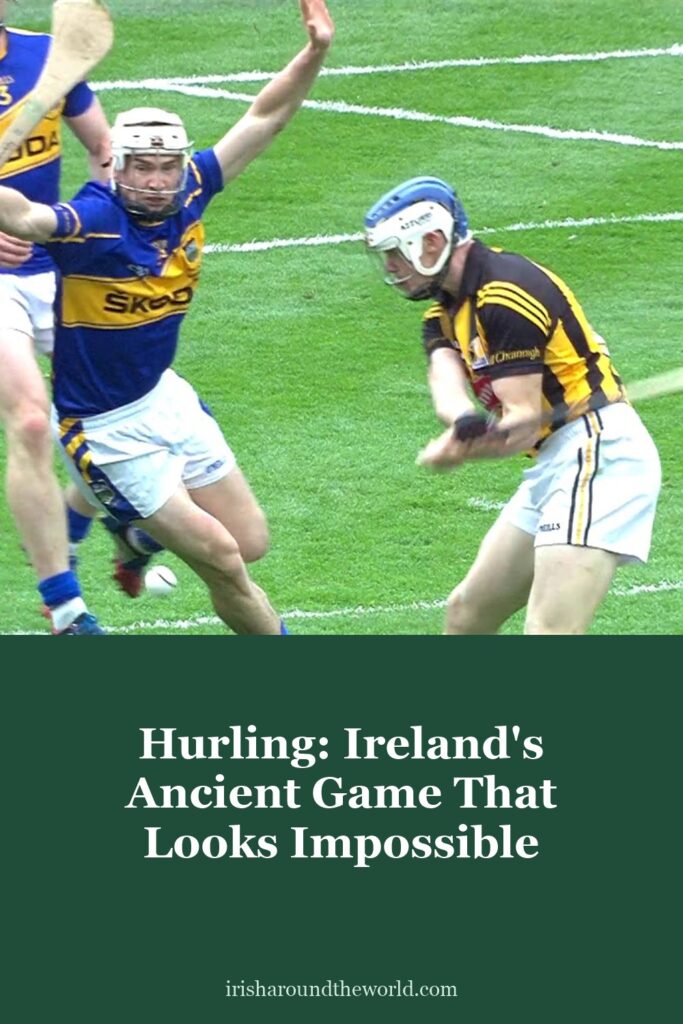
Helmets with face guards have been compulsory for some years now, which is why the modern game looks the way it does in the video.
An ancient game
Hurling appears all through Irish mythology. In the most famous story, the boy Setanta drives a sliotar down the throat of a ferocious guard dog belonging to Culann the smith, and takes the name Cú Chulainn, the Hound of Culann. The GAA, founded in 1884, wrote down the modern rules and turned it into the national game it is today.
In 2018, UNESCO added hurling and camogie to its Representative List of the Intangible Cultural Heritage of Humanity, recognising them as living Irish heritage.
Why the Irish love it
Hurling is about where you’re from. Players can only play for their own club and county, so the team on the pitch is made up of the lads from down the road. Counties such as Kilkenny, Cork, Tipperary, Limerick, Galway and Clare have fierce rivalries going back generations, and an All-Ireland final in Croke Park in the summer is one of the great days in Irish sport.
Hurling FAQ
Is hurling the fastest field sport in the world?
It is widely described as one of the fastest field games in the world, and the GAA calls it the fastest game on grass.
Are hurlers paid?
No. Hurling is an amateur sport.
What is the ball called in hurling?
A sliotar.
What is women’s hurling called?
Camogie.
When was hurling recognised by UNESCO?
In 2018, together with camogie.
More from Ireland
- Johnny Sexton’s drop goal in Paris
- Rachael Blackmore’s Grand National
- The day Ireland finally beat the All Blacks
- Katie Taylor v Amanda Serrano
- Rory McIlroy’s Masters
- Ireland’s Call, the rugby anthem
- The best viral Irish videos of all time
Featured image: still from the GAA’s official YouTube channel.
Love this? Save it to your Pinterest board for later.
A little bit of Ireland in your inbox every Friday ☘️
The free Weekly Dose of Irish: an Irish joke, a Celtic symbol, an Irish fact, a poem and the week’s best articles in one short email. Join 9,600+ readers.
Free. One short email every Friday. Unsubscribe any time.