Riverdance at Eurovision: quick facts
- When: 30 April 1994, during the interval of the Eurovision Song Contest.
- Where: the Point Theatre in Dublin (now the 3Arena).
- Who: lead dancers Jean Butler and Michael Flatley, music by Bill Whelan, with the choir Anúna and the RTÉ Concert Orchestra. Produced by Moya Doherty.
- How long: about seven minutes.
- Audience: thousands in the hall and an estimated 300 million on TV.
- What happened next: the single spent 18 weeks at number one in Ireland, the full show opened in February 1995, and Riverdance has since been seen live by more than 30 million people.
On the night of 30 April 1994, Ireland was hosting the Eurovision Song Contest for the second year in a row. While the votes were being counted, the producers filled the interval with a short piece of Irish dancing. Seven minutes later, the Point Theatre was on its feet, and Irish dancing would never be the same again.
This is the original performance, the one that started it all.
What makes this performance so special
Before 1994, Irish dancing was something most people only saw at a feis or a parish hall: stiff arms, rigid posture, children in heavy embroidered dresses. It was loved at home but rarely seen as exciting.
Riverdance changed that in a single night. It opens slowly, with the choir Anúna and soloist Katie McMahon singing the haunting “Cloudsong”. Then Jean Butler steps out alone, then Michael Flatley explodes across the stage, and finally a long line of dancers hits the floor in perfect unison, the sound of their heels building like thunder. The music, by Bill Whelan, mixed traditional Irish rhythm with something bigger and more modern, and the effect was electric.
By the end, the audience in the hall had leapt to their feet. Many people who watched it on television that night still remember exactly where they were.
The people behind it
- Moya Doherty, an RTÉ producer, came up with the idea for the interval act and produced it.
- Bill Whelan composed the music. He later won a Grammy in 1997 for the Riverdance album.
- Jean Butler, from New York, and Michael Flatley, from Chicago, were both Irish-American champion dancers. Their American upbringing gave the dancing a showbiz energy that Irish audiences had never seen.
- Anúna, the Irish choir, gave the opening its otherworldly sound.
The interval act that outshone the contest
Ireland won Eurovision that night too, with “Rock ‘n’ Roll Kids” by Paul Harrington and Charlie McGettigan, the country’s third win in a row. But it was the interval act everyone talked about the next morning.
The Riverdance single went straight to number one in the Irish charts and stayed there for 18 weeks, keeping the winning Eurovision song off the top spot. A charity release later that year, “Riverdance for Rwanda”, raised money for the famine and war in Rwanda.
From seven minutes to a world-famous show
Moya Doherty and her husband, director John McColgan, saw what they had. They expanded the seven-minute piece into a full two-hour show, and Riverdance opened at the Point Theatre on 9 February 1995. It sold out, then sold out again, then went to London and New York.
Not everything went smoothly. Michael Flatley left the show later in 1995 after a dispute with the producers, and went on to create his own hit, Lord of the Dance. Riverdance kept going without him, and it never really stopped. It has now played in more than 40 countries and has been seen live by more than 30 million people.
Read more: 10 things you didn’t know about Michael Flatley.
How Riverdance changed Irish dancing forever
It’s hard to overstate the effect. After 1994:
- Irish dancing schools around the world saw a wave of new students.
- Irish dance became a global stage art, with shows touring arenas from Tokyo to Toronto.
- Dancers began to use their arms, their style and their personality, not just their feet.
- A whole generation of performers, from the figure skater Jason Brown to today’s TikTok stars, grew up on Riverdance.
For Ireland itself, it arrived at just the right moment. The country was changing fast in the 1990s, growing more confident and more outward-looking, and Riverdance became a symbol of that new Ireland: proud of its traditions, but not stuck in them.
Riverdance today
Riverdance celebrated its 30th anniversary in 2024 and 2025 with a new world tour, and it is still touring today. Some of its current stars weren’t even born in 1994, including the Gardiner Brothers, whose own videos have been watched tens of millions of times.
If you only ever watch one Irish dancing video, make it the one above.
Riverdance at Eurovision FAQ
When did Riverdance first appear?
Riverdance first appeared on 30 April 1994, as the interval act of the Eurovision Song Contest in Dublin.
Who danced in the original Riverdance?
The lead dancers were Jean Butler and Michael Flatley, backed by a troupe of Irish dancers, with the choir Anúna and the RTÉ Concert Orchestra.
Who wrote the music for Riverdance?
Bill Whelan composed the music. He won a Grammy Award in 1997 for the Riverdance album.
How long was the original Riverdance performance?
About seven minutes.
Who won Eurovision in 1994?
Ireland, with “Rock ‘n’ Roll Kids” by Paul Harrington and Charlie McGettigan.
More Irish dancing
- 10 breathtaking Irish dancing videos from around the world
- Jason Brown’s Riverdance on ice
- The Galway girls who Irish danced to Shape of You
- Cairde’s Banjo Beat, watched over 80 million times
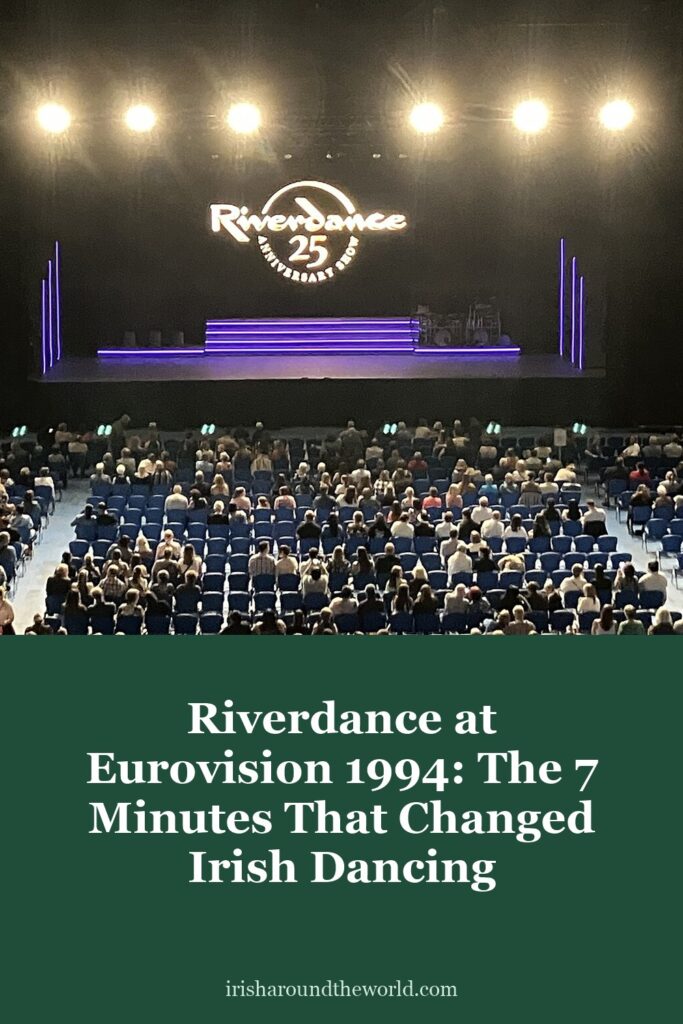
Featured photo: Riverdance on stage at the RAC Arena, Perth, 2024, by DaHuzyBru, CC BY-SA 4.0, via Wikimedia Commons.
Love this? Save it to your Pinterest board for later.
A little bit of Ireland in your inbox every Friday ☘️
The free Weekly Dose of Irish: an Irish joke, a Celtic symbol, an Irish fact, a poem and the week’s best articles in one short email. Join 9,600+ readers.
Free. One short email every Friday. Unsubscribe any time.