
The Stare’s Nest by My Window is part VI of W.B. Yeats’s sequence Meditations in Time of Civil War, written in 1922 at Thoor Ballylee, his tower house in Co. Galway, during the Irish Civil War. A stare is a starling. Shut in with only rumours for news, Yeats sets birds and bees building in his crumbling wall against the killing outside, admits that hate has outgrown love, and calls on the honey-bees to fill the starling’s empty nest. Below: the full public-domain text from The Tower (1928), the history, themes, key quotes and Leaving Cert Higher Level notes for 2027 and 2028.
In 1922, as the Civil War broke out, W.B. Yeats and his family were staying at their tower house, Thoor Ballylee, an old Norman keep beside a stream in Co. Galway. News reached them as rumour, and one midnight anti-Treaty fighters blew up the old bridge beside the tower.
A starling had built its nest in a hole in the wall by his bedroom window. Out of those months came this short, quiet poem: four stanzas about an empty nest, some honey-bees and a dead young soldier.
It’s one of 13 Yeats poems on the Higher Level English course for 2027 and 2028. For the full list, with a page for every poem, see my W.B. Yeats Leaving Cert guide.
Jump to:
- The Stare’s Nest by My Window at a glance
- The poem: full text
- What is a stare?
- The story behind the poem: Thoor Ballylee in 1922
- Where it fits in Meditations in Time of Civil War
- What happens in the poem, stanza by stanza
- Themes
- Imagery, tone and structure
- Leaving Cert notes: key quotes and points
- Who was W.B. Yeats?
- The Stare’s Nest by My Window FAQ
- More Yeats reading
The Stare’s Nest by My Window at a glance
- Poet: William Butler Yeats, 1865 to 1939.
- Where it comes from: part VI of Meditations in Time of Civil War, a sequence of seven poems.
- Written: at Thoor Ballylee, Co. Galway, in 1922, during the Civil War, according to Yeats’s own note. The Tower prints the year 1923 under the whole sequence.
- Collected in: The Tower (London: Macmillan, 1928).
- Form: four five-line stanzas rhyming ABAAB, each ending on the same refrain.
- Exam: Higher Level only, for June 2027 (circular 0021/2025) and June 2028 (circular 0024/2026). It isn’t on the Ordinary Level list.
The poem: full text
This is the text of the first edition, The Tower (London: Macmillan, 1928), pages 26 and 27, checked word for word against the scanned pages on Wikisource and the Project Gutenberg transcription of the same edition. Yeats died in 1939, so the poem is in the public domain.
VI
The Stare’s Nest by My Window
The bees build in the crevices
Of loosening masonry, and there
The mother birds bring grubs and flies.
My wall is loosening; honey-bees
Come build in the empty house of the stare.
We are closed in, and the key is turned
On our uncertainty; somewhere
A man is killed, or a house burned,
Yet no clear fact to be discerned:
Come build in the empty house of the stare.
A barricade of stone or of wood;
Some fourteen days of civil war;
Last night they trundled down the road
That dead young soldier in his blood:
Come build in the empty house of the stare.
We had fed the heart on fantasies,
The heart’s grown brutal from the fare,
More substance in our enmities
Than in our love; oh, honey-bees
Come build in the empty house of the stare.
Your anthology may print a later text, so if a comma differs, go with the version in your class book.
What is a stare?
A stare is a starling. Yeats explains it in his notes at the back of The Tower: “In the West of Ireland we call a starling a stare, and during the civil war one built in a hole in the masonry by my bedroom window.”
So the nest in the title was real, and it was right beside his bed.
That’s typical starling behaviour. BirdWatch Ireland describes the starling, Sturnus vulgaris, as a common resident all over Ireland that nests in holes and cracks in buildings and trees.
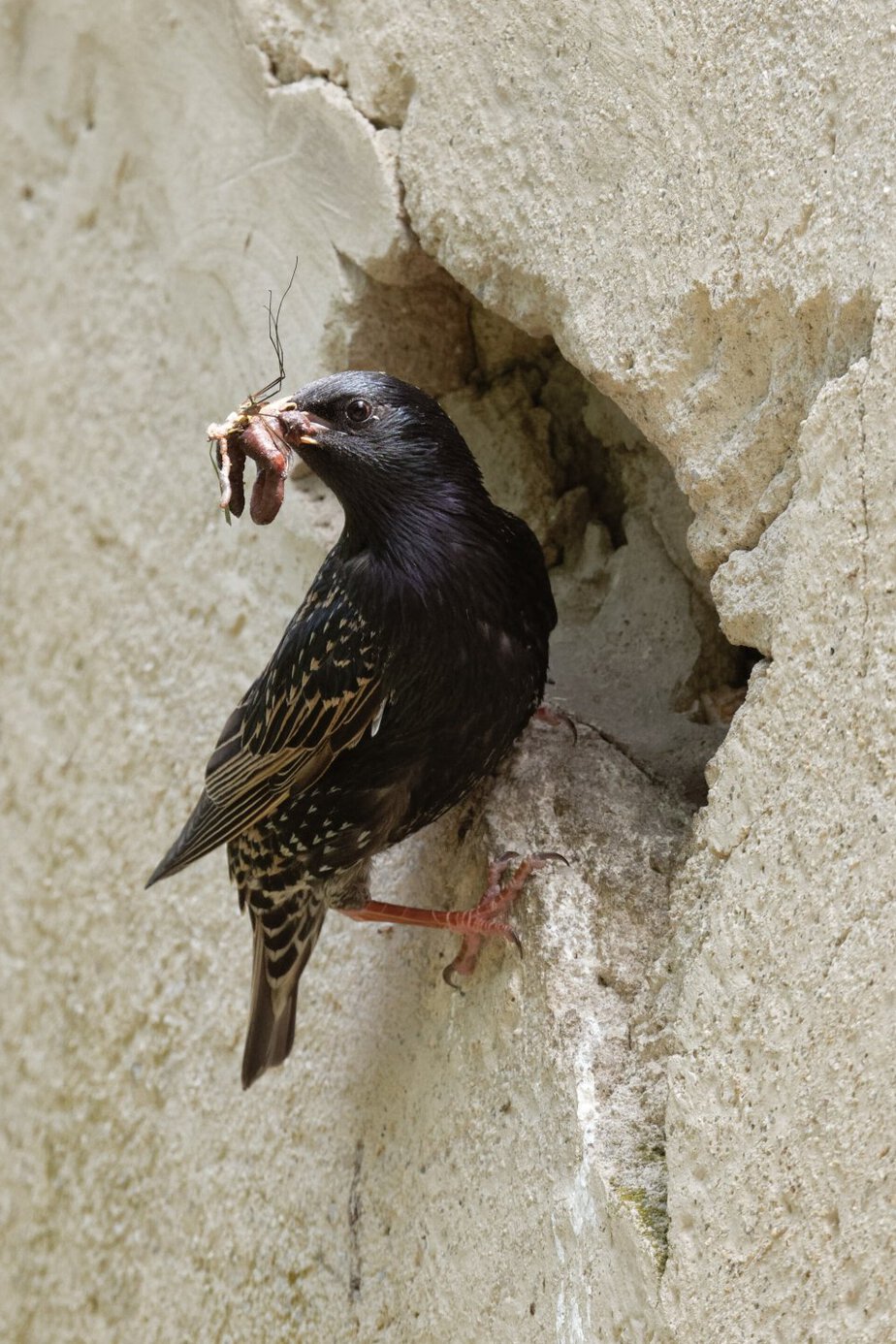
A starling carrying food to its nest in a crack in a wall, Auvergne, France. Photo: Marie-Lan Taÿ Pamart, CC BY 4.0, via Wikimedia Commons
In Irish a starling is a druid, a feminine noun in Ó Dónaill’s dictionary on teanglann.ie. Say it roughly DRID; the slender final d can sound a little like “drij”. Don’t mix it up with the word for the druids of old: that’s draoi (said DREE), plural draoithe. As it happens, druid is also the Irish verb for “close” or “shut”, which fits “We are closed in” rather well.
Spelling watch: you’ll sometimes see the title written as The Stares Nest or The Stair’s Nest. It’s Stare’s, with an apostrophe: the nest belongs to the stare.
The story behind the poem: Thoor Ballylee in 1922
Yeats bought a Norman tower at Ballylee, Co. Galway, in March 1917, according to the Dictionary of Irish Biography (DIB). He married George Hyde Lees that October, the couple oversaw the renovation in 1918, and that autumn they first moved into the cottage beside the tower. He called the place Thoor Ballylee (roughly THOOR bal-ee-LEE). Thoor is usually explained as an English spelling of túr (TOOR), the Irish word for a tower.
Then came the Civil War. It’s traditionally dated from 28 June 1922, when the new Provisional Government’s National Army attacked the anti-Treaty IRA in the Four Courts in Dublin, to the anti-Treaty side’s order to dump arms on 24 May 1923. My guide to Michael Collins explains the Treaty split behind it.
Historians from UCC’s Irish Civil War Fatalities Project, writing for RTÉ, counted 1,485 violent deaths across the island in that period, with Galway one of the secondary centres.
The DIB says the Yeats family lived through some of the war’s grimmest months at Thoor Ballylee in 1922, and that anti-Treaty forces blew up a bridge there. Yeats tells it himself, with a dry touch, in a note in The Tower. Before the poems were finished, he writes, “the Republicans blew up our ‘ancient bridge’ one midnight.” Then: “They forbade us to leave the house, but were otherwise polite, even saying at last ‘Goodnight, thank you’ as though we had given them the bridge.”
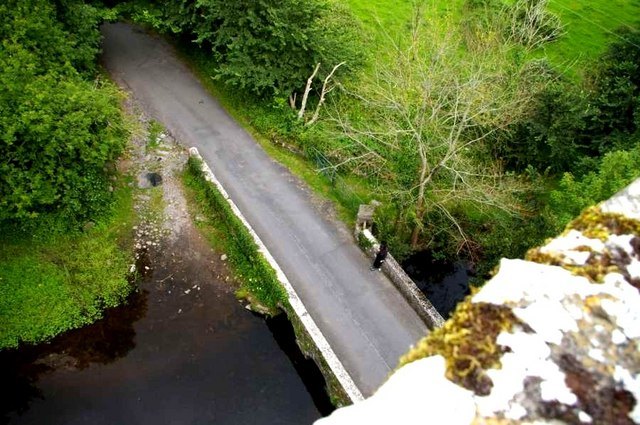
The bridge and stream at Ballylee today, seen from the top of Yeats’s tower. Photo: James Yardley, CC BY-SA 2.0, via Wikimedia Commons
It’s hard not to hear that night behind “We are closed in, and the key is turned”, though the poem never mentions the bridge. What it does give is war seen from a window: rumours (“somewhere / A man is killed, or a house burned”), a barricade, a count of days, a body taken down the road the night before.
If Yeats was counting from 28 June, “Some fourteen days of civil war” would put that stanza around the middle of July 1922. The word “some” keeps it loose, though, and his note gives no date.
Who was the dead young soldier? Neither the poem nor the note says, and the poem doesn’t tell us which side he fought on. That silence is worth noticing in an exam answer: the grief is for a young man, not for a cause.
Where it fits in Meditations in Time of Civil War
In Yeats’s 1928 book, which opens with Sailing to Byzantium, Meditations in Time of Civil War comes straight after the title poem, The Tower. It has seven parts:
- Ancestral Houses
- My House
- My Table
- My Descendants
- The Road at My Door
- The Stare’s Nest by My Window
- I See Phantoms of Hatred and of the Heart’s Fullness and of the Coming Emptiness
Only part VI is on the course, but its neighbours explain a lot:
- II, My House opens with “An ancient bridge, and a more ancient tower”: the bridge his note says was blown up.
- IV, My Descendants imagines the tower as “a roofless ruin” where an owl may “build in the cracked masonry” and cry out its desolation. In VI the masonry really is loosening, but the builders Yeats calls in are honey-bees, not the owl.
- V, The Road at My Door brings both sides to his door: “An affable Irregular” (“Irregulars” was what the Free State side called anti-Treaty fighters) cracking jokes about the war, and “A brown Lieutenant and his men, / Half dressed in national uniform”, most likely National Army troops. Yeats complains about the weather and turns back to his room.
- VII brings visions of hatred and emptiness from the tower top; in the last stanza the poet turns away and shuts the door.
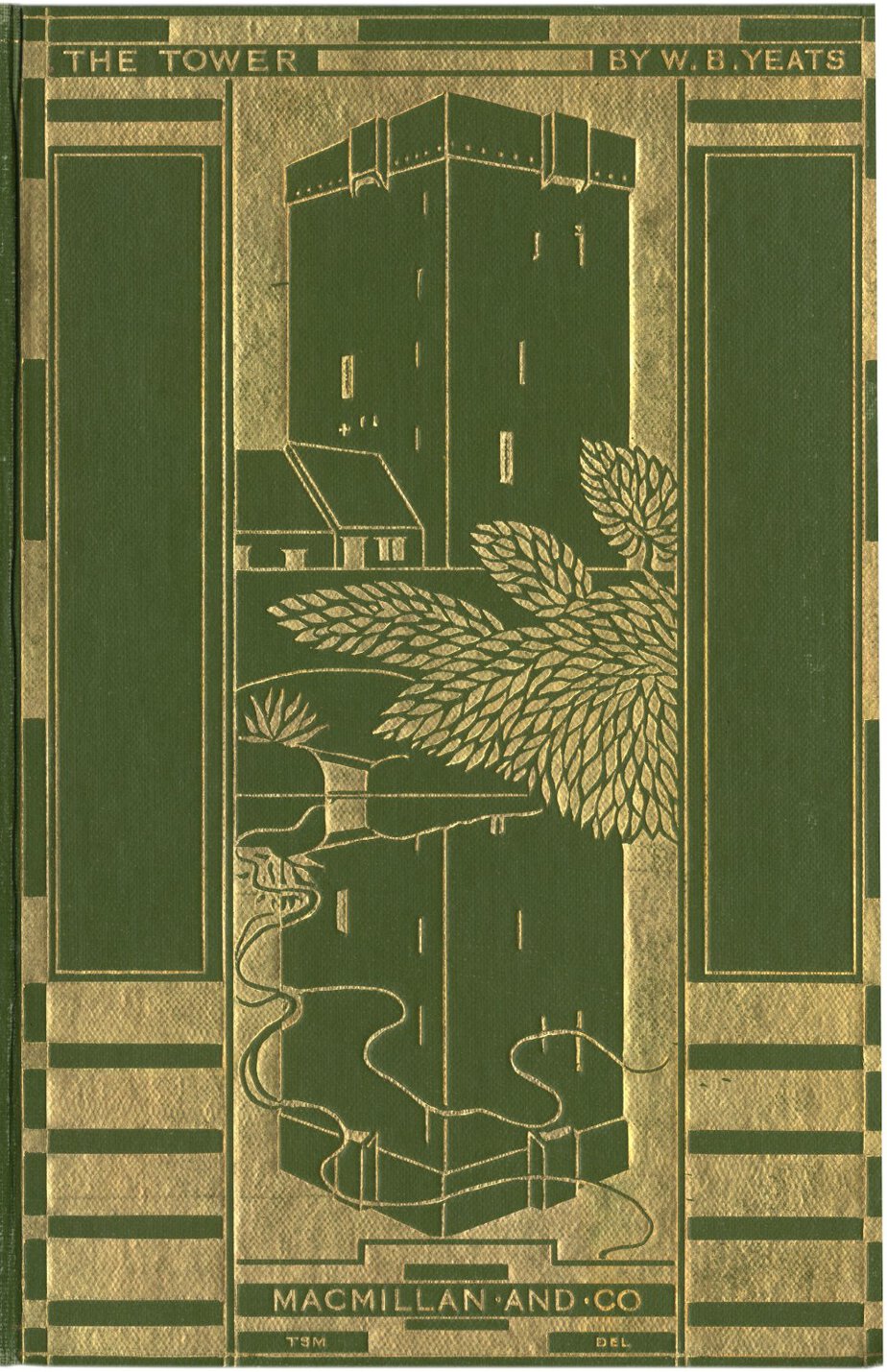
The cover of the first edition of The Tower (Macmillan, 1928), designed by Thomas Sturge Moore. Public domain, via Wikimedia Commons
What happens in the poem, stanza by stanza
Stanza 1: the crumbling wall
Bees are building in the cracks of old stonework, and mother birds are carrying grubs and flies to their young. Then the poet turns to himself: “My wall is loosening”. It’s his tower wall, but it also sounds like an ageing body (Yeats turned 57 in June 1922) and an old order coming apart. The stare has left its nest, and he invites the honey-bees in.
Stanza 2: shut in with rumours
The household is locked in with its “uncertainty”. Somewhere a man is killed or a house is burned, but nobody can tell what’s true. The flat, everyday grammar of “A man is killed, or a house burned” makes violence sound routine, and that’s the horror of it.
Stanza 3: the dead young soldier
Now the details come like notes jotted in a diary: a barricade, a count of days. Then the shock: “Last night they trundled down the road / That dead young soldier in his blood”. To trundle is to roll something heavy along on wheels, like a cart or a barrow, and the word turns a person into a load. “They” are never named.
Stanza 4: the confession
The last stanza turns from what he sees to what “we” have done. “We had fed the heart on fantasies, / The heart’s grown brutal from the fare”: dreams fed to the heart like food have made it cruel. There’s more substance in “our enmities” than in “our love”, and Yeats puts himself inside that “we”.
Some readers take the “fantasies” to include the romantic nationalism Yeats once wrote for; others read them as dreams on every side that soured into hate. Either way, the refrain becomes a plea: “oh, honey-bees”.
Themes
Violence and decay against renewal. Killing, burning and a crumbling wall on one side; bees building and birds feeding their young on the other. Nature keeps making and mending while people destroy.
The house as a symbol. The tower is Yeats’s home and the house he hoped to hand on (part IV). Its loosening wall also suggests his ageing body and the great houses of the past he broods on in part I. Widen it out, and the house falling apart is the country.
Isolation and uncertainty. The poet is locked in and can’t get at the truth: “no clear fact to be discerned”. War reaches him as rumour, until it rolls past on the road.
Self-accusation. The poem doesn’t blame one side. It blames “we”, the whole people, the poet included, for feeding on fantasies until hate outweighed love.
Hope as a prayer. There’s no political answer here. The only hope is in the bees, and it’s a wish, not a promise. Compare The Wild Swans at Coole, where wild birds seem untouched by the losses of the man watching them.
Imagery, tone and structure
- Bees and honey: honey-bees build orderly combs and turn what they gather into sweetness, an old image of patient, shared work. The bees build; the men destroy.
- The empty nest: the stare has gone. An empty nest suggests absence and loss, but it’s also a home waiting to be filled.
- Blood: the one brutal image, “That dead young soldier in his blood”, told in the plainest words in the poem.
- Food: the mother birds bring “grubs and flies”; we fed our hearts on fantasies, and the “fare” made them brutal. The same image gives opposite results.
- Tone: quiet and close at first, then uneasy, flat and shocked in stanza 3, confessional and pleading at the end.
- Rhyme and rhythm: four stanzas of five lines, rhyming ABAAB. Most lines have four beats; the refrain packs in more syllables, so it sounds longer and gentler. Every B rhyme lands on an “air” sound (there, somewhere, war, fare, stare), though “war” is only a half-rhyme. In stanza 3 the A rhymes roughen too: wood, road, blood.
- The refrain: “Come build in the empty house of the stare” comes four times, like a prayer or a charm. Each stanza before it is darker, so the same words carry more weight each time, until the last stanza adds the direct “oh, honey-bees”.
Leaving Cert notes: key quotes and points
Both circulars list the poem for Higher Level as “from Meditations in Time of Civil War: VI, The Stare’s Nest by My Window”, so only part VI is prescribed. This is an unofficial study guide, so check details with your teacher.
Points you could build an answer around, each with a quote to learn:
- Private and public: a nest by a bedroom window and a national war, in twenty lines. “somewhere / A man is killed, or a house burned”.
- Nature against violence: “The mother birds bring grubs and flies” against “That dead young soldier in his blood”.
- Uncertainty and isolation: “We are closed in, and the key is turned / On our uncertainty”; “Yet no clear fact to be discerned”.
- Honesty and self-criticism: “We had fed the heart on fantasies, / The heart’s grown brutal from the fare”. The poet includes himself.
- The refrain: how “Come build in the empty house of the stare” shifts from an invitation to a plea.
- Hope or despair? Argue both: the bees are life going on, but the poem only wishes for them, and its last word is “stare”, the bird that has left.
- Language: short, plain words, the West of Ireland word “stare”, and the shock of “trundled”.
Poems to pair it with
- Easter, 1916: “Too long a sacrifice / Can make a stone of the heart.” Set it beside “The heart’s grown brutal from the fare”. Six years apart, both poems ask what political passion does to the heart, but in 1922 there’s no “terrible beauty” in the killing.
- The Second Coming: “Things fall apart; the centre cannot hold”. The Second Coming imagines anarchy on a world scale; The Stare’s Nest shows it on one road in Galway and turns the blame inward.
- The Wild Swans at Coole: nature carrying on while the man watching it feels loss and change.
- In Memory of Eva Gore-Booth and Con Markiewicz: another look at how politics can harden and use up a life.
Who was W.B. Yeats?
William Butler Yeats was born at Sandymount, Dublin, on 13 June 1865, and died at Cap-Martin, near Menton on the French Riviera, on 28 January 1939. He won the Nobel Prize in Literature for 1923.
In December 1922, a few months after the summer of this poem, he was made a senator of the new Irish Free State, the DIB records. The same entry says many critics rank The Tower (1928) as his finest single book of poems, and that some of its bleakest passages come out of the Civil War and the War of Independence before it.
The tower turns up in other poems too, including A Prayer for My Daughter, where the sea-wind screams upon it. For where Yeats stands among Ireland’s poets, see my guide to famous Irish poets.
The Stare’s Nest by My Window FAQ
What is The Stare’s Nest by My Window about?
Living through the Irish Civil War in 1922, shut inside Yeats’s tower in Co. Galway. Rumours, a barricade and a dead soldier are set against birds and bees building in the crumbling wall, and the poet asks the honey-bees to fill the starling’s empty nest.
What is a stare in Yeats’s poem?
A starling. Yeats’s note says people in the West of Ireland call a starling a stare, and that one nested in a hole in the wall by his bedroom window during the Civil War.
What do the honey-bees symbolise?
Most readers take them as life, sweetness and patient building, the opposite of the destruction around the tower.
When was The Stare’s Nest by My Window written?
In 1922, at Thoor Ballylee during the Civil War, according to Yeats’s note. The Tower (1928) dates the whole sequence 1923.
Is The Stare’s Nest by My Window on the Leaving Cert in 2027?
Yes. It’s on the Higher Level English list for June 2027 and June 2028, as part VI of Meditations in Time of Civil War. It’s not an Ordinary Level poem.
What is the rhyme scheme of The Stare’s Nest by My Window?
ABAAB in each of the four five-line stanzas, with the refrain as the fifth line every time.
Which side was the dead young soldier on?
The poem doesn’t say, and neither does Yeats’s note. Leaving him unnamed keeps the focus on a young life lost rather than on a side.
Love this? Save it to your Pinterest board for later.
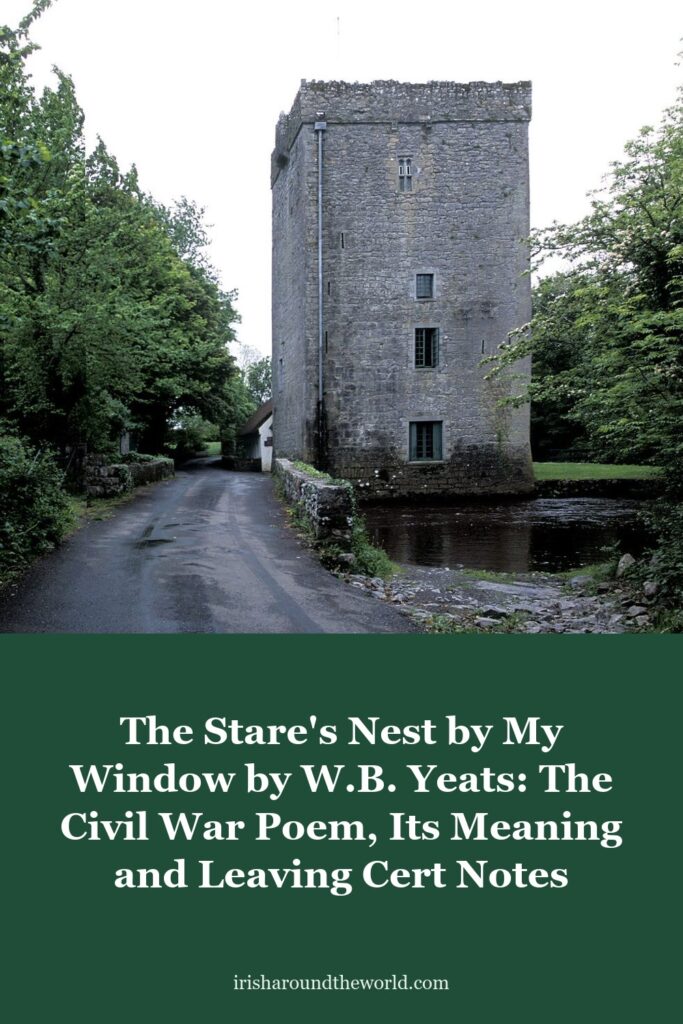
Pin image: Thoor Ballylee, Yeats’s tower house in Co. Galway. Photo: Jerzy Strzelecki, CC BY-SA 3.0, via Wikimedia Commons
A little bit of Ireland in your inbox every Friday ☘️
The free Weekly Dose of Irish: an Irish joke, a Celtic symbol, an Irish fact, a poem and the week’s best articles in one short email. Join 9,600+ readers.
Free. One short email every Friday. Unsubscribe any time.
More Yeats reading
- W.B. Yeats for Leaving Cert English 2027 and 2028: Every Prescribed Poem
- Easter, 1916 by W.B. Yeats: Meaning and Analysis
- The Second Coming by W.B. Yeats: Meaning and Analysis
- The Tower by W.B. Yeats: Poem and Meaning
- Sailing to Byzantium by W.B. Yeats: Meaning and Analysis
- The Wild Swans at Coole by W.B. Yeats: Meaning and Analysis
- A Prayer for My Daughter by W.B. Yeats: Poem and Meaning
- In Memory of Eva Gore-Booth and Con Markiewicz by W.B. Yeats
Featured image: Thoor Ballylee, Yeats’s tower house in Co. Galway. Photo: Jerzy Strzelecki, CC BY-SA 3.0, via Wikimedia Commons.