This weeks top Irish poem is “The Second Coming” it is one of Yeats’s most famous poems. It comes in at number 29 on my list of top 100 Irish poems.
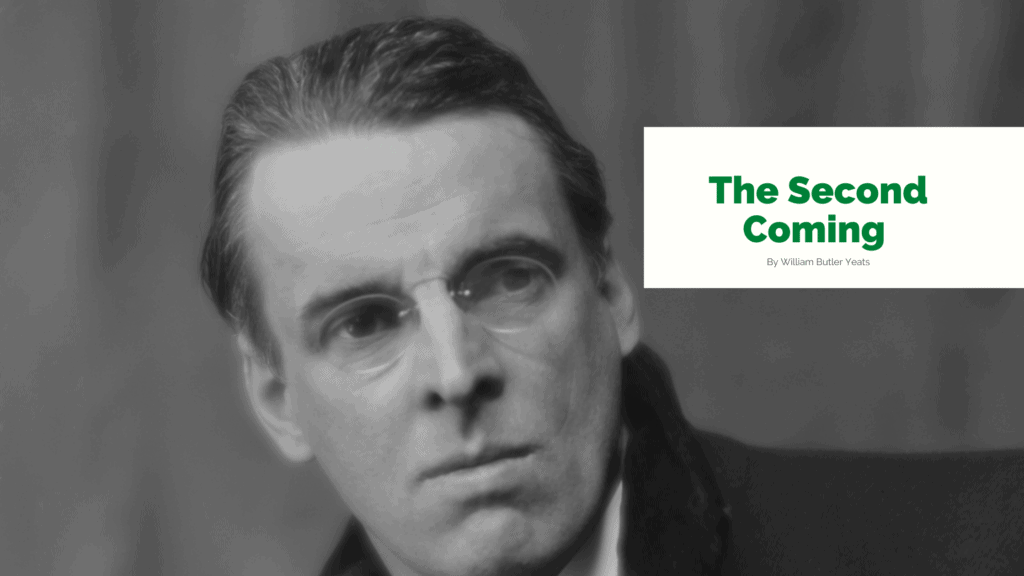
Written by W.B Yeats in 1919 in the aftermath of the first world war. And at first read, you might be saying just what the heck is Yeats trying to say in this poem. I don’t blame you, these older poems really use a lot of words that typically are not used in the present day. That said it does bring uniqueness to this poem.
The poem is connected to the 1918–1919 flu pandemic: In the weeks preceding Yeats’s writing of the poem, his pregnant wife Georgie Hyde-Lees caught the virus and was very close to death. The highest death rates of the pandemic were among pregnant women—in some areas, they had up to a 70 per cent death rate. While his wife was convalescing, he wrote “The Second Coming”
While this poem was written in 1919 it appeared in 1921. Yeats believed that the world was on the threshold of an apocalyptic revelation.
What can we take from this poem a century later? It’s up to us and like many of you I hope the second coming of hope and positivity makes its way in 2021.
If you enjoy this poem get your weekly dose of Irish straight to your inbox every Friday here.
The Second Coming BY William Butler Yeats
Turning and turning in the widening gyre
The falcon cannot hear the falconer;
Things fall apart; the centre cannot hold;
Mere anarchy is loosed upon the world,
The blood-dimmed tide is loosed, and everywhere
The ceremony of innocence is drowned;
The best lack all conviction, while the worst
Are full of passionate intensity.
Surely some revelation is at hand;
Surely the Second Coming is at hand.
The Second Coming! Hardly are those words out
When a vast image out of Spiritus Mundi
Troubles my sight: somewhere in sands of the desert
A shape with lion body and the head of a man,
A gaze blank and pitiless as the sun,
Is moving its slow thighs, while all about it
Reel shadows of the indignant desert birds.
The darkness drops again, but now I know
That twenty centuries of stony sleep
Were vexed to nightmare by a rocking cradle,
And what rough beast, its hour come round at last,
Slouches towards Bethlehem to be born?
Enjoy this Irish poem? Comment below.
The Second Coming: meaning and analysis
Yeats wrote “The Second Coming” in January 1919, just after the First World War and amid the Russian Revolution and rising violence in Ireland. It was published in 1920 and collected in Michael Robartes and the Dancer (1921).
What it means
The first stanza describes a world spinning out of control: a falcon that can no longer hear the falconer, “things fall apart”, anarchy loosed upon the world, and the best lacking all conviction while the worst are full of passionate intensity.
In the second stanza the speaker expects a revelation, a Second Coming, but what he sees is not Christ. It’s a vast image rising from the desert, a creature with a lion’s body and a man’s head, and the poem ends by asking what “rough beast” is slouching towards Bethlehem to be born.
Behind it lies Yeats’s theory of history as turning “gyres”, great cycles of about 2,000 years. The Christian era, he believed, was ending, and something new and terrifying was on its way.
It’s one of the most quoted poems in English. Chinua Achebe took the title of his novel Things Fall Apart from it, and journalists reach for it whenever the world seems to be coming apart.
Form
Two stanzas of loose blank verse, unrhymed lines that loosen and break apart much like the world they describe.
Key themes
- Chaos and the collapse of order
- Cycles of history
- Revelation and fear of the future
More Irish poems
A little bit of Ireland in your inbox every Friday ☘️
The free Weekly Dose of Irish: an Irish joke, a Celtic symbol, an Irish fact, a poem and the week’s best articles in one short email. Join 9,600+ readers.
Free. One short email every Friday. Unsubscribe any time.