
Swift’s Epitaph is W.B. Yeats’s six-line English version of the Latin epitaph Jonathan Swift wrote for his own grave in St Patrick’s Cathedral, Dublin. Yeats keeps the “savage indignation” and the challenge to the passing traveller, drops Swift’s titles and dates, and adds a sea voyage and a “world-besotted” reader. Below are the full poem as printed in 1933, the Latin with a literal translation, a line-by-line comparison and notes for Leaving Cert Higher Level English in 2027 and 2028.
Jonathan Swift wrote his own epitaph. He chose the words, in Latin, before he died, and left directions for them to be cut deep into black marble and gilded. The tablet is still there on a wall of St Patrick’s Cathedral in Dublin, where he was dean for 32 years.
Nearly two centuries later, W.B. Yeats, who liked to wander through the cathedral, turned those Latin lines into a poem of just six lines. It’s a free translation, and what Yeats changed tells you as much as what he kept.
Swift’s Epitaph is one of the 13 Yeats poems on the Leaving Cert Higher Level English course for 2027 and 2028. For the full list, with a page for every poem, see my guide to W.B. Yeats for the Leaving Cert.
Jump to:
- Swift’s Epitaph at a glance
- The poem
- The Latin original and a literal translation
- Line by line: what Yeats kept, cut and added
- Saeva indignatio explained
- Who was Jonathan Swift?
- Why Swift mattered to Yeats
- Themes
- Imagery, tone and structure
- Exam notes: writing about a very short poem
- Seeing the epitaph in St Patrick’s Cathedral
- Swift’s Epitaph FAQ
- More Yeats reading
Swift’s Epitaph at a glance
- Poet: W.B. Yeats (1865 to 1939).
- Collected in: The Winding Stair and Other Poems (Macmillan, London, September 1933), between For Anne Gregory and At Algeciras: a Meditation upon Death.
- Source: the Latin epitaph Jonathan Swift (1667 to 1745) composed for himself, on his memorial in St Patrick’s Cathedral.
- Form: six short lines in two sentences, rhyming ABABCC.
- Exam: Higher Level only, for June 2027 (circular 0021/2025) and June 2028 (circular 0024/2026). It isn’t on the Ordinary Level list.
The poem
Swift’s Epitaph
Swift has sailed into his rest;
Savage indignation there
Cannot lacerate his breast.
Imitate him if you dare,
World-besotted traveller; he
Served human liberty.
This is the text of The Winding Stair and Other Poems (Macmillan, London, 1933), page 36, checked word for word against a scan of the December 1933 reprint on the Internet Archive. I’ve dropped the printer’s small capitals and the space before each semicolon. Yeats’s Collected Poems (Macmillan, 1933, reprinted 1934) agrees word for word.
Yeats also quoted the lines in his introduction to his play The Words upon the Window-pane; in its book version, in Wheels and Butterflies (1934), the first line ends with a colon. Yeats’s commentary on the play first ran in the Dublin Magazine late in 1931, so the six lines may have reached print there before the book, though I haven’t been able to check that issue. If your anthology’s punctuation differs slightly, learn your class’s version.
The Latin original and a literal translation
Here is the inscription line by line as cut on the stone, with its old spellings (Ionathan for Jonathan, æ for ae).
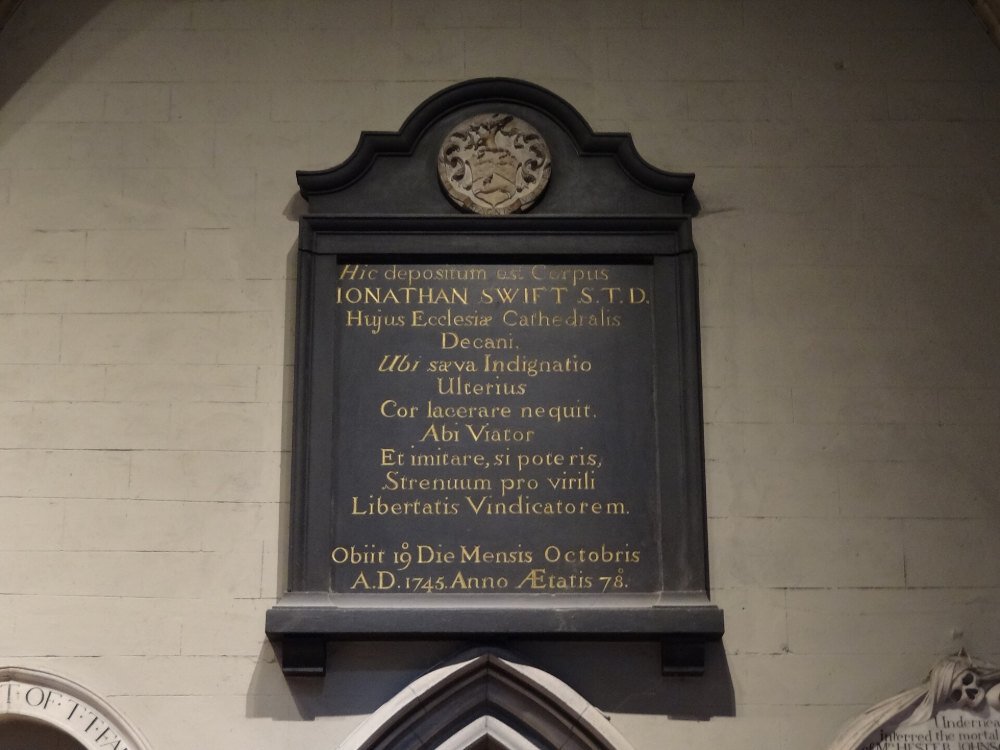
Swift’s epitaph on the wall of St Patrick’s Cathedral, Dublin. Photo: Antoine Rex, CC0, via Wikimedia Commons
Hic depositum est Corpus
IONATHAN SWIFT S.T.D.
Hujus Ecclesiæ Cathedralis
Decani.
Ubi sæva Indignatio
Ulterius
Cor lacerare nequit.
Abi Viator
Et imitare, si poteris,
Strenuum pro virili
Libertatis Vindicatorem.
Obiit 19o Die Mensis Octobris
A.D. 1745. Anno Ætatis 78o.
My literal translation, kept close to the Latin:
Here is laid the body
of Jonathan Swift, S.T.D.,
Dean of this cathedral church,
where fierce indignation
can no longer
tear his heart.
Go your way, traveller,
and imitate, if you are able,
one who strove, as far as one man could,
to champion liberty.
He died on the nineteenth day of the month of October,
AD 1745, in the 78th year of his age.
S.T.D. stands for Sacrae Theologiae Doctor, Doctor of Sacred Theology; the cathedral’s own translation calls it Doctor of Divinity. Pro virili is short for the idiom pro virili parte, roughly “as far as one man can”. And “in the 78th year of his age” means Swift was 77: born on 30 November 1667, he died about six weeks before his 78th birthday.
The Dictionary of National Biography (1898) says the words were engraved, at Swift’s own direction, “in large letters deeply cut and strongly gilded”.
Line by line: what Yeats kept, cut and added
| Latin | Literally | Yeats |
|---|---|---|
| Hic depositum est corpus Ionathan Swift S.T.D., huius ecclesiae cathedralis decani | Here is laid the body of Jonathan Swift, D.D., dean of this cathedral | Swift has sailed into his rest; |
| ubi saeva indignatio ulterius cor lacerare nequit | where fierce indignation can no longer tear his heart | Savage indignation there Cannot lacerate his breast. |
| Abi viator et imitare, si poteris | Go your way, traveller, and imitate, if you are able | Imitate him if you dare, World-besotted traveller; |
| strenuum pro virili libertatis vindicatorem | one who strove, as far as one man could, to champion liberty | he Served human liberty. |
| Obiit 19 die mensis Octobris A.D. 1745, anno aetatis 78 | He died on 19 October 1745, in the 78th year of his age | (left out) |
What he kept
The core survives, in the same order: a dead man, the anger that tormented him, a challenge to the passer-by and a verdict on his life. Four of his key words are English cousins of the Latin ones: indignation, lacerate, imitate and liberty, while “Savage” translates saeva. The English still sounds like the stone.
What he cut
Everything official goes: the body, the doctorate, the deanship, the date and the age. Swift’s Latin is a church monument; Yeats’s poem is about the man, not the office. The command Abi, “go on your way”, disappears too.
What he added or changed
- “Swift has sailed into his rest”. The Latin says the body lies here. Yeats gives Swift a voyage instead, and the word “rest”, which recalls the prayer that the dead may rest in peace. In Sailing to Byzantium (1928), too, the old speaker has “sailed the seas” to reach his holy city.
- “there” for “where”. In the Latin, ubi points to the grave, where anger can’t reach him. Yeats’s “there” points away from the tomb, to wherever the voyage ended. He also drops ulterius, “any longer”: the Latin admits the anger used to tear at Swift, while the English simply says it “Cannot”.
- “breast” for “heart”. Cor means heart. “Breast” rhymes with “rest”, and Yeats linked the word with Swift elsewhere: in Blood and the Moon, from the same 1933 book, he pictures “Swift beating on his breast in sibylline frenzy blind”.
- “if you dare” for “if you can”. Si poteris asks whether you’re able to match Swift. Yeats asks whether you’re brave enough.
- “World-besotted traveller”. The Latin viator is simply a passer-by. Yeats’s traveller is besotted with the world: utterly infatuated, as Merriam-Webster defines it, with a hint of the drunkard (a sot). It’s the poem’s one insult, and it’s aimed at us.
- “he / Served human liberty”. Vindicatorem means a champion or defender; the verb behind it, vindicare, can mean to lay claim to something or to set someone free. Yeats softens it to “served”, a humbler verb, and adds “human”, widening Swift’s liberty from the Irish causes he fought for to people everywhere. The line break after “he” makes you wait for the verdict.
Yeats put the epitaph into English prose too. In The Words upon the Window-pane, the young scholar John Corbet calls it “the greatest epitaph in history” and renders it: “He has gone where fierce indignation can lacerate his heart no more.” Set that beside the poem and you can see what the verse adds: “gone” becomes “sailed”, “heart” becomes “breast”, and a plain sentence becomes rhymed lines.
Saeva indignatio explained
Saeva indignatio is the most famous phrase on the stone. In classical Latin it sounds roughly like SY-wuh in-dig-NAH-tee-oh; in church Latin, SAY-vuh in-dee-NYAH-tsee-oh. Saeva means fierce, savage or cruel, and indignatio is indignation: anger at something unworthy or unjust.
The phrase has become shorthand for the rage that drives satire, an old idea: the Roman satirist Juvenal said that if nature denies a man talent, “facit indignatio versum”, indignation makes the verse (Satires 1.79).
Swift’s anger runs through his best-known work. Gulliver’s Travels (1726) mocks politicians, scientists and human pride. A Modest Proposal (1729) suggests, in a perfectly calm voice, that the children of the Irish poor be used as food: a savage joke about how Ireland’s poor were treated. His letters as “M.B. Drapier” (from 1724) attacked a patent to mint copper halfpence for Ireland, and the patent was given up. The epitaph says that same anger tormented Swift himself, and only death ended it.
Who was Jonathan Swift?
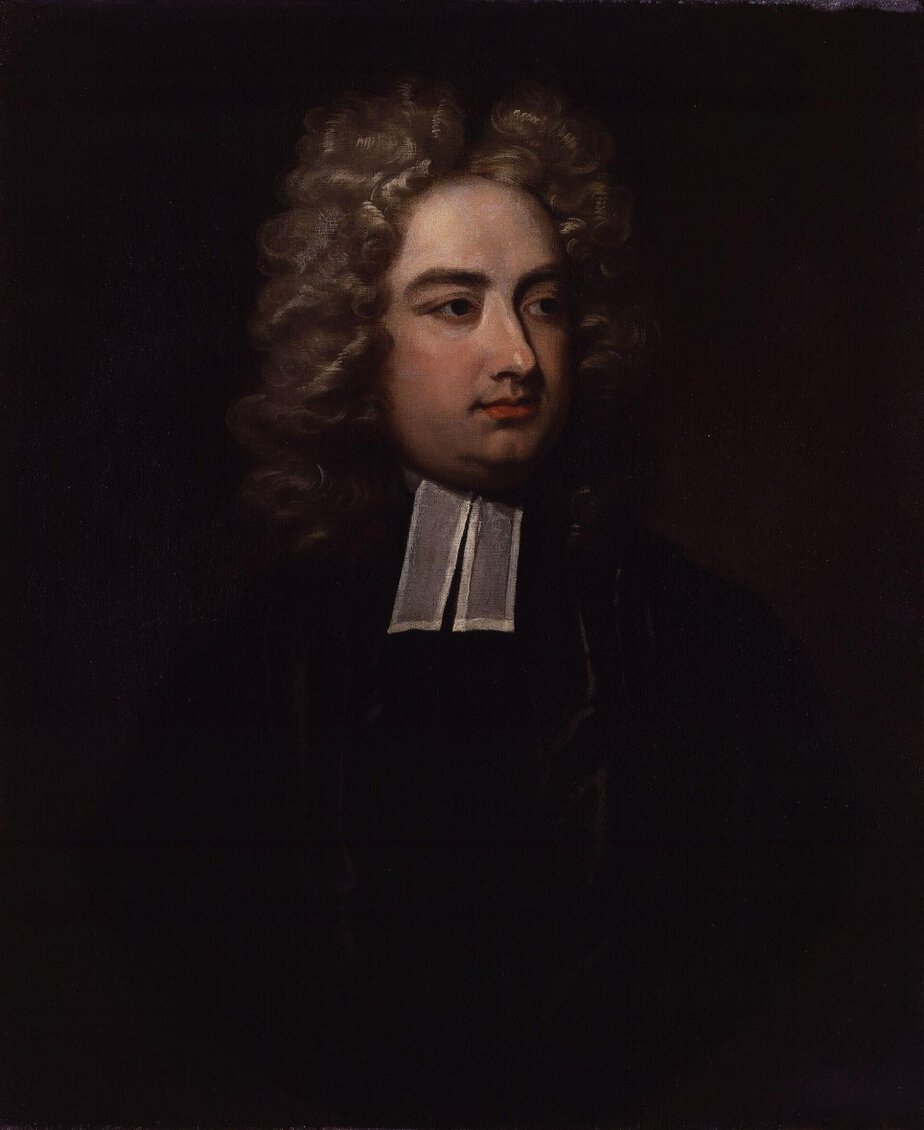
Jonathan Swift by Charles Jervas, about 1710. National Portrait Gallery, London. Public domain, via Wikimedia Commons
Swift was born at Hoey’s Court, Dublin, on 30 November 1667, according to the Dictionary of National Biography. He became a clergyman and was installed as Dean of St Patrick’s on 13 June 1713, though the cathedral notes he would have preferred a post in England.
He’s known now for Gulliver’s Travels, but in his own day he was a Dublin hero. The Drapier letters made him, in the Dictionary of National Biography’s words, “the idol of the people”, and Dublin Corporation gave him the freedom of the city. His will paid for a hospital for people with mental illness, which still exists as St Patrick’s Hospital.
In old age he suffered from dizziness and noises in his ears, and after a stroke in 1742 many people called him mad. He died on 19 October 1745 and was buried in his cathedral beside Esther Johnson, the woman he called Stella.
Why Swift mattered to Yeats
Yeats admitted that, as a romantic, he had once turned away from Swift, valuing no English verse or prose from Swift’s era. By the early 1930s he was reading Swift “for months together”, and he wrote: “Swift haunts me; he is always just round the next corner.” Both lines come from his introduction to The Words upon the Window-pane, where he also says he went to St Patrick’s “to wander and meditate”.
Part of the pull was history and pride. Yeats, a Protestant, sat in the Seanad of the new Irish Free State, and he began to claim the great Anglo-Irish writers of the eighteenth century as his own tradition. In a Seanad debate on divorce on 11 June 1925, speaking as one of the Protestant minority, he said: “We are the people of Burke; we are the people of Grattan; we are the people of Swift”. In The Tower (1928) he wrote of “The people of Burke and of Grattan”.
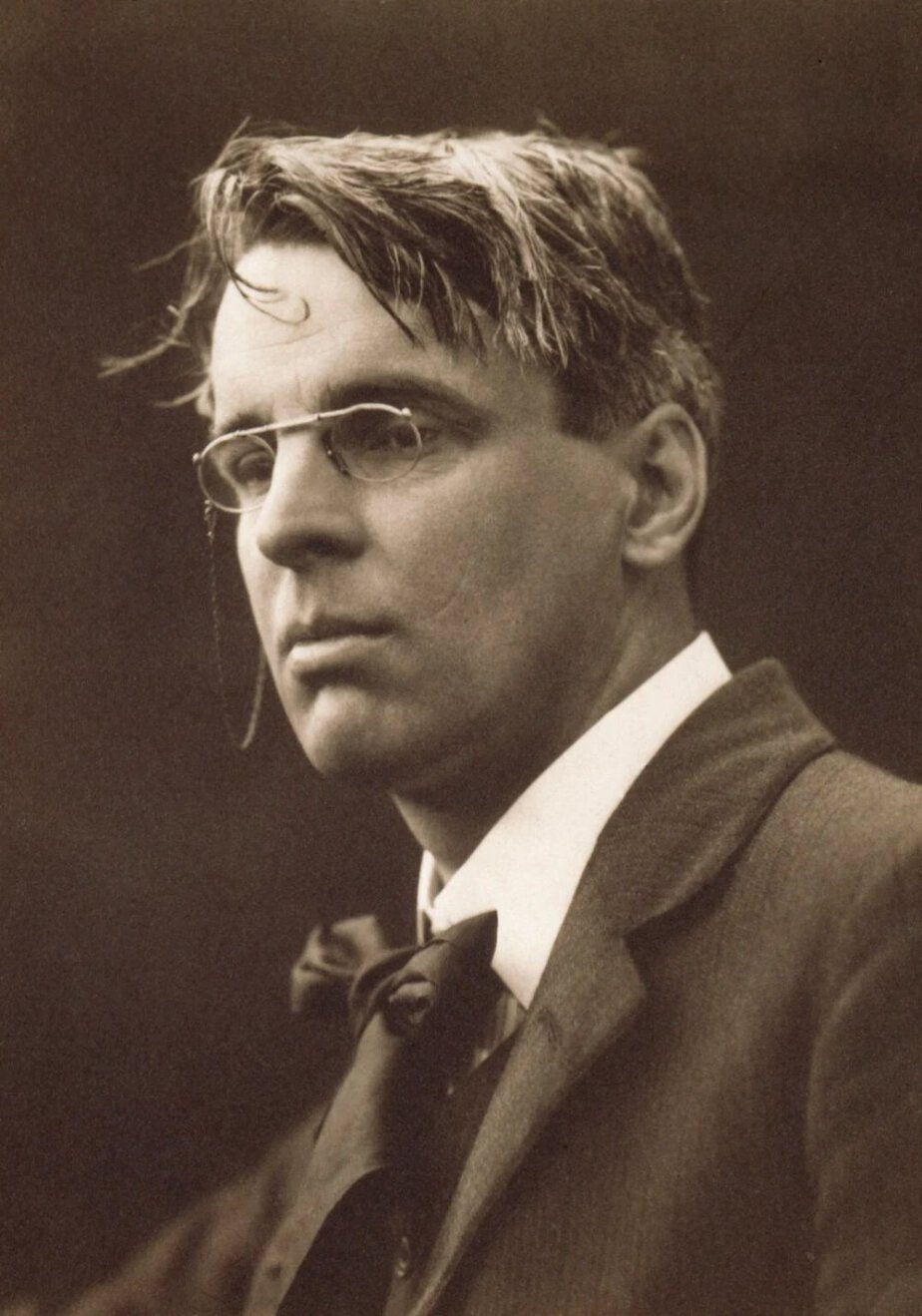
W.B. Yeats in 1911, photographed by George Charles Beresford. National Portrait Gallery, London. Public domain, via Wikimedia Commons
Swift turns up in several poems in The Winding Stair and Other Poems. Blood and the Moon names “Goldsmith and the Dean, Berkeley and Burke”, and in The Seven Sages one of the seven old men says “The tomb of Swift wears it away”. Yeats called the eighteenth century “that one Irish century that escaped from darkness and confusion”, a very personal reading of Irish history.
The Words upon the Window-pane
Yeats’s one-act play was first performed at the Abbey Theatre on 17 November 1930. At a séance in an old Dublin lodging house, where lines from a poem Stella wrote for Swift’s birthday are written on a window-pane, the medium begins to speak in Swift’s voice. Corbet, who is writing an essay on Swift, is among the sitters; it’s he who praises the epitaph.
It’s easy to see why this proud, angry, ageing Swift appealed to an ageing Yeats, who in An Acre of Grass would pray for “an old man’s frenzy”.
Themes
Death as release. The poem opens with Swift at rest. Death isn’t mourned; it ends a torment.
Righteous anger. “Savage indignation” drove Swift’s satire, and it hurt him. Yeats admires the anger and admits its cost in the same breath.
Liberty and public service. The verdict isn’t about Swift’s genius or fame but his service: “he / Served human liberty.”
Courage and the reader. “Imitate him if you dare” turns an epitaph into a dare, and the “World-besotted” reader is found wanting.
Tradition and inheritance. By putting Swift into English verse, Yeats sets himself in a line of Irish writers he admired. Compare September 1913, where an older, braver Ireland is held up against a meaner present.
Imagery, tone and structure
- The voyage: “sailed into his rest” makes death a journey ending in harbour, not a body placed in a vault.
- The wound: “lacerate” means to tear flesh, a violent, physical word for an inner pain, kept from the Latin.
- Sound: hissing s sounds open the poem (Swift, sailed, his rest, Savage), then the hard c and clipped t sounds of “Cannot lacerate” bite.
- Metre: four of the six lines have seven syllables and four beats, starting and ending on a stress: SWIFT has SAILED in-TO his REST. The beat is clipped, more like an inscription than speech.
- Rhyme: ABABCC: rest and breast, there and dare, he and liberty. The last rhyme lands on the light final syllable of “liberty”, a quiet click to close.
- Syntax: two sentences, each split by a semicolon, make three moves: a statement about Swift, an order to the reader, a verdict. The run-on “he / Served” leaves the verdict alone in the shortest line.
- Tone: admiring, terse and defiant, with a flash of scorn for the reader.
Exam notes: writing about a very short poem
A six-line poem can look like a gift or a trap. You can quote nearly all of it, but you can’t pad an answer with summary.
- Treat every word as a choice. “sailed”, “Savage”, “lacerate”, “dare”, “World-besotted” and “Served” each deserve a sentence or two. The Latin helps you show what Yeats chose, but keep the focus on his English.
- Use it as a supporting poem. It’s rarely enough alone, but it fits questions on Yeats’s public voice, Irish history, heroism, death or his strong, plain language.
- Keep context brief. Swift’s dates, the 1933 book, the 1930 play and Yeats’s love of the eighteenth century are worth two or three sentences, no more.
- Make connections. Under Ben Bulben (V and VI are on your course) ends with Yeats’s own epitaph speaking to a passer-by, “Horseman, pass by!”, just as Swift’s Latin speaks to the viator. Easter, 1916 also weighs passion against the heart: “Too long a sacrifice / Can make a stone of the heart.” And In Memory of Eva Gore-Booth and Con Markiewicz opens the same 1933 book.
A sample opening point: “In six lines Yeats turns a church memorial into a challenge. Swift’s Latin tells the passer-by to imitate him if he can; Yeats’s ‘if you dare’ makes Swift’s life a test of courage, and ‘World-besotted traveller’ puts the reader on trial.”
This is an unofficial study guide, so check details with your teacher.
Seeing the epitaph in St Patrick’s Cathedral
You can still read Swift’s Latin where he meant it to be read. His grave is a plain brass plate set into the floor near the cathedral’s west end, with Stella’s beside it. The black marble tablet faces the grave from the nearby wall, its gold letters still crisp, and Stella’s own memorial hangs close by.
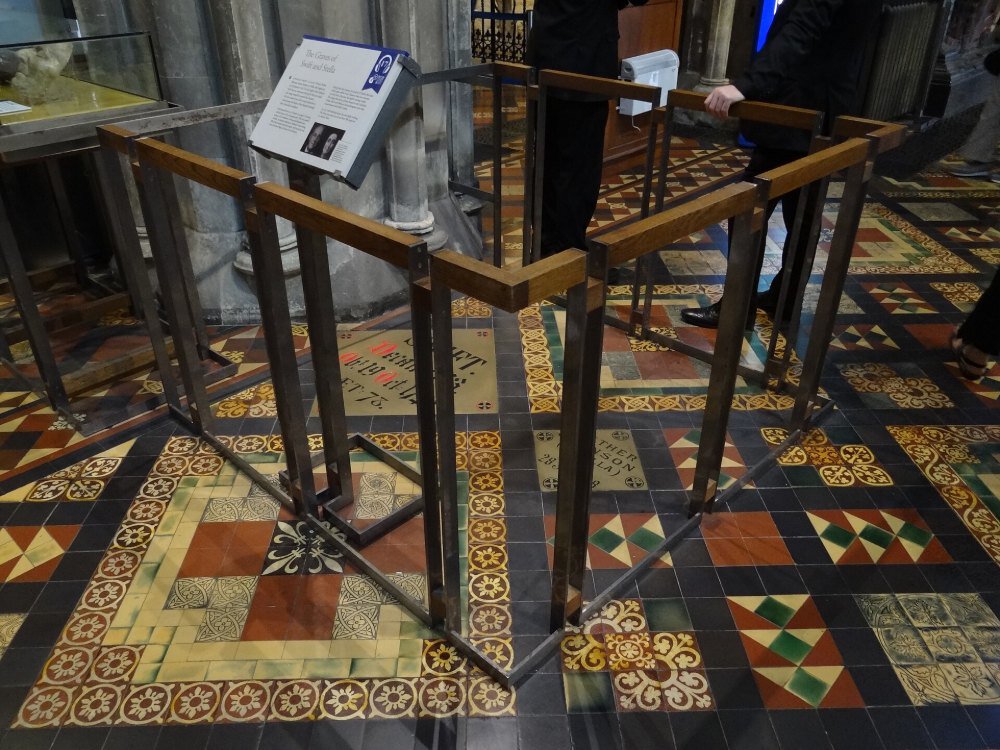
The graves of Swift and Stella in the floor of St Patrick’s Cathedral, Dublin. Photo: Antoine Rex, CC0, via Wikimedia Commons
The cathedral keeps other traces of its most famous dean: the pulpit he preached from, two of his death masks, a cast of his skull, early editions of his writings and the communion table from his country church at Laracor, near Trim, Co. Meath.
When I checked the cathedral’s visit page in November 2026, an adult ticket was €11.50, and a joint ticket with Marsh’s Library next door was €17. Opening times change around services, so check before you go. For more ideas, see my guide to things to do in Dublin.
Swift’s Epitaph FAQ
What is Swift’s Epitaph by Yeats about?
It’s a six-line tribute to Jonathan Swift, adapted from the Latin epitaph Swift wrote for his grave. Swift’s savage anger can no longer hurt him, the reader is dared to live as boldly, and his life is summed up in one line: he served human liberty.
Did Yeats write Swift’s epitaph?
No. Swift composed the Latin, carved on his memorial in St Patrick’s Cathedral after his death in 1745. Yeats made the English verse version, collected in The Winding Stair and Other Poems (1933).
What does saeva indignatio mean?
Fierce or savage indignation: furious anger at injustice. Yeats renders it “Savage indignation”.
What does “world-besotted traveller” mean?
It’s the reader, pictured as a passer-by infatuated with the world and its rewards. Yeats added “world-besotted”; the Latin simply says “traveller”.
Where is Jonathan Swift buried?
In St Patrick’s Cathedral, Dublin, near the west end, beside Esther Johnson (Stella), with his epitaph on the wall facing the grave.
Is Swift’s Epitaph on the Leaving Cert in 2027 and 2028?
Yes, for Higher Level English in both years, as one of 13 prescribed Yeats poems. It isn’t on the Ordinary Level list.
Love this? Save it to your Pinterest board for later.
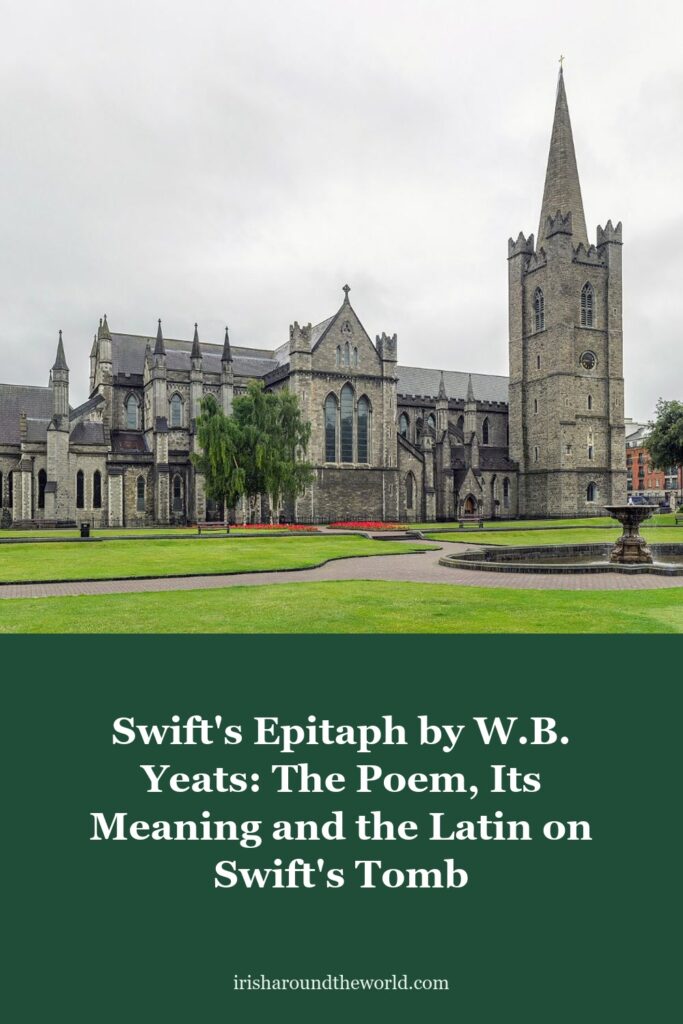
Pin image: St Patrick’s Cathedral, Dublin, seen across St Patrick’s Park. Photo: Diliff, CC BY-SA 3.0, via Wikimedia Commons
A little bit of Ireland in your inbox every Friday ☘️
The free Weekly Dose of Irish: an Irish joke, a Celtic symbol, an Irish fact, a poem and the week’s best articles in one short email. Join 9,600+ readers.
Free. One short email every Friday. Unsubscribe any time.
More Yeats reading
- Yeats Leaving Cert Poems 2027 and 2028: All 13 Poems, With Notes
- Under Ben Bulben by W.B. Yeats: The Poem That Wrote His Own Epitaph
- September 1913 by W.B. Yeats: Meaning and Analysis
- Easter, 1916 by W.B. Yeats: Meaning and Analysis
- Sailing to Byzantium by W.B. Yeats: Meaning and Analysis
- The Tower by W.B. Yeats: Poem and Meaning
- In Memory of Eva Gore-Booth and Con Markiewicz by W.B. Yeats
- An Acre of Grass by W.B. Yeats
- Famous Irish Poets: The Greatest of All Time, in Order
Featured image: St Patrick’s Cathedral, Dublin, seen across St Patrick’s Park. Photo: Diliff, CC BY-SA 3.0, via Wikimedia Commons.