
Irish stew is lamb or mutton, potatoes and onions, layered in a pot with water and simmered slowly until the meat falls off the bone and the potatoes thicken the broth. The traditional version has no stout and no flour, and carrots are optional (and fiercely argued over). This Irish stew recipe serves 6 and takes about 2 hours 40 minutes, with oven, slow cooker and Instant Pot timings too.
Irish stew is made from almost nothing: cheap neck chops, a heap of potatoes, a few onions and a kettle of water. Give it two quiet hours, though, and the bottom layer of potatoes melts into a thick, peppery broth that tastes far richer than it has any right to.
The recipe comes first, in metric and US measures. Then the great carrot argument and the history, from a countess’s handwritten recipe book to a dead water-rat in Three Men in a Boat. If you came for beef and stout, that’s a different dish: see the beef and Guinness stew.
Jump to:
- Irish stew recipe
- Oven, slow cooker and Instant Pot Irish stew
- Lamb, hogget or mutton?
- The great carrot argument
- Is there Guinness in Irish stew?
- A short history of Irish stew
- Irish stew in Irish
- Storing, freezing and reheating
- Irish stew FAQ
- More Irish recipes
Irish stew recipe
This is a “white” stew: nothing gets browned, and the potatoes do all the thickening. It follows the layered, lid-on method of the old Victorian cookbooks, sized for a modern pot.
Prep: 25 minutes | Cook: 2 hours 15 minutes | Serves: 6
Ingredients
- 1.2kg (2⅔ lb) lamb neck chops, or lamb shoulder chops (gigot chops in Ireland), on the bone
- 1.5kg (3¼ lb) floury potatoes, such as Rooster or Kerr’s Pink in Ireland, or russets in the US
- 3 large onions (about 600g, 1⅓ lb), thickly sliced
- 600ml (2½ US cups) water, or light lamb or chicken stock
- A few sprigs of thyme and 1 bay leaf
- 1½ teaspoons salt, plus more to taste (use less if your stock is salty)
- Plenty of freshly ground black or white pepper
- A handful of chopped parsley, and a few chives if you have them, to finish
- Optional, for the carrot camp: 3 or 4 medium carrots (about 300g, 10 oz), cut into thick chunks
Method
- Trim any thick pads of fat from the chops, but leave some on, as it flavours the broth. Season the meat well with salt and pepper.
- Peel the potatoes. Slice about a third of them thinly, about 5mm (¼ inch) thick. Cut the rest into big chunks, roughly the size of an egg.
- Lay the thin potato slices over the bottom of a heavy casserole or Dutch oven with a tight-fitting lid. Add a layer of onion, then half the lamb, then the herbs (and half the carrots, if using). Repeat with the rest of the onions, lamb and carrots.
- Pile the potato chunks on top and season them with a little more salt and pepper.
- Pour in the water or stock. It won’t cover everything, and it shouldn’t: the top potatoes cook in the steam under the lid.
- Bring slowly to the boil and skim off any grey foam. Cover tightly, turn the heat right down and simmer very gently for 2 hours (2½ to 3 hours for mutton). Don’t stir: give the pot a shake now and then so nothing catches, and add a splash of boiling water if it ever looks dry.
- It’s ready when the meat slides off the bone and the bottom potatoes have melted into the broth. Spoon off some of the fat if you like, check the seasoning, scatter over the parsley and serve in warm bowls.
Tips
Two jobs for the potatoes. The thin slices dissolve and thicken the broth, while the big chunks keep their shape. Eliza Acton went further in 1845: “For a real Irish stew the potatoes should be boiled to a mash.”
Keep the bones. Neck chops give the broth body. Boneless shoulder, about 1kg (2¼ lb) in large chunks, works too, but the broth will be thinner.
To brown or not? The old recipes never brown the meat. Darina Allen of Ballymaloe Cookery School browns her chops lightly in rendered lamb fat and may finish the broth with a little roux. Both make a good stew.
Make it a day ahead. It tastes even better reheated. Serve it with soda bread to mop up the broth.
Oven, slow cooker and Instant Pot Irish stew
Layer everything exactly as above, then pick your method.
- Hob (stovetop): as in the recipe, 2 hours at the gentlest simmer, or 2½ to 3 hours for mutton.
- Oven: bring the casserole to a simmer on the hob, cover and bake at 160°C (140°C fan, 325°F, gas 3) for 2 to 2½ hours. Mrs Beeton noted in 1861 that Irish stew could also be baked in a jar in a moderate oven in about 2 hours.
- Slow cooker (crock pot): cut the liquid to 400ml (1¾ US cups), because almost nothing evaporates. Keep the potato slices at the bottom, pour in boiling liquid and cook on low for 8 hours or on high for 4 to 5 hours.
- Instant Pot or other electric pressure cooker: layer the stew in the inner pot with 500ml (2 US cups) of liquid, staying within your manual’s minimum liquid and maximum fill lines. Cook at high pressure for 25 minutes for lamb (35 for mutton), then let the pressure release naturally for 15 minutes. The top potatoes will be softer than on the hob.
Two slow cooker rules from safefood, the all-island food safety body: thaw frozen meat fully in the fridge first, and don’t keep lifting the lid, because every peek lets heat escape and lengthens the cooking time.
Lamb, hogget or mutton?
The Irish Farmers Journal sorts sheepmeat by age: lamb is under one year, hogget up to two, and mutton anything older. The older the animal, the deeper the flavour and the longer the cooking.
The early cookbook recipes further down all use mutton. Alan Davidson’s Oxford Companion to Food explains why: sheep were kept for their wool and milk, so only old or unproductive animals went into the pot, and they needed hours of slow cooking.
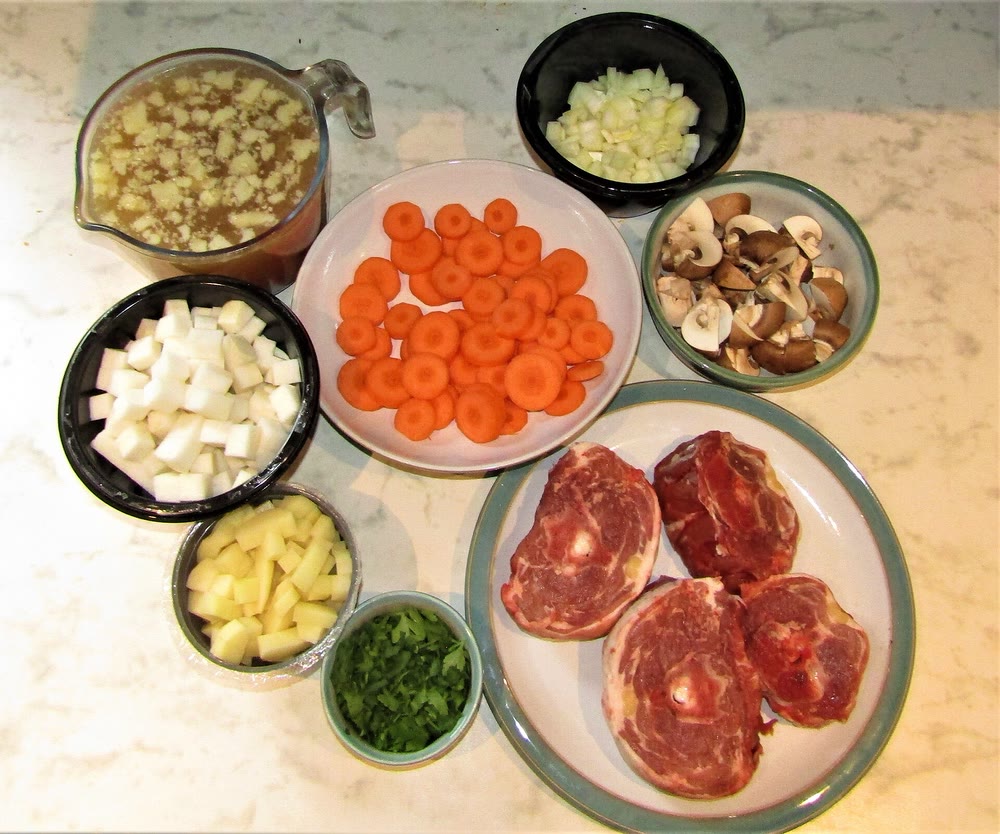
Ingredients for an Irish stew with neck of lamb, plus the cook’s own extras. Photo: Kolforn (Wikimedia), CC BY-SA 4.0, via Wikimedia Commons
Most modern Irish recipes use lamb, and Darina Allen uses neck chops, gigot (shoulder) chops or a mix. Chef Paul Flynn told the Farmers Journal in 2024 that Irish lamb reaches its full flavour in late summer.
In the US, ask for lamb neck slices, or blade or arm shoulder chops. Mutton is hard to find in supermarkets, so try a halal butcher or a sheep farmer at your local market.
The great carrot argument
Ask a room full of Irish people whether carrots belong in Irish stew, then stand well back.
The purists say no. Davidson’s Oxford Companion describes purists who accept only neck of mutton (or kid, meaning young goat), potatoes, onions and water, and who say carrots, turnips or pearl barley “spoil the true flavour of the dish”. Food writer Theodora FitzGibbon agreed in her 1968 book A Taste of Ireland, as chef JP McMahon has quoted her.
The best-known old cookbooks back them up: Melroe, Acton and Beeton use no carrots, and Acton even made the onions optional. Yet the row is old. Food historians Dorothy Cashman and John Farrelly found carrots as a main ingredient in a recipe printed in 1800 by Duncan MacDonald, a London tavern cook, and note that they have been controversial ever since.
The carrot camp says yes. In The Ballymaloe Cookbook, Myrtle Allen recalled asking everyone she met whether they put carrots in their Irish stew, and the answer was always yes. The classic version has none, she admitted, but carrots were common in the south. Her daughter-in-law Darina Allen uses eight. Writing in the Irish Examiner in 2023, Darina said carrots are a must in Cork, but parts of Ulster leave them out.
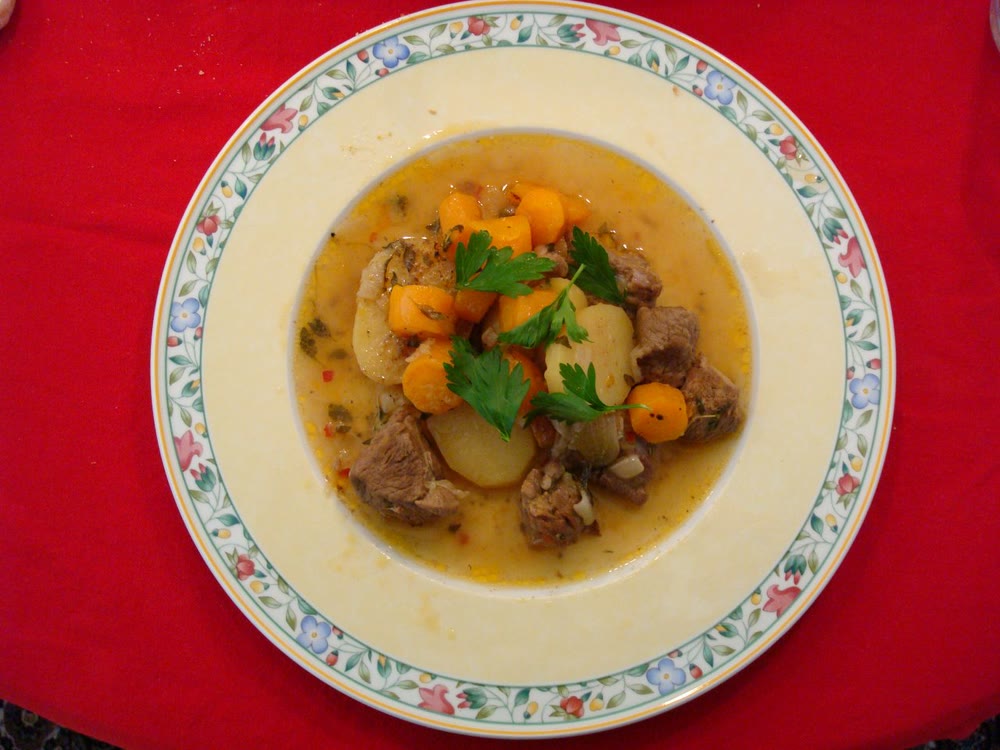
Irish stew with carrots, the way many families make it. Photo: Asmoo, public domain, via Wikimedia Commons
Dublin against the country? No reliable source backs that one up: the documented split runs south to north. Dublin’s own one-pot dinner is coddle, which Máirtín Mac Con Iomaire, then a lecturer at the Dublin Institute of Technology, called “a city man’s Irish stew” (Dublin Inquirer, 2017), made with rashers and sausages in place of mutton.
Some kitchens followed no rule at all. An account from Drumgownagh school, Co. Leitrim, in the 1930s Schools’ Collection recalls a feast-day Irish stew of potatoes and cabbage boiled with meat, usually veal in those days, because calves went for a song.
Irish stew was always made from whatever was in the house. Leave the carrots out for the clean, classic taste of lamb, onion and potato. Put them in if your family always did. Nobody’s calling the guards.
Is there Guinness in Irish stew?
Not in the traditional one. None of the old recipes in this article uses stout, wine or any other alcohol, so classic Irish stew is naturally alcohol-free: an easy dinner for children, or anyone who doesn’t drink.
Beef browned in flour and braised in stout is a different, darker dish, and a very good one. For that, see our beef and Guinness stew.
A short history of Irish stew
Davidson ties Irish stew to a way of cooking that relied almost wholly on the open fire: one pot over the hearth, simmering for hours.
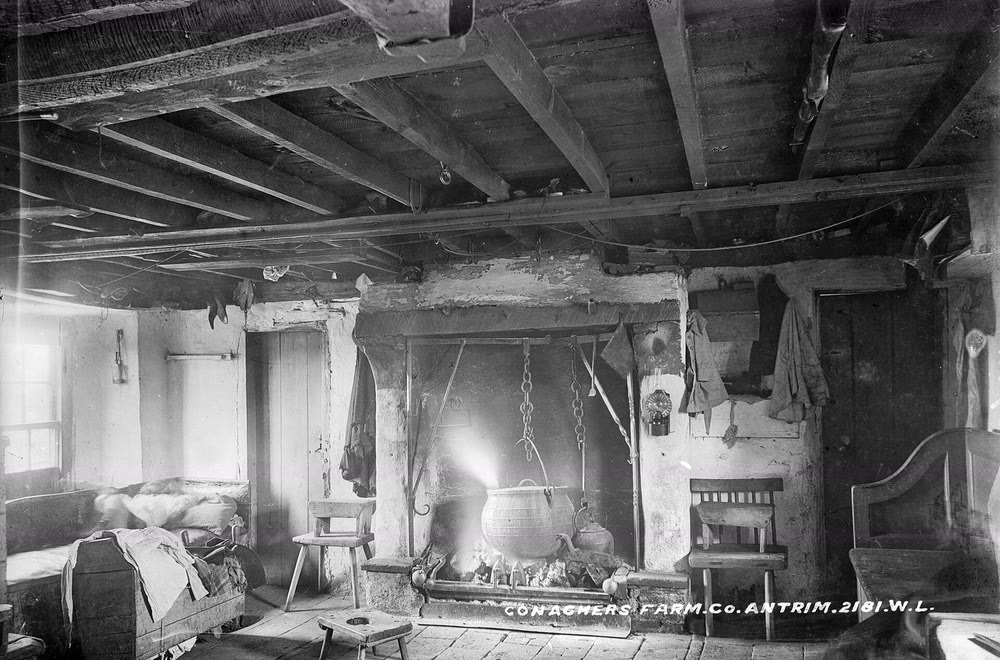
A pot over the open fire at Conagher’s Farm, Co. Antrim, photographed around the 1890s. Photo: Robert French, Lawrence Collection, National Library of Ireland, no known copyright restrictions, via Wikimedia Commons
The first recipes
You’ll often read that the first Irish stew recipe dates from the 1600s and the O’Brien family. The real source is later: a handwritten recipe book among the Inchiquin papers in the National Library of Ireland, put together by Elizabeth, Countess of Thomond (who married into the O’Brien family and died in 1734) and those who came after her. It includes a recipe “to make an Irish stew of mutton”.
Cashman and Farrelly’s 2021 history of the recipe notes that the book is dated 1753 and was added to over many years, so the recipe can’t be dated exactly. It points to the 1700s, not the 1600s.
The first printed recipe they found is in Eliza Melroe’s An Economical and New Method of Cookery (London, 1798): fat mutton chops and potatoes, with onions or leeks, stewed in a little water for an hour and a half in a covered pot. The note with it calls it “a very cheap, wholesome, nourishing dish”.
Eliza Acton, 1845
Eliza Acton’s Modern Cookery gave Irish stew its own recipe: 2 lb of small, thick mutton cutlets, 4 lb of sliced potatoes, three-quarters of a pint of cold water and two hours of gentle simmering. Onion went in only “when the addition of onion is liked”.
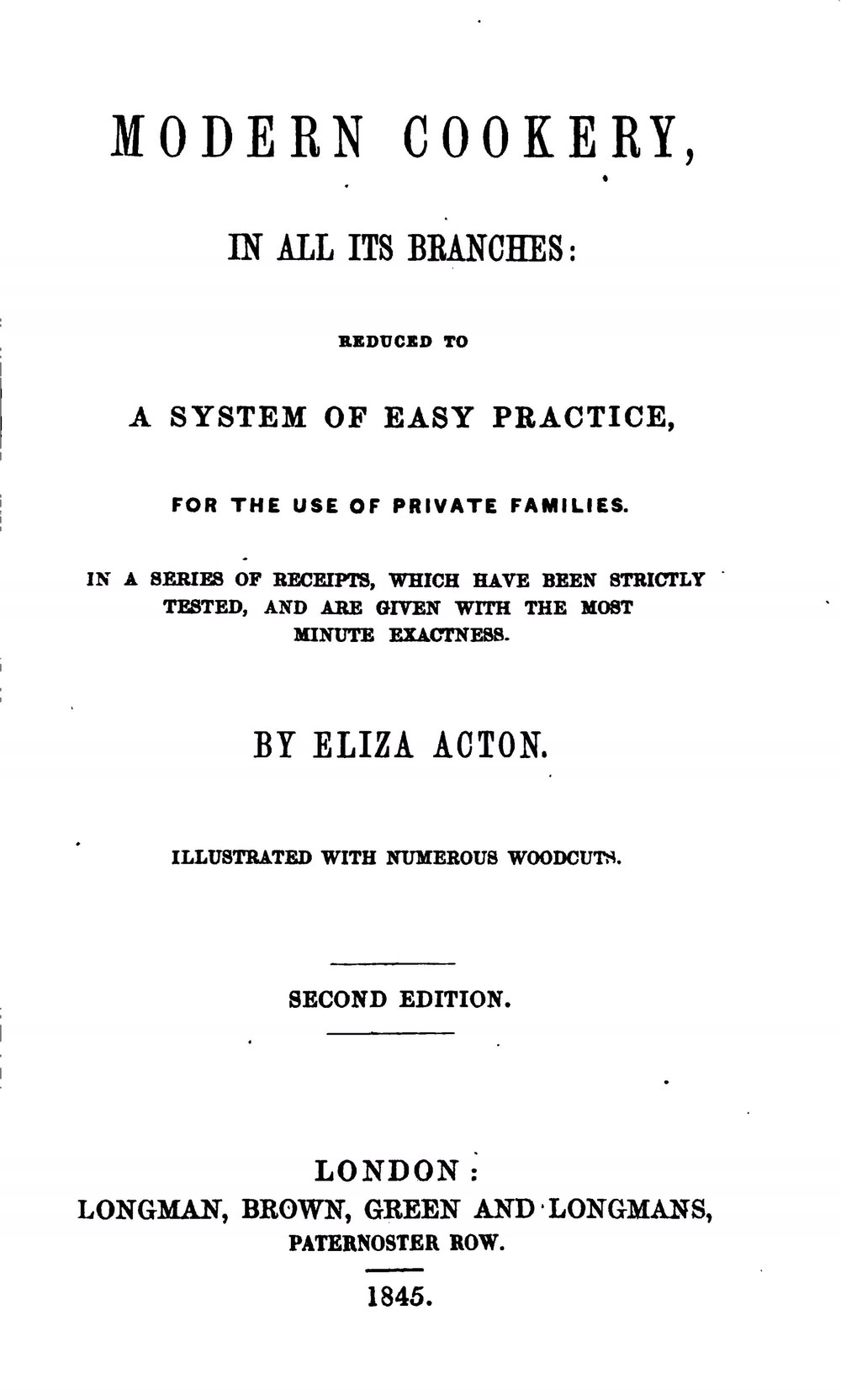
Title page of the second edition of Eliza Acton’s Modern Cookery, in All Its Branches (London, 1845). Public domain, via Wikimedia Commons
The book came out in 1845, the year potato blight reached Ireland. That autumn, the potato at the heart of this cheap, filling dish began rotting in the fields: the start of the Great Famine.
Mrs Beeton, 1861
Isabella Beeton’s Book of Household Management (1861) layers 3 lb of loin or neck of mutton with 5 lb of potatoes and 5 large onions in a little over a pint of water, stewed for 2½ hours with the lid shut tight. It cost 2 shillings and 8 pence, fed 5 or 6, and was “more suitable for a winter dish”.
Three Men in a Boat, 1889
The most famous Irish stew in English fiction is a glorious shambles. In Jerome K. Jerome’s comic novel, the three friends camp on a Thames island near Shiplake and turn their leftover cold beef and vegetables into an Irish stew.
After scraping four potatoes in 25 minutes, they add more unpeeled, then a cabbage, peas, half a pork pie, cold bacon, potted salmon and two cracked eggs. As George explains, that was “the advantage of Irish stew: you got rid of such a lot of things.”
Then Montmorency the fox terrier brings a dead water-rat as his contribution. Harris would add it, but George, standing up for precedent, has never heard of water-rats in Irish stew. Jerome never says who won, only that the stew was a great success.
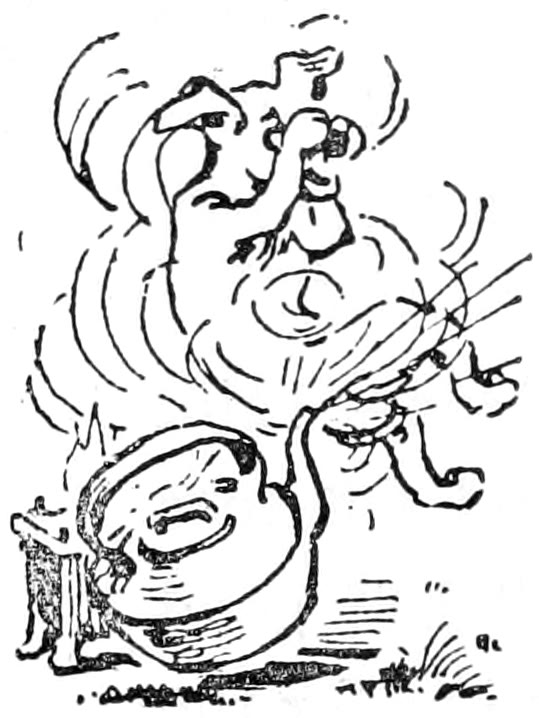
Right after the stew supper, Montmorency picks a fight with the kettle and loses. Illustration by A. Frederics for the first edition of Three Men in a Boat (1889). Public domain, via Wikimedia Commons
In Irish homes
An account from Carrickatee, Co. Monaghan, in the Schools’ Collection remembers boxty bread in every house, and Irish stew as a favourite everybody loved. For more from that kitchen, try my boxty recipe and colcannon recipe.
Irish stew in Irish
The Foras na Gaeilge dictionary at focloir.ie gives Irish stew as stobhach Gaelach, roughly STOW-ukh GAY-lukh (STOW rhymes with “cow”): stobhach means stew, and Gaelach means Irish. Sounds vary by dialect: teanglann.ie has recordings in Ulster, Connacht and Munster Irish. Lamb stew is stobhach uaineola. More words for the pot:
- caoireoil (KEE-rohl, or kee-ROHL in Munster): mutton
- uaineoil (roughly OO-un-yohl): lamb, as meat. A live lamb is an uan (OO-un).
- práta (PRAW-tuh): potato. Ulster speakers often say préata (PRAY-tuh).
- oinniún (IN-yoon, or in-YOON in Munster): onion
- meacan dearg (MYAK-un JAR-ug): carrot, literally “red root”. You’ll also hear cairéad (KAR-ayd, or ka-REE-ud in Munster).
Storing, freezing and reheating Irish stew
Refrigerate or freeze leftovers no later than two hours after cooking, safefood advises. The Food Safety Authority of Ireland says to eat them within 2 to 3 days and reheat them only once, to 70°C (158°F) or higher.
Irish stew freezes, though the potatoes turn a little watery, so eat it within a few weeks. Freeze it in small containers so it cools fast, and thaw it in the fridge overnight.
Irish stew FAQ
What is traditional Irish stew made of?
Lamb or mutton (traditionally neck chops), potatoes, onions, water, salt and pepper, often with thyme and parsley. Carrots are a popular but disputed extra.
What’s the difference between Irish stew and beef stew?
Irish stew is lamb or mutton simmered in water with potatoes and onions, so it’s pale and brothy. Beef stew is usually browned, thickened and often braised in stout, like our beef and Guinness stew.
What do you serve with Irish stew?
Nothing else is needed, since the potatoes are already in the pot, but bread and butter or soda bread is lovely for mopping up the broth.
Love this? Save it to your Pinterest board for later.
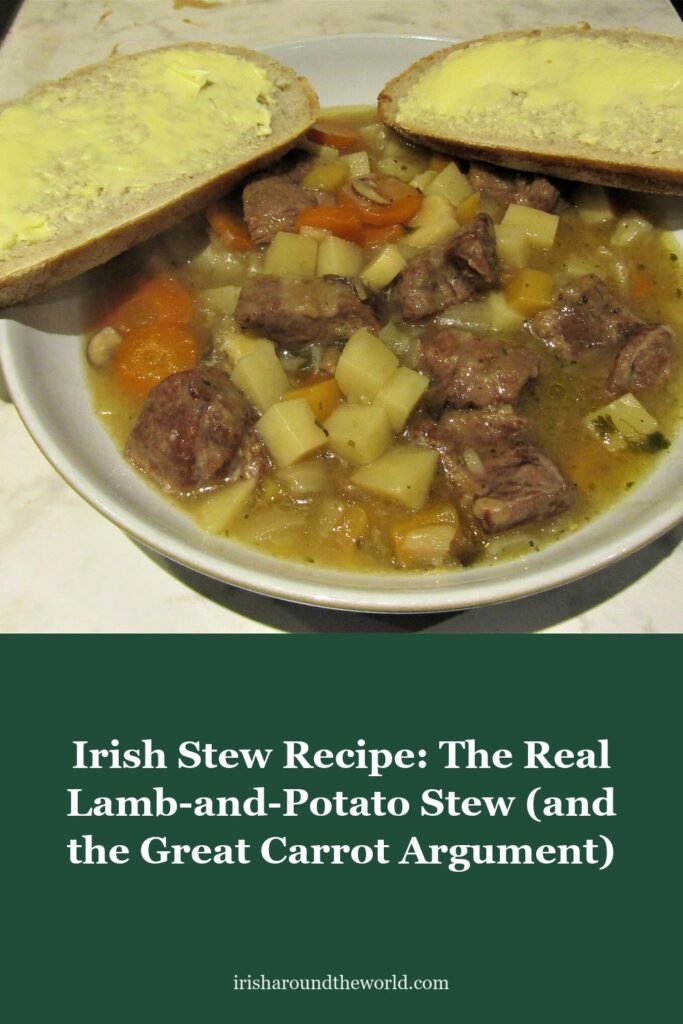
Pin image: A bowl of Irish stew with buttered bread. Photo: Kolforn (Wikimedia), CC BY-SA 4.0, via Wikimedia Commons
A little bit of Ireland in your inbox every Friday ☘️
The free Weekly Dose of Irish: an Irish joke, a Celtic symbol, an Irish fact, a poem and the week’s best articles in one short email. Join 9,600+ readers.
Free. One short email every Friday. Unsubscribe any time.
More Irish recipes
- Beef and Guinness Stew by The Wonky Spatula
- Colcannon Recipe: The Irish Halloween Mash That Hides Your Fortune
- Irish Soda Bread Recipe: The 4-Ingredient Loaf With a Cross to Keep the Fairies Away
- Boxty Recipe: The Irish Potato Pancake That Came With a Marriage Warning
- Traditional Irish Bacon and Cabbage (With a Wonky Twist)
- Full Irish Breakfast: What Goes on the Plate and How to Get It All Hot at Once
- Irish Apple Cake Recipe: The Warm Bramley Bake You Drown in Custard
- Irish Grace Before Meals: Table Blessings in Irish and English, and Where They Really Come From
An earlier version of this page was a guest recipe by The Wonky Spatula. Nicola’s beef and Guinness stew is still on the site.
Featured image: A bowl of Irish stew with buttered bread. Photo: Kolforn (Wikimedia), CC BY-SA 4.0, via Wikimedia Commons.
dolphingb4
Sunday 1st of October 2017
No Irish stew is ever mad using sweet potato.Ever.weres he oxo.