
Padraig Ó Conaire, Gaelic Storyteller – Irish Poem
They’ve paid the last respects in sad tobacco
And silent is this wakehouse in its haze;
They’ve paid the last respects; and now their whiskey
Flings laughing words on mouths of prayer and praise;
And so young couples huddle by the gables.
O let them grope home through the hedgy night –
Alone I’ll mourn my old friend, while the cold dawn
Thins out the holy candlelight.Respects are paid to one loved by the people;
Ah, was he not – among our mighty poor –
The sudden wealth cast on those pools of darkness,
Those bearing, just, a star’s faint signature;
And so he was to me, close friend, near brother,
Dear Padraic of the wide and sea-cold eyes –
So, lovable, so courteous and noble,
The very west was in his soft replies.They’ll miss his heavy stick and stride in Wicklow –
His story-talking down Winetavern Street,
Where old men sitting inthe wizen daylight
Have kept an edge upon his gentle wit;
While women on the grassy streets of Galway,
Who hearken for his passing – but in vain,
Shall hardly tell his step as shadows vanish
Through archways of forgotten Spain.Ah, they’ll say, Padraic’s gone again exploring;
But now down glens of brightness, O he’ll find
An alehouse overflowing with wise Gaelic
That’s braced in vigour by the bardic mind,
And there his thoughts shall find their own forefathers –
In minds to whom our heights of race belong,
in crafty men, who ribberd a ship or turned
The secret joinery of song.Alas, death mars the parchment of his forehead;
And yet for him, I know, the earth is mild –
The windy fidgets of September grasses
Can never tease a mind that loved the wild;
So drink his peace – this grey juice of the barley
Runs with a light that ever pleased his eye –
While old flames nod and gossip on the hearthstone
And only the young winds cry.


About Pádraic Ó Conaire


© Photo: Pádraic Ó Conaire statue, Eyre Square (1974) Copyright and with thanks to RTE Archives.
Sources: RTE Archives and Wikipedia
I will be featuring a poem every week from my list of top 100 Irish poems. You can get it straight to your inbox by joining my newsletter here.
Pádraic Ó Conaire, Gaelic Storyteller: meaning and analysis
What it means
This is an elegy, written by Higgins for a friend. It opens at the wake: the “sad tobacco” smoke, the whiskey bringing laughter into the prayers, young couples huddling by the gables. Higgins lets them all go home, because he wants to mourn his friend alone as the dawn thins out the candlelight.
He praises Ó Conaire as “sudden wealth” to the poor, a “close friend, near brother” with “sea-cold eyes”, and the very west of Ireland in his voice. Then he pictures the places that will miss him: Wicklow, Winetavern Street in Dublin, the streets of Galway and even Spain, because Ó Conaire travelled widely. Higgins imagines him in the afterlife, finding an alehouse full of wise Gaelic talk among the old bards and craftsmen. The poem ends with a toast: drink his peace with “this grey juice of the barley”.
Form
Eight-line stanzas with rhymes on alternate lines and long, musical lines that suit a lament spoken over a glass.
Key themes
- Friendship and grief: personal, not formal.
- The Irish wake: sorrow and laughter side by side.
- The Gaelic revival: Ó Conaire, author of M’Asal Beag Dubh, was one of the first great modern writers in Irish.
More Irish poems
- Father and Son by F.R. Higgins
- The Wayfarer by Pádraig Pearse
- The best Irish poets
- Ireland’s top 100 Irish poems
Love this? Save it to your Pinterest board for later.
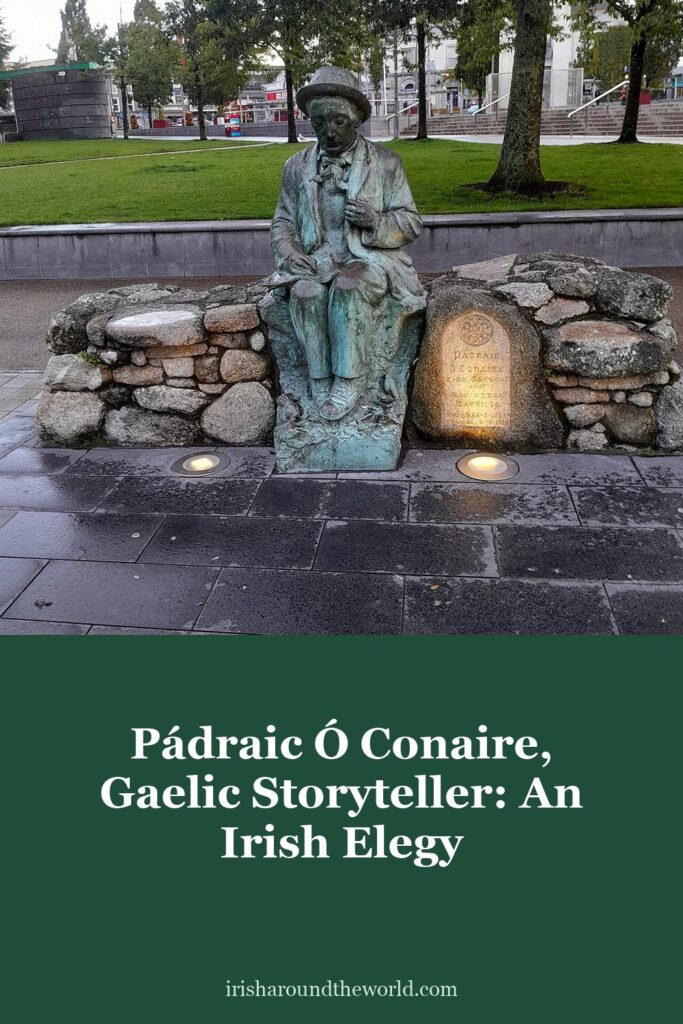
Pin photo: the Pádraic Ó Conaire statue in Eyre Square, Galway, by August Dominus (CC0), via Wikimedia Commons.
A little bit of Ireland in your inbox every Friday ☘️
The free Weekly Dose of Irish: an Irish joke, a Celtic symbol, an Irish fact, a poem and the week’s best articles in one short email. Join 9,600+ readers.
Free. One short email every Friday. Unsubscribe any time.