The history of St Patrick’s Day starts with Patrick, a Roman Briton kidnapped to Ireland at 16, who came back as a bishop in the 5th century. 17 March, his traditional death day, was his feast by the 7th century. The first known procession was in Spanish Florida in 1601. Irish emigrants made New York’s parade in 1762, and Ireland made it a holiday in 1903.
Every 17 March, half the world goes green for a man most people know almost nothing about. Ask around a pub and you’ll hear he was Irish, he banished the snakes and he explained God with a shamrock. None of that is quite right.
Patrick wasn’t Irish. Ireland had no snakes to banish. And the shamrock story first turns up in writing about 1,200 years after he died.
So here’s the real history of St Patrick’s Day, from a kidnapped teenager to the biggest party on the calendar. I’ve stuck to what the sources say and marked the legends as legends.
Jump to:
- Who was St Patrick, really?
- The legends, and what’s actually true
- The origin of St Patrick’s Day: how 17 March became his feast
- How it became a holiday in Ireland
- How the emigrants made it a parade
- Green or blue?
- St Patrick’s Day today
- St Patrick’s Day history for kids
- St Patrick’s Day timeline
- St Patrick’s Day history FAQ
- More St Patrick’s Day reading
Who was St Patrick, really?
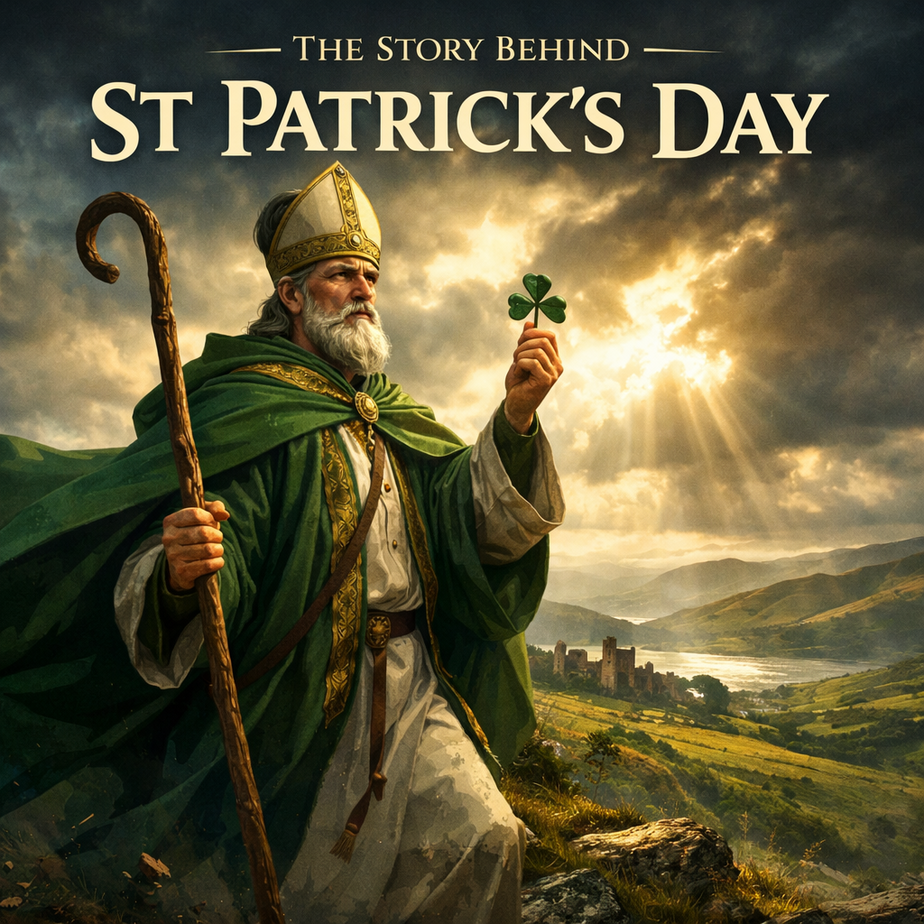
A modern illustration of Patrick as later tradition pictures him. No image of him from his own lifetime survives, and the green robes, mitre and shamrock all came centuries after his death.
Patrick was born in Roman Britain, most likely in the 5th century. His family were Christian and comfortable. His father, Calpornius, was a deacon and a town official, and his grandfather, Potitus, was a priest.
Nobody knows exactly where he grew up. He names his father’s estate near Bannavem Taburniae, a place never found.
So Ireland’s patron saint wasn’t Irish. He spoke Latin and British, an early form of Welsh. He learned Irish the hard way.
Kidnapped at 16
When he was about 16, Irish raiders carried him off to Ireland. He says he was taken “along with thousands of others”. He hadn’t taken religion seriously as a boy. Slavery changed that.
He spent six years minding sheep. He says he prayed up to a hundred times a day, and nearly as often at night.
Slemish in Co. Antrim is often named as the mountain where he worked. That’s a tradition from a Life written about 200 years after him, by Muirchú.
The only Irish place Patrick names himself is the wood of Voclut, “near the western sea”, whose people called to him in a dream. A 7th-century writer placed it near Killala Bay in Co. Mayo, and many think he was held nearby.
Escape and the call back
After six years, a voice in a dream told him his ship was ready. The ship was “a good two hundred miles away”. He made it there and got aboard.
He got home to Britain. Then came another dream. A man called Victoricus brought him letters headed “the voice of the Irish”. He heard them call: “We beg you, holy boy, to come and walk again among us.”
So he went back, by choice, to the country that had enslaved him. That takes some nerve.
A bishop in Ireland
Where he trained is unknown. Gaul, roughly modern France, is the usual guess. He came back as a bishop and spent the rest of his life in Ireland. He paid the sons of kings to escort him and was once taken prisoner.
He wasn’t the first Christian in Ireland, either. In 431 Pope Celestine sent a bishop called Palladius “to the Irish believing in Christ”.
7th-century tradition says he died at Saul, Co. Down, and was buried at Downpatrick.
The dates nobody agrees on
Scholars agree Patrick lived in the 5th century. The Irish annals give two death dates, around 460 and around 493, neither written at the time.
The famous arrival date of 432 was worked out afterwards. The Dictionary of Irish Biography gives his dates as about 420 to 490, with a question mark. That question mark is doing a lot of work.
You’ll also read that his real name was Maewyn Succat. That glues together two of the four names 7th-century writers gave him. In his own writing, he is simply Patricius.
Patrick’s own writings
Almost everything we know comes from two short Latin texts he wrote himself: the Confessio and the Letter to the Soldiers of Coroticus. They are the earliest surviving documents of Irish history.
The Confessio, written in old age to answer his critics, is personal and sometimes moving. The Letter is angrier. It condemns soldiers who killed or enslaved his new converts.
The Royal Irish Academy has both texts free online at confessio.ie, in Latin, English and Irish.
The legends, and what’s actually true
Most Patrick stories were written down centuries after he died. Ireland was never short of a good story, as my guide to Irish mythological creatures shows.
The snakes
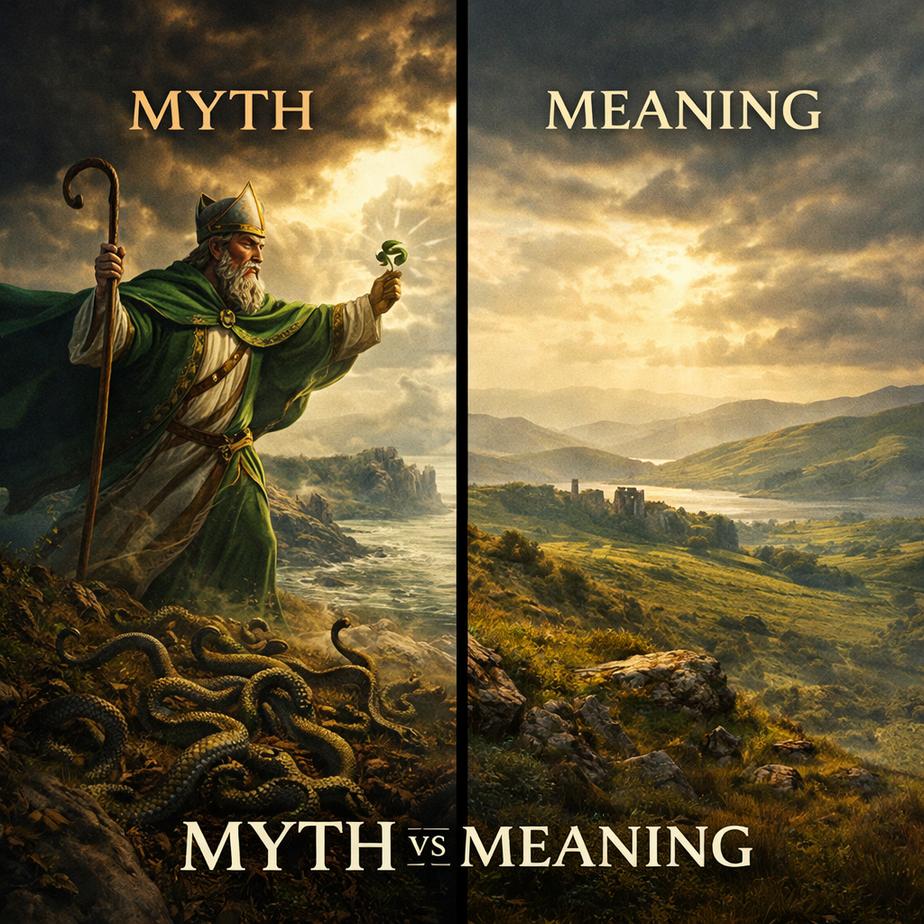
The snakes legend on one side, a snake-free Ireland on the other. The story first appears about 700 years after Patrick.
The story says Patrick drove every snake in Ireland into the sea. The earliest writers to say so are Jocelin of Furness, and Gerald of Wales, who wasn’t convinced, both in the 12th century, some 700 years after him.
There’s one small problem. There’s no evidence of snakes in Ireland since the last Ice Age, so there was nothing to banish. The snakes are usually read as a symbol of evil or paganism.
Here’s my 90-second video on the snakes story.
The shamrock
Patrick never mentions the shamrock in either of his texts. The earliest written account of him using it to explain the Holy Trinity is in a 1726 book by the botanist Caleb Threlkeld. The Dictionary of Irish Biography dates it to 1727.
People were wearing shamrock on the day before that. An English traveller, Thomas Dineley, noted it in 1681.
Lovely story. We just can’t pin it on Patrick. There’s more in my piece on why the shamrock became the symbol of St Patrick’s Day.
Croagh Patrick
In the 7th century, Tírechán has Patrick spend 40 days and nights on top of Croagh Patrick in Co. Mayo. The 9th-century Tripartite Life makes the comparison with Moses on Mount Sinai explicit.
The pilgrimage is real, and people still climb it. The Annals of Loch Cé record that 30 pilgrims were struck by lightning there on St Patrick’s Day 1113. Bring a raincoat.
His staff
In the legends, Patrick drives out the snakes with his staff. A famous staff did exist: the Bachall Ísu, or Staff of Jesus, the chief relic of his cult at Armagh.
It first appears in the annals in 868, and that entry doesn’t mention Patrick at all. It was moved to Dublin in the 12th century. In 1538 it was burned there as an object of superstition.
The origin of St Patrick’s Day: how 17 March became his feast
17 March is traditionally the day Patrick died. It was first named as his day by Muirchú, who wrote a life of Patrick in the 7th century. By the 8th century, it was in church calendars on the Continent.
For about a thousand years, it stayed a mainly Irish feast. Then a Waterford man in Rome got involved.
Luke Wadding (1588 to 1657) was a Franciscan scholar. He worked with the group Pope Urban VIII set up in 1629 to reform the breviary, the Church’s book of daily prayer. The Dictionary of Irish Biography credits him with getting the feast onto the whole Church’s calendar.
It went into the Roman breviary in 1631 and the revised Roman calendar in 1632. Websites saying it “began in 1631” have it wrong. That’s when the rest of the Catholic world was told.
It was still mainly a church day, though by the 1700s people were drowning the shamrock too, much to one botanist’s disgust.
How it became a holiday in Ireland
It took until 1903 for 17 March to become a public holiday in Ireland. The Bank Holiday (Ireland) Act 1903 came from a bill proposed by William Redmond and seconded by James O’Mara. You’ll often read that O’Mara introduced it. He seconded it.
After independence in 1922, the new Irish Free State kept the day fairly sober. There was a military parade and a Mass in Irish. The first official state-sponsored Dublin parade is usually dated to 1931.
The pubs were mostly shut until 1961
The Intoxicating Liquor (General) Act 1924 banned the sale of drink on Christmas Day, Good Friday and St Patrick’s Day. The Intoxicating Liquor Act 1927 kept the ban.
There were loopholes. Hotels could serve you with a proper meal, and when 17 March fell on a Sunday, ordinary Sunday hours applied. Northern Ireland wasn’t covered.
The Intoxicating Liquor Act 1960 gave the day Sunday opening hours instead. So 1961 was the first ordinary St Patrick’s Day in decades when pubs in the Republic could open.
How the emigrants made it a parade
For centuries, Ireland marked the day in church and the Irish abroad marked it in the street. The first procession on record, though, wasn’t an emigrant one.
St Augustine, Florida, 1600 and 1601
The earliest known St Patrick’s procession wasn’t in Boston or New York, but in Spanish Florida. Historian J. Michael Francis found the records in Seville.
Gunpowder accounts show the town marked the feast of San Patricio with cannon fire in 1600. In March 1601, its people processed through the streets in his honour. They were Spaniards, Africans, Native Americans and at least two Irishmen.
The town’s Irish priest, Ricardo Artur, was probably behind it.
Boston, 1737
You’ll often read that Boston held the first parade in 1737. It didn’t. That year, Irish merchants and others in Boston founded the Charitable Irish Society, a charity.
The Society still holds its dinner on 17 March, a tradition dating from 1737. A dinner, not a parade.
New York, 1762
New York’s first parade was on 17 March 1762, 14 years before the Declaration of Independence. According to the parade organisers, it was made up of Irish emigrants and Irish soldiers serving in the British Army.
Today it runs up Fifth Avenue from 44th to 79th Street. The organisers count about 150,000 marchers and roughly 2 million spectators.
The parades came before the Great Famine of the 1840s, but Famine emigration made them far bigger. The day became a show of Irish pride, and of Irish numbers.
More Irish abroad than at home
In 2024, 32.4 million people in the US claimed Irish ancestry, according to the US Census Bureau. That’s 9.5% of the population.
Ireland had about 5.46 million people in April 2025 (CSO estimate). That’s nearly six Irish-Americans for every person in Ireland.
The world’s shortest parade, in Co. Cork
In 1999, the village of Dripsey in Co. Cork started what it billed as the shortest St Patrick’s Day parade in the world.
It ran from the Weigh Inn to the Lee Valley Inn. The Irish Times put it at 25 yards, about 23 metres. My own video says 26 metres, so it depends on who held the tape.
In March 2008 the Irish Times reported that the parade had failed to start, because one of the pubs had closed.
Here’s my short video on Dripsey’s famous parade.
Green or blue?
You may have heard that St Patrick’s colour was originally blue. That’s half true. Patrick himself had no colour at all.
The blue link comes from the Order of St Patrick, an order of knights set up by King George III in 1783. Its knights wore sky blue, now often called St Patrick’s blue.
Green grew from the shamrock and then from Irish nationalism. “The Wearing of the Green” became a rebel song after the 1798 Rising. When the Free State painted its post boxes green in the 1920s, the argument was over. There’s more on this in my St Patrick’s Day facts.
St Patrick’s Day today
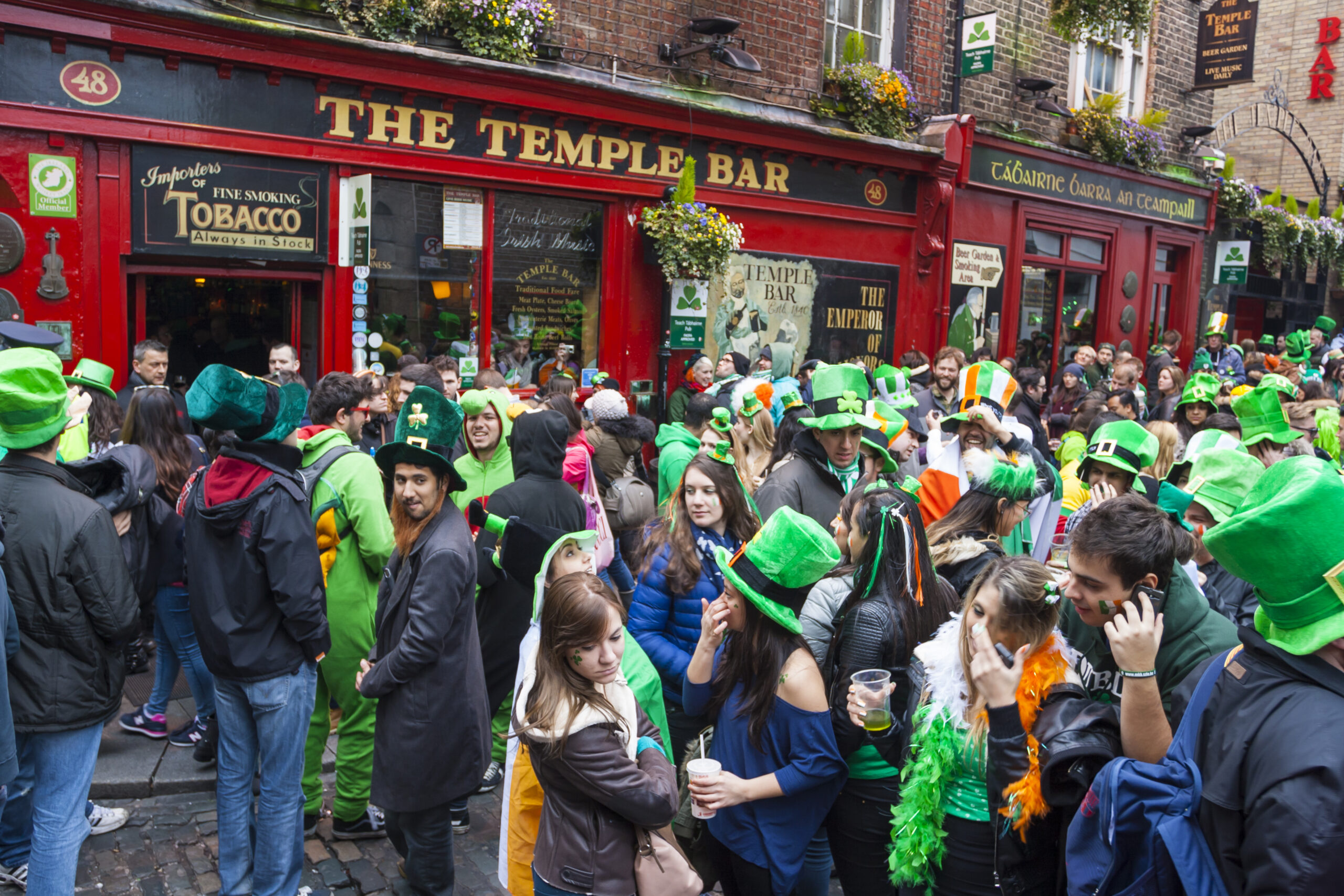
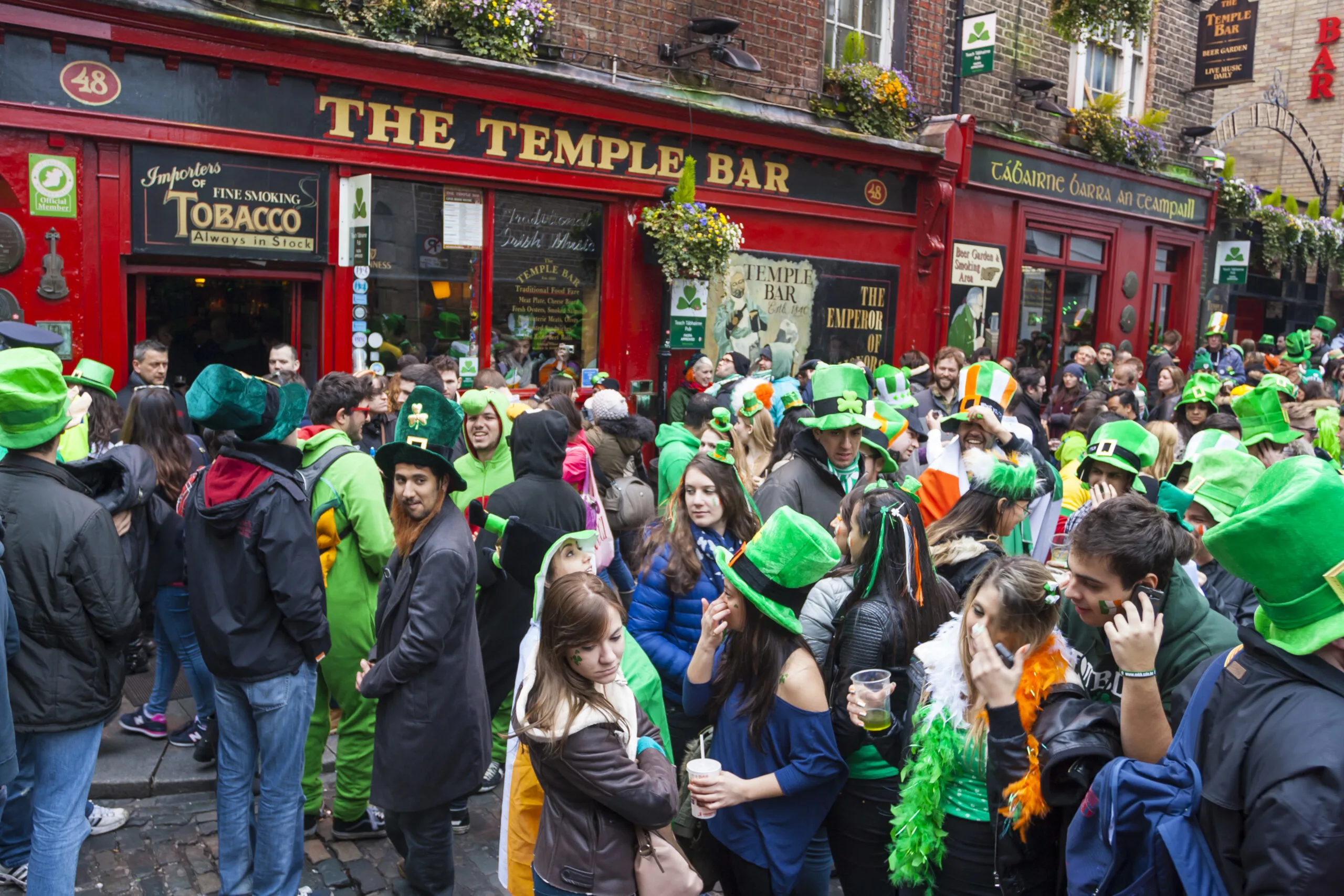
St Patrick’s Day crowds outside The Temple Bar pub in Dublin
In Ireland, the big festival is younger than you’d think. St Patrick’s Festival in Dublin was set up in 1996, and it started as a single day.
It now runs over five days. According to the festival, the 2027 edition runs from Saturday 13 to Wednesday 17 March. It also claims a global reach of over 523 million people in 2026. Not bad for a man with a question mark after his dates.
The parade has been stopped a few times. In 2001, foot-and-mouth disease pushed Dublin’s celebrations back to May. In 2020 Covid-19 cancelled parades across Ireland, and Dublin’s was cancelled again in 2021.
The world goes green
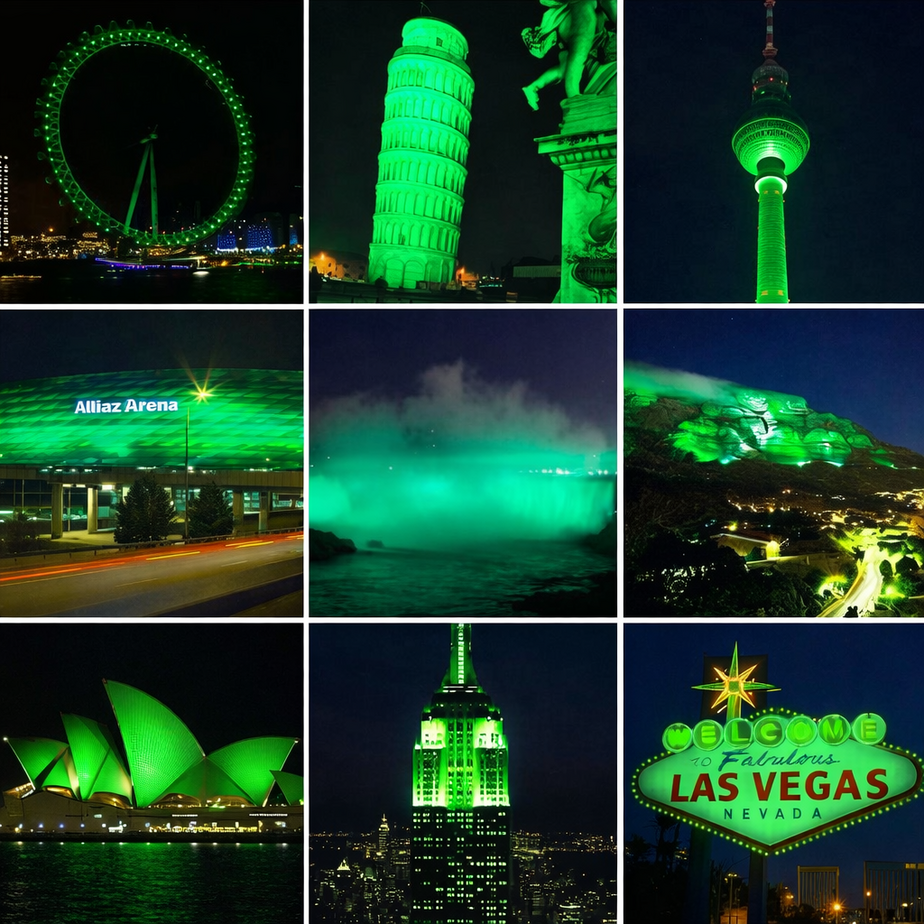
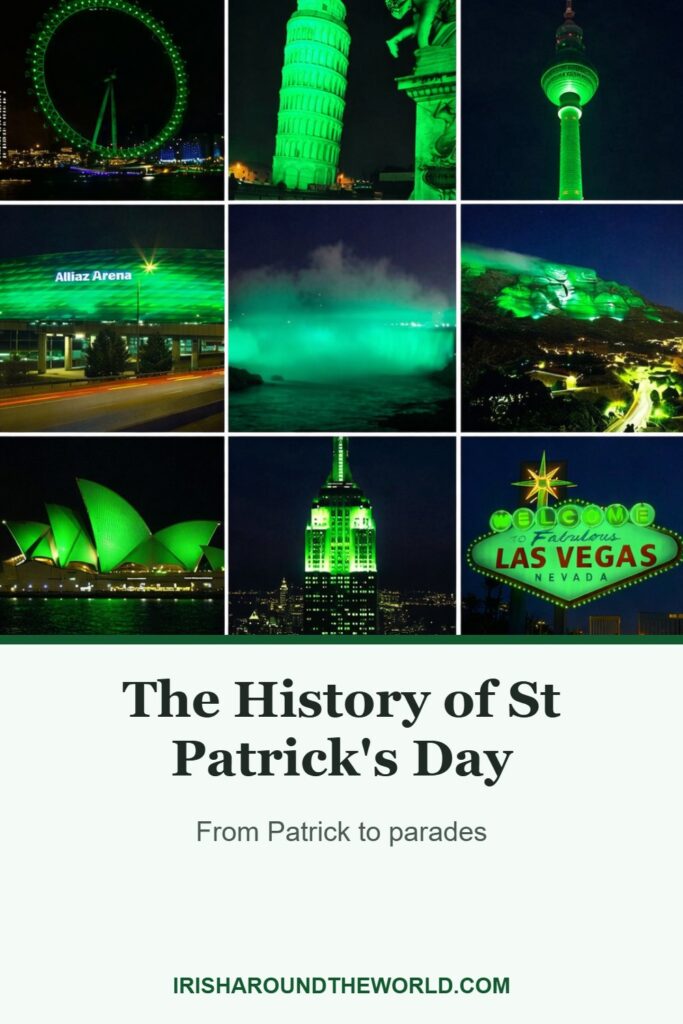
Landmarks lit green for St Patrick’s Day, from the Sydney Opera House to the Empire State Building
Famous buildings are lit green for the day, from the Sydney Opera House to the Empire State Building.
Chicago dyes its river green
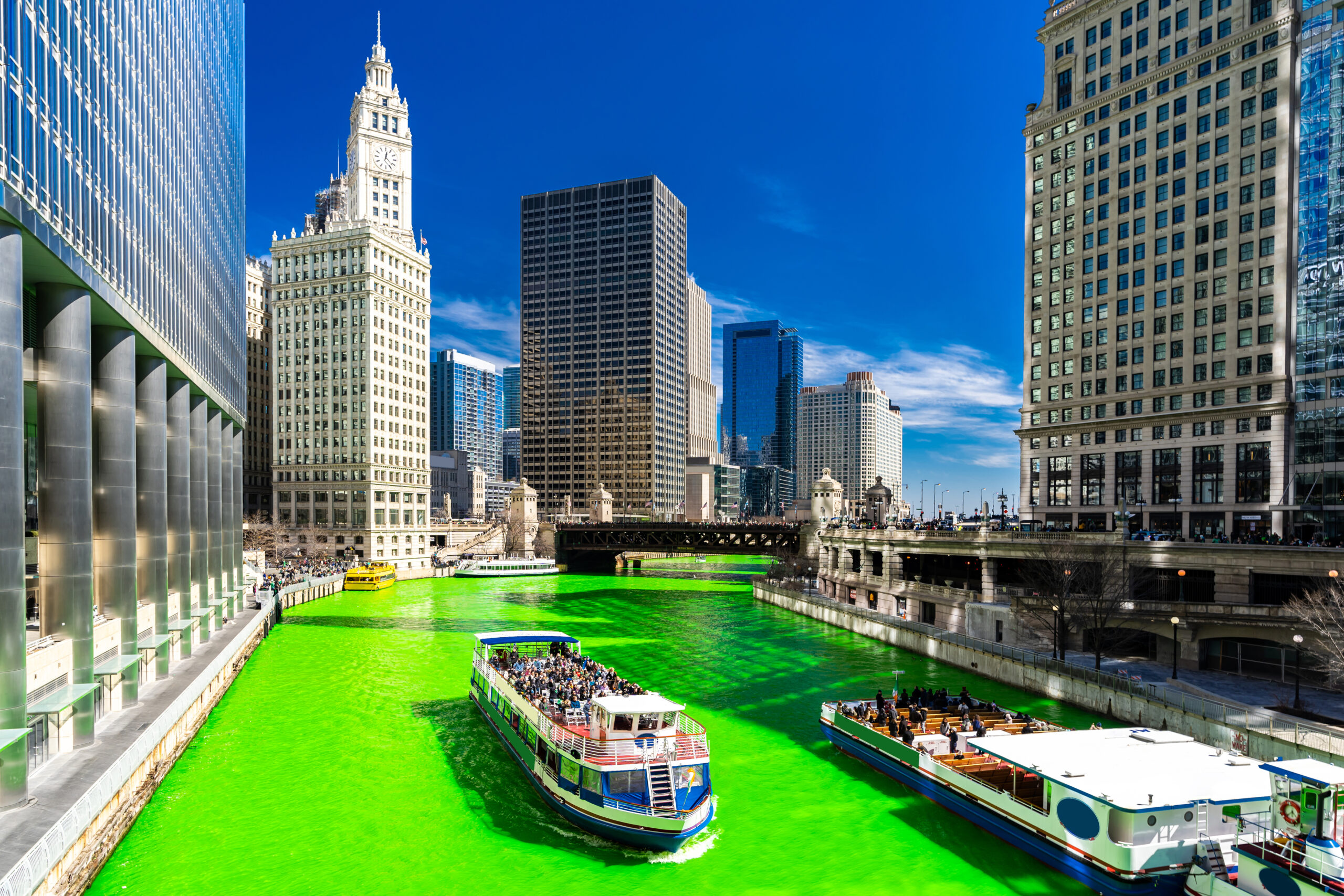
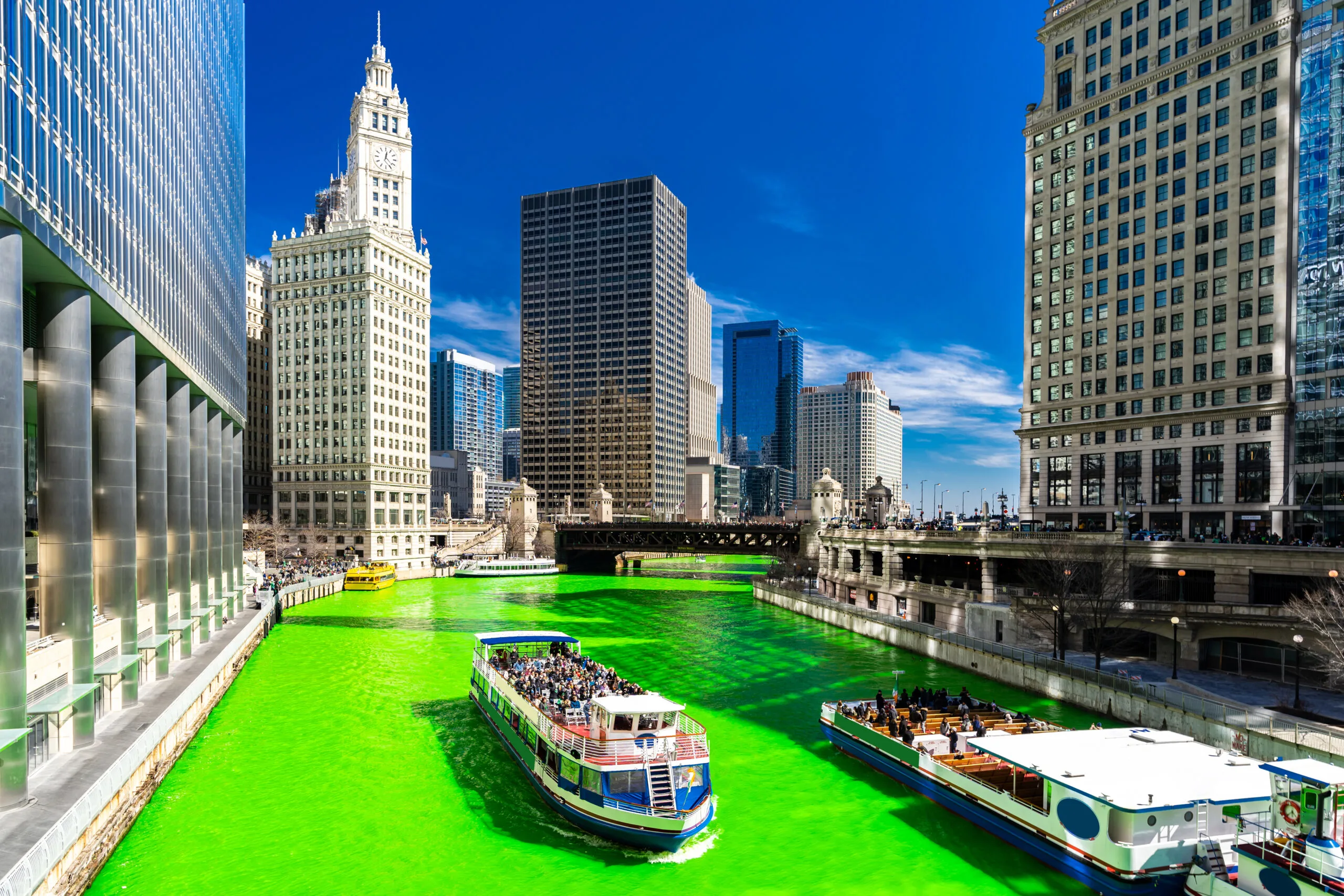
The Chicago River dyed green for St Patrick’s Day
Chicago goes one better. According to the Christian Science Monitor, a plumbers’ union boss got the idea in 1961 from a plumber’s coveralls stained by leak-tracing dye.
In 1962 the union tipped 100 pounds of it into the river. It stayed green for a week. These days they aim for a day.
St Patrick’s Day in space


NASA astronaut Cady Coleman on the International Space Station, where she played Matt Molloy’s flute on St Patrick’s Day 2011
On St Patrick’s Day 2011, NASA astronaut Cady Coleman played an Irish flute on the International Space Station. She had taken it up in December 2010.
The flute belonged to Matt Molloy of The Chieftains. She also had a tin whistle belonging to his bandmate Paddy Moloney.
The American way
In 2026, 60% of Americans planned to celebrate, according to the National Retail Federation. The NRF projected $7.7 billion in spending, or a record $47.45 a head.
Corned beef and cabbage is an Irish-American dish. In Ireland, the traditional dinner would more likely be bacon and cabbage.
If you want to wish someone a happy St Patrick’s Day in Irish, it’s Lá Fhéile Pádraig sona duit.
St Patrick’s Day history for kids
Patrick was a boy from Britain who lived about 1,600 years ago. At 16, raiders kidnapped him and took him to Ireland, where he minded sheep for six years.
He escaped on a ship. Later he dreamed the Irish were calling him, so he went back to teach them about Christianity.
Stories say he chased all the snakes out of Ireland. But there were no snakes to chase! 17 March is remembered as the day he died.
Irish people who moved to America made the big parades famous. People wear green because of the shamrock, a little plant with three leaves.
St Patrick’s Day timeline
- 5th century: Patrick works in Ireland as a bishop. His exact dates are unknown.
- 7th century: Muirchú names 17 March as Patrick’s day.
- 1600: St Augustine, Florida, marks the feast with cannon fire.
- 1601: St Augustine’s procession is the earliest on record.
- 1631 and 1632: The feast enters the Roman breviary and calendar, with Luke Wadding’s help.
- 1726: The earliest written account of Patrick and the shamrock.
- 1737: Boston’s Charitable Irish Society is founded.
- 1762: New York’s first St Patrick’s Day parade.
- 1903: St Patrick’s Day becomes a bank holiday in Ireland.
- 1924: Selling drink on 17 March is banned in the Free State.
- 1961: Pubs can legally serve on the day again.
- 1996: The first St Patrick’s Festival in Dublin.
St Patrick’s Day history FAQ
When did St Patrick’s Day start?
17 March was named as Patrick’s feast day in the 7th century. It joined the Church’s universal calendar in 1631 and 1632. The first known procession was in St Augustine, Florida, in 1601 (the town also marked the feast in 1600).
Why is St Patrick’s Day on 17 March?
It’s traditionally the day Patrick died. Muirchú named it in the 7th century, and the Church added it to its universal calendar in 1631 and 1632.
Was St Patrick Irish?
No. He was born in Roman Britain, though nobody knows exactly where. He came to Ireland as a kidnapped slave at about 16, escaped, and later came back by choice.
Why do we celebrate St Patrick’s Day?
It began as a church feast for Ireland’s patron saint. Irish emigrants turned it into a celebration of being Irish, which is mostly what it is today.
Did St Patrick really drive the snakes out of Ireland?
No. There’s no evidence of snakes in Ireland since the last Ice Age. The story first appears in the 12th century, and the snakes are usually read as a symbol of paganism or evil.
Were pubs closed on St Patrick’s Day in Ireland?
Yes, apart from a few loopholes. The Intoxicating Liquor (General) Act 1924 banned the sale of drink on the day. The Intoxicating Liquor Act 1960 ended that, so pubs opened on 17 March 1961.
More St Patrick’s Day reading
- 17 Irish Blessings for St Patrick’s Day
- The Best St Patrick’s Day Jokes
- The Muppets Sing Danny Boy for St Patrick’s Day
- Leprechauns in Irish Folklore
- 100+ Remarkable Facts About Ireland
- The St Patrick Snakes Legend: Ireland Never Had Any. So Where Did the Story Come From?
- Croagh Patrick: Ireland’s Holy Mountain, Where Pilgrims Still Climb Barefoot
Love this? Save it to your Pinterest board for later.
A little bit of Ireland in your inbox every Friday ☘️
The free Weekly Dose of Irish: an Irish joke, a Celtic symbol, an Irish fact, a poem and the week’s best articles in one short email. Join 9,600+ readers.
Free. One short email every Friday. Unsubscribe any time.