A leprechaun is a solitary fairy from Irish folklore: a small, old, bearded shoemaker who hides a crock of gold. Catch him and keep your eyes on him, and he may hand it over. Look away and he’s gone. The name comes from medieval Irish luchorpán, usually read as “small body”. Most Irish storytellers of the 1800s dressed him in red.
Every March, the leprechaun turns up everywhere. On beer mats, cereal boxes and parade floats, in a green suit with a buckle on his hat.
The Irish leprechaun is a different fellow. He’s older, crankier and usually dressed in red. He mends shoes and is very hard to rob. The stories about him go back more than a thousand years.
Here’s where he comes from, what the old sources really say and which popular “facts” are made up. We’ll finish with a mountain in Co. Louth and a tree in Alabama.
Jump to:
- What is a leprechaun?
- The Irish name and what it means
- The oldest leprechaun story
- What the old sources really say
- The pot of gold and the three wishes
- Red coat or green suit?
- The clurichaun and the far darrig
- Carlingford’s “protected” leprechauns
- The Crichton Leprechaun
- Leprechauns and St Patrick’s Day
- Leprechaun myths
- Leprechaun FAQ
- More Irish folklore
What is a leprechaun?
In Irish folklore, a leprechaun is a solitary fairy. He lives alone, away from the fairy hosts of the forts and raths. He looks like a tiny, wrinkled old man.
His trade is shoemaking. In the old tales you hear him before you see him, tapping away with his little hammer. He’s usually working on one shoe, never a pair.
He is also rich. He keeps a purse or a crock of gold hidden somewhere, which is why people try to catch him. In Croker’s tales the rule is simple: take your eyes off him and he vanishes.
He has plenty of company, from the banshee to the púca. You’ll find the rest in my guide to Irish mythological creatures.
The Irish name and what it means
The modern Irish word is leipreachán. It sounds roughly like “LEP-ra-khawn”, with the “ch” as in Scottish “loch”. In English, most people say “LEP-ruh-kawn”. The teanglann.ie dictionary has audio in all three main dialects.
The older forms are luchorpán and lupracán. Both are listed in eDIL, the online edition of the Royal Irish Academy’s Dictionary of the Irish Language. The traditional explanation is lú (“small”) plus corp (“body”). Scholars such as P.W. Joyce gave that reading in the 1800s.
Not everyone accepts it. In 2019 the dictionary’s editors suggested a link to the Luperci, priests of an old Roman festival (BBC News, 5 September 2019). That one is unsettled, so don’t bet the pot of gold on it.
You’ll often read that it comes from leath bhróg, “one shoe”. Douglas Hyde suggested it, and Yeats printed it in 1888. It’s a lovely fit for a fairy who makes one shoe at a time. But it’s a folk etymology, not the accepted one.
He didn’t have one name everywhere, either. In his notes, Croker recorded “Cluricaune” in Cork, “Luricaune” in Kerry and “Lurigadaune” in Tipperary. In Ulster he was the “Logherry-man”.
The oldest leprechaun story
The oldest known written mention is in a medieval tale, Echtra Fergusa maic Léti (“The Adventure of Fergus son of Léte”). The scholar D.A. Binchy edited it in the journal Ériu in 1952. The story survives in early Irish law texts, usually dated to around the 8th century.
Fergus, a king of Ulster, falls asleep on the shore. He wakes as water sprites, lúchorpáin, carry him into the sea. He catches them, and they buy their freedom with the power to go under water. Modern retellings usually turn this into “three wishes”.
Notice what’s missing. There’s no shoemaking, no gold and no green hat. Those came much later.
What the old sources really say
Most of what we “know” about leprechauns comes from 19th-century collectors. They wrote down tales from country people.
Croker: the little shoe and the field of ragwort
Thomas Crofton Croker’s Fairy Legends and Traditions of the South of Ireland (1825) has two of the best tales. Croker calls the little shoemaker a Cluricaune, but he’s plainly our man.
In “The Little Shoe”, near Kilmallock in Co. Limerick, a man hears hammering in his stable. He finds a little fellow under the mare, in an apron and a red nightcap, making a shoe. He grabs him and demands the purse. The man loosens his grip for a second, and the little fellow jumps away laughing. All that’s left is one tiny shoe.
Better again is “The Field of Boliauns”. Tom Fitzpatrick catches the little shoemaker, who leads him to a field of boliauns, or ragwort. The gold, he says, is under one particular plant.
Tom has no spade. So he ties his red garter round the plant and makes the little man swear not to touch it. When Tom gets back with a spade, every boliaun in the field has a red garter on it. The field was more than forty good Irish acres.
That, to me, is the leprechaun in one story. He doesn’t break his word. He just beats you anyway.
Yeats, McAnally and Allingham
W.B. Yeats put the leprechaun among “The Solitary Fairies” in his 1888 Fairy and Folk Tales of the Irish Peasantry. He wrote that the leprechaun “makes shoes continually, and has grown very rich”.
The American writer D.R. McAnally, in Irish Wonders (1888), makes him about three feet high, in a little red jacket. Yeats, quoting McAnally, gives him seven rows of seven buttons. In Ulster, McAnally says, he balances on the point of his hat with his heels in the air.
The poet William Allingham made him far smaller: “a span and a quarter in height”. His leprechaun has “nine-and-ninety treasure-crocks” and escapes by flinging snuff in the narrator’s face.
Lady Wilde and the schoolchildren
Lady Wilde, Oscar’s mother, wrote in 1887 that leprechauns make shoes for the fairies and know where treasure is hidden. She warned they “can be bitterly malicious if they are offended”, so treat them with great civility.
In the late 1930s, Irish schoolchildren wrote down local folklore for the Schools’ Collection, now on duchas.ie. A child in Knockanean, Co. Clare, described a leprechaun in a red cap and green coat who mended boots for the fairies. In Ballymahon, Co. Longford, he was “The Little Red Man”, and it was “very hard to get the gold from him”.
The pot of gold and the three wishes

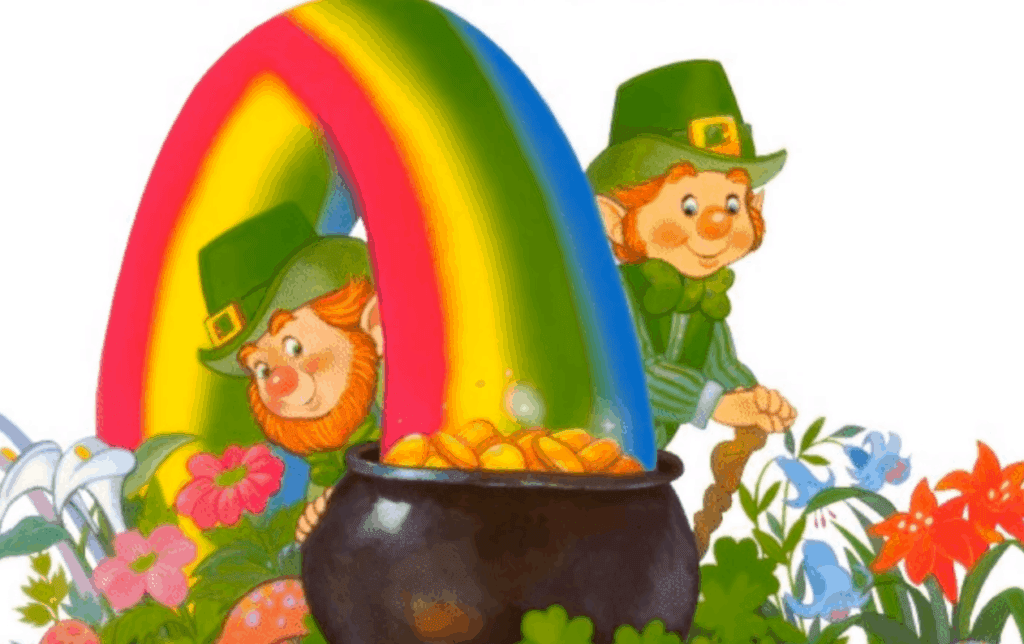
The modern picture: leprechauns in green beside a pot of gold at the end of a rainbow. The rainbow is a later addition to the story.
The gold is old. Croker has the purse, Yeats and Allingham have treasure crocks, and Lady Wilde has a pot buried in a fairy rath.
The rainbow is another matter. It doesn’t appear in Croker, Yeats, McAnally or Lady Wilde. It looks like a later addition. A rainbow has no end, which is very handy if you’re a leprechaun minding your savings.
In most Irish folk tales the prize is simply the gold. The three wishes are mostly a modern idea. They were read back into the Fergus saga, and Herminie Templeton Kavanagh’s Darby O’Gill stories (1903) and Disney’s film (1959) made them famous.
Does anybody ever win? Hardly ever. Lady Wilde tells of a boy near Castlerea who got the gold and banked it in Dublin. In most tales, though, you look away, or you loosen your grip, or you’re left with forty acres of ragwort.
Red coat or green suit?


A modern cartoon of the older look: a leprechaun in red, as 19th-century Irish writers described him
Ask most Irish storytellers in the 1800s and the leprechaun wore red. Croker has a red nightcap. Samuel Lover’s Legends and Stories of Ireland (1831) gives him a red coat laced with gold. McAnally has the red jacket. Not everyone agreed. Lady Wilde, in 1887, has one dressed all in green.
Yeats had an explanation. The trooping fairies, he wrote, wear green jackets, and the solitary ones wear red. The leprechaun is a solitary fairy, so he’s in red. By the 1930s, as the schoolchildren show, red caps and green coats were mixing.
The full green suit is largely a 20th-century look. Green had been Ireland’s colour since at least the 1640s, when the Confederate Catholics flew a green flag. Popular culture, much of it American, then settled the green leprechaun.
Disney’s Darby O’Gill came out in 1959. General Mills created Lucky the Leprechaun in 1963, and Lucky Charms reached the shops in 1964. Notre Dame adopted the Leprechaun as its official mascot in 1965.
Not everyone in Ireland was thrilled. In December 1963, the former Taoiseach John A. Costello complained in the Dáil that tourist advertising had sunk to “the caubeen and the shillelagh, not to speak of the leprechaun”.
The clurichaun and the far darrig
Yeats grouped the leprechaun with two other solitary fairies. They’re easy to mix up, and the old writers mixed them up too.
The clurichaun is the drinker of the family, raiding gentlemen’s wine cellars. Yeats wrote that “some suppose he is merely the Lepracaun on a spree”.
The far darrig is an fear dearg, “the red man”. He wears a red cap and coat and plays practical jokes that Yeats calls “gruesome”. He’s the least friendly of the three.
None of them belongs to the trooping fairy host of the forts. A leprechaun might trick you out of his gold, but in the stories he doesn’t steal children. That’s a different department.
Carlingford’s “protected” leprechauns
A popular story says 236 leprechauns live on the mountain above Carlingford, Co. Louth, protected under the European Habitats Directive.
The truth is duller. Carlingford Mountain is a Special Area of Conservation under that directive. The National Parks and Wildlife Service lists it as site 000453, protected for its heath, blanket bog, fens and scree. Leprechauns are not on the list.
The famous roadside sign is a local joke. The “236 leprechauns” figure comes from Kevin Woods, who calls himself the last leprechaun whisperer.
It all goes back to 1989, and accounts differ. One version credits local publican P.J. O’Hare with finding a tiny suit and gold coins near a wishing well, now on show in his pub. Other local accounts credit Woods with the find. Either way, it’s a tourism tale, and a good one.
The Crichton Leprechaun

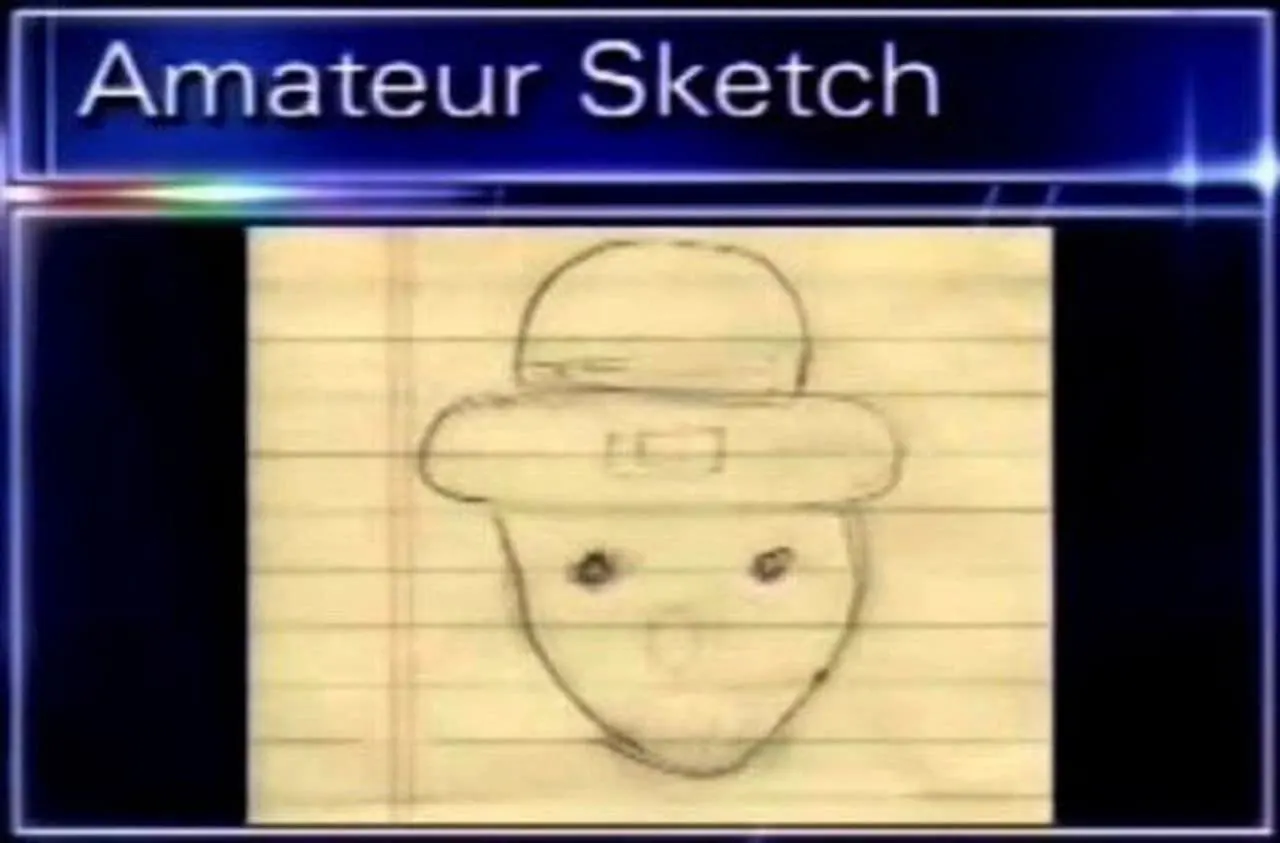
The “amateur sketch” of the Crichton Leprechaun, as broadcast in Mobile, Alabama, in March 2006 (WPMI NBC 15)
The most famous modern sighting wasn’t in Ireland at all. It was in Mobile, Alabama.
On 14 March 2006, WPMI NBC 15 sent reporter Brian Johnson to Le Cren Street in Crichton, near Toulminville. A crowd had gathered, and residents said a leprechaun was living in a tree. A local resident drew a sketch, and the station showed it on air.
The sketch was later auctioned on eBay, raising $1,100 for the American Cancer Society’s Relay for Life, according to Mobile’s Press-Register (April 2006).
The clip went on YouTube on St Patrick’s Day 2006 and became one of its early viral hits. The New York Times picked it up within weeks. One YouTube copy alone had passed 28 million views by 2023. South Park and Key & Peele both parodied it.
I came across it going through old YouTube footage, and it’s one of the funniest clips I’ve seen. Here’s the original NBC 15 report.
Leprechauns and St Patrick’s Day
There are no leprechauns in the stories of St Patrick. The leprechaun belongs to folklore, not to the saint.
The pairing grew mostly in America, alongside green beer and big parades. Even the first St Patrick’s Day parades were in the Americas, not Ireland. I cover that in the real story behind St Patrick’s Day.
In the US, leprechaun traps are now a family custom. Children build them from shoeboxes and glitter. By morning the leprechaun has made a mess and escaped, which is very true to the old tales.
Portland, Oregon, has a leprechaun colony too. Columnist Dick Fagan dedicated tiny Mill Ends Park on St Patrick’s Day 1948. Fagan later called it “the only leprechaun colony west of Ireland”. It’s two feet across, and Guinness listed it as the world’s smallest park until 2025.
And because no St Patrick’s Day page is complete without one:
When does a leprechaun cross the street?
When it turns green.
There are plenty more in my best St Patrick’s Day jokes.
Leprechaun myths
The internet is full of leprechaun “facts” nobody can source. An older version of this page had a few of them. This is what the sources say.
“Leprechauns have always worn green”
No. Most 19th-century Irish sources dress him in red, though Lady Wilde has one in green in 1887. The green suit is largely a 20th-century look.
“Leprechauns live 300 to 500 years and grow to 15 inches”
There’s no folklore source for these numbers, or for the glass pot. In the old tales his size ranges from “a span and a quarter” to three feet. The fourth wish that cancels the others comes from Disney’s Darby O’Gill, not Irish folklore.
“There are no female leprechauns”
The old stories almost always describe a little old man. Nobody in the 1800s held a census.
The Hollywood ones
Sean Connery was in Darby O’Gill, but as a human, Michael McBride. Jimmy O’Dea played the leprechaun king. The story that the film won Connery the Bond role is often told, but there’s no solid source for it.
Jennifer Aniston was in Leprechaun (1993), starring Warwick Davis. It didn’t launch her career. Friends did, a year later.
Leprechaun FAQ
What is a leprechaun?
A leprechaun is a solitary fairy in Irish folklore. He looks like a tiny old man, works as a shoemaker and hides a crock of gold.
Are leprechauns real?
No. They’re folklore characters, written about for over a thousand years. The “sightings” in Carlingford and Alabama are tourism tales and local legend.
Where do leprechauns come from?
Ireland. The earliest known written mention is in the tale of Fergus mac Léti, usually dated to around the 8th century. The shoemaker with the gold comes from folk tales collected in the 1800s.
What is the Irish word for leprechaun?
The modern Irish word is leipreachán, said roughly “LEP-ra-khawn”. Older forms include luchorpán and lupracán.
What does leprechaun mean?
It comes from the Irish luchorpán, usually explained as “small body”.
Why are leprechauns green?
They weren’t always. Most old Irish sources dress him in red. Green took over in the 20th century, helped by films, advertising and St Patrick’s Day.
What happens if you catch a leprechaun?
In the stories, he promises you his gold if you let him go. Then he tricks you into looking away and vanishes.
More Irish folklore
- Irish Mythological Creatures
- The Clurichaun: The Leprechaun’s Drinking Cousin
- St Patrick’s Day Facts
- The Real Story Behind St Patrick’s Day
- The Shamrock and St Patrick’s Day
- The Best St Patrick’s Day Jokes
- Irish Sayings and What They Mean
Love this? Save it to your Pinterest board for later.
A little bit of Ireland in your inbox every Friday ☘️
The free Weekly Dose of Irish: an Irish joke, a Celtic symbol, an Irish fact, a poem and the week’s best articles in one short email. Join 9,600+ readers.
Free. One short email every Friday. Unsubscribe any time.