The Celtic shield knot is a closed knot with four corners, often drawn inside a circle. Today it’s sold as the Celtic symbol for protection. Four-cornered knots really are carved on Irish, Welsh, Scottish and English stones from about the 8th to the 11th century. The name “shield knot” is far newer, and so is the link between this knot and protection. I can’t trace either before the 1990s.
If you’re picking a symbol for a pendant, a tattoo or a gift for someone who needs minding, the shield knot is probably on your list. It’s simple, sturdy and looks well in silver.
Most websites say Celtic warriors carried it into battle. I went looking for the evidence. Some of it is there, and some of it isn’t. None of it is a reason not to wear one.
Jump to:
- What is the Celtic shield knot?
- Where the name comes from
- Four-cornered knots in Ireland and Britain
- Four-fold knots beyond Ireland
- Where the protection meaning comes from
- Variations
- Shield knot vs other knots
- Jewellery, tattoos and gifts
- FAQ
- More reading
What is the Celtic shield knot?
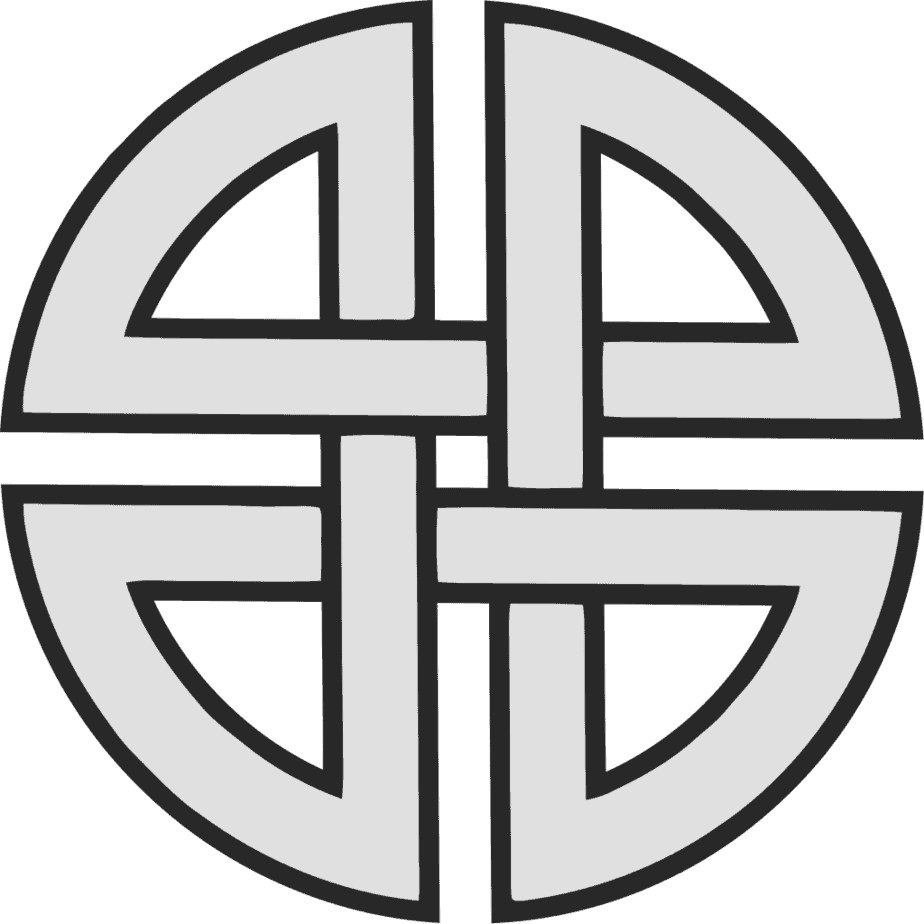
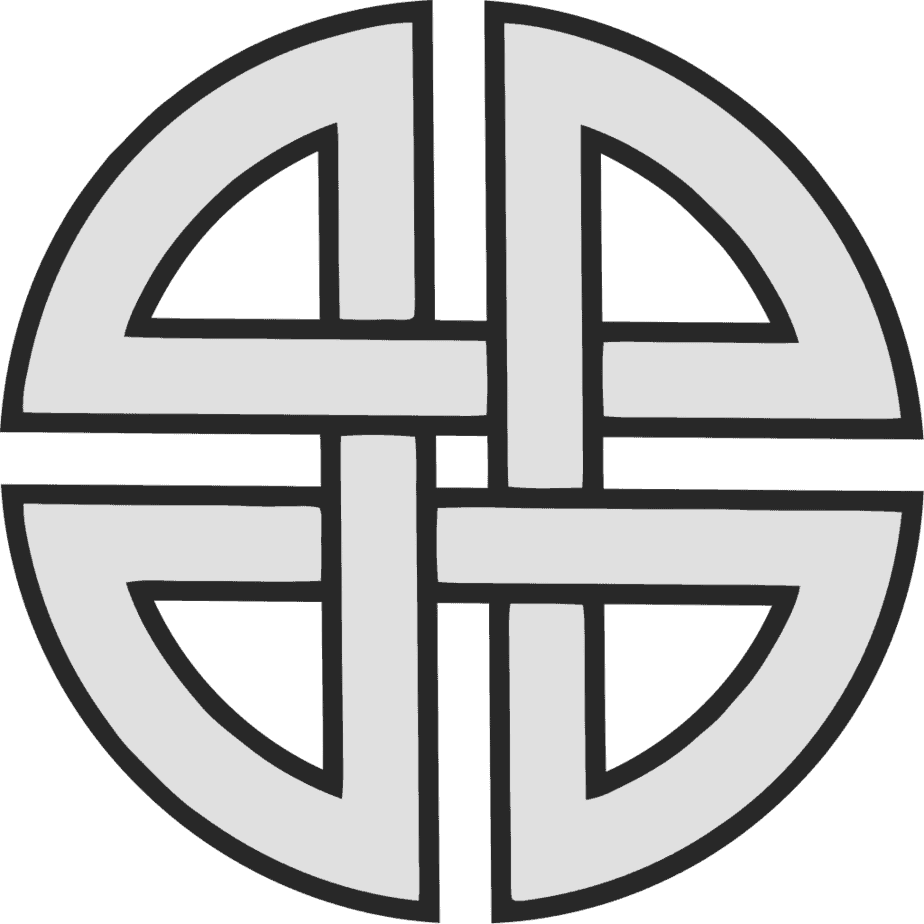
The shield knot as most jewellers draw it today: four loops whose outer curves form a circle.
The shield knot is a closed knot with four corners. The bands weave over and under each other, and there are no loose ends.
The best-known version is a four-part knot that makes a circle. In some versions the loops themselves form the circle, like the one above. In others, a separate ring is woven through the knot.
Some versions drop the circle altogether. Others square the whole thing off.
Its usual modern meaning is protection. You’ll also see it linked to the four elements or the four directions.
In short, it’s a modern name for an old pattern. That’s true of half the things in an Irish gift shop, and nobody minds.
Where the name “shield knot” comes from
Google’s Ngram Viewer counts phrases across millions of English books. “Shield knot” barely registers in the books it samples until the late 1990s. It only turns up regularly from 2008.
A necktie first
Before that, a shield knot was something you wore under your collar. Eaton’s catalogue for 1920 to 1921 sells “Men’s Shield Knot Ties”, a ready-tied necktie. The Edmonton Daily Bulletin was advertising them in 1908.
Protection, in those days, meant protection from tying your own tie.
The 1990s pagan revival
The earliest use I can find for the symbol is in a neo-pagan newsletter, Inner Circle News, in March 1992. It mentions an altar’s “pentacle or shield knot”.
By the late 1990s some Odinist books were already calling it a protective sign. So the protection meaning arrived within a few years of the name. That’s the 1990s, mind, not the 900s.
The 2008 encyclopedia
Much of the wording online seems to trace back to Adele Nozedar’s The Element Encyclopedia of Secret Signs and Symbols (HarperElement, 2008).
She calls the shield knot a protection symbol found in every culture. She says an early form is a Mesopotamian square with a loop at each corner, and links it to the Kabbalah.
I couldn’t find a source for either claim in the book. To be fair, she hedges on the Celtic side, saying knotwork could have been used for amulets. Within a few years the Mesopotamia line was everywhere, usually with soldiers added.
The Victorians had their own name for the shape: the four-cornered knot.
What’s documented: four-cornered knots in Ireland and Britain
The shape itself has a long, dated record on carved stone.
The Victorian term
The antiquarian J. Romilly Allen used “four-cornered knot” in a paper read in 1887. He described a pre-Norman cross shaft at Stowe Nine Churches in Northamptonshire.
Its carved band is interlaced with a four-cornered knot, which Allen numbered 209 in his analysis of Celtic interlace. No shields, no meanings, just a number.
Maen Achwyfan Cross, Wales
Maen Achwyfan stands near Whitford in Flintshire. Cadw, the Welsh heritage body, dates it to the late 10th century. It stands 3.4 metres high, and is often called Britain’s tallest wheel cross.
A report in Archaeologia Cambrensis in 1891 describes one panel as “a circular ring interlaced with a four-cornered knot”. That’s more or less the modern shield knot, a thousand years before the pendant.
Allen and Anderson’s catalogue, 1903
Allen and Joseph Anderson’s The Early Christian Monuments of Scotland (1903) sorts every interlace pattern by number.
Their No. 732 is a four-fold knot filling a square. It turns up at Glendalough in Co. Wicklow, at Kil Eany on Aran, and at Meigle, Govan, Penally and Britford.
It’s also in an Irish psalter now in the British Library, known as Cotton Vitellius F. XI.
No. 780 is a related four-part design “adapted to the circular instead of to the square shape”. It appears at Meigle, at Pen-Arthur in Pembrokeshire, and at Clonmacnoise.
The Clonmacnoise slab, AD 994
The Clonmacnoise example is the grave slab of Odhrán ua hEolais, a scribe at the monastery. The Annals of the Four Masters record his death in 994.
It reads OR DO ODRAN HAU EOLAIS, “a prayer for Odhrán ua hEolais”. The knotwork sits in the centre and arms of the carved cross.
George Petrie and R.A.S. Macalister both recorded it. Macalister, writing in 1909, called the cross “a very poor piece of work”. Harsh, but the knot outlived the review.
The manuscripts
In manuscripts, art historians usually trace the earliest insular knotwork to the Durham Gospels fragment, from the mid 7th century. Knotwork then fills the Book of Durrow (about 700) and the Book of Kells (about 800), both at Trinity College Dublin.
What none of them tell us
Not one of these stones or books says what a knot meant. Allen was blunt about it.
In 1903 he wrote there was “not the least foundation” for reading the triquetra as a symbol of the Holy Trinity. He allowed just two exceptions, at Meigle and Llanfrynach.
George Bain’s Celtic Art: The Methods of Construction (1951) taught people how to draw the knots. Its reissue in the early 1970s helped make knotwork popular again.
Four-fold knots beyond Ireland
Roman floors and Solomon’s knot


This is Solomon’s knot, not a shield knot: two closed loops linked together, a favourite of Roman mosaic floors.
Knot patterns appear in late Roman floor mosaics of the 3rd and 4th centuries AD.
The best known is Solomon’s knot, two closed loops linked together. It turns up in Roman mosaics at Aquileia, in synagogue floors at Sepphoris and Ostia, and in the Church of the Nativity in Bethlehem.
The Mesopotamia story
Many sites say the shield knot began in Mesopotamia, carried by soldiers. The only concrete item I found is a stamp seal with a cross-shaped interlace.
A 1989 Christie’s sale catalogue dated it to the Ubaid period, around 4500 BC. An auction catalogue isn’t an excavation report. And I found nothing at all about Mesopotamian soldiers.
The Nordic looped square
A square with a loop at each corner is carved on the Havor picture stone at Hablingbo, Gotland, dated AD 400 to 600.
Finnish folk tradition puts it on homes, farm buildings and dishes as a charm against bad luck. A pair of skis roughly a thousand years old is said to carry it.
Nordic road signs use it to mark places of interest. In 1983 Apple designer Susan Kare found it in a symbol dictionary and made it the Mac’s Command key, as Andy Hertzfeld tells it.
So a cousin of the shield knot guarded Finnish barns and now sits beside your space bar.
Where the protection meaning comes from
The idea that a knot protects you is old. The best evidence is Roman and Byzantine, though, not Irish.
Knots that guarded floors
In January 2026, archaeologists announced a mosaic floor from ancient Smyrna, modern İzmir in Türkiye. The team is from İzmir Kâtip Çelebi University, under Akın Ersoy.
The floor is about 3 by 4 metres and dates from the 4th to 6th century AD. It includes a Solomon’s knot.
Archaeology Magazine reported the knot was believed to protect against evil and misfortune.
In 2016 Jelena Erdeljan and Branka Vranešević wrote about a 6th century Solomon’s knot mosaic at Herakleia Lynkestis, near Bitola in North Macedonia.
Their paper discusses the knot’s protective role in early Byzantine art.
The art historian Henry Maguire, in “Magic and Geometry in Early Christian Floor Mosaics and Textiles” (1994), argued that interlace was thought to entangle evil.
Did Celtic warriors carry it on their shields?
Not that we know of. The Battersea Shield in the British Museum dates from about 350 to 50 BC. It’s decorated with swirling La Tène curves and red enamel, and there isn’t a knot on it.
Celtic art before about AD 450 was spirals, trumpet curves and flowing La Tène shapes. Knotwork came into it centuries later, with Christian manuscripts, metalwork and carved crosses.
Battlefields and sickbeds
You’ll read on many sites that the knot was placed on battlefields or beside the sick. I can’t find any source for that. It’s a modern story, and so is the four elements reading.
So is the meaning fake?
No. A meaning people give a symbol today is still a real meaning.
Give a shield knot to your daughter heading off to Boston and it means protection. It just doesn’t come with a 1,000-year guarantee.
Variations: quaternary, circle and square
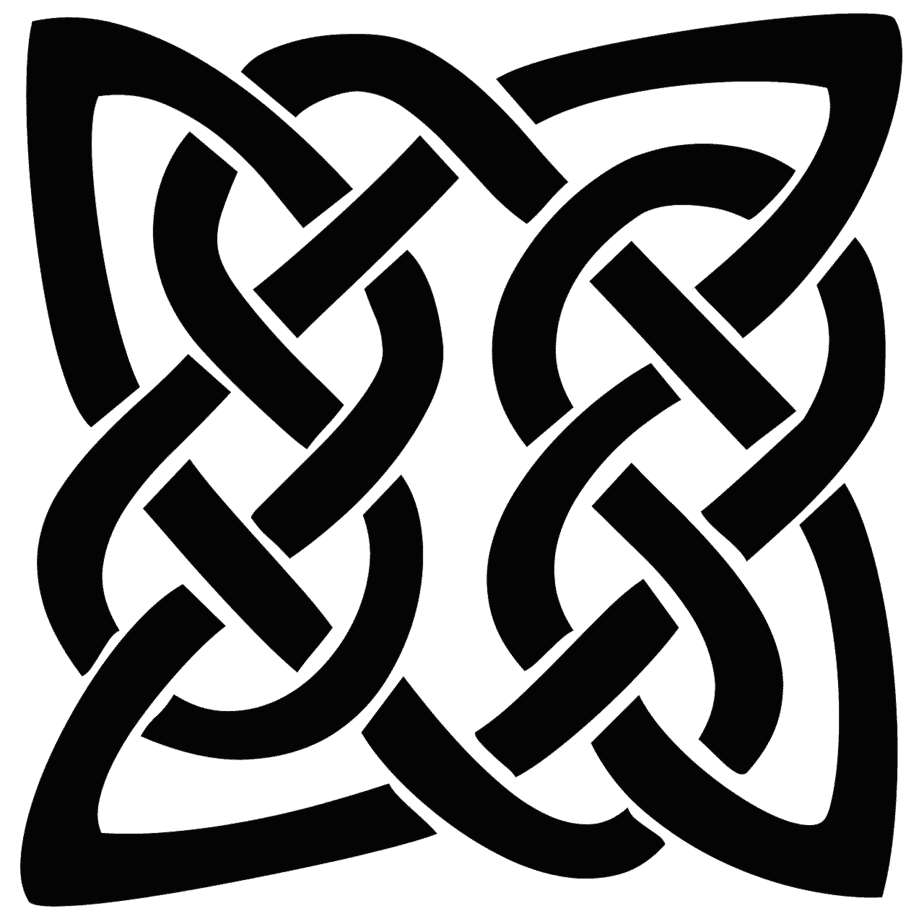
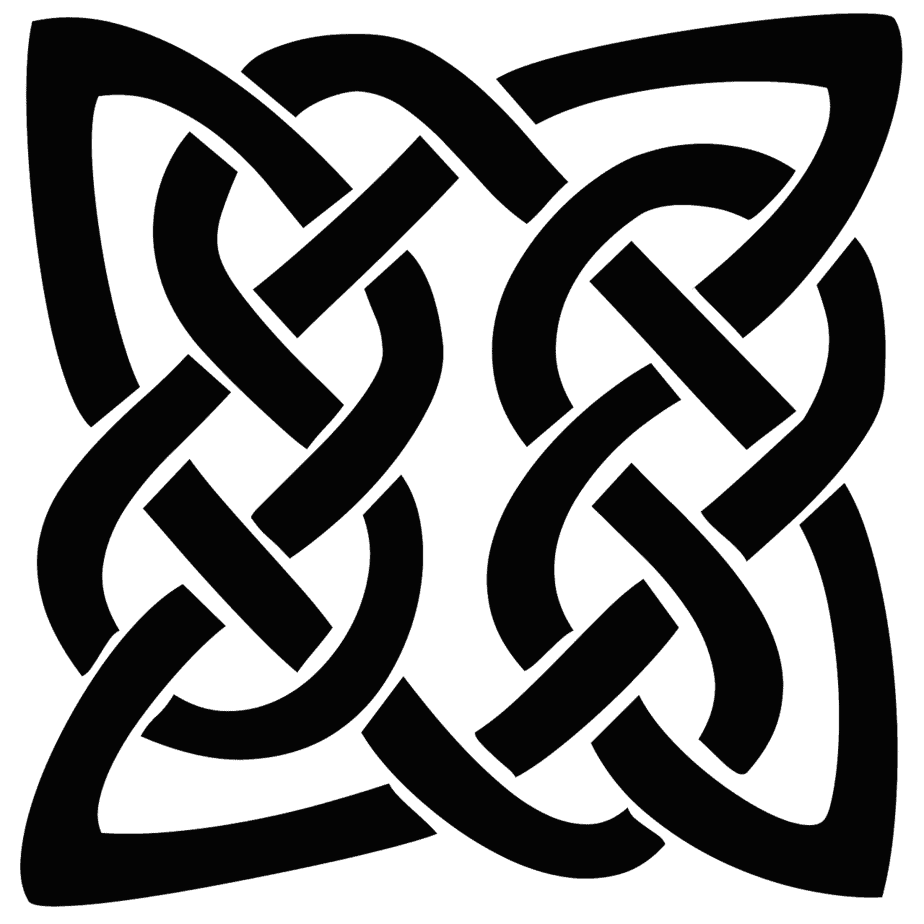
A square, four-cornered version, often sold as the quaternary Celtic knot.
The quaternary Celtic knot. Quaternary just means “in fours”. Shops use it for any four-part knot, usually a square one with no ring.
The circle version. Some old carvings bend the knot itself to fill a circle (Allen’s No. 780, used at Clonmacnoise). Others weave a separate ring through it, as at Maen Achwyfan.
The square version. Four loops fill a square, with pointed or rounded corners. It’s close to Allen’s No. 732, from Glendalough and Aran.
Shops don’t agree on names. The same design may be sold as a shield knot, a quaternary knot or even a Dara knot. Go by the shape, not the label.
Shield knot vs Dara, Solomon’s and trinity knots
| Knot | Shape | Documented history | Usual modern meaning |
|---|---|---|---|
| Shield knot | Four corners, closed, often in a circle | Four-fold knots on 8th to 11th century stones; name from the 1990s | Protection |
| Dara knot | Interlace said to show oak roots | Name from Irish doire, an oak wood; no early record | Strength |
| Solomon’s knot | Two closed loops linked together | Roman mosaics onwards; seen as protective in late antiquity | Union, eternity, protection |
| Trinity knot | Three points | Book of Kells and many carved stones | Holy Trinity, a link Allen doubted in 1903 |
The quickest test is to count. Four corners is a shield knot. Three points is a trinity knot. Two linked loops is Solomon’s knot. The Dara knot varies, but it’s usually sold as oak roots.
Shield knot jewellery, tattoos and gifts
Jewellery. It works well as a pendant, ring or cufflinks, and the closed outline doesn’t snag. On a good piece you can follow the bands over and under all the way round.
Celtic shield knot tattoos. The circle version reads best at small sizes. Fine lines blur as a tattoo ages, so go a little bigger than you think.
Gifts. People choose it for a new home, a new baby, a wedding or someone moving abroad. Tell them the shape was carved on Irish stones a thousand years ago.
For an Irish protection symbol with a long folk record, consider the St Brigid’s cross, hung in Irish houses to protect them.
Celtic shield knot FAQ
What does the Celtic shield knot mean?
Today it means protection, and sometimes the four elements. Those meanings were attached to this knot in the 1990s, though knots as protective charms go back to Roman floors. The early carvers left no record of what the shape meant to them.
Is the shield knot really Celtic?
The shape is. Four-cornered knots are carved at Clonmacnoise, Glendalough and Maen Achwyfan, among others, from roughly the 8th to the 11th century. The name is modern.
What is the Celtic symbol for protection?
The shield knot is the one most often sold that way. In Irish folk custom, the St Brigid’s cross has the longer record as a household protector.
Is a quaternary knot the same as a shield knot?
Near enough. “Quaternary” just means four-part, and shops often use it for a square version with no ring.
Is the shield knot Norse or Celtic?
Both, in a way. Four-cornered knots appear in insular Christian art, and the related looped square is old in Scandinavia. The Thor link is a 1990s invention.
Is the shield knot a good tattoo?
Yes, especially the circle version, which holds its shape at small sizes. Ask your artist to keep the over and under weave clear, and go a little bigger so fine lines don’t blur.
What is the difference between a shield knot and a Dara knot?
A shield knot has four clear corners and is sold for protection. A Dara knot is a looser interlace said to show oak roots, and is sold for strength.
More Celtic knots and symbols
- Celtic Symbols and Their Meanings
- The Celtic Knot and Its Meanings
- The Dara Knot
- The Triquetra, or Trinity Knot
- The Celtic Cross
- St Brigid’s Cross
- The Celtic Motherhood Knot
A little bit of Ireland in your inbox every Friday ☘️
The free Weekly Dose of Irish: an Irish joke, a Celtic symbol, an Irish fact, a poem and the week’s best articles in one short email. Join 9,600+ readers.
Free. One short email every Friday. Unsubscribe any time.