The Celtic love knot is usually a woven knot with heart-shaped loops, or the Serch Bythol: two trinity knots joined by a circle. Couples wear them for love, partnership and lasting commitment. The honest history: both are modern designs built from real early medieval knotwork. There is no known ancient heart-shaped Celtic knot. Ireland’s documented love symbol is the Claddagh ring, from about 1700.
Search for a Celtic symbol for love and you’ll find plenty of woven hearts. Many come with a line about ancient Celts swapping knots like wedding rings.
I went looking for those ancient Celts. I couldn’t find them.
That doesn’t make the love knot a fake. It’s a modern design built from real old knotwork. Here’s what’s old, what’s new, and how to choose.
Jump to:
- What is the Celtic love knot?
- How old is the Celtic love knot?
- Where the heart shape comes from
- Serch Bythol: the Welsh “everlasting love” knot
- Real love knots: Chaucer, sailors, lovespoons and brooches
- Tying the knot and handfasting
- The Claddagh: Ireland’s documented love symbol
- Love knot, Claddagh and the rest compared
- What the Celtic love knot means today
- How to choose a love knot for a wedding, anniversary or tattoo
- Celtic love knot FAQ
- More Celtic symbols and love
What is the Celtic love knot?
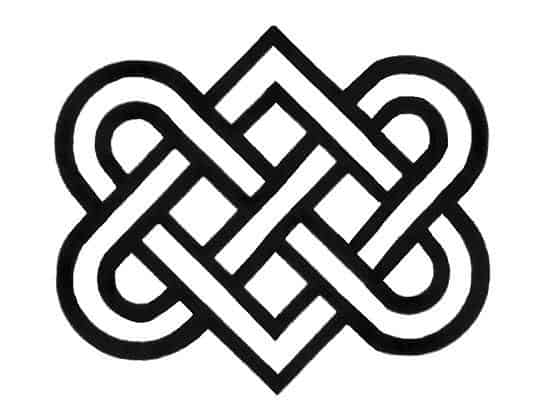
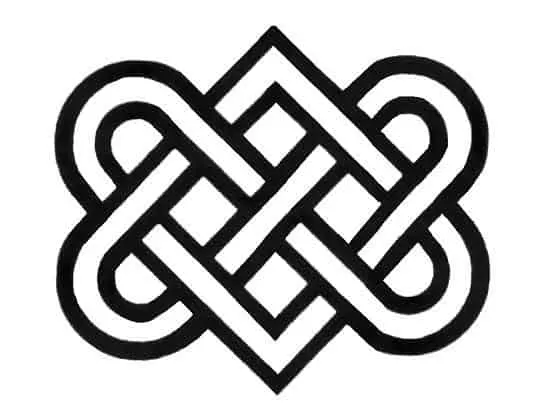
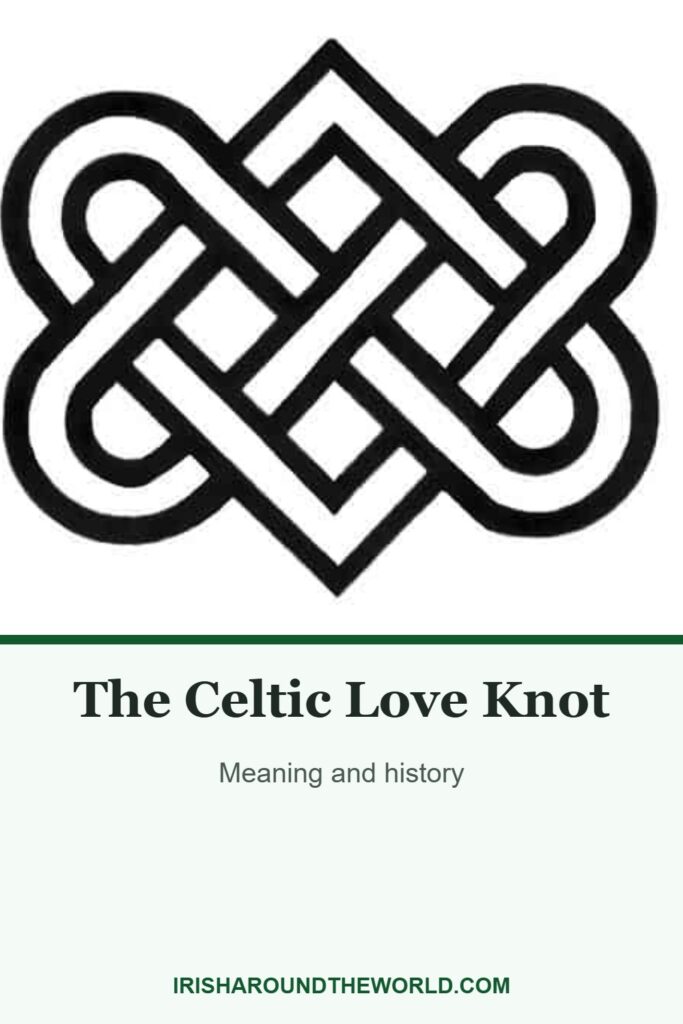
A popular modern “Celtic love knot”: a woven diamond of interlace, usually read as two hearts woven through each other.
There’s no single design. When people say “Celtic love knot”, “Celtic heart knot” or “Irish love knot”, they usually mean one of three things.
- The heart knot: one woven band that loops into a heart, or into two hearts. This is the one on most pendants.
- The Serch Bythol: two trinity-knot shapes joined by a circle, sold under a Welsh name meaning “everlasting love”.
- Two interlocked hearts: two heart outlines woven over and under each other, often for couples.
The Claddagh ring often gets lumped in too. It has hands, a heart and a crown, but no knot. More on that below.
How old is the Celtic love knot?
The knotwork is old. The hearts are not.
Knot patterns first appear in Roman floor mosaics of the 3rd and 4th centuries AD. True knotwork reached Ireland and Britain by the 7th century. One early example is a Gospel fragment in Durham Cathedral Library (MS A.II.10).
The high point is the Book of Kells, made around 800 and kept at Trinity College Dublin. One old count, repeated in the Catholic Encyclopedia of 1913, found 158 interlacings in a single square inch.
What the experts recorded
In 1904 the antiquary J. Romilly Allen published Celtic Art in Pagan and Christian Times. He found eight basic knots behind nearly all Celtic interlace. None of them is a heart, and he gives no meanings for any of them.
George Bain’s Celtic Art: The Methods of Construction (1951) taught artists how to draw these knots. It was reissued in paperback in 1973 and is still the standard how-to book.
I know of no heart-shaped knot in any early Irish or British manuscript, metalwork or carved stone. That isn’t proof none exists. But nobody selling the “ancient” version has ever pointed to one.
A young name, too
Google’s Ngram Viewer counts phrases across millions of books. “Celtic love knot” doesn’t register there before 1991. “Celtic heart knot” and “Serch Bythol” don’t register at all.
In 2014 NPR ran a piece on the American origins of the Celtic knot tattoo. A Dublin tattoo artist told them his Celtic knot customers were almost always American.
Where the heart shape comes from
Here’s the real giveaway. The heart as a symbol of love is a medieval European idea, and it arrived centuries after the Book of Kells.
The earliest known picture of a heart offered in love is in a French poem, the Roman de la poire. The manuscript was made in France in the 1250s. It’s now in the French national library as BnF MS français 2186.
That heart looks more like a pine cone than a valentine, and it points upwards.
Around 1305, Giotto painted Charity offering her heart to Christ in the Scrovegni Chapel in Padua. Red hearts were on playing cards by the late 15th century.
So a knotwork heart blends early Irish art with a later French and Italian idea. That’s a perfectly good thing to wear. It just isn’t ancient.
Serch Bythol: the Welsh “everlasting love” knot
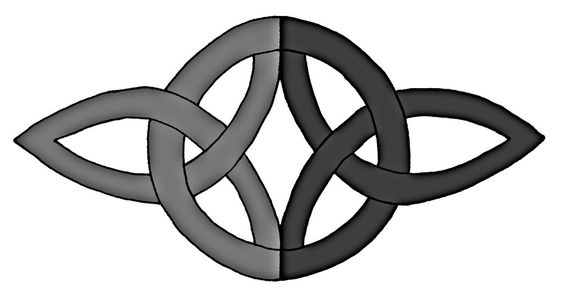
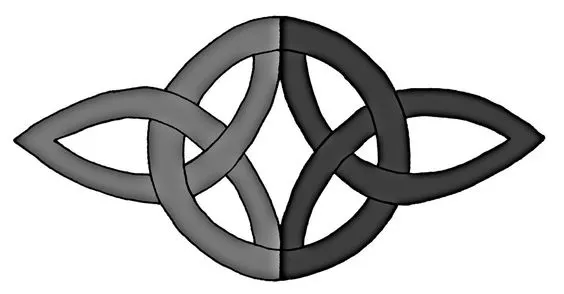
The design usually sold as Serch Bythol: two trinity-style knots joined by a circle. The Welsh name means everlasting love.
Serch Bythol is proper Welsh. Serch means love, and bythol means everlasting. Say it SERCH BUH-thol, with the ch as in loch and the th as in thin.
Serch shares a root with the Old Irish word serc, which also means love.
The design is two trinity knots, or triquetras, set side by side and joined by a circle. You’ll be told it shows two people joined in body, mind and spirit.
Some sellers call it two triskeles, but a triskele is a triple spiral.
The parts are old. The triquetra appears in early Irish art, the Book of Kells included. The combination and the name are another matter.
The name doesn’t show up in Google’s book data at all, and I know of no early example of the design. My best guess is that it spread through online symbol lists in the 2000s.
So treat it as a modern Welsh name for a modern design.
Real love knots: Chaucer, sailors, lovespoons and brooches
Now the good news. Love knots are real, and they’re old. They just aren’t heart-shaped Celtic interlace.
The word “love-knot” is in English from the late 1300s, says the Online Etymology Dictionary. It meant a ribbon or bow tied as a love token.
Chaucer gives us a famous one. In the General Prologue of the Canterbury Tales, the Monk pins his hood with a gold pin. It has “a love-knotte in the gretter ende”. Chaucer is having a dig: a monk has no business wearing a love token.
Sailors’ true lover’s knots
Clifford Ashley’s The Ashley Book of Knots (1944) gives the name true lover’s knot to several different knots. The classic one is two overhand knots tied so they lock around each other.
Ashley says it was once a common style for sailors’ wedding rings: gold wire with two loops that move but never come apart.
Welsh lovespoons
Wales has one of the best-documented love tokens in the Celtic world. Young men carved wooden spoons for the women they were courting.
Museum Wales says the oldest dated lovespoon in its collection, at St Fagans, is from 1667. The custom is probably older. The carvings include hearts for love, chain links for loyalty, and keys, wheels and diamonds.
In Glamorgan, the museum adds, people gave true lover’s knots as Valentine’s Day favours.
Scottish heart brooches
Scotland had the luckenbooth, a heart-shaped brooch, often crowned or made of two hearts entwined. It was given at betrothals and weddings.
In 2022 Lyndsay McGill of National Museums Scotland published a study of Scottish heart brooches from the 13th to the early 19th century. Her core sample of more than 350 is mostly 18th century.
She found they carried meanings of protection, faith and health as well as love. She also questions the old story that the name comes from Edinburgh’s locked booths. Most, she found, were made in northern Scotland.
Tying the knot and handfasting
The knot as a sign of marriage goes back a long way in English. The Online Etymology Dictionary dates it to the early 13th century. The phrase “tie the knot” is in print by the early 1700s.
Handfasting is older as a word. It meant making a contract, especially of marriage, sealed with a handshake. In late medieval Scotland it meant betrothal.
The “trial marriage for a year and a day” story came later. In 1958 the legal historian A. E. Anton traced it to Thomas Pennant’s tour of Scotland and Walter Scott’s novel The Monastery (1820).
The neo-pagan handfasting, often with the couple’s hands bound in cord, first shows up in print in 1969. That’s in Hans Holzer’s The Truth About Witchcraft. Plenty of couples love it. There’s just no record of it from the Celtic past.
The Claddagh: Ireland’s documented love symbol
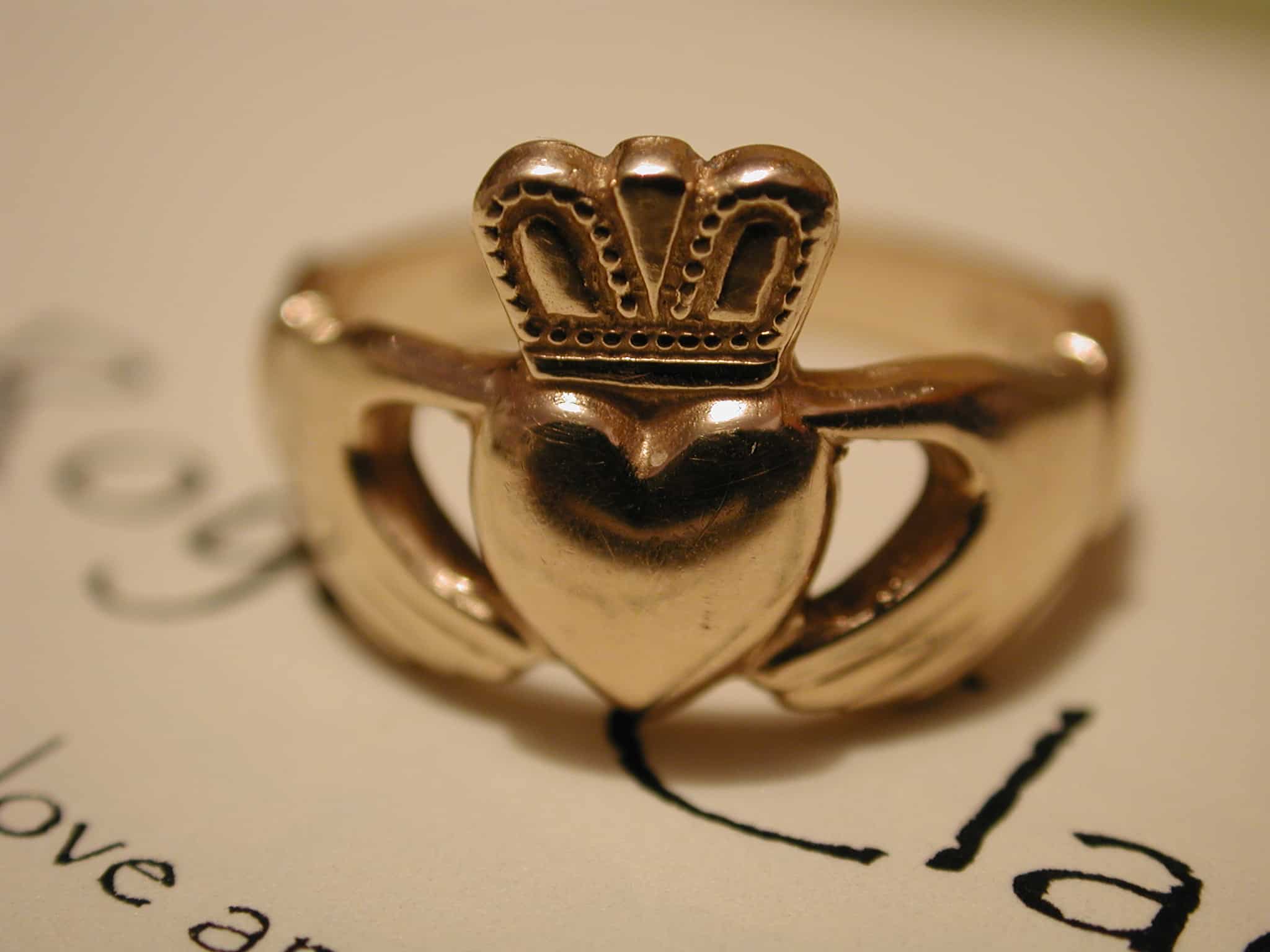
A gold Claddagh ring: two hands, a heart and a crown. The design dates from about 1700 in Galway.
If you want an Irish love symbol with real history behind it, it’s the Claddagh. It’s a ring, not a knot.
The National Museum of Ireland dates the earliest rings in this style to about 1700. The design is often credited to Richard Joyce, a Galway goldsmith.
Two hands hold a crowned heart. The museum says this is thought to mean friendship, love and loyalty. It was used as a betrothal and wedding ring.
The museum notes it looks like a fede ring, a clasped-hands friendship ring that goes back to Roman times.
My full guide to the Claddagh ring meaning covers which hand to wear it on.
Love knot, Claddagh and the rest compared
| Symbol | Earliest firm evidence | Source | Suits |
|---|---|---|---|
| Celtic heart knot | Modern; no early example | Name not in Google’s book data before 1991 | Pendants, gifts, tattoos |
| Serch Bythol | Modern; no early example | Not in Google’s book data | Matching tattoos, Welsh couples |
| Trinity knot | Early medieval, Book of Kells about 800 | Trinity College Dublin | Rings, pendants |
| Claddagh ring | About 1700, Galway | National Museum of Ireland | Engagement and wedding rings |
| Welsh lovespoon | Dated example from 1667 | Museum Wales, St Fagans | Wedding or anniversary gift |
| Luckenbooth brooch | Heart brooches from the 13th century; luckenbooth style mostly 18th century | National Museums Scotland (McGill 2022) | Bride’s brooch, Scottish couples |
| Love-knot / true lover’s knot | The word “love-knot” from the late 1300s | Chaucer; Ashley (1944) | Wedding bands |
What the Celtic love knot means today
Couples today read the love knot as:
- two lives woven into one;
- love with no beginning and no end, because the line never stops;
- faithfulness, because the cords hold each other in place;
- for the Serch Bythol, two people joined in body, mind and spirit.
Those meanings are modern. That doesn’t make them wrong. A love knot doesn’t need a 2,000-year pedigree to mean something to you.
Just skip the claims that “historians say” the Celts swapped love knots, or that knots ward off evil. I can’t find a historian who says either.
For the wider story of knotwork, see my guide to the Celtic knot and its meanings.
How to choose a love knot for a wedding, anniversary or tattoo
- Wedding band: a true lover’s knot or a simple band of interlace. Plain knots wear better than fine openwork.
- Engagement or anniversary: the heart knot or a Claddagh ring. If they love Ireland, the Claddagh carries more history.
- Matching tattoos: the Serch Bythol splits neatly into two halves, so it works well as a pair.
- For a mum: the Celtic motherhood knot is the design people usually want.
In a well-drawn knot the cord goes over, then under, all the way round. No strand should simply stop.
If the label says 2,500 years old, I’d shop elsewhere.
For words to engrave or put in the card, try my Irish sayings about love.
Celtic love knot FAQ
What is the Celtic symbol for love?
Today it’s usually the Celtic love knot, a woven knot with heart-shaped loops, or the Serch Bythol. Both are modern designs. The best-documented Irish love symbol is the Claddagh ring, from about 1700.
What does the Celtic love knot mean?
It stands for two lives woven together, with no beginning and no end. Those meanings are modern, given by jewellers and the couples who wear it. No early Irish or British source explains what any knot pattern meant.
Is the Celtic love knot ancient?
No. The knotwork it borrows goes back to the 7th century, but the heart shape came later from medieval Europe. There’s no known ancient example of a heart-shaped Celtic knot.
What does Serch Bythol mean?
It’s Welsh for “everlasting love”. The design is two trinity knots joined by a circle. The name doesn’t appear in Google’s book data, and no early example of the design is known.
Is the Celtic heart knot Irish?
It borrows interlace from early Irish and British art, so it has Irish roots. The heart knot itself is a modern design, with a big following in America.
What is the best Celtic knot for couples?
For a wedding band, a true lover’s knot or simple interlace. For documented Irish history, a Claddagh ring.
More Celtic symbols and love
- Anam Cara Meaning: the Irish Soul Friend and How to Say It
- Irish Wedding Traditions: What’s Old, Borrowed and New
- Irish Wedding Blessings, Toasts and Readings (and What’s Really Irish)
- How to Say I Love You in Irish (and 27 Irish Pet Names)
- The Claddagh Ring Meaning
- The Celtic Knot and Its Meanings
- The Triquetra, or Trinity Knot
- The Celtic Motherhood Knot
- The Dara Knot
- Celtic Symbols and Their Meanings
- Irish Sayings About Love
Love this? Save it to your Pinterest board for later.
A little bit of Ireland in your inbox every Friday ☘️
The free Weekly Dose of Irish: an Irish joke, a Celtic symbol, an Irish fact, a poem and the week’s best articles in one short email. Join 9,600+ readers.
Free. One short email every Friday. Unsubscribe any time.