
In short: RTÉ Archives has put thousands of old Irish TV reports online for free. These ten clips, plus a 1934 travelogue, show everyday Irish life from the 1930s to the end of the 1980s: big families, rural jobs that have vanished, the first foreign holidays and voices that remembered the Land War.
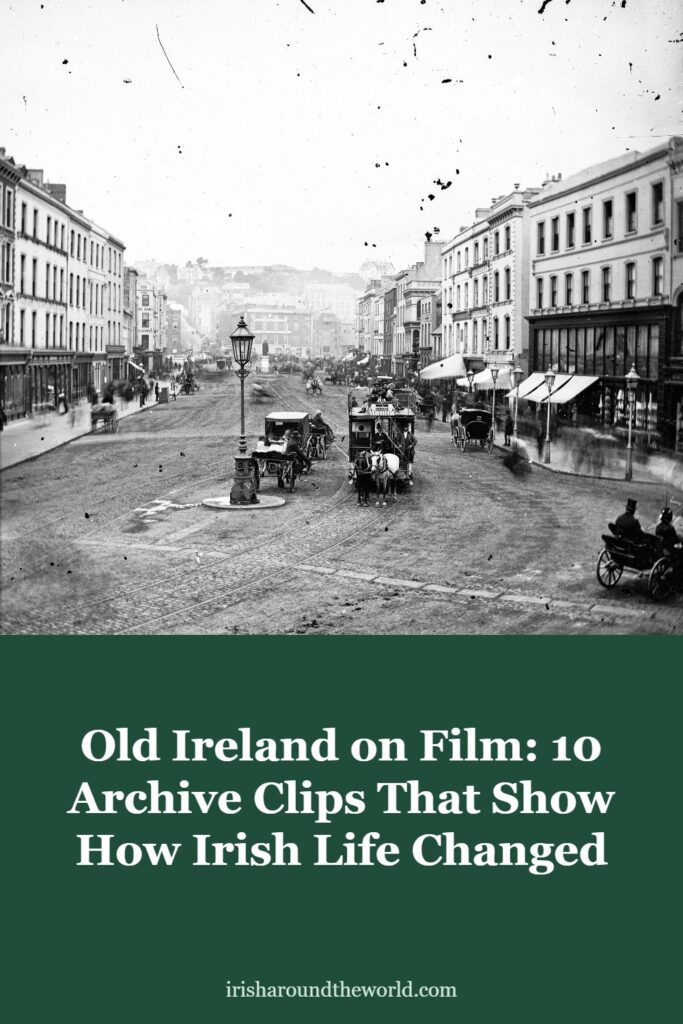
Ireland changed more between the 1930s and the 1990s than in the previous two centuries. Thatched cottages gave way to council estates, the bicycle gave way to the car, and the country went from mass emigration to package holidays in Corfu. The best way to feel that change is to watch it.
We have picked ten of our favourite clips, mostly from the RTÉ Archives website, where you can watch them free. Each one gets a short note on what it shows and why it is worth a few minutes of your time.
The clips at a glance
- 1934: Ireland, The Melody Isle
- 1965: How Travellers Live
- 1965: A 107-Year-Old Farmer Looks Back
- 1971: Ten Children in a Three-Bed Council House
- 1973: Where Are You Going on Your Holidays?
- 1974: How to Stop Rising Inflation
- 1975: The Cycling Postman of Goleen
- 1979: Dubliners Predict the Future
- 1988: A First World War Veteran on the Late Late Show
- 1989: The Doctor Still Working at 95
1934: Ireland, The Melody Isle
The oldest film on this list is an American travelogue made for cinema audiences in 1934 and now held by the Travel Film Archive. It is a tourist’s-eye view of the country, with a cheery narrator and plenty of romance, but look past the commentary and you get rare moving pictures of Ireland between the wars: country roads, market towns, cottages and the people living in them.
The film is said to include footage of the old Claddagh fishing village in Galway, the thatched cottages that were cleared in the 1930s. If that is right, it is one of the last chances to see the village where the Claddagh ring story began.
Want the story behind the ring? Read our guide to the Claddagh ring meaning.
1965: How Travellers Live
RTÉ’s ‘Discovery’ programme, broadcast on 30 April 1965 and narrated by Brian Cleeve, set out to show how Irish Travellers were living at the time, letting Travellers themselves describe their lives on the road.
The language of the period (“itinerants”) has aged badly, and some of the attitudes on show are hard to watch. But it is a valuable record: it came two years after the government’s Commission on Itinerancy reported in 1963, and more than fifty years before the State formally recognised Travellers as an ethnic group in 2017.
Watch it: free on RTÉ Archives.
1965: A 107-Year-Old Farmer Looks Back
On 7 January 1965, ‘Newsbeat’ reporter Jim Norton visited Michael Fitzpatrick, a farmer then aged 107. Originally from County Clare, he had moved to a farm near Maynooth in 1940 under the Land Commission, which broke up large estates and resettled farming families across the country.
The remarkable part is that he could remember the Bodyke evictions in County Clare in June 1887, one of the most notorious episodes of the Land War. Hearing a first-hand memory of the Land War on Irish television is a reminder of how recent that history really is.
Watch it: free on RTÉ Archives.
1971: Ten Children in a Three-Bed Council House
For ‘Report’, broadcast on 4 November 1971, Patrick Gallagher visited the Hall family in Ballyfermot, west Dublin, who were raising ten children in a three-bedroom Dublin Corporation house. Dad John was earning about £23 a week.
Big families were still common in early-1970s Ireland, and this is a straightforward, unsentimental look at how one of them made it work: the budgeting, the bunk beds and the sheer logistics of feeding twelve people.
Watch it: free on RTÉ Archives.
1973: Where Are You Going on Your Holidays?
On 1 August 1973, ‘Agenda’ reporter Doireann Ní Bhriain stopped people on Grafton Street and Camden Street in Dublin to ask about their summer holiday plans. The answers range from France, Spain and Corfu to the West Indies, and, in a very Irish touch, Arklow.
It captures the moment foreign holidays were taking off in Ireland, while plenty of people were still happy with the seaside an hour down the road.
Watch it: free on RTÉ Archives.
1974: How to Stop Rising Inflation
Prices were rising fast in 1974, and on 27 September ‘Seven Days’, with Michael Ryan, brought together seven citizens affected by inflation, including the businessman Sir Basil Goulding, before two economists, John Bristow and Ian Gough, set out their rival answers.
If the cost-of-living crisis of recent years feels familiar, this one is fascinating: the same arguments about wages, prices and who should carry the burden, fifty years earlier.
Watch it: free on RTÉ Archives.
1975: The Cycling Postman of Goleen
A ‘Newsround’ report broadcast on 2 November 1975 met Mike Sheehan, who had delivered the post around Goleen in west Cork by bicycle for 42 years on a 27-mile route. Over that time he had gone through 22 bikes and 96 pairs of tyres, and covered the equivalent of ten trips around the Equator.
It is a lovely, gentle clip, and a portrait of a job, and a pace of rural life, that has almost completely disappeared.
Watch it: free on RTÉ Archives.
1979: Dubliners Predict the Future
On New Year’s Eve 1979, ‘Year In’, presented by Pat Kenny, asked people what they thought the world would look like in the years ahead.
Watching it now is the fun part. With the benefit of more than four decades of hindsight, you get to mark their homework: some guesses are wildly off, and some are closer than you would expect.
Watch it: free on RTÉ Archives.
1988: A First World War Veteran on the Late Late Show
On 11 November 1988, Armistice Day, Gay Byrne interviewed Jack Campbell on the Late Late Show. He talks about lying about his age to join up, and about being gassed at the Somme on the same day his brother was killed.
For decades the Irishmen who served in that war were rarely talked about at home. Hearing one of them speak plainly on the country’s biggest chat show is part of how that slowly began to change.
Watch it: free on RTÉ Archives.
1989: The Doctor Still Working at 95
In an RTÉ News report broadcast on 8 May 1989, George Devlin met Dr Jeremiah Lane of Belgooly, County Cork. Born in 1893 and qualified in 1919, he was still practising in his mid-nineties.
The best detail: he only retired as the local dispensary doctor in 1966, when the authorities discovered he was already three years over the age limit.
Watch it: free on RTÉ Archives.
Where to find more
RTÉ Archives adds new clips regularly, sorted by decade and theme, and the Irish Film Institute’s IFI Player also has a free collection of older Irish films. Both are well worth an evening if you have family roots in Ireland and want to see the world your grandparents grew up in.
Keep reading
- Facts about Ireland
- Irish inventions
- Irish surnames and their meanings
- The Great Blasket Island
- Christmas in Ireland
- Irish slang words
Love this? Save it to your Pinterest board for later.
A little bit of Ireland in your inbox every Friday ☘️
The free Weekly Dose of Irish: an Irish joke, a Celtic symbol, an Irish fact, a poem and the week’s best articles in one short email. Join 9,600+ readers.
Free. One short email every Friday. Unsubscribe any time.