Irish slang is the everyday English of Ireland, with its own words and twists. The big ones are grand (fine, or quietly not fine), craic (fun and chat, said “crack”), eejit (idiot), yoke (a thing), giving out (scolding) and the jacks (the toilet). Most of it is English, not the Irish language. It changes a lot between Cork, Dublin, the countryside and the North.
They say the Irish have the gift of the gab. Spend a day in any Irish town and you’ll see why.
I remember sharing my table of things Irish people say versus what they really mean. The reaction was priceless: over 100k shares, and I loved the feedback.
Since then, I’ve realised there are a lot more Irish slang words. They change from place to place, too. Cork and Dublin can sound like two different countries.
I’m a Cork man, and these were common Irish slang words growing up. You’d be surprised how often they come into everyday conversation.
So here’s the tidied-up version. I’ve sorted the words by type and region, checked the meanings against proper dictionaries, and cut the ones that are really British slang.
Jump to:
- What do craic and grand mean?
- Everyday Irish slang words
- What Irish people say vs what they really mean
- Irish phrases that confuse visitors
- Irish slang for people
- Drinking and pub slang
- Regional slang: Cork, Dublin, rural Ireland and the North
- Feck, and other mild swearing
- Irish words hiding in the slang
- Hiberno-English grammar in a nutshell
- Irish slang FAQ
- More Irish words and sayings
What do craic and grand mean?
Craic
Craic is said “crack”. It means fun, good company and lively chat, all rolled together. “What’s the craic?” means “what’s happening?” or simply “how are you?”
The word is older than the spelling. Merriam-Webster traces it to the Scots and northern English “crack”, meaning lively talk or news. Its earliest record of craic is from 1972.
Professor Raymond Hickey, emeritus at the University of Duisburg-Essen and now at the University of Limerick, runs the Irish English Resource Centre. He calls craic a loan from Irish, which had borrowed it from English first. So the word went abroad and came back with a new spelling.
“The craic was mighty” means a great night. “Minus craic” means a dull one, or a dull person.
Grand
Grand means fine. Or great. Or awful, depending on the face that comes with it.
The Cambridge Dictionary gives the Irish English sense as excellent or enjoyable. Hickey says grand for approval or reassurance is especially Irish. On the written record, that use seems to take off in the second half of the 19th century.
“You’re grand” might be the most useful phrase in the country. It can mean no harm done, don’t worry about it, or no thanks, I’m sorted.
Everyday Irish slang words
These are the words you’ll hear in any kitchen, shop or bus queue in Ireland.
| Slang | Meaning | Example or note |
|---|---|---|
| Gas | Funny | “He’s gas.” |
| Deadly | Brilliant | Nothing to do with danger. |
| Savage | Excellent | A compliment, mostly from younger people. |
| Sound | Decent, reliable | “He’s sound.” Also “sound as a pound”. |
| Fierce | Very | “It’s fierce cold out.” |
| Quare | Very, or remarkable | “That’s a quare price.” |
| Yoke | A thing or gadget | For anything whose name escapes you. Collins and Cambridge both label it Irish. |
| Gaff | House or home | “Back to my gaff after.” |
| Press | Cupboard | “The cups are in the press.” Oxford labels it Irish and Scottish English. |
| The messages | The grocery shopping | “I’m going for the messages.” Also heard in Scotland. |
| The jacks | The toilet | Probably from the older English word “jakes”, first recorded in 1538. |
| Giving out | Scolding or complaining | “Mam was giving out to me.” |
| Banjaxed | Broken, ruined | Origin unknown, says Merriam-Webster. First recorded in 1939. |
| Hames | A complete mess | “He made a hames of it.” Hickey links it to the collar of a horse’s harness. |
| Bold | Naughty | Said of children. Hickey says Irish English kept this older meaning. |
| Mitching | Skipping school | An old word Hickey lists among the survivors. |
| Jammers | Packed full | “The pub was jammers.” |
| Scratcher | Bed | “I’m off to the scratcher.” |
| Shift | A kiss, or to kiss | “Did you get the shift?” A teenage disco classic. |
| Lashing | Raining hard | You’ll need this one. |
| Wet the tea | Make a pot of tea | You’ll need this one more. |
| Dose | A nuisance, or a bad cold | “He’s an awful dose.” |
| A holy show | An embarrassing scene | “You made a holy show of me.” |
| Tayto | A much-loved brand of crisps | “A bag of Tayto.” American readers: crisps are your chips. |
| Nixer | A job on the side, cash in hand | “He’s doing a nixer at the weekend.” |
| Header | A mad person | “He’s a total header.” |
| Jaysus | Good grief | A softened “Jesus”. Mild, but mind the company. |
What Irish people say vs what they really mean
This is the table that started it all. I first shared it as an image on our Facebook page.
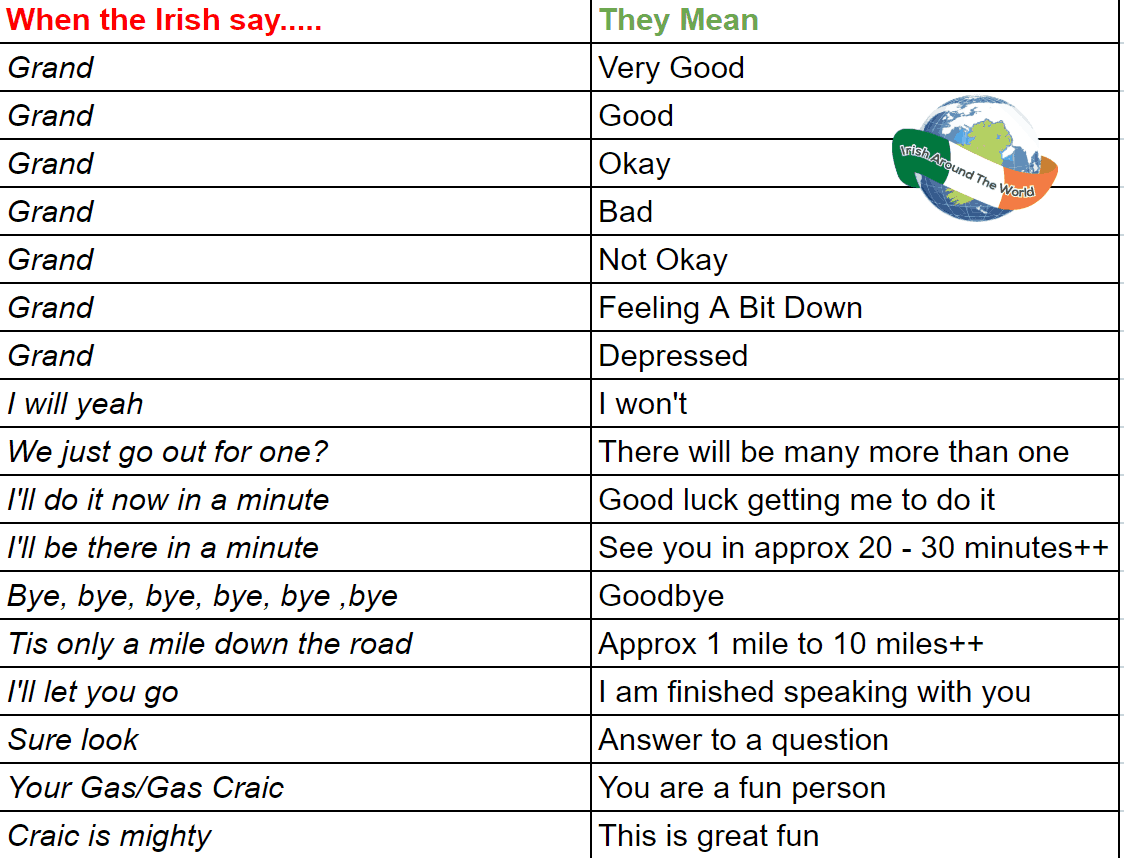
My original “When the Irish say… they mean” table, first shared on our Facebook page.
Here it is again in words.
| When the Irish say | They mean |
|---|---|
| Grand | Brilliant, honestly |
| Grand | Fine |
| Grand | Middling |
| Grand | Not great |
| Grand | Bad, but I won’t be saying so |
| Grand | A bit low today |
| Grand | Properly down, though you’d never know it |
| I will, yeah | I will not |
| We’ll just go out for one | It won’t be one |
| I’ll do it now in a minute | Don’t hold your breath |
| I’ll be there in a minute | Twenty minutes to half an hour, at least |
| Bye bye bye bye bye bye | Goodbye (the phone call is ending) |
| ‘Tis only a mile down the road | Anywhere from one mile to ten |
| I’ll let you go | I’m done talking now |
| Sure look | A full answer to any question |
| You’re gas / gas craic | You’re great fun |
| The craic is mighty | We’re having a brilliant time |
Here they are read out, with what each one really means.
I felt grand writing this section. Make of that what you will.
Irish phrases that confuse visitors
- “What’s the story?” A greeting, not a request for a story. Same with “what’s the craic?” and “how’s the form?” Answer “not a bother” and you’re fine.
- “You’re grand.” Don’t worry about it. Said when you apologise, offer to pay or bump into someone.
- “I will, yeah.” With the right tone, this means a flat no.
- “Go way outta that!” Disbelief, as in “you’re joking”. It’s also the standard reply to a compliment.
- “Come here till I tell you.” Nobody expects you to move. It means “listen to this”.
For more ways to say hello, see my guide to Irish greetings.
Irish slang for people
Ireland has a word for every kind of person. A good few of them mean “fool”.
- Eejit (EE-jit): an idiot, usually said with some affection. Collins calls it a Scottish and Irish word. A “buck eejit” is a total one.
- Amadán (OM-a-dawn): a fool, straight from the Irish language.
- Gobdaw, gom, sap, flute: more ways of saying fool.
- Chancer: someone always trying it on.
- Cute hoor: a sly operator who always comes out ahead. You’ll hear it said of politicians.
- Sleeveen: a sly, untrustworthy type, from the Irish slíbhín.
- Dote: a lovely person, often a child. “Ah, he’s a dote.”
- Yer man and yer one: that man and that woman. Used when you can’t remember the name, or don’t want to say it.
- Himself and herself: the boss, or the man or woman of the house. “Is himself in?” Hickey notes it’s used sparingly now, as it smacks of stage-Irish.
- Not the full shilling: not quite all there.
- Culchie and jackeen: a country person and a Dubliner. Usually friendly, but culchie can be a put-down. Collins suggests culchie may come from a local way of saying Kiltimagh, in Co. Mayo.
Drinking and pub slang
| Slang | Meaning |
|---|---|
| Sláinte (SLAWN-cha) | Cheers, literally “health” |
| A sesh | A long drinking session |
| On the tear | Out on a night’s drinking |
| On the skite | On a drinking spree, usually a longer one |
| Scoops, a few jars | Drinks, usually pints |
| Your round | Your turn to buy for the group. Skip it at your peril. |
| A naggin | A small bottle of spirits |
| A lock-in | Drinking after closing time with the doors shut |
| Locked, scuttered, ossified, buckled, wrecked | Drunk, and very drunk |
| Langers | Very drunk, especially in Cork |
| One for the road | Never just one |
So if I said, “Let’s head out for a bit of craic, maybe a lock-in, and start off in your gaff first,” you’d know exactly what I mean. Haha.
For the full Irish-language version of cheers, see how to say cheers in Irish.
Regional slang: Cork, Dublin, rural Ireland and the North
Irish slang is local. A word that’s everywhere in one city can get a blank look 50 miles away.
Cork
Cork slang is famous enough to have its own book: Seán Beecher’s A Dictionary of Cork Slang, published in Cork in 1983.
- Langer: a fool or an annoying fella. Collins lists it as Irish slang, and its first meaning there is rude, so go easy. “Langers” means very drunk.
- On the lang: skipping school, Cork’s version of mitching.
- Boy: said to anyone, any age. “How’s it going, boy?”
Dublin
- Oul fella and oul one: your dad and your mam.
- Mot: girlfriend.
- Rapid: great.
- Scarlet: mortified, red-faced.
- Chisler: a child. Hickey lists it as an older word, long tied to Dublin speech.
- Delira and excira: delighted and excited. You’ll hear it in Dublin, often tongue in cheek.
- Youse or yiz: you, plural. More on that in the grammar section below.
Rural Ireland
- A soft day: a day of fine, misty rain. A polite way of saying it’s wet.
- Beyant: beyond, over there.
- Gombeen man: a shady small-time dealer or moneylender. Merriam-Webster traces it to the Irish gaimbín.
- Boreen: a narrow country lane, from the Irish bóithrín.
Northern Ireland
Hickey describes three main kinds of English in the North. Ulster-Scots comes from 17th-century Scottish settlers. Mid-Ulster English comes largely from northern English settlers. South Ulster English sits between north and south.
That’s why many Northern words are shared with Scotland. The Dictionaries of the Scots Language, a Scottish charity, record several in Ulster.
- Aye: yes.
- Wee: small, and attached to nearly everything. “A wee cup of tea.”
- Wean: a child. The Scots dictionary has Ulster examples from 1869 on.
- Thon: that, or yon. “Thon man over there.”
- Scundered: embarrassed, or fed up. It’s related to the Scots scunner, meaning disgust.
- Catch yourself on: cop on, be sensible.
- Bout ye: a Belfast greeting, short for “how about you?”
- Hoke: to rummage. “Hoke in the drawer for it.”
- Houl yer whisht: be quiet.
- Coupon and bake: face and mouth. “Shut your bake.”
For the deep dive, see James Fenton’s The Hamely Tongue and Caroline Macafee’s Concise Ulster Dictionary (Oxford University Press, 1996).
Feck, and other mild swearing
Feck is a softer stand-in for the stronger F word. You’ll hear it from people who would never use the real thing. Father Ted helped carry it around the world.
Here’s a fact for the pub quiz. Feckless has nothing to do with feck. Merriam-Webster traces it to a Scots word, feck, meaning value or effect. So a feckless person is one without much use in them.
Two more, both a notch ruder:
- Gobshite: a fool or a loudmouth. Cambridge marks it as offensive, so mind the company.
- Me hole: a rude “no way”. “You’ll be on time? Me hole you will.”
Irish words hiding in the slang
Plenty of people assume Irish slang is full of Irish-language words. Hickey says Irish English has very few Irish loanwords, because people switching to English tended to avoid them. Most of it is English with an Irish twist.
A handful did slip through, though. All of these are in Ó Dónaill’s Irish-English dictionary:
- Plámás (PLAW-mawse): flattery or soft talk.
- Grá: love, or a fondness. “I’ve a grá for the place.”
- Ciotóg (roughly KUH-tohg): the left hand, and so a left-handed person.
- Cúpla focal: “a couple of words”. Hickey notes the habit of dropping a few Irish words into English, like sláinte or plámás.
“Giving out” mirrors the Irish tabhairt amach, which Ó Dónaill also gives as to scold. Which came first is hard to prove.
Some Irish words went further and joined everyday English worldwide. Galore comes from go leor. Whiskey comes from uisce beatha, “water of life”. Smithereens is perhaps from smidiríní. I’ve covered the full list in English words that come from Irish.
Hiberno-English grammar in a nutshell
The grammar has its own habits too. Linguists call it Hiberno-English or Irish English.
- “I’m after eating.” This means “I’ve just eaten”, not “I’m looking for food”. Linguists sometimes call it the “hot news” perfect. Hickey says it’s very common across all sections of society. Many linguists link it to the Irish construction with tar éis, meaning after.
- Ye, youse and yiz. Irish English kept a plural “you”. Hickey says ye is the neutral form, while youse and yiz are more local, especially in Dublin.
- “Amn’t I?” Heard especially in the south, where others would say “aren’t I?”
- Now and sure. “There you are now” closes a deal. “Sure” softens or reassures. “Sure it’ll be grand.”
- “Come here till I tell you.” Here till means “so that”.
To go further, start with Terence Dolan’s A Dictionary of Hiberno-English (3rd edition, Gill and Macmillan, 2012). Then try Hickey’s Irish English: History and Present-Day Forms (Cambridge University Press, 2007).
What Irish slang words do you know that I might have missed? Comment below and let me know your favourites. Slán go fóill, goodbye for now.
Irish slang FAQ
What does craic mean, and how do you say it?
Craic is said “crack” and means fun, good company and lively chat. “What’s the craic?” means “how are you?” The word is usually traced to Scots and northern English, and Merriam-Webster’s earliest record of the spelling craic is from 1972.
What does “grand” mean in Ireland?
Grand means fine, and sometimes excellent. But “I’m grand” can also cover a bad day, so listen to the tone. “You’re grand” means don’t worry.
What does “I’m after” mean in Irish English?
“I’m after eating” means “I’ve just eaten”. It’s used for fresh news. In this sense it has nothing to do with wanting something.
What is Irish slang for drunk?
Take your pick: locked, scuttered, ossified, buckled, wrecked, or langers if you’re in Cork. A night out drinking is being “on the tear” or “on the skite”.
Is feck a swear word?
A mild one. It’s a softened stand-in for the stronger word, and it’s widely used in Ireland.
Is Irish slang the same as the Irish language?
No. Irish slang is mostly English with Irish twists. The Irish language, Gaeilge, is a separate Celtic language. Only a handful of its words, like plámás and sláinte, turn up in everyday slang.
More Irish words and sayings
- English Words That Come From Irish
- Irish Sayings and What They Mean
- Irish Greetings
- How to Say Cheers in Irish
- Top 10 Irish Toasts
- Funny Irish Jokes
Love this? Save it to your Pinterest board for later.
A little bit of Ireland in your inbox every Friday ☘️
The free Weekly Dose of Irish: an Irish joke, a Celtic symbol, an Irish fact, a poem and the week’s best articles in one short email. Join 9,600+ readers.
Free. One short email every Friday. Unsubscribe any time.