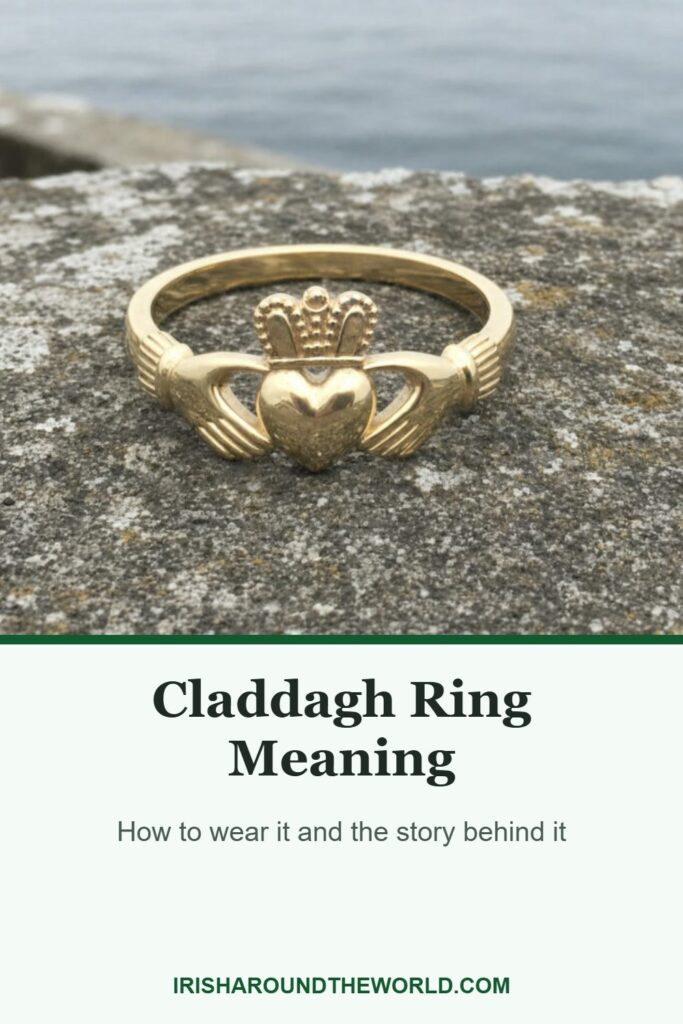
The Claddagh ring meaning is in its design: two hands holding a crowned heart. The National Museum of Ireland says it stands for friendship, love and loyalty. The usual modern rule: right hand, heart out, means single; right hand, heart in, means taken; left hand, heart out, means engaged; left hand, heart in, means married. It comes from Galway.
Few pieces of Irish jewellery travel as far as the Claddagh ring. Irish families from Boston to Sydney pass it down the generations.
Most people know it means love. Fewer know which hand it goes on, or how much of the famous pirate story is actually on record.
This guide covers the meaning, how to wear it, and the real history, with the legends marked as legends. Nobody here is trying to sell you a ring.
Jump to:
- Claddagh ring meaning: hands, heart and crown
- How to wear a Claddagh ring
- The Claddagh: the village behind the name
- Richard Joyce: what’s documented and what’s legend
- The oldest Claddagh rings and their makers
- Older ancestors: fede and gimmel rings
- How the ring spread with emigrants
- Is it bad luck to buy your own Claddagh ring?
- How to tell an Irish-hallmarked ring
- Claddagh rings for men, weddings and engagements
- Famous wearers
- Claddagh ring FAQ
- More Irish symbols and sayings
Claddagh ring meaning: hands, heart and crown
The design has three parts. Two hands hold a heart, and a crown sits on top.
The National Museum of Ireland says the design is “thought to represent friendship, love and loyalty”. The usual split goes like this:
- The hands stand for friendship.
- The heart stands for love.
- The crown stands for loyalty.
Galway City Museum simply calls the ring “a love token”. It served as a wedding ring, a betrothal ring and a friendship token.
How do you say Claddagh?
Say it CLAD-ah. The “gh” is silent.
The name comes from An Cladach, an Irish-speaking fishing village just outside Galway’s old walls. Cladach means “the shore”. In Irish the ring is fáinne Chladaigh.
What about a Claddagh with no crown?
Some rings show the hands and heart with no crown. This is sometimes called the Fenian Claddagh, and RTÉ Brainstorm notes it is sometimes linked to rejecting the British crown.
Not everyone agrees. Galway City Museum says some of Joyce’s contemporaries left the crown off, and “the reason for this is not known”.
How to wear a Claddagh ring
The hand you choose, and the way the heart points, is meant to tell the world whether you’re spoken for.
First, the directions. Facing out means the point of the heart faces your fingertips, with the crown towards your wrist. Facing in means the point faces your wrist, with the crown towards your fingertips.
| How you wear it | Usual modern meaning | What the National Museum says |
|---|---|---|
| Right hand, heart facing out | Single and open to love | Not yet found love |
| Right hand, heart facing in | In a relationship | In a romance |
| Left hand, heart facing out | Engaged | Left hand means married (no direction given) |
| Left hand, heart facing in | Married | Left hand means married (no direction given) |
On either hand, the ring goes on the ring finger, next to your little finger.
Tradition, not law
Here’s the honest part. These “rules” are tradition, and not a very old one.
The National Museum’s curator puts it plainly: “the origin of these traditions is uncertain.” The museum gives three positions, not four. I couldn’t find the engaged-versus-married split in any museum or academic source.
Go back further and the rules vanish. A Galway jeweller, W. Dillon, wrote about the ring in 1905. He called it the wedding ring of country people around Galway, and said nothing about hands or hearts facing anywhere.
So wear it how you like. Tourism Ireland notes many people wear it simply as a statement piece or a nod to their heritage. Just know that someone in an Irish bar may read your hand like a sign on a door.
The Claddagh: the village behind the name
The Claddagh was a fishing village on the western shore at the mouth of the River Corrib. It sat just outside the medieval walls of Galway city, says Galway City Museum.
The National Museum says the village elected a “King of the Claddagh” every 23 June.
The ring and the king were linked. A Galway school’s entry in the Schools’ Collection, folklore gathered by pupils in the late 1930s, says the king wore the Claddagh ring when he married. He then left it to the next king. You can read it on duchas.ie.
In 1927 the village was declared an “unhealthy area”, and its thatched cottages were knocked down over the following years. The name, and the ring, outlived the thatch.
My guide to things to do in Galway covers the Claddagh today. As a Cork man, I’ll admit Galway does a fine job of it.
Richard Joyce: what’s documented and what’s legend
The ring is usually credited to Richard Joyce, a Galway goldsmith whose marks show him at work from 1691 to at least 1737. The National Museum’s wording is careful: the design is “often credited to” him.
What Hardiman wrote in 1820
The earliest account is in James Hardiman’s History of the Town and County of Galway, published in 1820. That’s more than 80 years after Joyce’s last known work.
Hardiman says a young Galway man named Joyes, sailing for the West Indies, was taken by an “Algerine corsair”, a North African pirate ship. In Algiers a wealthy Turkish goldsmith bought him and taught him the trade.
Fourteen years later, William III demanded the release of British subjects enslaved in Algiers. Joyes was freed. His master offered him his only daughter and half his property to stay. He said no.
Back in Galway he married, worked as a goldsmith “with considerable success” and bought an estate at Rahoon. He left his property to three daughters.
Hardiman never mentions a Claddagh ring, or a sweetheart waiting at home. He doesn’t even give a first name.
He does note that some of Joyes’ silver, “stamped with his mark”, still survived. That line is what led Robert Day to Joyce’s RI mark.
What the hard evidence shows
In 1905 the antiquary Robert Day matched Joyce to an “R.I.” mark on Galway chalices dated 1717 to 1732. These were church silver, not rings.
Old lettering often used I for J. A maker’s mark is the stamp a goldsmith struck on his own work.
Day also noted an anchor next to RI on later pieces, and read it as Joyce’s emblem of hope. Today it’s usually described as Galway’s town mark.
The dates of Joyce’s working life come from Galway City Museum, citing the historian J. Mulveen. A 1724 tax roll, the Hearth Money roll, lists him in Shop Street.
He came from one of the Tribes of Galway, the 14 merchant families who ran the town for generations.
What’s legend
Several popular details have no early source:
- That he designed the ring while enslaved. The museum says only that he “is said to have” made it in captivity.
- That he made it for a sweetheart who waited for him.
- That he was a fisherman snatched just before his wedding. That version comes from shop websites.
- That he added the crown for William III. Galway City Museum’s Eoin O’Neill suggested this to National Geographic.
The capture itself is believable. Barbary corsairs did raid Irish waters, most famously in the 1631 Sack of Baltimore in west Cork. Galway City Museum says the story can’t be proven with 100% certainty, but the events of the time suggest it’s true.
For another Galway sea tale, read about Grace O’Malley, the pirate queen of Connacht.
The older tale of Margaret Joyce
The National Museum records a second story. A ring like the Claddagh dropped into the lap of Margaret Joyce, wife of Oliver Óg French, Mayor of Galway in 1596.
Hardiman tells it too: an eagle dropped the ring while she watched her workmen build bridges. But his ring was gold set with a brilliant stone, nothing like a Claddagh. He called the whole thing a “fable”, which saves me the trouble.
The oldest Claddagh rings and their makers
The oldest known Claddagh ring, Galway City Museum says, is in its own collection. It’s gold, made around 1700 and well worn. Inside, it carries Joyce’s RI mark and two sets of owners’ initials.
The museum says the initials suggest a marriage. Eoin O’Neill told the Irish Times they might instead belong to a mother and daughter, as rings often passed down the female line.
How it came home to Galway
The ring belonged to the late Garech Browne of Luggala, Co. Wicklow, a Guinness heir who collected Claddagh rings. Sotheby’s sold his collection in London in January 2020.
The Irish Times reported that the Joyce ring, estimated at up to £2,500, sold for £8,125. Galway City Museum says it acquired the ring early in 2020. The Irish Times reported the purchase in April 2020.
The other early makers
Joyce had company. The Browne sale included rings by James Clinch, Nicholas Burge, George Robinson and Austin French, Antiques & Art Ireland reported.
A ring of about 1700 by Thomas Meade, of Kinsale or Galway, sold for £9,375. So Joyce’s ring has a rival for the title of oldest.
The National Museum of Ireland holds rings by:
- Austin French, mark “F”, 1770 to 1800
- Andrew Robinson, mark “AR”, 1800 to 1830
- James Sealy, mark “JS”, before 1850
Curiously, Dillon’s 1905 article didn’t mention Joyce at all, though Day’s paper on Joyce’s chalices ran in the same issue. The earliest rings Dillon knew were stamped “G.R.”, for George Robinson. Joyce’s claim rests on RI-marked rings studied later.
Where to see them
The Joyce ring sits on its own plinth in the Silver Room at Galway City Museum, RTÉ Brainstorm reported in February 2026.
The museum also says two Joyce chalices, dated 1730 and 1731, are on show in the Silver Room from July 2026 to March 2027. They’re on loan from the Poleberry Foundation. Check opening times before you travel.
Older ancestors: fede and gimmel rings
The design had European ancestors. Galway City Museum calls the Claddagh “a Galway variation” of a ring type once popular in medieval Europe.
That type is the fede ring. Fede, or mani in fede, is Italian for hands clasped in faith.
The V&A in London says fede rings were known in Roman times and worn in Europe until the 19th century. It even describes its Andrew Robinson Claddagh as “a variety of fede ring”.
Then there’s the gimmel ring, from the Latin gemelli, “twins”. It’s two or more hoops that lock together. The V&A says gimmel rings were popular love gifts in the 16th and 17th centuries, and many carried fede hands.
So the clasped hands are ancient, and the crowned heart is the Galway touch. Dillon noted similar rings in Normandy and Brittany. He thought Spain, Galway’s old trading partner, “not at all unlikely” as the source, but admitted he couldn’t be certain.
For more on old designs, see my guides to Celtic symbols and Celtic knots.
How the ring spread with emigrants
For a long time the Claddagh was a local ring. In 1905 Dillon said it was worn from the Aran Islands through Connemara to Galway, and no more than about 12 miles east or south.
Dillon wrote that poor families would pay four times the price of an ordinary ring for a proper Claddagh.
The Famine and the pawnshop
Dillon also recorded a sadder chapter. After the Famine years of 1846 and 1847, Claddagh people emigrating “in hundreds” pawned their rings.
One Galway pawnbroker, a Mr Kirwan, was left holding £500 worth. He sold them as old gold for melting. That’s a lot of wedding rings.
Many of those emigrants went to the United States. Dillon mentions “a colony of them, at Boston, called Claddagh”.
From Galway ring to Irish symbol
By 1905, Dillon said, the ring had become fashionable. He claimed it was the only ring ever made in Ireland for Queen Victoria. I can’t confirm that, so take it as a jeweller’s boast.
Galway City Museum says the ring became “a symbol of Irish identity abroad”, thanks to the Irish diaspora. It’s one reason so many Irish American families have one in a drawer.
Is it bad luck to buy your own Claddagh ring?
You’ll often hear that a Claddagh must be given, never bought for yourself. I looked for a museum or academic source for this, and found none.
What exists is folk testimony. The University of Southern California’s Folklore Archives records a student who studied in Galway. Irish friends told her buying your own was bad luck. Even she wasn’t sure “tradition” was the right word.
Gifting was the norm. Galway City Museum says the rings were “traditionally handed down from mother to daughter”.
Another USC entry records a Chicago-born Irish American grandmother in Texas who gave Claddaghs to her granddaughters at their Confirmation.
So treat the “curse” as a modern folk belief, heard in Galway as well as abroad. Buy your own if you want one. If anyone objects, say it’s a gift to yourself.
How to tell an Irish-hallmarked ring
A hallmark is a set of tiny stamps on gold or silver. In Ireland they show the metal was independently tested, or assayed. They’re struck by the Assay Office, set up in 1637 and now based in Dublin Castle.
The three compulsory marks
Gold, silver, platinum and palladium jewellery sold in Ireland must carry an Irish hallmark, or a recognised Convention or EU equivalent, however light. The Assay Office lists three compulsory marks:
- The maker’s or sponsor’s mark: initials showing who made or sent in the piece.
- The Hibernia mark: introduced in 1730 to show duty was paid, and now the Dublin Assay Office’s own mark.
- The fineness mark: the purity in parts per thousand.
Common gold numbers are 375 (9 carat), 585 (14 carat), 750 (18 carat) and 916 (22 carat). Sterling silver is 925. An optional date letter changes every 1 January.
The Hibernia trap
Since 2002, the Hibernia mark goes on everything the Assay Office hallmarks, wherever it was made.
So on a newer ring, Hibernia proves the metal was tested in Dublin. It doesn’t prove the ring was made in Ireland, let alone Galway. The maker’s mark tells you who made it.
Before 2002, though, Hibernia went only on Irish-made pieces. So an older ring with Hibernia and a date letter from before 2002 was made in Ireland.
Is there a Galway hallmark?
Not today. The Assay Office lists no Galway or Claddagh mark.
Galway never had an assay office of its own. The Dublin office was set up in 1637 to hallmark gold and silver made “throughout the whole of Ireland”.
Robert Day noted in 1905 that an Act of 1784 made provincial smiths, Galway’s included, register their names in Dublin. Galway smiths struck their own maker’s marks, and sometimes the anchor.
A ring stamped only “14K” in the US carries the maker’s own claim. No independent office has tested it.
Claddagh rings for men, weddings and engagements
Can men wear a Claddagh ring?
Yes, and men have worn them for centuries. Joyce’s ring in Galway City Museum has an inside diameter of 2.2 cm (about 7/8 inch). The museum says it’s “probably a man’s ring”.
A 1930s schoolboy’s account says the King of the Claddagh wore one at his wedding. Writing in 1905, Dillon said King Edward VII wore one “when passing through this portion of his dominions”, which most likely means his 1903 tour of the west.
As a wedding or engagement ring
This is the ring’s oldest job. The National Museum says Claddagh rings “were used as marriage and betrothal rings”, and still are. Betrothal is an old word for engagement.
Under the modern four-way rule, the ring moves to the left hand at engagement and turns heart in at the wedding. One ring can see you from first date to marriage.
For the words to go with it, try my Irish sayings about love.
Famous wearers
The stories here need a pinch of salt. RTÉ says historical wearers are “said to include” Queen Victoria, John F. Kennedy and Grace Kelly.
The best-recorded royal case is Edward VII, noted by a Galway jeweller in 1905. For actors and musicians, see my list of celebrities who wear the Claddagh ring.
Claddagh ring FAQ
What does a Claddagh ring mean?
The hands stand for friendship, the heart for love and the crown for loyalty. The National Museum of Ireland says the design is thought to represent all three.
What hand do you wear a Claddagh ring on?
The usual rule is the right hand if you’re single or dating, and the left if you’re engaged or married. It goes on the ring finger. These are customs, not rules anyone enforces.
What does a Claddagh ring on the left hand mean?
It usually means engaged or married. Heart out, with the point towards your fingertips, means engaged, and heart in, pointing towards your wrist, means married. The National Museum simply says left hand means married, and that the origin of these customs is uncertain.
Can men wear a Claddagh ring?
Yes. Galway City Museum says its ring from about 1700 is probably a man’s ring. Edward VII is said to have worn one too.
Can you buy a Claddagh ring for yourself?
Yes. I couldn’t find a museum or academic source for the bad-luck idea. It’s a modern folk belief with no early source behind it.
Did Richard Joyce invent the Claddagh ring?
He’s often credited with it, and the ring Galway City Museum calls the oldest known carries his RI mark. But the earliest account of his life never mentions the ring. The clasped hands go back to Roman fede rings.
How can I tell if a Claddagh ring is Irish?
Look for a maker’s mark, the Hibernia mark and a fineness number such as 585 or 925. Since 2002, Hibernia proves Dublin testing, not Irish making. There is no Galway hallmark.
More Irish symbols and sayings
- Irish Wedding Traditions: What’s Old, Borrowed and New
- Anam Cara Meaning: the Irish Soul Friend and How to Say It
- Irish Wedding Blessings, Toasts and Readings (and What’s Really Irish)
- How to Say I Love You in Irish (and 27 Irish Pet Names)
- Celebrities Who Wear the Claddagh Ring
- Celtic Symbols and Their Meanings
- The Celtic Knot and Its Meanings
- The Triquetra, or Trinity Knot
- The Celtic Love Knot and Serch Bythol
- Irish Sayings About Love
- Things to Do in Galway
- Irish Gifts
Love this? Save it to your Pinterest board for later.
A little bit of Ireland in your inbox every Friday ☘️
The free Weekly Dose of Irish: an Irish joke, a Celtic symbol, an Irish fact, a poem and the week’s best articles in one short email. Join 9,600+ readers.
Free. One short email every Friday. Unsubscribe any time.