
The Aran sweater, geansaí Árann in Irish, is a chunky cream jumper of raised cables and textured panels, named after the Aran Islands in Galway Bay. It isn’t ancient. Knitting for sale was encouraged in the west of Ireland from the 1890s, the patterned jumper took shape in the early 20th century, and a Dublin shop was selling it by the 1930s. There’s no evidence that family patterns identified drowned fishermen, and the stitch meanings are lovely modern traditions, not ancient codes.
Pick up an Aran sweater in a gift shop and there’s often a story attached. Every island family, it goes, had its own stitch pattern, so if the sea gave back a drowned fisherman weeks later, his family would know him by his jumper.
It’s a moving story, but it isn’t history. The real one is younger and, I think, better: island women in hard times turning a plain fisherman’s jersey into folk art the world wanted. Here’s how it happened, and how to spot, buy and care for a good one.
Jump to:
- What is an Aran sweater?
- How the Aran sweater really began
- The drowned fisherman myth
- Heinz Kiewe and the “ancient” Aran
- Aran stitches and their meanings
- The Clancy Brothers and the 1960s boom
- Aran sweaters in museums
- Hand-knit or machine-knit?
- How to wash and care for an Aran
- Buying an Aran sweater
- Aran sweater FAQ
- More Irish heritage reading
What is an Aran sweater?
An Aran sweater is a heavy wool pullover or cardigan, traditionally in undyed cream wool, knitted in vertical panels of raised stitches: cables, diamonds, honeycomb, zigzags and bobbles. In Ireland it’s usually called an Aran jumper.
The Irish name, as focloir.ie gives it, is geansaí Árann (GAN-see AW-run). Geansaí is borrowed from guernsey; Ó Dónaill’s dictionary glosses it as guernsey, gansey or jersey.
You’ll also hear báinín (BAW-neen; in Munster, baw-NEEN). In Ó Dónaill it means woven woollen cloth or flannel, and also a jacket of white homespun. Sellers now use it for the undyed, creamy wool of a classic Aran.
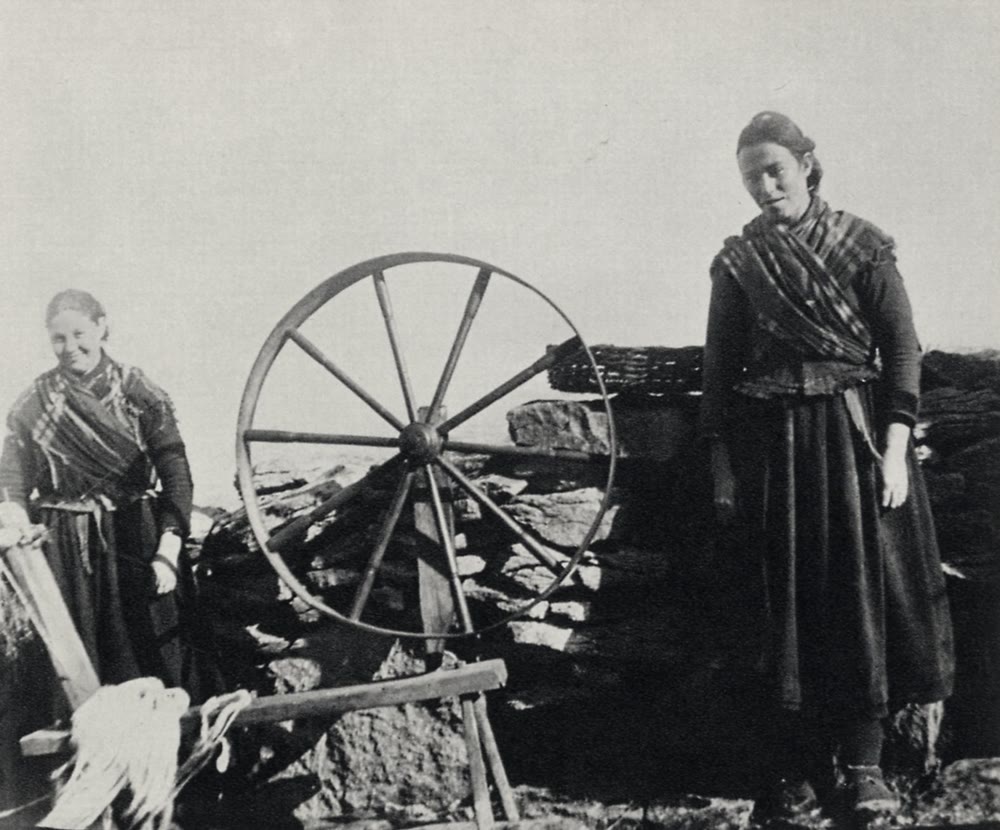
Two women with a spinning wheel on the Aran Islands, photographed by J. M. Synge around 1898. Public domain, via Wikimedia Commons
The three islands are Inis Mór (IN-ish MORE), also called Árainn (AW-rin), Inis Meáin (IN-ish MAWN) and Inis Oírr (IN-ish EER). Two common slips online:
- Aran, not Arran. The Isle of Arran is in Scotland, and Arranmore, Árainn Mhór (AW-rin WORE), lies off Co. Donegal.
- Keep the fadas. It’s geansaí Árann and Inis Oírr, not “geansai Arann” or “Inis Oirr”.
How the Aran sweater really began
Knitting reached Ireland some time in the 1600s, and by the 18th century knitted socks and stockings were a cash earner for thousands of homes, the National Museum of Ireland says. But other knitted garments weren’t traditional Irish dress: until the early 20th century, people preferred woven wool and linen.
That fits what the playwright J. M. Synge saw on Inis Meáin in 1898, a visit he wrote up in The Aran Islands (1907). The men wore homespun flannel, waistcoat over waistcoat, from yarn the women spun from their own sheep. Of jerseys, he wrote:
“In Aranmor many of the younger men have adopted the usual fisherman’s jersey, but I have only seen one on this island.”
Aranmor is Inis Mór. So in 1898 a jersey was still a rarity on Inis Meáin, let alone a patterned one.
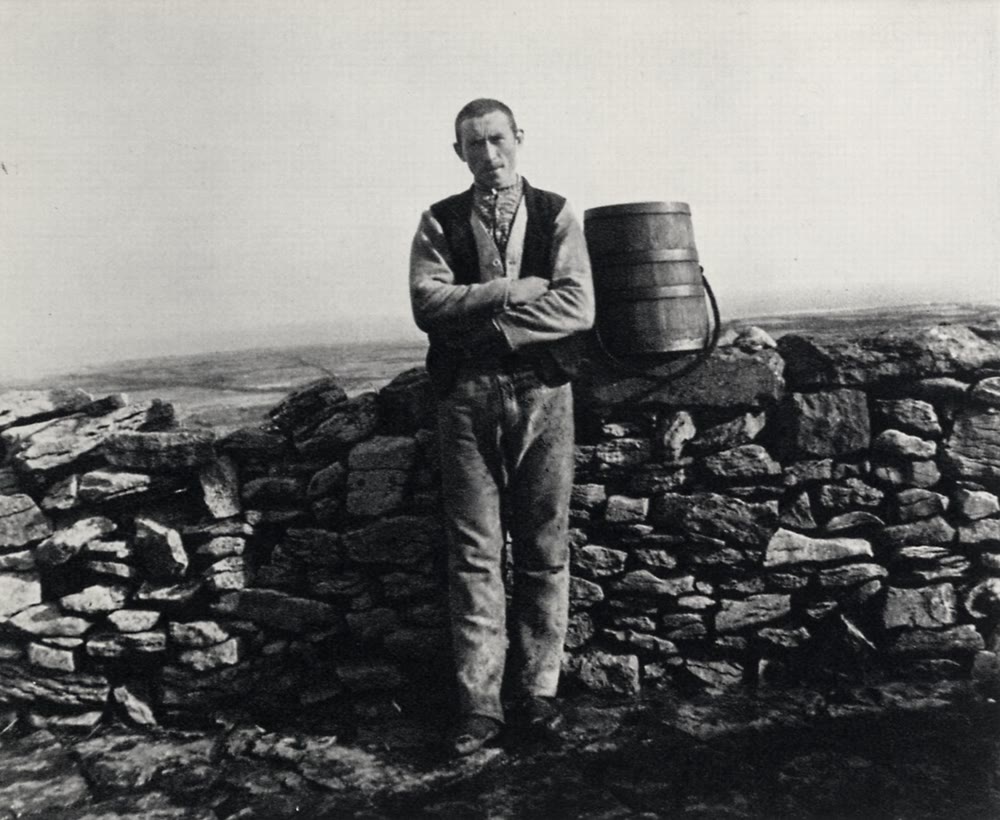
An islander on Inis Meáin in a waistcoat and homespun clothes, photographed by J. M. Synge around 1898. Public domain, via Wikimedia Commons
Change came with outside help. The Congested Districts Board, set up in 1891 to fight poverty in the west, encouraged knitting and weaving for sale, say both the National Museum and the Victoria and Albert Museum. The museum links the Aran’s stitches to the jumpers of Scottish and Channel Island fishermen.
Mary Burke, an English professor at the University of Connecticut, writes that islanders adapted the ganseys worn by British fishermen who arrived with an early 20th-century fisheries scheme and, citing Elizabeth McCrum, that returned emigrants brought patterns home from Boston.
The V&A says the Board trained knitters in more complex patterns, and that the islanders swapped dark, oiled wool for thick undyed yarn. Texture spread over the whole garment. The National Museum adds that the knitters lived not only on Aran but in many other places, especially along the west coast. The exact date is still argued, but the cabled Aran is a 20th-century creation.
The 1930s: from island craft to shop window
Muriel Gahan, a campaigner for rural crafts, ran The Country Shop in Dublin, on St Stephen’s Green, which opened in the early 1930s (1931, says the National Museum; some accounts say 1930). The museum calls it the first shop to sell Aran jumpers as a retail product. It sold the knitters’ work for 48 years, and Gahan urged them to keep adding new stitches. Ó Máille’s (oh MAWL-yuh) in Galway was selling them by the late 1930s.
The writer Clara Vyvyan, who first visited in the 1930s, described the knitters improvising their patterns “as a musician will improvise on some simple melody.” As more women took up the work, the museum says, the designs grew more intricate.
Among the early pieces in the museum’s folklife collection are a red Aran cardigan knitted for the museum in 1937, with diamond, blackberry and sheaf-of-wheat stitches, and a cream jumper from 1940, given in 1942 by the Irish Homespun Society, which Gahan founded.
The drowned fisherman myth: where it really came from
Knitting historians treat the story of family patterns identifying drowned fishermen as a myth, and island makers doubt it too. Tarlach de Blácam (TAR-lukh duh BLAW-kum), owner of the Inis Meáin Knitting Company, told Tourism Ireland that “most families would have had their own patterns”, yet he believes the drowned-fisherman story is untrue. The Irish Times went further in 2018: “family” patterns of the sort visitors ask for, an O’Flaherty Aran, say, don’t exist.
Riders to the Sea: a stocking, not a sweater
The Irish Times traces the tale to a “careless reading” of Synge’s one-act play Riders to the Sea, first staged in Dublin in 1904. It’s set on “an Island off the West of Ireland”, usually taken to be Inis Meáin. Old Maurya has lost her husband and most of her sons to the sea. Clothes from a man drowned in faraway Donegal arrive, and her daughters must decide whether they’re their brother Michael’s.
A scrap of shirt flannel proves nothing, Cathleen says, since the Galway shops sell great rolls of that cloth. Then Nora counts the stitches in a plain stocking she knitted herself:
“It’s the second one of the third pair I knitted, and I put up three score stitches, and I dropped four of them.”
That’s the whole identification: a plain stocking, known by its stitch count. No family pattern, no cables, no jumper. The last scene is full of keening, the old lament for the dead, which I’ve covered in my guide to Irish wake traditions.
Synge drew on a real event, recorded in The Aran Islands. When a body washed ashore in Donegal, a drowned islander’s sister recalled all she could of her brother’s clothes: his purse, his tobacco box, his stockings. Again, no patterned jersey.
Why the story won’t die
The researcher Siún Carden (SHOON), writing in the journal Costume in 2014, argues that the tale endures because it speaks to kinship, belonging and emigrant longing. The V&A says similar tales, of British fishermen whose home towns could be read from their ganseys, belong to knitting mythology too.
Some shops now sell “clan” Arans matched to surnames, and at least one seller says it displays a register of historic family patterns. Enjoy a clan Aran as a modern gift, but it isn’t an island custom revived. For your family name, my guide to Irish surnames is a better place to start.
Heinz Kiewe and the “ancient” Aran
The other big myth is age: that Aran stitches go back to the monks or the druids. Much of that traces to Heinz Edgar Kiewe, a German-born textile writer who ran Art Needlework Industries in Oxford. The V&A credits his campaign with helping Aran knitting sell to tourists in Dublin by the 1930s. In 1967 Kiewe published The Sacred History of Knitting, presenting Aran patterns as ancient and religious. According to Tourism Ireland, he even believed the Book of Kells pictured an Aran jumper.
Knitting historians, among them Richard Rutt in A History of Hand Knitting (1987), Alice Starmore and Vawn Corrigan, have rejected his theory. Rutt pointed out that Kiewe offered it as an intuition, not scholarship, before wool-industry publicity stretched it across millennia.
The trade leaned into romance too. In the late 1950s the former barrister Pádraig Ó Síocháin (PAW-rig oh SHEE-uh-khawn) commissioned drawings from the painter Seán (SHAWN) Keating for a brochure, Sculpture in Wool, which linked Aran designs to the knitters’ supposed Far Eastern ancestry and a great Celtic empire.
None of this makes the craft less impressive: as with many Celtic symbols, the skill is real and many of the meanings are modern.
Aran stitches and their meanings
As more women knitted from the mid-1930s, the National Museum says, some stitches picked up names and romantic meanings. Kiewe and, later, shop tags spread them. These are the meanings you’ll most often be told:
- Cable: a fisherman’s rope, and a wish for a good day at sea. Ó Dónaill gives the Irish for cable stitch as cor na péiste (kur nuh PAYSH-tchuh), literally the twist of the péist, a word for a worm, serpent or monster.
- Honeycomb: the busy bee, hard work and its sweet reward.
- Diamond: the small walled fields of the islands and a wish for wealth, or the mesh of a fishing net.
- Trellis or basket: stone walls, or a fisherman’s basket and the hope of a full catch.
- Zigzag: twisting cliff paths, or, as “marriage lines”, the ups and downs of married life.
- Trinity or blackberry stitch: clusters of bobbles said to stand for the Holy Trinity, the reading Christians also give the trinity knot. The name may simply describe the method: three stitches made from one, then three worked together as one.
- Tree of life: family and long life; see my guide to the Celtic tree of life.
- Moss stitch: growth, or the seaweed islanders spread on their fields as fertiliser. Tags sometimes call it Irish moss, the English name for carrageen, carraigín (KAR-ig-een; in Munster, kar-ig-EEN) in Irish.
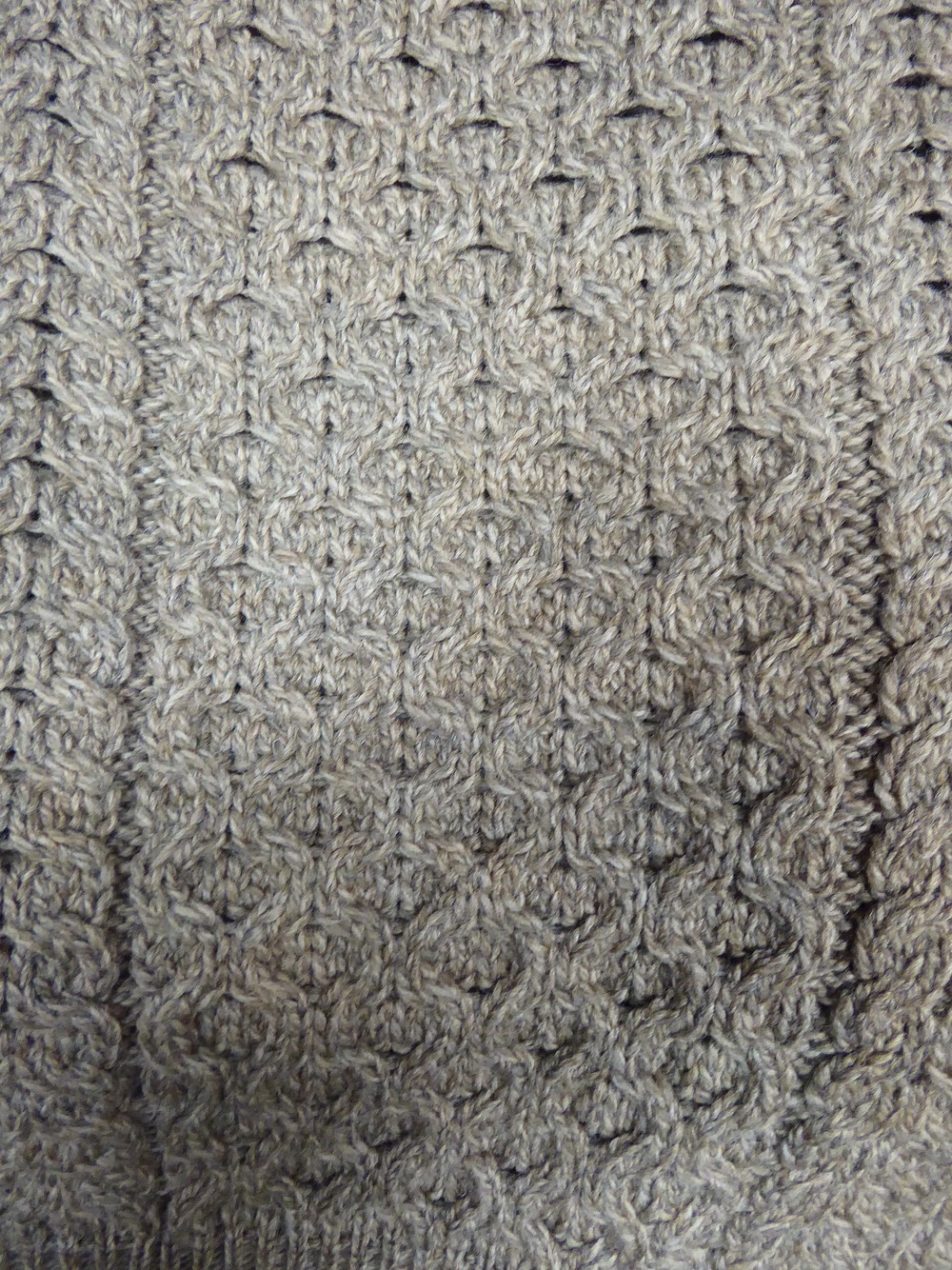
Honeycomb stitch on the centre panel of an Irish Aran sweater. Photo: Ww2censor, CC BY-SA 4.0, via Wikimedia Commons
There’s no evidence of an older system behind these, and sellers don’t even agree: one tag’s diamond means wealth, another’s a fishing net. Choose the pattern that speaks to you.
The Clancy Brothers and the 1960s boom
By the 1950s the Aran was going global. American visitors poured into Ireland as air travel grew, Mary Burke writes, and Steve McQueen, Grace Kelly and Marilyn Monroe were all pictured in Aran or Aran-style knits.
Then came television. On 12 March 1961, on a St Patrick’s-themed Ed Sullivan Show, the Clancy Brothers and Tommy Makem had been booked to sing one song. Another act cancelled, and they ended up performing for more than ten minutes, NPR recalled. They wore thick white Aran sweaters.
As Irish America magazine and Tourism Ireland both tell it, their mother, Johanna, had sent the sweaters over to keep her boys warm through a New York winter. They became the group’s trademark. Some of their best-loved recordings are in my list of St Patrick’s Day songs.
The National Museum credits the Clancys with helping to fuel a huge export push to America from the 1960s. Ó Síocháin’s company, Galway Bay Products, for one, supplied knitters with wool, taught them to work to standard sizes and sold their work as far away as Japan.
The money mattered. By 1963 one Galway Aran business had more than 500 home knitters, Burke writes, and a government-commissioned study found that for some farm households in the west’s Irish-speaking districts, the wife’s knitting earned more than the land. By 1973, though, a survey found some tourists thought Arans “bulky and unfashionable”. Burke’s article on RTÉ Brainstorm follows the story to Taylor Swift’s Folklore photoshoot in 2020.
Aran sweaters in museums
To see early Arans, visit the National Museum of Ireland, Country Life, at Turlough Park near Castlebar, Co. Mayo. Admission is free. Its 2008 exhibition Romantic Stitches and Realist Sketches told the Aran’s commercial story. Check what’s on display before you travel.
In 2017 an Aran went to New York. The Museum of Modern Art’s exhibition Items: Is Fashion Modern? (1 October 2017 to 28 January 2018) chose 111 garments and accessories that shaped the past century, from Levi’s 501s to the little black dress. Its Aran was that 1940 jumper from Turlough Park.
How to tell a hand-knit Aran from a machine-knit
Most Arans in tourist shops are machine-made, the Irish Times notes, and some are made outside Ireland. Here’s how to tell what you’re holding:
- Read the label. “Hand knitted” means needles and hands. “Hand loomed” means a knitter working a hand-operated knitting machine: skilled, but not hand-knitting. “Aran style” describes the look, not where or how it was made.
- Feel the weight. A hand-knit is usually denser and heavier, with cables in deep relief. Machine knits tend to be lighter and flatter.
- Study the patterns. Hand-knits often combine many different panels, bobbly trinity stitch included. Simple repeated cables are more typical of machines.
- Look inside. Many machine-made sweaters are cut from knitted fabric and sewn, leaving overlocked edges at the seams. A hand-knit is shaped as it’s knitted.
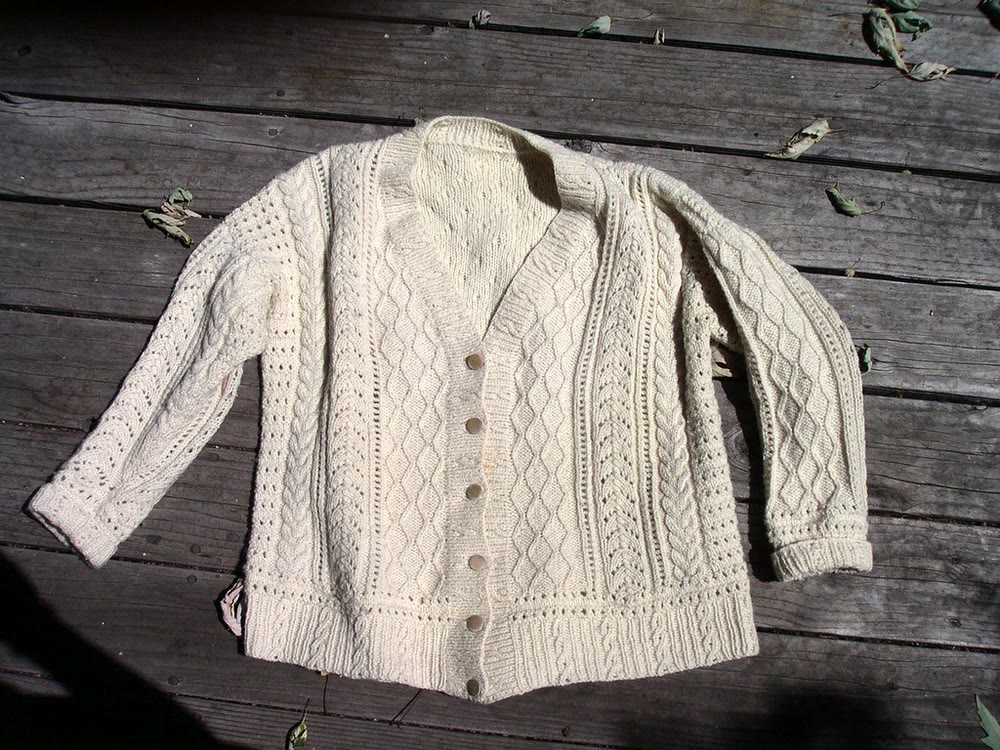
A cream Aran cardigan with cable, diamond and openwork panels. Photo: Lisa Dusseault, CC BY 2.0, via Wikimedia Commons
No single test is foolproof; the best hand-loomed sweaters are hard to tell from hand-knits. Price is often the giveaway. Tourism Ireland notes that one Aran may contain as many as 100,000 stitches, and Ó Máille’s in Galway says each of its hand-knits takes hundreds of hours.
How to wash and care for an Aran sweater
Tourism Ireland says early Arans were made of unscoured wool, which kept out the rain. Whatever yours is made of, check the care label first. Here’s the Woolmark Company’s advice in short:
- Wash less. Wool resists odours and stains, so a good airing often does the job.
- Machine wash only if the label allows it. Turn it inside out, or put it in a laundry bag, add wool detergent and choose the wool cycle, or a cold or delicates wash.
- To hand wash, soak it for about 10 minutes in lukewarm water with wool detergent, rinse well in lukewarm water, then rinse again in cold.
- Dry it flat on a clean, pale towel, eased back into shape, away from direct sun and radiators. Hanging a wet knit stretches it.
- Store it folded, clean and not hung, in a breathable cotton bag, with cedar rather than mothballs.
Buying an Aran sweater: makers and prices
- Check where it was made. Look for “made in Ireland” on the label. Guaranteed Irish assesses businesses on jobs, community and provenance, so its mark alone doesn’t prove a sweater was knitted in Ireland. Design & Crafts Council Ireland lists Irish makers in its directory.
- Buy from makers with real Irish roots. The Aran Sweater Market on Inis Mór sells traditional styles, though its history page still tells the drowned-fisherman legend. The Inis Meáin Knitting Company has designed and hand-finished knitwear on its island since 1976. Ó Máille’s on Galway’s High Street, whose family tailored many costumes for The Quiet Man, says it works with more than 100 home knitters.
- Know the price ranges. In October 2026, one large Irish online retailer priced most machine-knit adult Arans at about US$70 to US$180, and adult hand-knits at about US$145 to US$250. Inis Meáin’s designer knitwear ran from just under €200 to about €1,500.
- Check the measurements. Sizing varies between makers, so compare them with a sweater you already own.
- Order early. US Thanksgiving falls on 26 November in 2026; for a hand-knit from Ireland in time for the holidays, check the maker’s delivery dates first.
For more ideas, see my traditional Irish gifts and Irish Christmas gifts guides. To buy one on the islands themselves, ferries sail from Rossaveel all year, with seasonal boats from Doolin; my Wild Atlantic Way guide has more.
Aran sweater FAQ
Were Aran sweaters used to identify drowned fishermen?
There’s no evidence they were. The idea seems to come from a misreading of Synge’s play Riders to the Sea (1904), where the family recognise a drowned man by a hand-knitted stocking, not a patterned sweater.
How old is the Aran sweater?
About a century. The cabled style developed in the early 20th century, and The Country Shop in Dublin was selling Arans by the 1930s.
Is an Aran sweater the same as a fisherman sweater?
It grew out of the plain jerseys and ganseys fishermen wore, hence the name. But the heavily cabled cream Aran is a 20th-century creation that won its fame as knitwear made for sale.
What do the stitches on an Aran sweater mean?
Popular meanings include luck at sea for the cable, hard work for the honeycomb, wealth for the diamond and family for the tree of life. They’re 20th-century traditions, not an old island code.
How do you say Aran sweater in Irish?
Geansaí Árann (GAN-see AW-run). You’ll also hear báinín (BAW-neen) for the cream wool.
Love this? Save it to your Pinterest board for later.
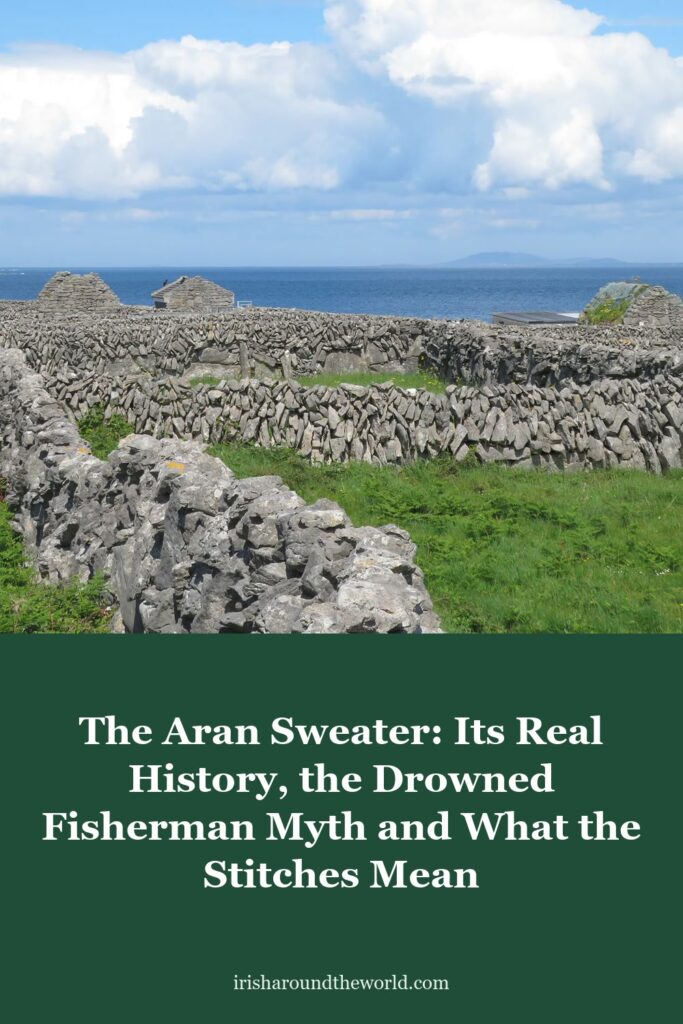
Pin image: Dry stone walls and small stone barns on Inis Meáin, Aran Islands. Photo: Gordon Hatton, CC BY-SA 2.0, via Wikimedia Commons
A little bit of Ireland in your inbox every Friday ☘️
The free Weekly Dose of Irish: an Irish joke, a Celtic symbol, an Irish fact, a poem and the week’s best articles in one short email. Join 9,600+ readers.
Free. One short email every Friday. Unsubscribe any time.
More Irish heritage reading
- Traditional Irish Gifts for Every Occasion (and the Stories Behind Them)
- 20+ Celtic Symbols and Their Meanings Explained
- Celtic Tree of Life (Crann Bethadh): Meaning, History and Symbol
- Irish Surnames: Meanings, Origins and the Top 100 Names in Ireland
- Irish Wake and Funeral Traditions: Keening, Clay Pipes and What to Say
Featured image: Dry stone walls and small stone barns on Inis Meáin, Aran Islands, looking out to sea. Photo: Gordon Hatton, CC BY-SA 2.0, via Wikimedia Commons.