
Irish soda bread is a quick bread raised with bread soda (bicarbonate of soda) and buttermilk instead of yeast. The everyday loaf has just four ingredients: flour, bread soda, salt and buttermilk. A soda bread recipe was in print in Ireland by 1836, and by the later 1800s it was the daily bread of country kitchens, often baked in a pot oven over the fire. This recipe makes one round loaf in about 50 minutes.
Shape the dough into a round, take a floured knife and cut a deep cross across the top. The Schools’ Collection, the folklore gathered by Irish schoolchildren in the 1930s, records the reasons people gave: to bless the bread, to help it bake, and to keep the fairies from taking it.
The recipe comes first, in metric and US cups, with brown bread, spotted dog and griddle farl variations. Then the history, from an 1836 newspaper recipe to the sweet American loaf. For a yeasted fruit bread, see my barmbrack recipe.
Jump to:
- Irish soda bread recipe
- Troubleshooting
- Storing and freezing
- What to serve with soda bread
- Is soda bread really Irish? A short history
- Baking in the bastible over the fire
- Why soda bread has a cross on top
- Farls or a round cake: the Ulster way
- Spotted dog, currants and caraway
- American Irish soda bread: how it differs
- Irish soda bread FAQ
- More Irish recipes and food history
Irish soda bread recipe (white soda bread)
This is the plain white loaf of an Irish farmhouse table.
Prep: 10 minutes | Bake: 35 to 40 minutes | Makes: 1 round loaf, about 10 slices
Ingredients
- 450g (about 3¾ US cups, spooned and levelled) plain flour, called all-purpose flour in the US, plus extra for dusting
- 1 level teaspoon bread soda (bicarbonate of soda, called baking soda in the US)
- 1 level teaspoon fine salt
- 350 to 425ml (1½ to 1¾ US cups) buttermilk
Method
- Heat the oven to 230°C (450°F), or 210°C with a fan. Dust a baking sheet with flour.
- Sieve the flour, bread soda and salt into a large, wide bowl and toss them together with your fingers.
- Make a hollow in the middle and pour in about 350ml (1½ cups) of the buttermilk.
- Hold one hand like a stiff claw and stir in wide circles from the centre out, drawing the flour into the milk. Add more buttermilk, a splash at a time, until there is no dry flour left. The dough should be soft and slightly sticky, not wet.
- Tip it onto a floured worktop. Do not knead. With floured hands, tuck the edges underneath, turn it over and pat it into a round about 4cm (1½ inches) high.
- Lift it onto the baking sheet. Cut a deep cross across the top with a floured knife, right out to the edges and about halfway down.
- Bake for 15 minutes, then turn the oven down to 200°C (400°F), or 180°C fan, and bake for another 20 to 25 minutes. It’s done when well browned and the base sounds hollow when tapped.
- Cool on a wire rack. Wrap it in a clean tea towel while it cools for a soft crust, or leave it bare for a crisp one.
Tips
Work fast and lightly. Bread soda starts reacting the moment it meets the buttermilk, so get the loaf into the hot oven straight away. Kneading makes it tough. The 1836 Newry recipe wanted the dough as soft as could be handled, “the softer the better”.
No buttermilk? University of Illinois Extension’s swap is 1 tablespoon of lemon juice or white vinegar topped up with milk to make 1 US cup (240ml), left to stand for 5 minutes. Make about 1¾ cups for this loaf.
Measure the soda carefully. Too much gives a soapy taste, and lumps of soda leave yellowish specks. Use a level spoon and sieve it with the flour.
Bastible style. To copy the old pot oven, bake the loaf in a preheated, lidded cast-iron casserole for 30 minutes, then uncover it for 10 to 15 minutes to brown.
Variations
- Brown soda bread (arán donn, roughly AH-rawn DOON in Connacht, uh-RAWN DOWN in Munster): use 400g (about 3⅓ US cups) coarse wholemeal flour and 75g (about ⅔ cup) plain flour, the same soda and salt, and about 425ml (1¾ cups) buttermilk. Shape a round and cut the cross, or use a greased 900g (2 lb) loaf tin. Bake 15 minutes at 230°C (450°F), then 30 to 35 minutes at 200°C (400°F). In the US, stone-ground whole wheat flour is the closest match.
- Spotted dog: stir 1 to 2 tablespoons of sugar and 75 to 100g (½ to ⅔ cup) of currants, raisins or sultanas into the flour. Beat 1 egg in a jug and make it up to 400ml (1⅔ cups) with buttermilk. Bake 10 minutes at 220°C (425°F), then 25 to 30 minutes at 200°C (400°F), since the egg browns faster. For a seed loaf, add 1 to 2 teaspoons of caraway.
- Soda farls: heat a dry griddle or heavy frying pan over a medium-low heat and dust it with flour. Flatten the dough into a circle 2cm (¾ inch) thick, cut it into quarters and cook for 8 to 10 minutes a side, until risen, golden and dry at the cut edges.
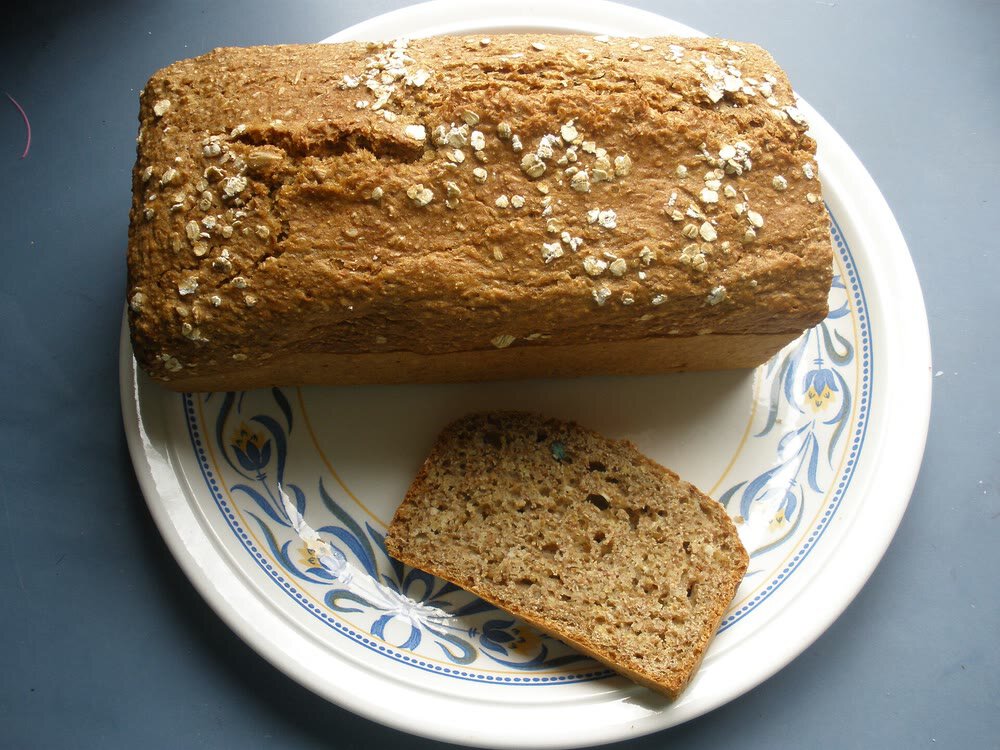
Home-made Irish brown soda bread, baked in a loaf tin and topped with oats. © O’Dea at Wikimedia Commons, CC BY-SA 4.0
Troubleshooting
- Flat and heavy: the dough was too dry or overworked, the soda was old, or the loaf sat around before baking.
- Doughy in the middle: it needed longer, or the round was too high. Cut the cross deeper.
- Spread sideways: too much buttermilk.
Storing and freezing soda bread
Soda bread is best the day it’s baked. It stales fast: a 1930s account from Templeglentan, Co. Limerick, says bread had to be made every other day at least, or it crumbled. Keep it in a tea towel or bread bin, and toast it after the first day.
It freezes well, whole or sliced. University of Illinois Extension gives baked quick breads 2 to 3 months at -18°C (0°F) for best quality.
What to serve with soda bread
- Salted butter and jam, with a pot of tea
- Soups and stews, such as my Irish stew or a beef and Guinness stew
- Smoked salmon, or a sharp cheddar
- Fried soda farls in an Ulster fry
- A bowl of colcannon
Is soda bread really Irish? A short history
Soda bread, arán sóide in Irish (AH-rawn SOH-jeh; Munster speakers say uh-RAWN), is younger than most people think. Note the spelling: sóide is the genitive of sóid, the Irish for soda, so it’s arán sóide, not “arán sóda”. Before bread soda, much Irish country bread meant oatcakes, potato cakes and boxty, with wheaten bread where wheat was grown.
The 1836 recipe
The earliest Irish soda bread recipe usually cited came from a correspondent to the Newry Telegraph. London’s Farmer’s Magazine reprinted it in 1836, and by July 1837 it had reached Philadelphia’s Journal of the Franklin Institute.
It’s essentially a brown bread: wheaten meal, salt, “super-carbonate of soda” and very sour buttermilk, shaped into a cake an inch thick and baked in a covered pan, with live coals laid on the lid. The writer called it “as wholesome food as ever entered man’s stomach”. A local gentleman ordered a sample baked, and the meal stocked for sale at the temperance soup and coffee rooms in Markethill, Co. Armagh.
By the 1840s, says the Oxford Companion to Food, bread soda was commonplace in Irish baking. The Encyclopaedia of Ireland (2003) calls soda bread daily fare in rural homes from the second half of the 1800s.
So soda bread was there before the Great Famine of 1845 to 1852, not born of it. Indian meal (maize), imported in bulk as Famine relief, also went into the soda bread mix as yellow-meal bread, arán buí (AH-rawn BWEE) in Irish.
Why soda suited Ireland
The Oxford Companion also notes that rural Ireland had no strong tradition of yeast baking, and that soda gives a reliable rise whatever the strength of the flour. The usual explanation adds that Ireland’s damp climate tended to grow soft, low-protein wheat that made poor yeast bread. Treat that as a generalisation: Teagasc trials show bread-quality wheat can be grown in Ireland today, though it yields less than feed wheat.
Buttermilk, bláthach (BLAW-hukh) in Irish, is the sour liquid left after churning butter, and any farmhouse with a cow had it. Add bread soda from the shop, and fresh bread took under an hour.
Baking in the bastible over the fire
Until the late 1800s, the Oxford Companion says, Irish home baking relied on a few simple utensils, chiefly the pot oven, or bastible, and the flat iron griddle. A bastible (also bastable) is a lidded pot, earthenware at first and later cast iron, often on three short legs, set in the embers or hung over the fire. The Oxford English Dictionary traces the word to Barnstaple in Devon. In Irish it’s a bácús (BAW-koos), Ó Dónaill’s word for both a bakehouse and a pot oven.
A 1930s account from Milford, Co. Donegal, describes pot-oven bread of flour, baking soda and buttermilk, cooked under a lid heaped with red-hot coals. In Ballyduff, Co. Waterford, the whole week’s baking was done in one day over a turf fire, in a bastable.
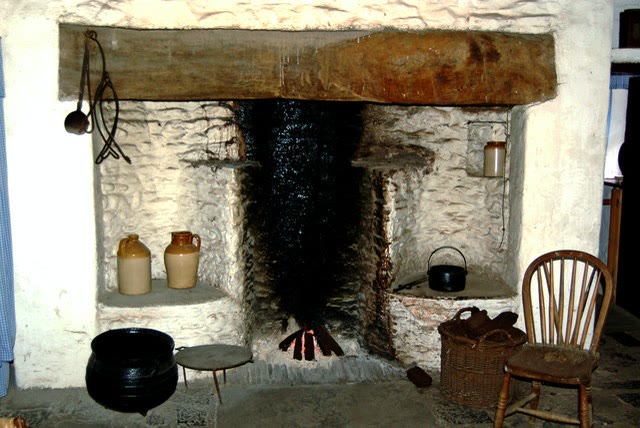
The open hearth of the byre dwelling at Bunratty Folk Park, Co. Clare, with iron pots by the fire. Photo: Joseph Mischyshyn, CC BY-SA 2.0, via Wikimedia Commons
Thinner cakes went on the griddle (grideall, GRIJ-ul). The bastable cake also turns up in custom: in one 1930s Co. Cork account, it was thrown at the back door on New Year’s Eve, part of the Irish New Year tradition of beating hunger out of the house.
Why soda bread has a cross on top
The practical reason: a deep cut lets heat reach the thick middle and gives the loaf room to open as it rises. Once baked, it breaks neatly into four. A Ballyduff, Co. Waterford, account gives much the same reasons, plus luck. In Glasdrumman, Co. Leitrim, the quarters let each person take a share.
The folklore: the Schools’ Collection also recorded these beliefs:
- In Errew, Co. Mayo, the cross blessed the work, helped the bread bake and kept the fairies away.
- In Drogheda, Co. Louth, a cross on Indian-meal bread kept away the devil and the fairies.
- In Dunshaughlin, Co. Meath, Ballyroddy, Co. Roscommon, and Clontuskert, Co. Galway, it stopped the fairies taking the cake. In Drumbeg, Co. Donegal, it kept them from spoiling it.
- In Templeglentan, Co. Limerick, a sword shape replaced the cross on May Eve and November Night, as fairies were thought unable to face weapons.
- In Facefield, Co. Mayo, it was for good luck.
You’ll often read today that the cross “lets the fairies out”. In the 1930s accounts above, it works the other way: the cross is a blessing that keeps the fairies off the bread.
Farls or a round cake: the Ulster way
South of the border, soda bread is usually baked as a round cake. In Northern Ireland it’s usually cut into four farls and cooked on a griddle or pan, and brown soda bread is known as wheaten, says CCEA, the Northern Ireland curriculum body. A soda farl in Irish is farla sóide (FAR-luh SOH-jeh).
Farl is a Scots word. The Dictionary of the Scots Language traces it to fardel, from the Old English for a fourth part. It means a quarter of a round oatcake, and in Ulster it was used for flour scones too.
Spotted dog, currants and caraway
Darina Allen of Ballymaloe Cookery School recalls in The Forgotten Skills of Cooking that, when she was a child, white flour was dearer than brown, which made a white loaf a treat. At harvest or threshing time, or when Sunday visitors were due, the woman of the house added sugar, dried fruit and an egg. The result was spotted dog, or railway cake. The Encyclopaedia of Ireland likewise notes that soda bread was enriched with dried fruit for festive occasions.
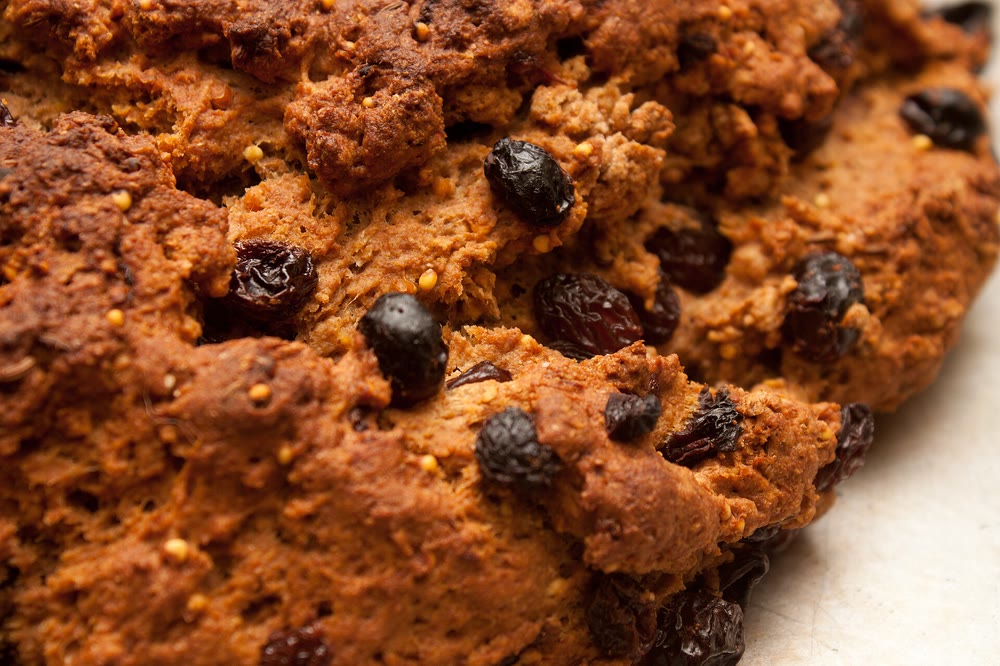
Caraway isn’t only an American habit. Ó Dónaill’s Irish dictionary has an entry for caraway seed cake, and 1930s accounts from Facefield, Co. Mayo, and Glasdrumman, Co. Leitrim, mention caraway in home baking. Allen writes that seeds and sultanas in soda bread went out of fashion in Ireland, while American loaves often keep both.
American Irish soda bread: how it differs
Buy Irish soda bread in a US bakery around St Patrick’s Day and you’ll often get something richer, with sugar, butter, eggs, baking powder, raisins and sometimes caraway. Entries from staff at Boston radio station WBUR in a 2011 bake-off follow that pattern, one with 1¼ cups of sugar. In Ireland, a loaf like that is closer to a spotted dog, or even a cake.
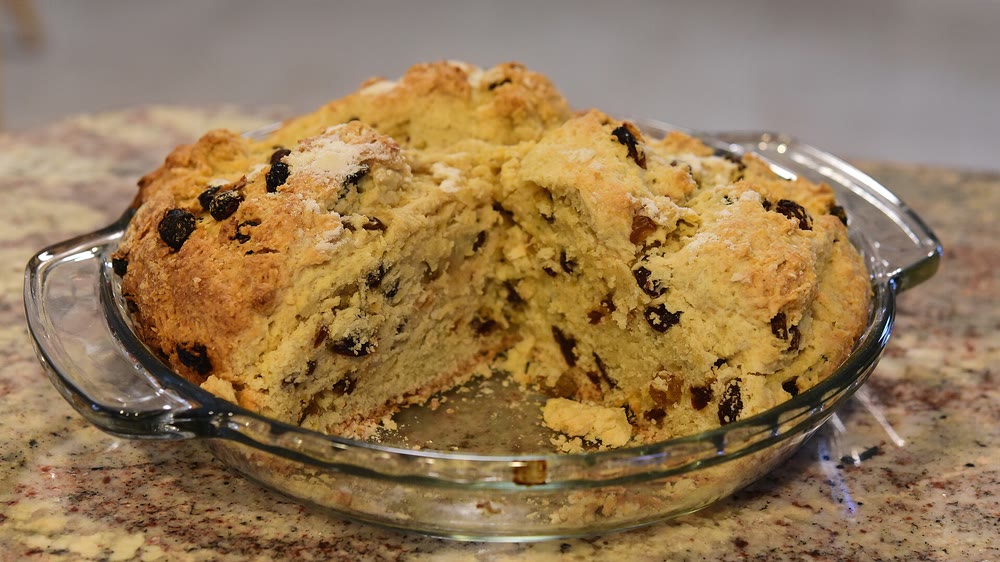
A raisin-filled soda bread baked for St Patrick’s Day. Photo: slgckgc, CC BY 2.0, via Wikimedia Commons
The Society for the Preservation of Irish Soda Bread, a US website run by Ed O’Dwyer, takes a firm line: four ingredients only, with dried fruit kept for holidays because it was dear. Its tagline sums it up: “In America it was Christmas every day.” It’s an enthusiast’s site, not a scholarly one, but its 1836 reference is genuine.
If your family loaf has raisins and caraway, it’s a real Irish-American tradition with roots in the Irish holiday loaf. It just isn’t what most Irish kitchens bake on a Tuesday.
Irish soda bread FAQ
What makes Irish soda bread different from regular bread?
It rises with bread soda and buttermilk instead of yeast, so there’s no kneading or proving. It’s in the oven within 10 minutes.
Why do you cut a cross in soda bread?
It helps heat reach the centre and lets the loaf open as it rises. In Irish folklore, the cross also blessed the bread and kept the fairies from taking it.
Do Irish people put raisins in soda bread?
Not in the everyday loaf. White soda bread with fruit, sugar and egg is a spotted dog or railway cake, traditionally kept for special days.
Can I make soda bread without buttermilk?
Yes. Put 1 tablespoon of lemon juice or vinegar in a cup measure, top up with milk to 1 US cup and leave for 5 minutes.
How long does Irish soda bread last?
It’s best on the day it’s baked and good for toast for a day or two after. Wrapped well, it keeps 2 to 3 months in the freezer.
Love this? Save it to your Pinterest board for later.
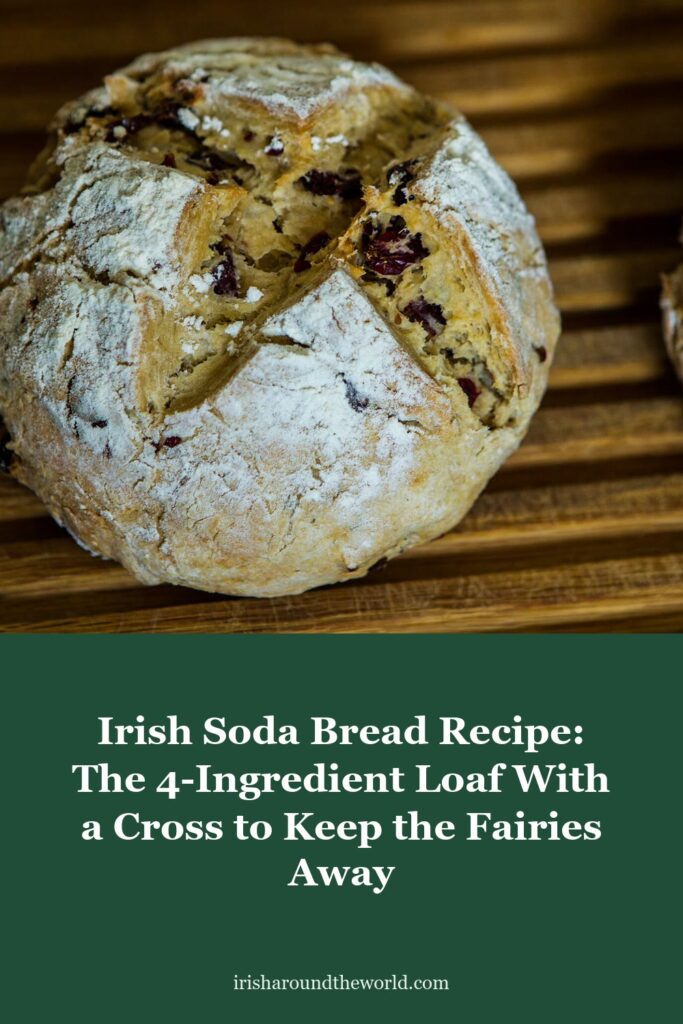
Pin image: A round Irish soda bread with a deep cross cut in the top, studded with dried fruit. Photo: Jim Lukach, CC BY 2.0, via Wikimedia Commons
A little bit of Ireland in your inbox every Friday ☘️
The free Weekly Dose of Irish: an Irish joke, a Celtic symbol, an Irish fact, a poem and the week’s best articles in one short email. Join 9,600+ readers.
Free. One short email every Friday. Unsubscribe any time.
More Irish recipes and food history
- Boxty Recipe: Traditional Irish Potato Pancakes
- Full Irish Breakfast: What’s In It and How to Cook It
- Irish Apple Cake Recipe With Bramley Apples
- Colcannon Recipe: The Irish Halloween Mash That Hides Your Fortune
- Barmbrack Recipe: The Irish Halloween Bread That Predicts Your Future
- Hearty Irish Stew Recipe For The Whole Family To Enjoy
- Beef and Guinness Stew by The Wonky Spatula
- Irish New Year Traditions: Bread at the Door, First Footing and More
- How to Celebrate St Patrick’s Day: 36 Ideas from an Irishman
- The Irish Potato Famine (An Gorta Mór): Ireland’s Great Hunger, 1845 to 1852
Featured image: A round Irish soda bread with a deep cross cut in the top, studded with dried fruit. Photo: Jim Lukach, CC BY 2.0, via Wikimedia Commons.