In short: an Ancestry DNA kit tests your saliva and compares your DNA with a database of nearly 30 million people. You get an ethnicity estimate, which can show Irish regions, and a list of DNA matches, who are often the real key to finding Irish relatives. Pair it with Ireland’s free online records, including the 1926 census released in April 2026.
This page contains affiliate links. As an Amazon Associate I earn from qualifying purchases, at no extra cost to you.
Ancestry DNA kits come up all the time in our Facebook group. Readers want to know how Irish they really are, which county their family came from, and whether a spit test can really answer that. There’s a lot of confusion, so here’s a plain guide: how the kits work, how accurate they are, what happens to your DNA, and how to use the results to trace your Irish roots.
Jump to
- How do Ancestry DNA kits work?
- How accurate are they?
- What a DNA test can tell you about Irish roots
- Is your DNA safe?
- Which kit should you buy?
- Free Irish records to use with your results
- FAQ
How do Ancestry DNA kits work?
- Order a kit and register it online with the activation code inside. Registering is important: it links the sample to your account.
- Spit in the tube up to the line. It takes a few minutes, and you shouldn’t eat, drink or smoke for 30 minutes beforehand.
- Post it back in the prepaid box.
- Wait for results. It usually takes several weeks once the lab receives your sample.
- Explore your results online: your ethnicity estimate, your DNA matches and, if you build one, your family tree.
How accurate are Ancestry DNA tests?
There are two parts to your results, and they’re accurate in very different ways.
- DNA matches are very reliable. If the test says someone is your second cousin, they almost certainly share a close common ancestor with you. Matches are the most useful part of the test for family history.
- The ethnicity estimate is just that, an estimate. It compares your DNA with reference groups from around the world. Percentages can shift when the company updates its reference panels, and it’s hard to separate closely related populations, such as Irish, Scottish and Welsh. Treat it as a broad picture, not an exact recipe.
What a DNA test can tell you about Irish roots
If you have Irish ancestry, your results may go further than just “Ireland”. Ancestry groups testers who share DNA into more specific communities, which can point to regions such as Munster or Connacht. That can narrow down where to look.
The real breakthrough usually comes from your matches. Many Irish Americans, Australians and Canadians find cousins who still live in the same parish their ancestors left. Look for matches with family trees, note the surnames and places that keep coming up, and get in touch. Our guide to Irish surnames and their meanings can also hint at which part of Ireland a name comes from.
Is your DNA safe?
It’s a fair question. When 23andMe filed for bankruptcy in 2025, a lot of people started thinking harder about who holds their genetic data. Before you test with any company:
- Read its privacy policy and check whether it shares data with third parties or law enforcement.
- Look at the research consent settings, and opt out if you prefer.
- Know that you can usually download your raw data and ask the company to delete your sample and results.
Which DNA kit should you buy?
For tracing Irish roots, Ancestry is the usual first choice, simply because its database is so large. In March 2026, genetic genealogist Leah Larkin reported it was approaching 30 million kits, bigger than the other genealogy DNA databases combined. More testers means more potential cousins.
- Best for most people: the AncestryDNA kit on Amazon, rated 4.6 stars from tens of thousands of reviews.
- If you’re curious about traits too: the AncestryDNA + Traits kit adds results on things like taste and hair.
DNA kits make a thoughtful gift for anyone with Irish roots. See more ideas in our traditional Irish gifts guide.
Free Irish records to use with your DNA results
DNA gives you clues; records turn them into a family tree. These are free:
- The 1926 census: released online free by the National Archives of Ireland on 18 April 2026, with more than 700,000 household returns. It records names, ages, birthplaces, occupations and whether people spoke Irish. See nationalarchives.ie.
- The 1901 and 1911 censuses: also free on the National Archives website.
- Civil records: births, marriages and deaths on irishgenealogy.ie.
- Catholic parish registers: digitised by the National Library of Ireland at registers.nli.ie.
- Northern Ireland: start with PRONI, the Public Record Office of Northern Ireland.
Visiting Dublin? The Irish Family History Centre at EPIC can help you in person. See our Dublin guide.
FAQ
Can a DNA test tell me which Irish county I’m from?
Not directly. It can sometimes point to a region, and your matches can lead you to a parish, but you’ll need records to confirm the county.
How long do Ancestry DNA results take?
Usually several weeks after the lab receives your sample, longer around Christmas when lots of kits are sold.
Is Ancestry or 23andMe better for Irish ancestry?
For finding relatives and building a family tree, Ancestry’s much larger database usually gives you more matches.
Keep exploring your Irish roots
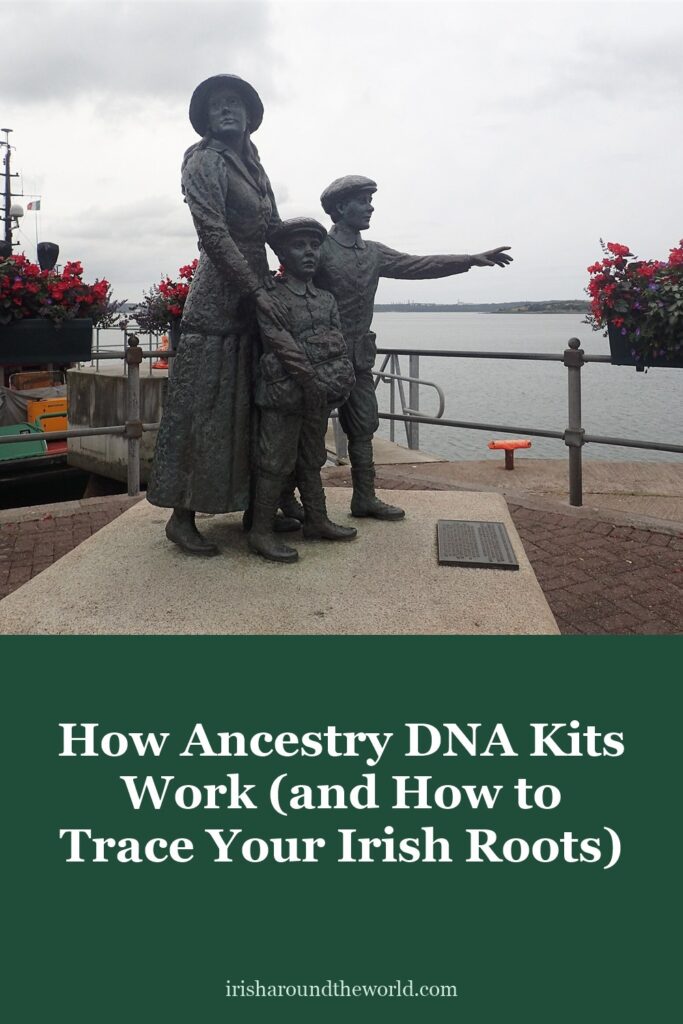
Featured photo: Annie Moore statue at Cobh by Marathon, licensed under CC BY-SA 2.0, via Wikimedia Commons. Annie Moore, from Cork, was the first immigrant processed at Ellis Island in 1892.
Love this? Save it to your Pinterest board for later.
A little bit of Ireland in your inbox every Friday ☘️
The free Weekly Dose of Irish: an Irish joke, a Celtic symbol, an Irish fact, a poem and the week’s best articles in one short email. Join 9,600+ readers.
Free. One short email every Friday. Unsubscribe any time.
Barbara Allyn Cain
Friday 17th of May 2019
Love this site.
JamieH
Thursday 1st of March 2018
Thanks a lot for the post.Really thank you! Much obliged.
ken
Saturday 17th of February 2018
A friend told me that when her husband was filling the tube with his saliva and he stepped out of the room for a moment she put a small amount of her cats saliva in the tube. She is hope the results will tell him he is the pussy she always thought he was.
Janice
Wednesday 3rd of January 2018
I did he test and it confirmed what I already knew. However, I’ve been told that you and your siblings will have different results, so I don’t put too much weight on the percentages. Also, I had a lot of “Great Britain” in me, but I wish it was broken down into Northern Ireland and England.
KAREN YOUNG
Sunday 17th of December 2017
The Ancestry DNA results verified my Irish ancestry! I was/am thrilled. I always thought I was mostly German because my paternal grandparents spoke fluent Pennsylvania Dutch...not so...the other majority of my DNA is Scandinavian. The 35% Irish Ancestry comes from my maternal grandfather. Through Ancestry matches, I met Unknown cousins, and obtained a picture of my Irish 3rd Great-grandparents!!! Karen