The Book of Kells (Trinity College Dublin MS 58) is a richly decorated Latin copy of the four Gospels, made around 800. Most scholars think monks of St Colm Cille’s community made it on Iona, at Kells in Co. Meath, or partly at each, though some argue for Northumbria or Pictland. It has 340 calfskin leaves and the famous Chi Rho page, and its blues are indigo: costly lapis lazuli was probably never used. Almost certainly the Gospel stolen from Kells in 1007 and stripped of its gold cover, it reached Trinity College around 1661 and is still on show there.
One night in 1007, thieves slipped into the great stone church at Kells, in Co. Meath, and carried off its most precious possession: a Gospel book in a gold-adorned cover. Two months and twenty nights later it turned up under a sod of earth. The gold was gone, but the book had survived.
That book is almost certainly the Book of Kells. Today close to a million people a year go to see it at Trinity College Dublin: 968,666 in 2024, according to Fáilte Ireland figures reported by Travel Extra.
I’ve written about the knotwork that fills its pages in my guide to Celtic knot meanings. Here’s the book itself: where it came from, who made it, what its colours really are, and how to see it, in Dublin or online.
Jump to:
- What is the Book of Kells?
- When and where was it made?
- Who made the Book of Kells?
- The Chi Rho page
- Other pages to look for
- The colours: what the artists really used
- Stolen in 1007: the theft and the lost cover
- How it came to Trinity College
- Book of Kells myths and mix-ups
- How to see the Book of Kells today
- Book of Kells FAQ
- More Irish heritage reading
What is the Book of Kells?
The Book of Kells is a handwritten copy of the four Gospels, Matthew, Mark, Luke and John, in Latin. Its text mostly follows St Jerome’s Vulgate translation, mixed with readings from an older Latin version, Trinity’s library explains.
Before the Gospels come canon tables, which line up passages shared by two or more Gospels, plus Gospel summaries and prefaces about the evangelists. Page after page is alive with spirals, animals, faces and knotwork, including the three-cornered knot now called the triquetra.
The pages are vellum, calfskin specially prepared for writing, and the script is a bold, rounded hand called insular majuscule. There are 340 leaves (folios), which makes 680 pages. Each now measures about 33 by 25.5 cm (13 by 10 inches), because the pages were heavily trimmed, and their edges gilded, when the book was rebound in the 1800s.
In Irish it’s Leabhar Cheanannais (LYOWR HYAN-uh-nish; in Ulster, LYORE HYAN-uh-nish), the book of Ceanannas (KYAN-uh-nus), the Irish name for Kells. The English name was first used by the scholar James Ussher (1581 to 1656), to tell apart two Gospel books linked with St Colm Cille, one at Kells and one at Durrow, writes Rachel Moss, professor of art history at Trinity.
When and where was the Book of Kells made?
Nobody knows for sure. Trinity says it must have been written close to the year 800, and Moss says art historians and handwriting experts mostly place it in the late 700s.
The community that owned it began on Iona, Í Cholm Cille (ee KHOL-um KIL-yuh) in Irish, a small island beside Mull, off Scotland’s west coast. The Annals of Ulster record Colm Cille (KOL-um KIL-yuh), also known as Columba, sailing there in 563, and his monastery became the head of a family of monasteries in Ireland and Scotland.
Then came the Vikings. The same annals record Iona burned in 802 and 68 of its community killed in 806. Meanwhile, in 804, Kells was handed over to Colm Cille’s community, and the annals note a new monastery being built there in 807, with its church finished in 814.
So where was the book made? Most scholars now favour the scriptorium on Iona, Trinity says, but there’s no way of knowing whether it was made wholly there, wholly at Kells, or partly at each. The main theories:
- Begun on Iona, finished at Kells. In 2018 Bernard Meehan, a former Keeper of Manuscripts at Trinity, was reported as arguing that John’s Gospel and the opening of Mark were written first, on Iona, and that Viking raids, and possibly an epidemic, held up the rest for about 50 years until it was finished at Kells.
- Northumbria. Some scholars have looked to northern England, home of the Lindisfarne Gospels.
- Pictland. In 2025 the art historian and archaeologist Victoria Whitworth proposed Portmahomack, a Pictish monastery in north-east Scotland. Digs there found the first known evidence for making parchment on a large scale in northern Europe, and Whitworth points to Pictish stones carved with designs like the book’s.
Here’s the puzzle, as Moss sets it out: if the book dates from the late 700s, it’s older than the monastery at Kells. She calls the Pictish case an important new possibility, though one that can’t be proved beyond doubt. What is certain is that the book was at Kells by the 11th century and stayed there until the 1650s, some 600 years or more.
Who made the Book of Kells?
Nobody who worked on the book signed it. Trinity’s experts see four main scribes copying the text and three artists painting the great decorated pages. The art historian Françoise Henry told those three apart in her 1974 study of the book, and they’re now known as the Goldsmith, the Illustrator and the Portrait Painter. The Goldsmith made the Chi Rho page, and his ornament is as minutely fine as metalwork, hence the name.
Some of the scribes had quirks. One left the decorated letters at the start of verses to an artist. Another, who may have worked last of all, wrote in bright reds, purples and yellows, and filled spare space by writing some passages out a second time.
Not everyone accepts that head count. Moss says the script is so uniform that even the number of scribes is unknown. And whether the scribes were also the artists is still an open question, Trinity says.
Beautiful, but full of mistakes
Turn from folio 218v to 219r and you’ll meet the same lines twice: a scribe copied them again by mistake, and the earlier copy on 218v was neatly cancelled with red crosses. Elsewhere letters and whole words go missing, where a scribe’s eye jumped ahead.
Slips like these, in such a lavish book, help explain why Trinity’s experts think it was made for show, brought out on great feast days such as Easter rather than read at everyday services.
The Chi Rho page
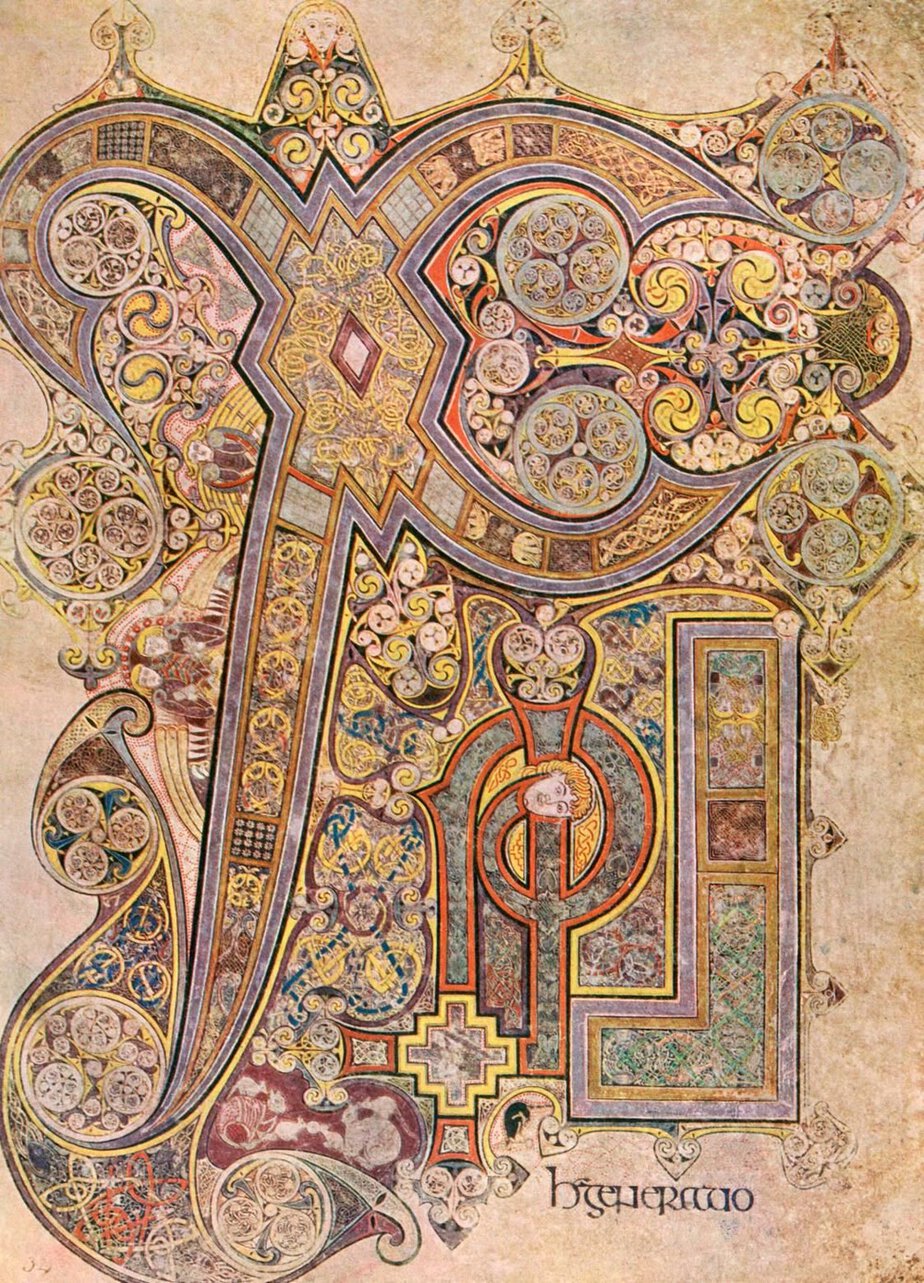
The Chi Rho page, folio 34r of the Book of Kells, Trinity College Dublin MS 58. Public domain, via Wikimedia Commons
Folio 34r is the star. Trinity’s library calls it “the single most famous page in medieval art”. It marks Matthew 1:18, where Matthew begins the story of Jesus’s birth.
In the Latin Vulgate that verse opens Christi autem generatio sic erat, “Now the generation of Christ was in this wise” in the old Douay-Rheims translation. Scribes abbreviated Christi as XPI, starting with chi (X) and rho (P), the first two letters of Christ’s name in Greek, as the National Museum of Ireland explains. Here the X fills almost the whole page, packed with swirling spirals like the triskele of far older Irish art.
Look closely and you’ll find a small zoo, says Trinity’s visitor website. Near the bottom an otter holds a fish, and two cats sit with mice that seem to be nibbling the Communion bread. Moths or butterflies hide under the upper arm of the X, and angels sit beside its long stroke as it sweeps down the left side of the page. If you know Pangur Bán (PANG-gur BAWN), the Irish poem about a monk and his white cat, the mouse-hunters will look familiar.
Other pages to look for
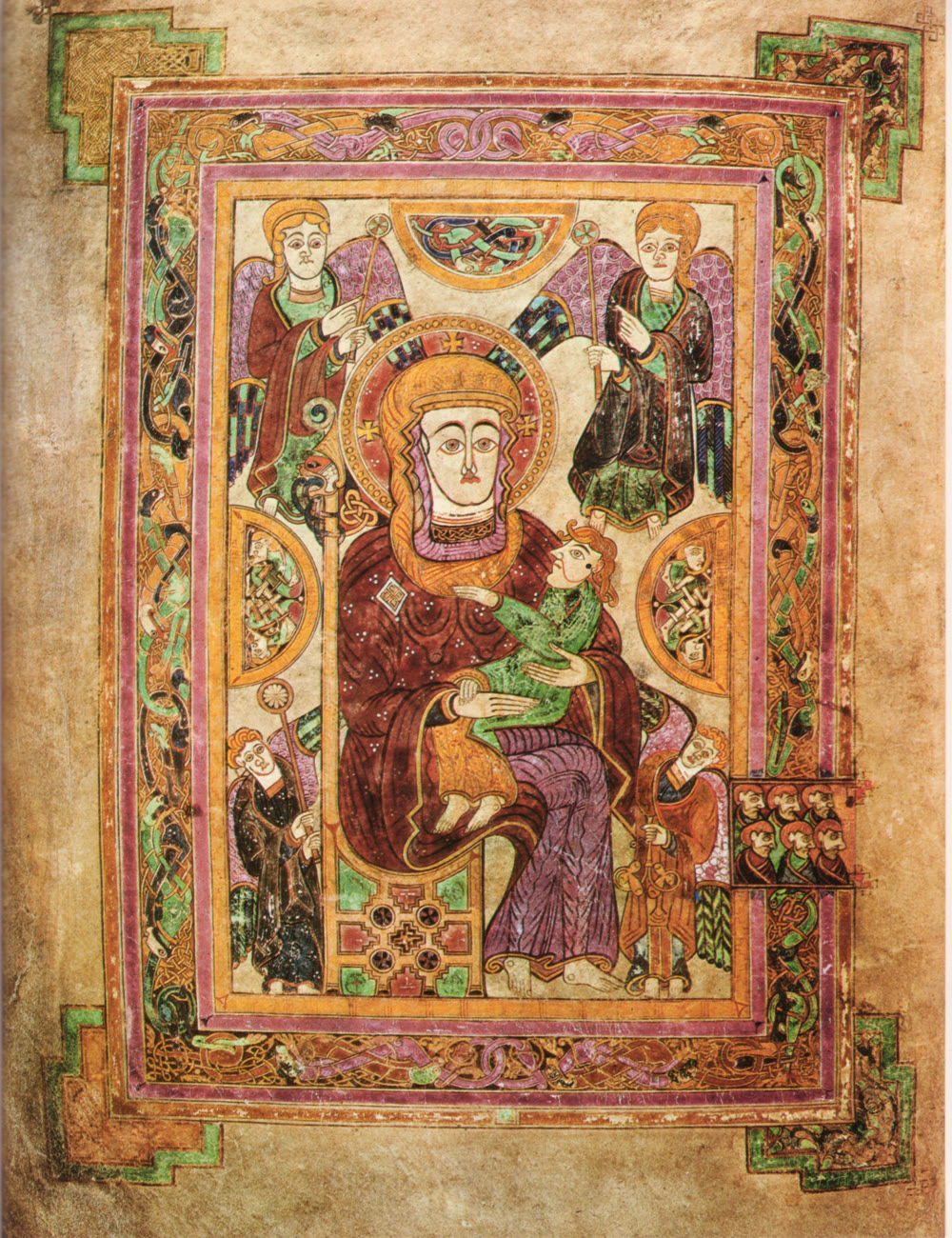
- The Virgin and Child (folio 7v): Mary on a throne with the infant Jesus on her knee and four archangels around them. It’s thought to be the oldest surviving image of the Virgin and Child in any Western manuscript, and it’s the book’s only major image of a woman.
- The four evangelist symbols (folio 27v): the Man for Matthew, the Lion for Mark, the Calf for Luke and the Eagle for John.
- Christ enthroned (folio 32v): a full-page portrait of Christ.
- The Arrest of Christ (folio 114r) and the Temptation of Christ (folio 202v): rare story scenes, among the earliest to survive in an Irish or British Gospel book.
- The missing portraits: Matthew and John have theirs, but none survives for Mark or Luke. They were probably on single leaves that came loose and were lost, like roughly 30 others over the centuries.
In the 11th and 12th centuries, later hands used blank spaces in the book to record the Kells monastery’s property deals, in Irish.
The colours: what the artists really used
The vellum alone was a huge investment: Moss cites an estimate of 159 calfskins for the surviving pages, some of very poor quality.
Between 2004 and 2006, Trinity researchers tested 681 spots across the four volumes with micro-Raman spectroscopy, a laser technique for identifying pigments. With later tests, here’s the palette:
- Blue: indigo, probably from woad, a dye plant grown in northern Europe since ancient times.
- Yellow: orpiment, a yellow arsenic sulphide. Yes, arsenic.
- Red and orange: red lead, plus organic reds that are still hard to identify.
- Green: vergaut, a mix of indigo and orpiment, and a copper green that reacted with damp and ate holes through some leaves.
- Purple: a dye made from lichens, called orcein or orchil, pinned down in later tests.
- White and black: gypsum for white, and carbon and iron gall ink for black.
Some colours are stacked: the painters laid up to three more pigments over an undercoat.
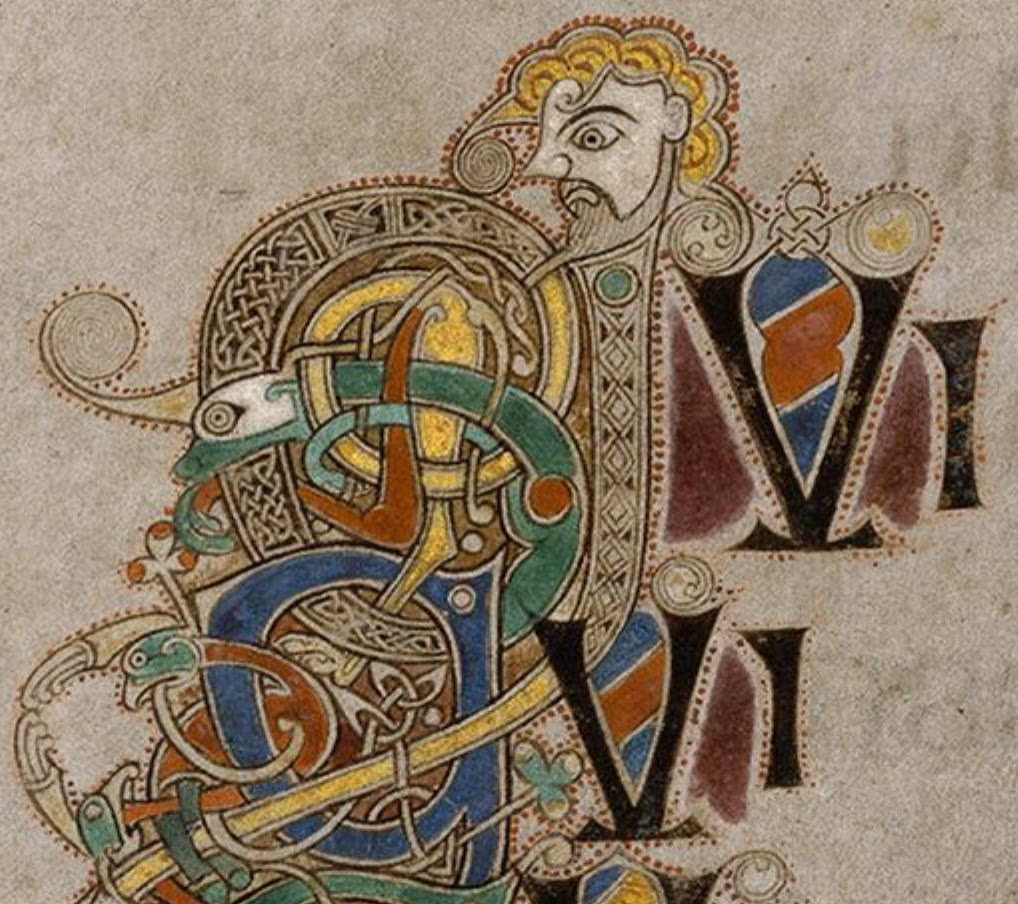
Detail from Luke’s list of Christ’s ancestors in the Book of Kells (Trinity College Dublin MS 58). Public domain, via Wikimedia Commons
The lapis lazuli myth
You’ll still read that the Kells blues are lapis lazuli, a costly stone from far-off Afghanistan. Research at Trinity suggests it was probably never used in the book at all.
Nor is there any gold on the pages. The painters blended pigments to imitate the gold and lapis lazuli they couldn’t get, Moss writes.
Stolen in 1007: the theft and the lost cover
In W. M. Hennessy’s 1887 translation of the Annals of Ulster, the great Gospel of Colm Cille was wickedly stolen by night from the west sacristy of the big stone church at Kells. Hennessy’s translation calls it “the chief relic of the western world, on account of its ornamental cover”.
It was found two months and twenty nights later, its gold stripped off, with a sod over it. The cover itself, a cumdach (in modern Irish cumhdach, KOO-dukh), was never recovered. Ó Dónaill’s dictionary still gives shrine and ornamental covering among its meanings.
Was the stolen Gospel the Book of Kells? Almost certainly. Hennessy identified it as such, and land records copied into the book show it was at Kells by the 11th century, so Moss judges it likely to be the same book.
You’ll see both 1006 and 1007 for the theft. The annals file it under 1006, but their dates at this period run a year behind, so historians usually correct it to 1007. Trinity’s library page keeps 1006.
How the Book of Kells came to Trinity College
Through the Middle Ages the book stayed at Kells, honoured as the great Gospel of Colm Cille and a relic of the saint.
After the 1641 rebellion, the church at Kells was a ruin. Around 1653 Charles Lambert, Earl of Cavan and governor of Kells, sent the book to Dublin to keep it safe.
Within a few years it was at Trinity, thanks to Henry Jones, who served the university as vice-chancellor and Cromwell’s army in Ireland as scoutmaster general, its intelligence chief. Trinity ties the gift to 1661, when Jones became Bishop of Meath. He also gave the college the Book of Durrow, an older Gospel book.
The book has been on show in Trinity’s Old Library since the mid-1800s. In 1953 the English bookbinder Roger Powell rebound it in the four volumes it has today, and in 2011 it was added to UNESCO’s Memory of the World register.
Book of Kells myths and mix-ups
- “St Colm Cille wrote it.” He died in the 590s, about two centuries before the book was made. It was his community’s treasure, not his handiwork.
- “The work of angels.” The phrase comes from Gerald of Wales, who in the 1180s saw a Gospel book at Kildare so intricate he judged it the work of angels, not men. The Kildare Archaeological Society says modern research suggests this was not the Book of Kells, though the two sound very alike. The Kildare book is lost.
- “It’s written in Irish.” The Gospels are in Latin, the language of the Western Church. The Irish in it comes from those later property records.
How to see the Book of Kells today
The book is at Trinity College Dublin, and you see it as part of the Book of Kells Experience. Trinity’s visitor site strongly recommends booking a timed ticket online and suggests allowing about 90 minutes.
- The Treasury: the Book of Kells itself, in the Old Library. The open pages are turned several times a year; in autumn 2026 they included the Virgin and Child (folio 7v). No photos.
- The Long Room: the Old Library’s famous barrel-vaulted hall upstairs. Most of its 200,000 or so books have been removed for conservation, except in the first four bays. The so-called Brian Boru harp is on show there too, though it probably dates from the 1400s, centuries after the high king died in 1014.
- The Red Pavilion: a temporary building in New Square, opened in 2024, with immersive digital galleries. Check your ticket: the Book of Kells and Old Library ticket doesn’t cover it.
Big changes are coming. The Old Library and Long Room stay open until the end of 2027, when restoration begins, says Trinity’s Old Library FAQ. During the work, the Book of Kells will move to the restored Printing House, elsewhere on campus. For the rest of the city, see my guide to things to do in Dublin.
See every page online, free
You don’t have to fly to Dublin. Trinity has put the whole manuscript online in its Digital Collections, free to browse. Trinity calls the images, rescanned from 1990 photographs, the next best thing to seeing the book in person.
Visiting Kells
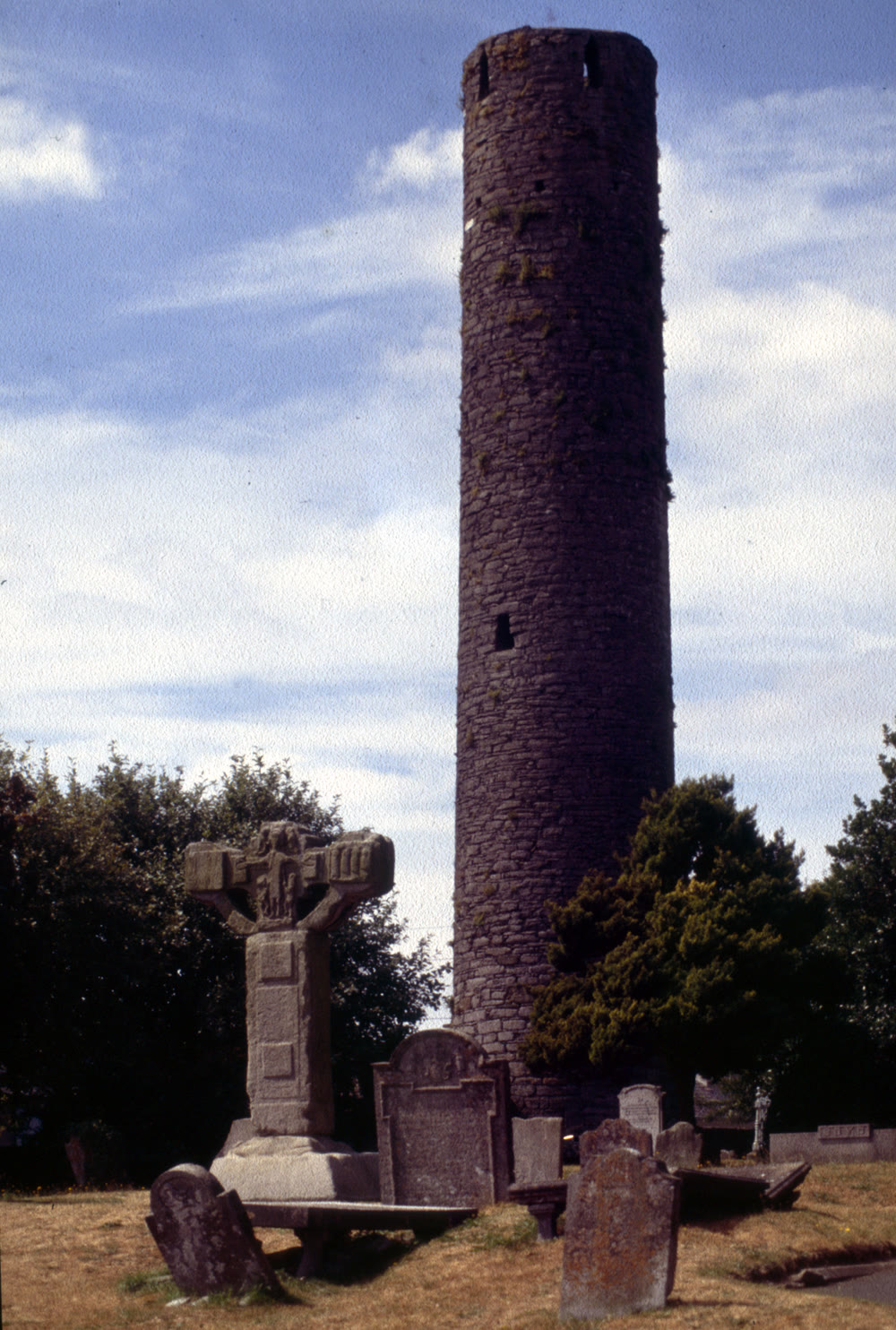
The round tower and a high cross at Kells, Co. Meath, in 1989. Photo: Gerd Eichmann, CC BY-SA 4.0, via Wikimedia Commons
Kells itself still has its monastic landmarks: a round tower first recorded in 1076, high crosses in the churchyard of St Columba’s Church, and St Colmcille’s House, an early stone oratory. Meath County Council’s heritage trail says the church holds a facsimile of the Book of Kells. Heritage Ireland currently lists the round tower site as closed for conservation works, so check before you travel. There’s more on the crosses in my guide to the Celtic cross.
The Secret of Kells
The book inspired The Secret of Kells (2009), Cartoon Saloon’s Oscar-nominated animated film about a boy who helps to finish a great illuminated book. Its white cat is called Pangur Bán, after the poem.
Book of Kells FAQ
How old is the Book of Kells?
About 1,200 years old. It was made around 800.
Where is the Book of Kells kept?
At Trinity College Dublin: in the Old Library until the end of 2027, then in the Printing House on campus while the Old Library is restored.
Can you see the Book of Kells online?
Yes. Every surviving page is free to view in Trinity College Dublin’s Digital Collections.
Why is it called the Book of Kells?
Because it was kept for centuries at the monastery of Kells, Co. Meath. In Irish it’s Leabhar Cheanannais.
How many pages does the Book of Kells have?
It has 340 folios, or 680 pages. About 30 more folios have been lost over the centuries.
Love this? Save it to your Pinterest board for later.
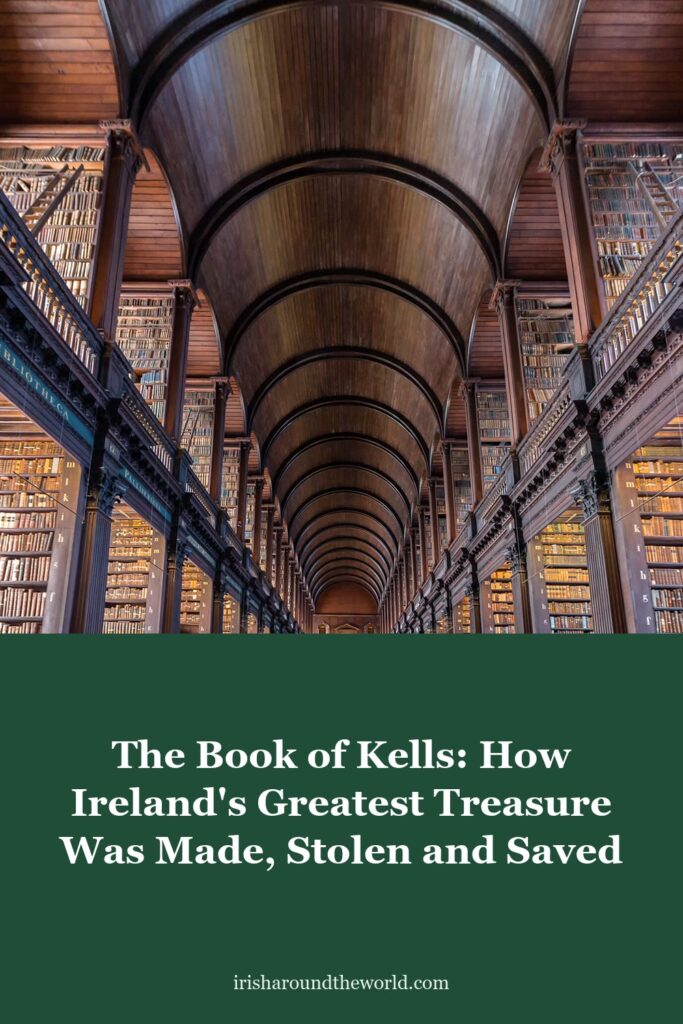
Pin image: the Long Room of the Old Library, Trinity College Dublin, in August 2017, before most of its books were removed for conservation. Photo: Rafesmar, CC BY-SA 4.0, via Wikimedia Commons.
A little bit of Ireland in your inbox every Friday ☘️
The free Weekly Dose of Irish: an Irish joke, a Celtic symbol, an Irish fact, a poem and the week’s best articles in one short email. Join 9,600+ readers.
Free. One short email every Friday. Unsubscribe any time.
More Irish heritage reading
- The Celtic Knot Meaning and the 8 Different Types Explained
- Triskele Meaning: The Triple Spiral from Newgrange to Today
- Triquetra Meaning: The Celtic Trinity Knot’s History and Symbols
- Pangur Bán: The 1,200-Year-Old Irish Poem About a Monk and His Cat
- The Celtic Cross: Meaning, History and Ireland’s Great High Crosses
- Things to Do in Dublin: 12 Best Sights, Day Trips and Tips
Featured image: the Long Room of the Old Library, Trinity College Dublin, in August 2017, before most of its books were removed for conservation. Photo: Rafesmar, CC BY-SA 4.0, via Wikimedia Commons.