Skellig Michael, Sceilg Mhichíl in Irish, is a 218-metre (715 ft) Atlantic rock about 12 km (7 miles) off the Iveragh Peninsula in Co. Kerry. Monks had settled there by the late 600s or early 700s, and over the following centuries built stone beehive huts, two oratories and a church, reached by 618 steps, with a hermitage or pilgrim station on the South Peak. Vikings raided it in 824. The community moved to Ballinskelligs on the mainland, probably in the 13th century. A UNESCO World Heritage Site since 1996, it played Luke Skywalker’s island in Star Wars. Boats land visitors from about mid-May to late September, weather permitting.
Imagine a jagged pyramid of rock jutting from the Atlantic, with no beach, no trees and no fresh spring. Near the top, about 180 metres (600 ft) above the waves, a cluster of stone huts shaped like beehives clings to a ledge. Monks built them without mortar, and most are still standing.
George Bernard Shaw, after a visit in 1910, called it an “incredible, impossible, mad place”. A century later, Star Wars cast it as Luke Skywalker’s hiding place.
I’ve covered the Kerry coast in my Wild Atlantic Way route guide. This is the full story of Skellig Michael: monks, Vikings, puffins, film crews, and how to visit.
Jump to:
- What is Skellig Michael?
- When did the monks arrive?
- The Viking raids
- The beehive huts
- The 618 steps
- The South Peak hermitage
- Why the monks moved to Ballinskelligs
- Pilgrims, lighthouses and UNESCO
- Puffins, gannets and storm petrels
- Skellig Michael and Star Wars
- How to visit Skellig Michael
- If you can’t land
- Skellig Michael FAQ
- More Irish heritage reading
What is Skellig Michael?
Skellig Michael is the larger of the two Skellig islands, steep sandstone peaks off the tip of the Iveragh Peninsula in south-west Kerry. The Office of Public Works (OPW), which cares for it, puts it 11.6 km (about 7 miles) from the mainland. Its smaller neighbour, Little Skellig, belongs to the gannets.
Its Irish name is Sceilg Mhichíl (SHKEL-ig vee-HEEL in Kerry; in Ulster the stress moves forward, closer to VIH-heel). Ó Dónaill’s dictionary defines sceilg as a steep rock or crag, and the Placenames Database of Ireland translates the full name as the steep rock of Michael, after the archangel.
The origin of sceilg is debated: the place-name scholar Paul Tempan argues it was borrowed from Latin spelunca, a cave, sometimes used of a hermit’s dwelling.
When did the monks arrive?
Nobody knows exactly. The OPW calls it St Fionán’s monastery, after a tradition first recorded by the historian Charles Smith in 1756. But no medieval source links Fionán (fih-NAWN) to the island.
Excavations from 1986 to 2010, published in 2011 (PDF) by Edward Bourke, Alan Hayden and Ann Lynch, found nothing earlier than the late 600s and concluded the monastery existed by the late seventh or early eighth century. The lowest layers and the huts themselves were never dug, though, and most studies place the foundation before 700.
Suibne of Scelig, a monk remembered on 28 April in the Martyrology of Tallaght, a calendar of saints compiled around 830, may have been a leading cleric there around 800.
Legend reaches further back. The medieval Book of Invasions says Ír (EER), a son of Míl (MEEL), whose sons were the legendary ancestors of the Gaels, pulled ahead of every ship as they rowed to Ireland. His oar snapped, he toppled backward and died the next night, and he was carried to Sceilg for burial. In the 1630s Geoffrey Keating told it differently: Ír drowned in a storm raised by Tuatha Dé Danann magic and was buried on Sceilg Mhichíl. Either way, it’s myth.
The name Michael probably came later. It first appears in the Annals of the Four Masters, compiled in the 17th century from older annals, for an Aed of Skellig Michael who died in 1044. The Annals of Inisfallen, probably kept at the time, call him plain Aed Sceilic. The excavators still allow a slight chance that Michael was there from the start.
A 13th-century Latin text by an Irish monk in Regensburg, Germany, explained the name with a legend: St Michael helped St Patrick drive the demons out of Ireland on this very rock. For the truth behind Patrick and the snakes, see the real story of St Patrick’s Day.
The Viking raids
Remoteness didn’t protect the monks. The Annals of Inisfallen record that in 824 Vikings plundered Scelec and carried off Étgal of Skellig, who starved to death as their captive. The Annals of Ulster say hunger and thirst. Some older books say 823, following the annals’ own dating.
A later propaganda history, The War of the Irish with the Foreigners, records a second, undated raid, probably ninth-century, that the excavators judge likely genuine.
The community survived. The Annals of Inisfallen note that Flann son of Cellach, abbot of Scelec, died in 882, so the monastery still had an abbot nearly 60 years after the first raid.
The beehive huts
The monks lived in beehive huts. In Irish each one is a clochán (KLOKH-awn; kluh-KHAWN in Kerry), which Ó Dónaill’s dictionary gives, among other senses, as an old stone structure or, in archaeology, a beehive hut.
They were built by corbelling: each ring of flat stones sits slightly inside the one below until a single capstone closes the top. There’s no mortar, yet they have shrugged off Atlantic storms for centuries.
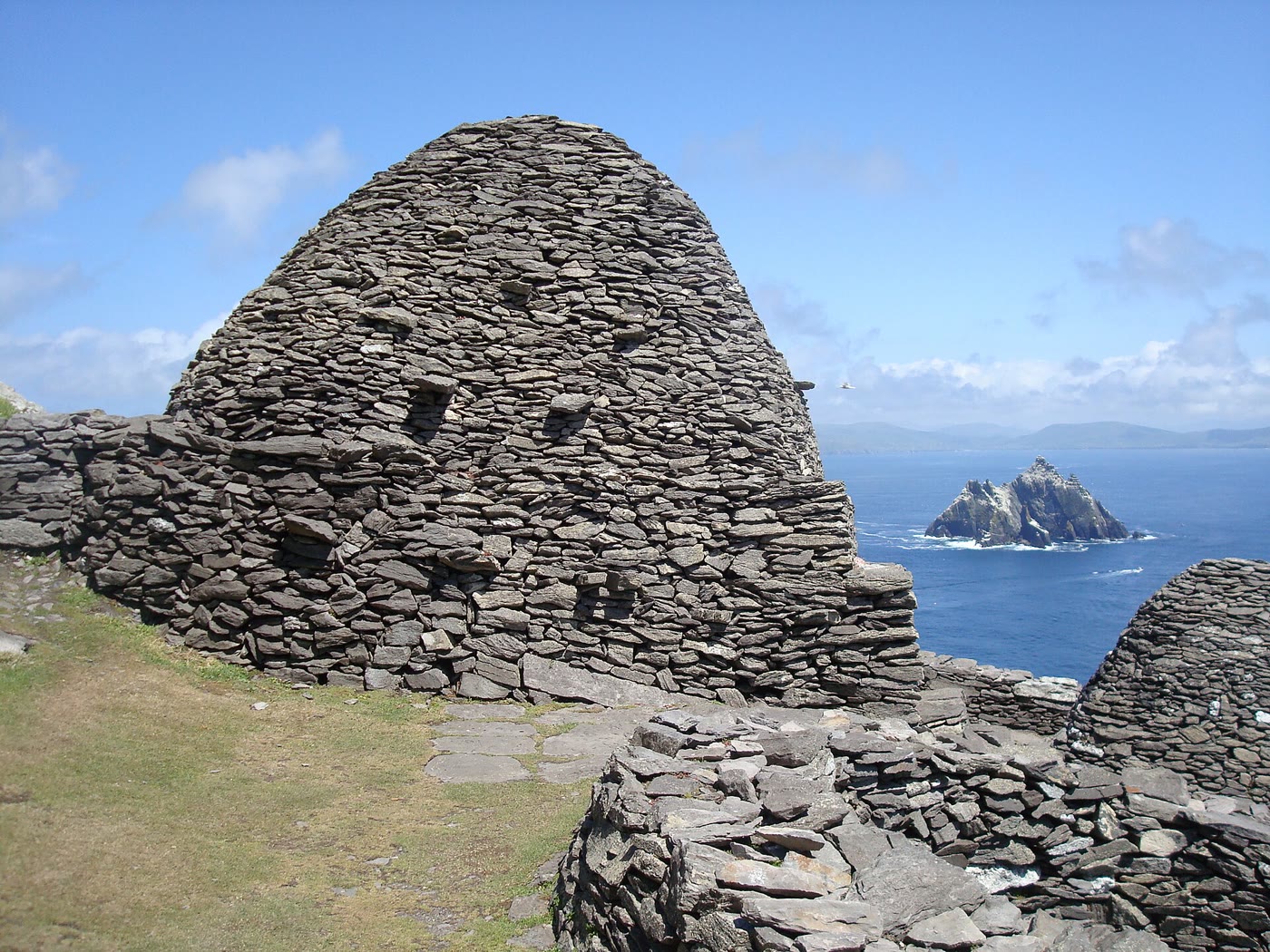
Beehive huts in the monastery on Skellig Michael, with Little Skellig beyond. Photo: highlander411, CC BY 2.0, via Wikimedia Commons
There are seven cells in all. The largest, Cell A, measures 4.6 by 3.8 metres (about 15 by 12.5 ft) inside and stands 5 metres (16 ft) high, with walls 1.8 metres (6 ft) thick at the base. The excavators believe it served the whole community.
Around the huts are two oratories, a monks’ graveyard and St Michael’s Church, the one mortared building, probably begun in the late 10th century and enlarged later. The island has more than 90 crosses and cross-slabs, mostly plain and rough, a world away from the carved high crosses of Clonmacnoise or Monasterboice.
Life was hard, but the monks didn’t starve. With no spring on the island, they cut channels in the rock to fill cisterns with rainwater. Pollen and seeds suggest they grew barley and oats on terraced gardens, and bones show they ate goat, sheep, seal, fish and seabirds, mostly Manx shearwaters and auks, the family puffins belong to.
The 618 steps
The monks built three long stairways, from landing places on the east, north and south, so they could come ashore whatever the wind was doing. The lowest steps were cut into the rock; higher up, beyond the storm waves, they were built of dry stone.
Today visitors land on the east side, walk the 1820s lighthouse road and climb the south steps. The OPW counts 618 of them, and the monastery sits about 180 metres (600 ft) above the sea. You pass a pillar of rock called the Wailing Woman, then reach Christ’s Saddle, the dip between the island’s two peaks, before a final flight leads to the monastery.
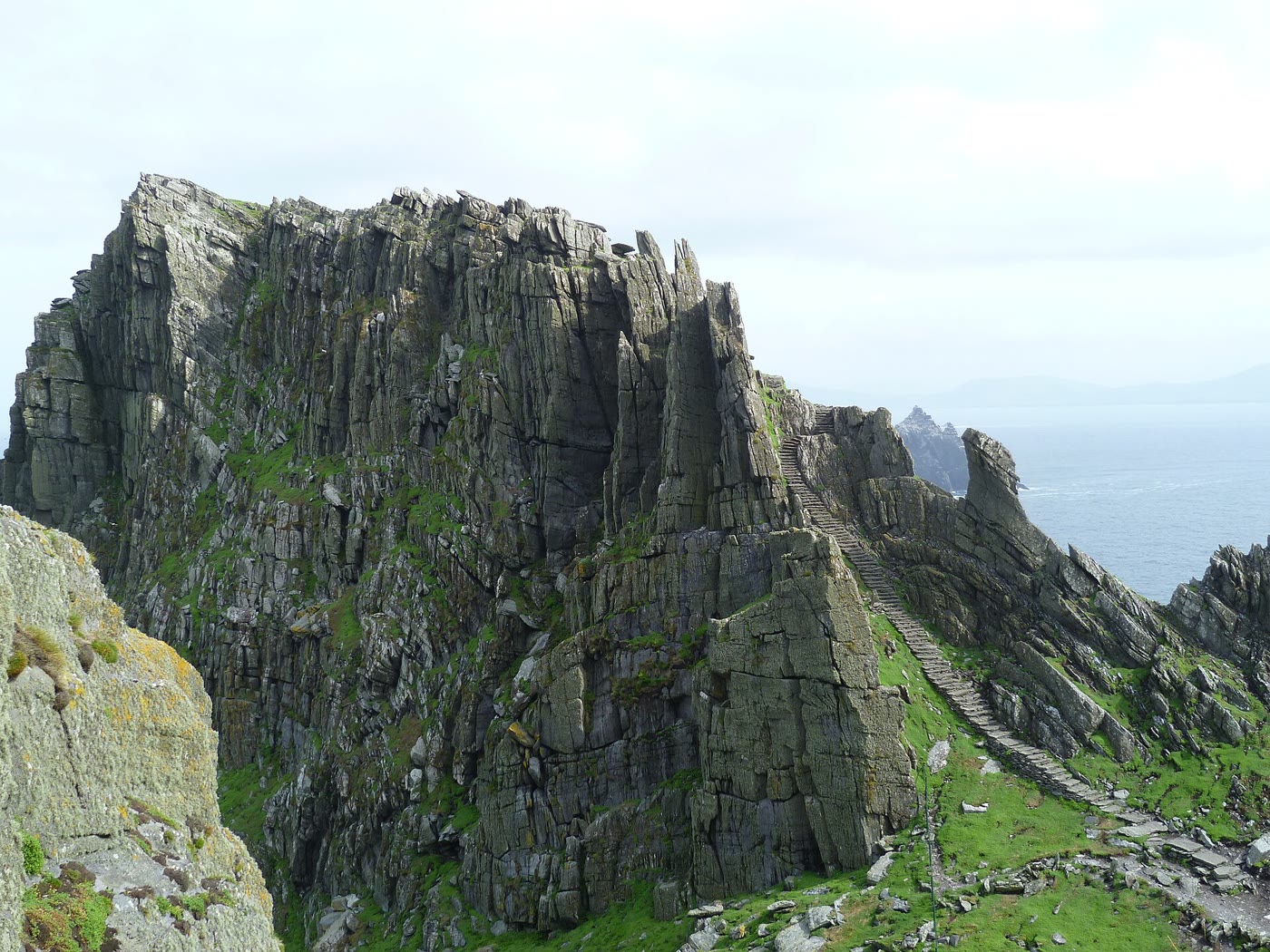
The monks’ stone steps on Skellig Michael, with Little Skellig in the distance. Photo: Katzegoesireland, CC BY-SA 4.0, via Wikimedia Commons
The South Peak hermitage
Above Christ’s Saddle rises the South Peak, the island’s summit at 218 metres (715 ft). On narrow ledges near the top, above sheer drops, the monks built terraces, a tiny oratory, walls and rock-cut water basins. They reached them by steps and handholds cut into the cliff and a near-vertical squeeze through a cleft called the Needle’s Eye.
Maps and pilgrims’ accounts from the 18th century on mention structures up there, but their full extent only emerged when Walter Horn, Jenny White Marshall and Grellan Rourke surveyed the peak in the late 1980s. Their 1990 book, The Forgotten Hermitage of Skellig Michael, argued it was both a hermitage and a place of pilgrimage.
The picture of a lone hermit has since been questioned. The excavators suggested the structures may have been above all an elaborate pilgrimage station. A cross-slab found there fits a ninth-century style, but the peak’s history is still uncertain. It’s closed to visitors.
Why the monks moved to Ballinskelligs
Monks were still on the rock in the late 12th century, when Gerald of Wales told of an island church of St Michael where a hollow stone filled with wine each day for Mass. He doesn’t name Skellig, but the excavators think no other place fits.
Why they left isn’t certain. The usual explanations are a colder, stormier climate in the 13th century and the 12th-century reform that reorganised the Irish Church around dioceses rather than great monasteries. The excavators add that the growing pilgrim traffic may have favoured a base on the mainland.
The community moved gradually to an Augustinian priory at Ballinskelligs, Baile an Sceilg (BAL-yuh un SHKEL-ig), the town of the Skellig, probably leaving the rock for good in the mid to late 1200s.
They didn’t abandon the rock entirely. Papal letters still called the prior of Ballinskelligs the prior of St Michael’s “of the Rock”, monks probably spent summers on the island, and pilgrims kept coming. The priory lasted until 1578, when, in the wake of the first Desmond rebellion, Elizabeth I dissolved monasteries that the Earl of Desmond had protected, and the Skelligs passed to the Butler family. The priory’s ruins survive as a national monument beside Ballinskelligs Bay.
Pilgrims, lighthouses and UNESCO
Pilgrimage outlived the monks. In 1756 Charles Smith described pilgrims, women as well as men, squeezing through the Needle’s Eye, hauling themselves up a smooth slab called the Stone of Pain, then edging out astride a narrow spur of rock over the sea, called the Spindle or the Spit. At its tip they said an Our Father at a carved stone cross.
Crowds had come from all over Ireland twenty years earlier, Smith wrote, but “the zeal of such adventurous devotees” had since cooled.
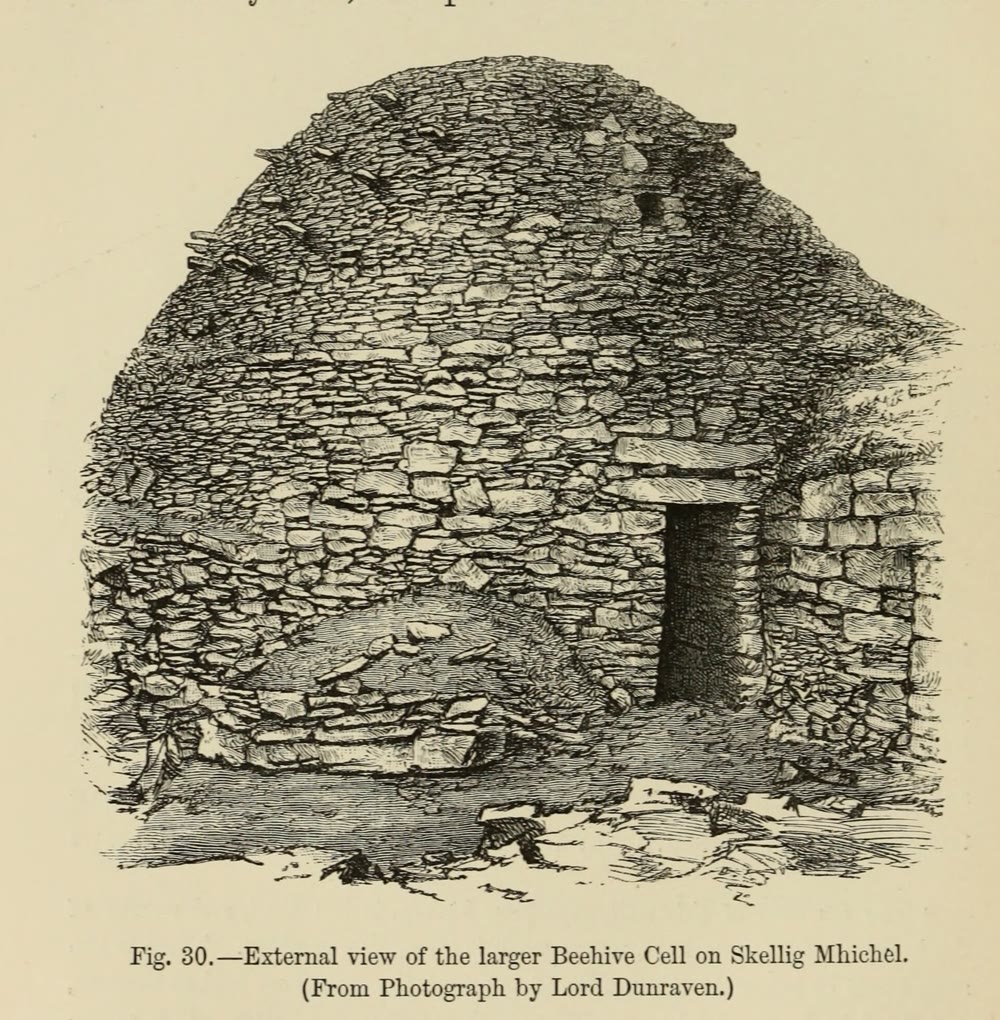
One of the larger beehive cells on Skellig Michael, engraved from a photograph by the antiquarian Lord Dunraven, from Joseph Anderson, Scotland in Early Christian Times (1881). Public domain, via Wikimedia Commons
In the 1820s the forerunner of the Commissioners of Irish Lights compulsorily bought the island from its owner, John Butler of Waterville, and built two lighthouses on its Atlantic side, finished by 1826. The builders blasted out the road visitors use today and lived in the beehive huts while they worked.
The OPW became guardian of the monastic remains in 1880, and the State bought most of the island in 1989. In 1996 UNESCO made it a World Heritage Site, saying it illustrates “as no other property can, the extremes of a Christian monasticism”. It’s one of only two in the Republic of Ireland, with Brú na Bóinne (broo nuh BOHN-yuh) in Co. Meath.
Puffins, gannets and storm petrels
Both Skelligs are statutory nature reserves and together form a Special Protection Area for seabirds.
Puffins are the stars. In Irish a puffin is a puifín (PWIF-een; pwih-FEEN in Kerry). Surveyors counted about 8,000 on and around Skellig Michael in May 2023, and the OPW says you can see them on the island until early August.
If a puffin needed an Irish pet name, a stór (a STORE) would suit: it means darling, from stór, treasure. It’s one of the endearments in my guide to Irish sayings about love.
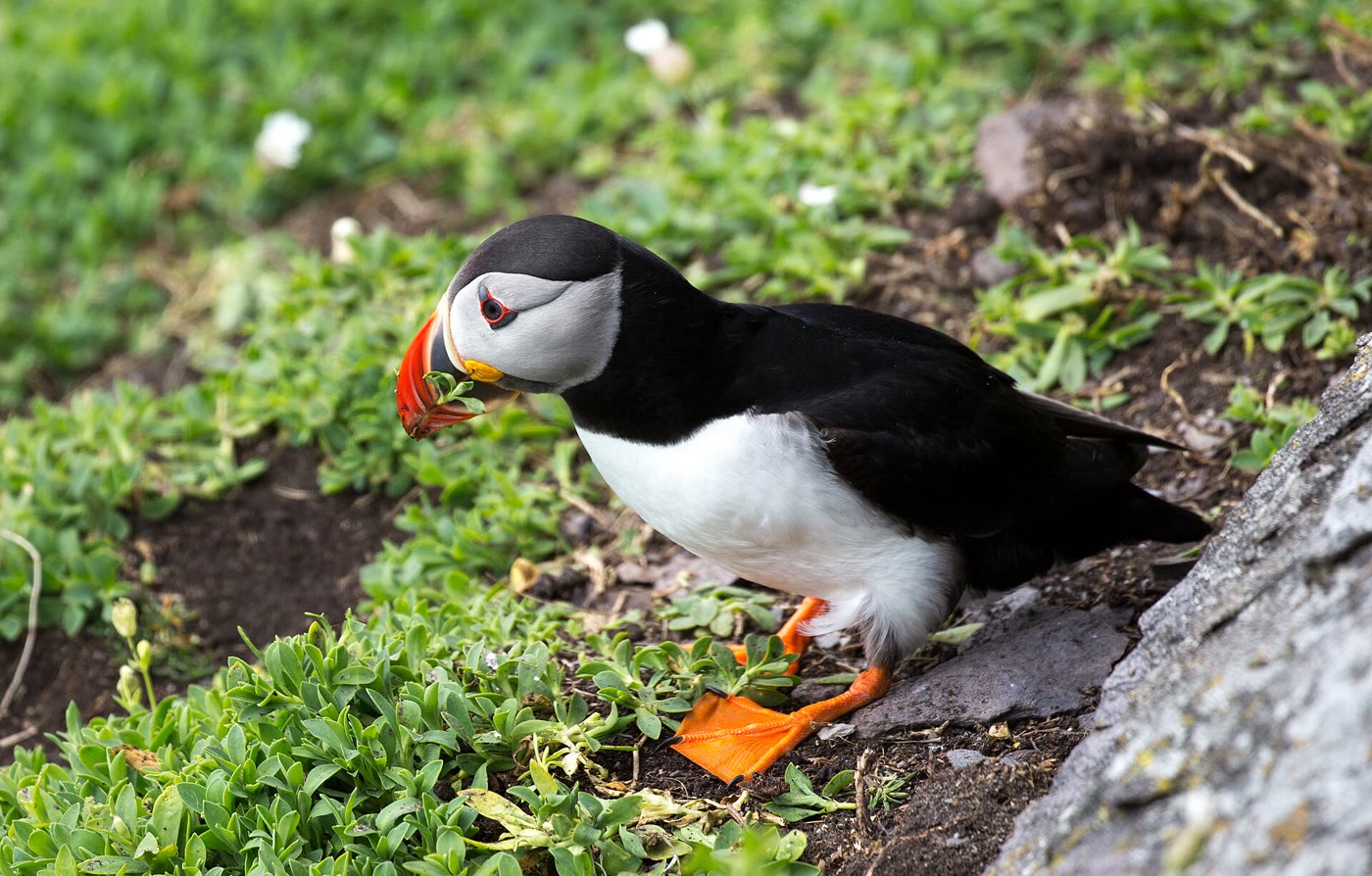
A puffin gathering nesting material outside its burrow on Skellig Michael, May 2015. Photo: Sascha Wenninger, CC BY-SA 2.0, via Wikimedia Commons
Storm petrels, Europe’s smallest seabird, nest in crevices in the monks’ own walls and in the scree: surveys in 2020 and 2021 estimated about 7,700 nest sites. Manx shearwaters, fulmars, kittiwakes, guillemots and razorbills breed here too.
Little Skellig, 134 metres (440 ft) high, is white with gannets. BirdWatch Ireland, which has run it as a reserve since 1969, calls it Ireland’s biggest gannet colony and one of the world’s largest. A national seabird report from the National Parks and Wildlife Service in 2019 gave 35,294 pairs. Bird flu struck in 2022: scientists estimated that at least 3,000 gannets from Little Skellig and the Bull Rock colony off west Cork died.
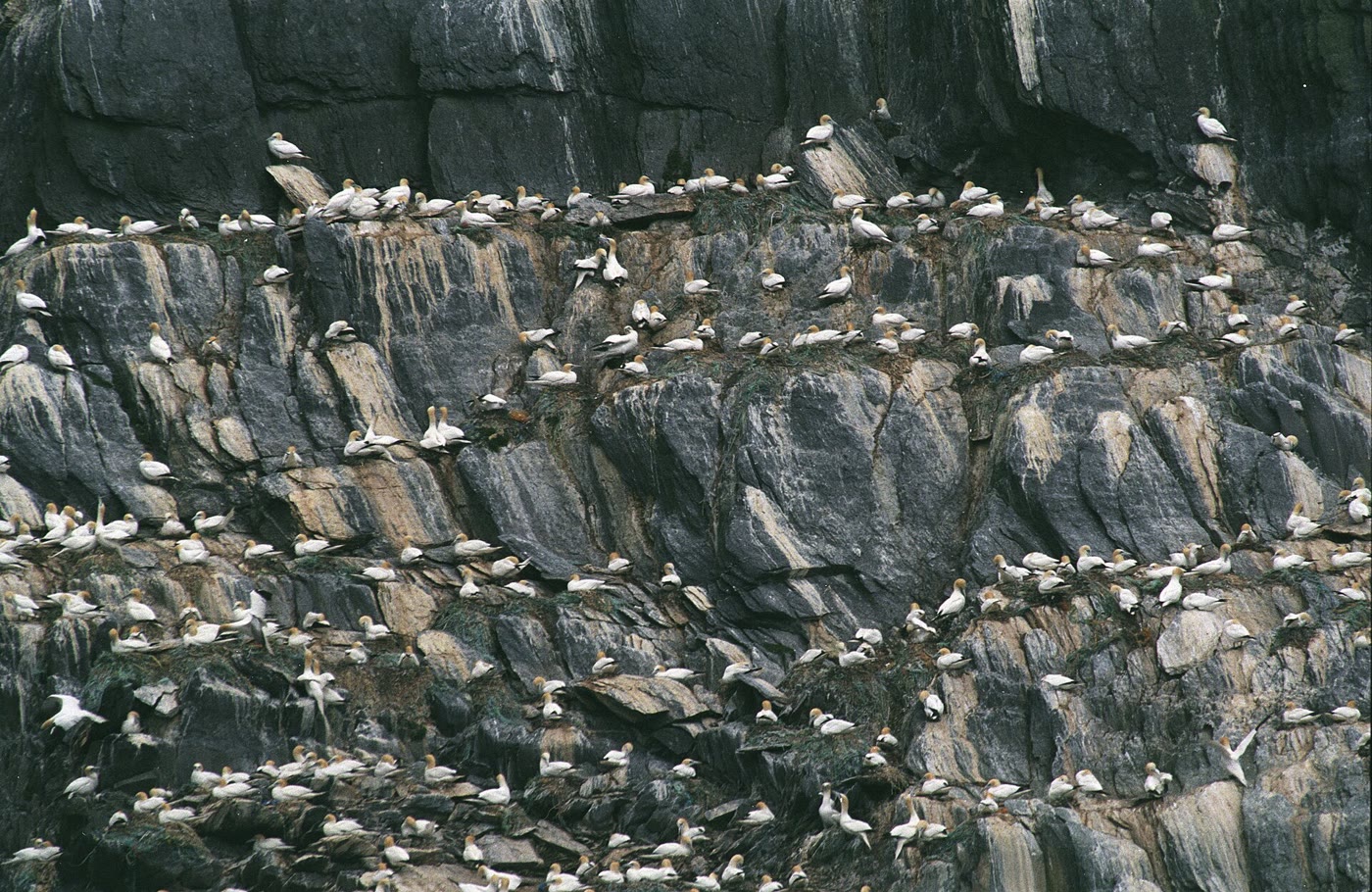
Gannets nesting on the cliffs of Little Skellig. Photo: Jerzy Strzelecki, CC BY-SA 3.0, via Wikimedia Commons
Skellig Michael and Star Wars
In summer 2014 a Lucasfilm crew spent a few days on the island filming the final scene of Star Wars: The Force Awakens (2015), in which Rey climbs the steps to find Luke Skywalker. Skellig became the planet Ahch-To, and it returned in The Last Jedi (2017).
For The Last Jedi the crew was allowed just two days on the island, in 2015, so in 2016 it built replica beehive huts on the mainland and filmed on headlands in Kerry, Clare, Cork and Donegal. The puffins left their mark, too. Digitally removing them would have been slow and difficult, creature designer Jake Lunt Davies explained, so director Rian Johnson invented a native creature inspired by them: the porg.
Not everyone cheered. An Taisce (un TASH-kuh), the National Trust for Ireland, said the 2014 shoot broke long-standing conservation policy. Before the 2015 return it warned that storm petrels and Manx shearwaters would still be there in numbers, and that rats could be brought ashore by accident. The heritage minister, Heather Humphreys, replied that the island already took up to 180 visitors a day and that an ecologist could stop filming at any point, TheJournal reported.
How to visit Skellig Michael
Landing on Skellig Michael is an adventure, and never guaranteed. Check the OPW’s Heritage Ireland page before you plan.
- Season: usually mid-May to the end of September, weather permitting. In 2026 the season opened in May and closed early, on 21 September, because of rough seas; landings resume in 2027.
- Boats: only permit holders may land visitors. Fifteen boats hold permits, carrying up to 12 passengers each, so no more than 180 people land a day. They sail from Portmagee, Valentia Island, Ballinskelligs and Derrynane, and the crossing can take over an hour. Book early.
- Cost: the site itself is free, but the boat isn’t. One operator’s fare was €160 a person in 2026, the Irish Times reported.
- Age limit: children under 12 are not allowed on the island.
- Fitness: the steps are steep, uneven and slippery when wet, with sheer drops and few barriers. Two American visitors died after falls in 2009. Wear boots or shoes with good grip; sandals and flip-flops aren’t allowed.
- Time: about two and a half hours on the island, and up to six hours for the whole trip. Bring water and food. There are toilets on the island.
- Rules: stay on the path, follow the OPW guides, don’t climb walls or move stones, and no drones or dogs.
Landings are often called off when the swell is up, so leave a spare day, and watch the OPW’s safety video before booking. Portmagee makes the handiest base; for Kerry more widely, see my guide to where to stay in Ireland.
If you can’t land
- Cruise around the islands. Many operators run trips that circle both Skelligs without landing, the only way to see the Little Skellig gannets up close anyway.
- The Skellig Experience. This visitor centre on Valentia Island, just over the bridge from Portmagee, covers the monks, the lighthouse and the seabirds. Check opening times first.
- The Skellig Ring. This steep loop off the Ring of Kerry, unsuitable for big vehicles, crosses the Coomanaspic Pass, with views of the Skelligs, to Irish-speaking Ballinskelligs and its ruined priory.
For another Kerry island with an extraordinary story, read why Great Blasket Island was evacuated.
Skellig Michael FAQ
How do you pronounce Skellig Michael?
In English, SKEL-ig MY-kul. The Irish name, Sceilg Mhichíl, is SHKEL-ig vee-HEEL in Kerry.
How many steps are on Skellig Michael?
The OPW counts 618 steps on the climb to the monastery, which sits about 180 metres (600 ft) above the sea.
Can you visit Skellig Michael?
Yes, on licensed boats from about mid-May to the end of September, weather permitting. Only 180 people can land a day, and children under 12 aren’t allowed.
Who built the monastery on Skellig Michael?
Early medieval monks, there by the late 600s or early 700s. Tradition credits St Fionán, but the founding date is unknown.
Was Star Wars filmed on Skellig Michael?
Yes. It appears in the final scene of The Force Awakens (2015) and as Luke Skywalker’s island in The Last Jedi (2017).
Love this? Save it to your Pinterest board for later.
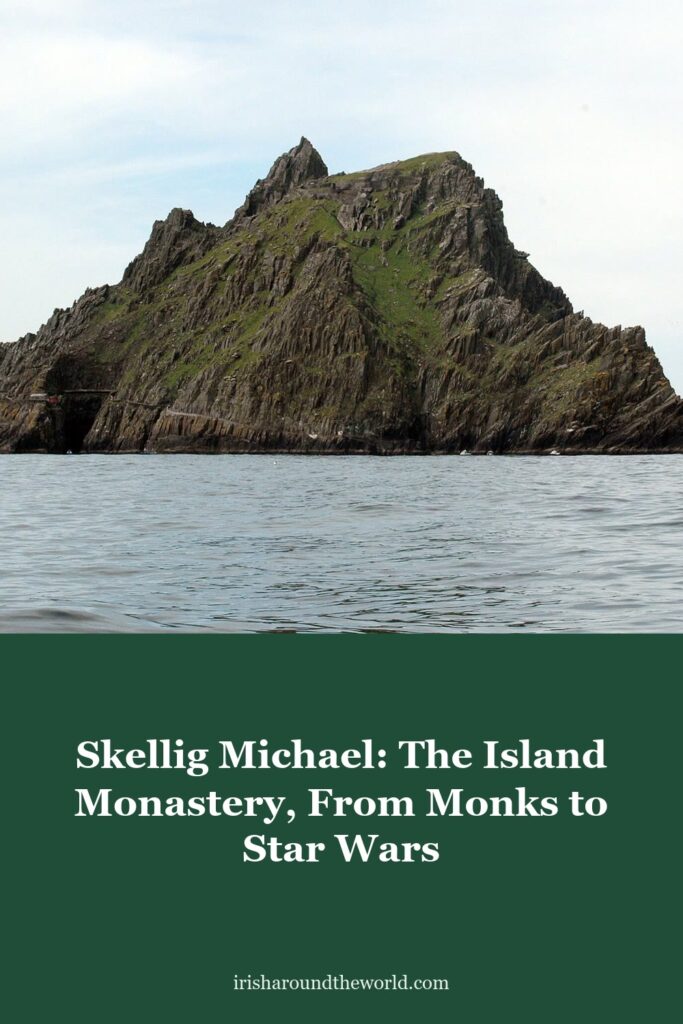
Pin image: Skellig Michael from the sea. Photo: Maureen from Buffalo, USA, CC BY 2.0, via Wikimedia Commons.
A little bit of Ireland in your inbox every Friday ☘️
The free Weekly Dose of Irish: an Irish joke, a Celtic symbol, an Irish fact, a poem and the week’s best articles in one short email. Join 9,600+ readers.
Free. One short email every Friday. Unsubscribe any time.
More Irish heritage reading
- Wild Atlantic Way Route: Map, Stops and Itineraries
- Great Blasket Island: Why It Was Evacuated, How to Visit
- St Brendan the Navigator: Did He Really Reach America?
- Celtic Cross Meaning, History and Ireland’s High Crosses
- History of St Patrick’s Day: The Real Story and Myths
Featured image: Skellig Michael from the sea. Photo: Maureen from Buffalo, USA, CC BY 2.0, via Wikimedia Commons.