In short: if one of your grandparents was born anywhere on the island of Ireland, you can claim Irish citizenship by registering on the Foreign Births Register. If one of your parents was born in Ireland, you’re usually already a citizen. You apply online, the fee is €278 for adults (€153 for under-18s), and it currently takes about 12 months. Once you’re registered, you can apply for an Irish passport.
Every week someone in our Facebook group asks the same question: “My granny was from Mayo. Can I get an Irish passport?” Very often, the answer is yes. Here’s how Irish citizenship by descent works, who qualifies, and exactly what you need to do.
This is a general guide, not legal advice. Always check the latest rules on the official ireland.ie Foreign Birth Registration page before you apply.
Who qualifies for Irish citizenship by descent?
| Your situation | What it means |
|---|---|
| A parent born on the island of Ireland | You’re usually an Irish citizen automatically. You don’t need to register; you can apply for a passport directly. |
| A grandparent born on the island of Ireland | You can become a citizen by registering on the Foreign Births Register. |
| A parent who was an Irish citizen when you were born, but born abroad | You can register on the Foreign Births Register. |
| Only a great-grandparent born in Ireland | You only qualify if your parent was registered on the Foreign Births Register before you were born. |
“The island of Ireland” includes Northern Ireland, so a grandparent born in Belfast or Derry counts too.
The great-grandparent rule, explained
This is where people get caught out. Citizenship by descent can pass down the generations, but only if each generation registers in time. If your parent qualified through an Irish-born grandparent but never registered before you were born, the chain stops with them. The official guidance is clear: if an expectant parent isn’t on the Foreign Births Register when the child is born, that child won’t be entitled to Irish citizenship this way.
So if you qualify, register before you have children. It protects their right to citizenship as well as yours.
How to apply: step by step
- Check you qualify using the table above.
- Gather the documents (see below). This is the slowest part, so start early.
- Apply online through the Foreign Births Register system on ireland.ie, and pay by card.
- Post your original documents and witnessed photos, as instructed when you apply.
- Wait. Applications are processed in strict date order, and the current wait is about 12 months.
- Receive your certificate. Once you’re entered on the register, you’re an Irish citizen.
- Apply for your Irish passport using your Foreign Birth Registration certificate.
What documents do you need?
For an adult applying through an Irish-born grandparent, you’ll typically need:
- Your own long-form civil birth certificate, showing your parents’ details
- Your passport or government photo ID, certified by an approved witness
- Your parent’s civil birth certificate, and their marriage certificate if applicable
- Your grandparent’s Irish civil birth certificate, and their marriage certificate
- Photo ID or a death certificate for your parent and grandparent
- Passport photos, some of them signed by a witness from the official list (such as a solicitor, doctor, police officer or bank manager)
The exact list depends on your situation, so follow the checklist on the official page. Irish civil birth, marriage and death records can be searched free on irishgenealogy.ie, and official certificates ordered from the General Register Office. For births in Northern Ireland, use GRONI, the General Register Office for Northern Ireland.
How much does it cost?
- 18 and over: €278 (€270 for registration and certificate, plus €8 postage and handling)
- Under 18: €153
Then there’s the cost of certificates and the passport itself. You don’t need to pay an agent: the online application is designed for individuals, and plenty of people do it themselves.
Tips from people who’ve done it
- Order your grandparent’s Irish birth certificate first. Finding the right one is often the hardest part, especially if names were spelled differently.
- Check that every name and date matches across the certificates. Small differences can cause delays.
- Don’t know where your grandparent was born? Start with the free 1901, 1911 and 1926 census records. Our guide to tracing your Irish roots explains where to look.
- Keep copies of everything you post.
What you get as an Irish citizen
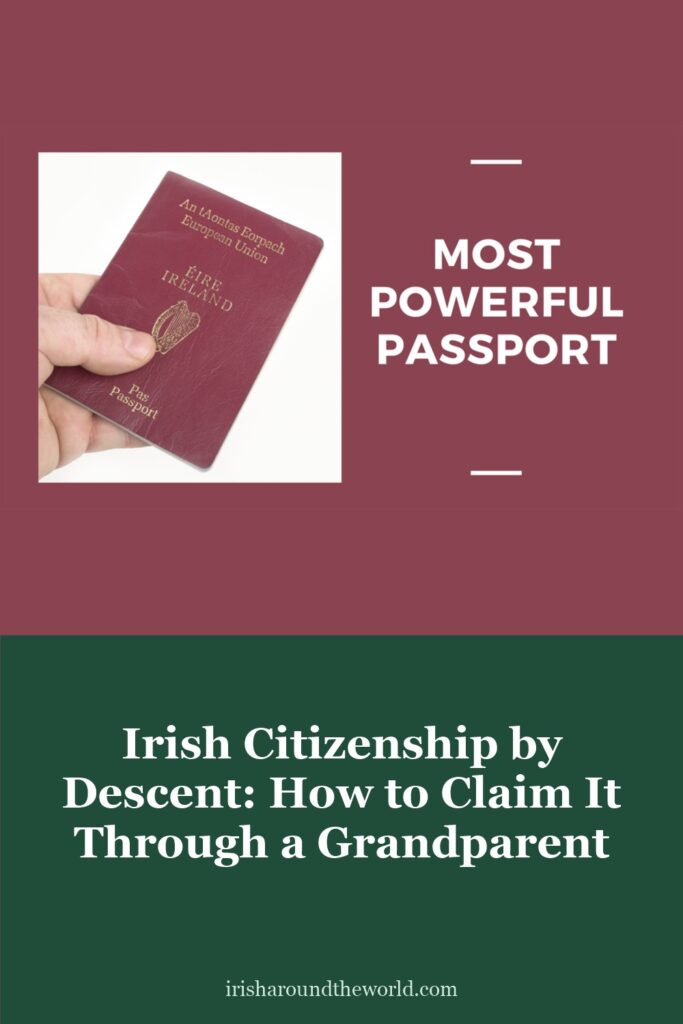
An Irish passport gives you visa-free travel to 186 destinations, plus the right to live and work anywhere in the EU and in the UK. See our guide to how powerful the Irish passport is.
FAQ
Can I get Irish citizenship through my great-grandparents?
Only if your parent was entered on the Foreign Births Register before you were born.
How long does Foreign Birth Registration take?
About 12 months at the moment, and applications are processed in strict date order.
Do I lose my current citizenship?
Ireland allows dual citizenship, but some countries don’t. Check the rules of your own country before you apply.
Does a grandparent born in Northern Ireland count?
Yes. A grandparent born anywhere on the island of Ireland counts.
Keep reading
- The Irish passport in 2026
- How to trace your Irish roots
- Irish surnames and their meanings
- Sending money to Ireland
Love this? Save it to your Pinterest board for later.
A little bit of Ireland in your inbox every Friday ☘️
The free Weekly Dose of Irish: an Irish joke, a Celtic symbol, an Irish fact, a poem and the week’s best articles in one short email. Join 9,600+ readers.
Free. One short email every Friday. Unsubscribe any time.