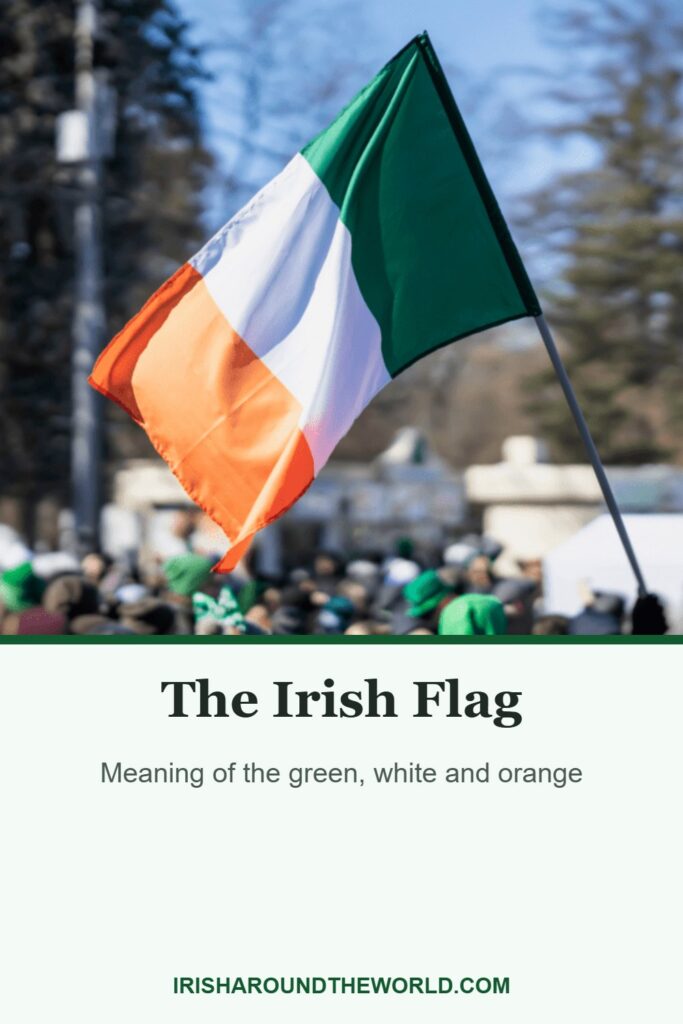
The Irish flag is a green, white and orange tricolour, twice as wide as high, with green next to the pole. Green stands for the older Irish nationalist tradition. Orange stands for the Protestant supporters of William of Orange. White is the peace hoped for between them. Thomas Francis Meagher presented it in 1848, it became the Free State’s flag in 1922, and the 1937 Constitution formally confirmed it.
Most people can picture the Irish flag. Ask what it means and things get shaky.
Some say the orange is gold. Some say it stands for “the British”. Some post the flag of Ivory Coast by mistake. Even Wayne Rooney managed that one.
This page sticks to the Department of the Taoiseach’s guidelines, the Constitution and some new research from 2026.
Jump to:
- What the colours of the Irish flag mean
- Irish flag history
- The official design and colours
- How to fly the Irish flag properly
- Ireland’s older flags
- Irish flag vs Ivory Coast flag
- What about Northern Ireland?
- Irish flag FAQ
What the colours of the Irish flag mean
The Department of the Taoiseach says the flag is meant to symbolise the inclusion and hoped-for union of the different traditions on this island.
- Green is the older Irish nationalist tradition. A green flag with a harp was its banner from at least the 1640s.
- Orange is the Protestant tradition. It comes from King William of Orange and the Orange Order, founded in 1795 in his memory.
- White is peace between the two.
The best explanation came from the man who presented it. In April 1848 Thomas Francis Meagher told a Dublin meeting that “the white in the centre signifies a lasting truce between Orange and Green”. He hoped Protestants and Catholics would one day clasp hands beneath it.
You’ll read online that orange means “British settlers in Northern Ireland”. That’s not how the State describes it, and it’s not what Meagher said. Orange is an Irish tradition, and the flag was made to include it.
Irish flag history
Before 1848
For centuries Ireland’s flag was green with a gold harp. The official guidelines trace it back at least to Confederate Ireland and Owen Roe O’Neill in the 1640s. The Irish Volunteers used it in the 1780s, and the United Irishmen carried it in 1798.
The same guidelines note that Irish tricolours were mentioned as early as 1830. Historian John Crotty filled in that story in the Irish Examiner in February 2026.
He wrote that a green and orange cockade was worn at an election event in Cork City in March 1830. Being from Cork, I’m happy to take that one.
Crotty credits the first orange, white and green cockade to Emilia Eleanor Hamilton of Fairview in Dublin, later that year. She made it for a meeting saluting the 1830 revolution in France.
1848: Meagher and Young Ireland
The tricolour took off in 1848, a year of revolutions across Europe. From March, Irish tricolours appeared beside French ones at meetings celebrating the new French republic.
The official account says Meagher, a Young Ireland leader, flew a tricolour from 33 The Mall in Waterford on 7 March 1848. It flew for a week until the authorities took it down. The same day, a tricolour was reportedly carried to Vinegar Hill in Enniscorthy, Co. Wexford.
Later that month Meagher was chosen to help carry an address to the new French government. The Dictionary of Irish Biography says he came back from Paris with the tricolour. In April he presented it in Dublin and explained the colours.
Was it really first flown in Waterford?
In his 2026 book The Irish Tricolour, Crotty argues that the Waterford flag of 7 March was a French tricolour, later mistaken for an Irish one. He points out an odd problem. Meagher supposedly flew a flag in Waterford a month before he got it in Paris.
Eugene Broderick, chairman of Waterford Civic Trust, told the Waterford News & Star there can never be a definitive answer. He said the Trust would discuss the plaque on 33 The Mall.
The Government says Waterford, 7 March 1848. A new study disagrees. The question is open.
The gift from French women
You’ll often read that French women made the flag and gave it to Meagher. Crotty says that story isn’t true.
He traces the tale to F. B. Head, a writer shown “Meagher’s flag” at Dublin Castle a few years later. Head claimed it came from “certain Paris ladies of easy political virtue”. Crotty reads that as a slur that hardened into legend.
The delegation did bring home an Irish tricolour of French silk, Crotty writes. He doesn’t say who made it.
From 1848 to 1916
After 1848 the tricolour went quiet. The guidelines say it was little used until 1916, and the green harp flag still ruled right up to the Rising.
Early tricolours weren’t standardised either. Orange was sometimes next to the staff.
1916, the Free State and 1937
On Easter Monday 1916 the tricolour flew over the GPO in Dublin, beside a large green flag reading “Irish Republic”. The Citizen Army’s Starry Plough flew on the Imperial Hotel.
There’s another Cork link. The Dictionary of Irish Biography says Pearse ordered Gearóid O’Sullivan, born at Coolnagrane, Skibbereen, to raise “the flag of rebellion” over the GPO. It doesn’t say which flag.
After the Rising, the tricolour became the flag of the independence movement. The Irish Free State adopted it in 1922 and used it officially until 1937. Then Article 7 of the 1937 Constitution formally confirmed it: “The national flag is the tricolour of green, white and orange.”
The official design and colours
The Department of the Taoiseach’s guidelines, updated in September 2025, give the specification.
| Feature | Official specification |
|---|---|
| Shape | Twice as wide as it is high (2:1) |
| Stripes | Three equal vertical bands |
| Order | Green next to the staff, then white, then orange |
| Colours | Green Pantone 347, white, orange Pantone 151 |
| Size | Any, as long as the proportions are kept |
The hex and RGB codes you see online aren’t in the official guidelines. Only the two Pantone references are.
A gold fringe is allowed indoors and at outdoor ceremonies. Lettering or emblems on the flag are not.
Orange, not gold
“Green, white and gold” turns up in songs, on scarves and on plenty of cheap flags. The guidelines call yellow or gold a misrepresentation that should be actively discouraged. Swap the orange for gold and you’ve dropped one of the two traditions the flag was made to unite.
How to fly the Irish flag properly
There is no law on it. The guidelines say there are no statutory requirements and the Department’s role is advisory. They’re still worth following.
The basics
- Green always goes next to the pole.
- No flag flies above it, and only one Irish flag goes in a group.
- With other flags at the same height, it goes on the far left as you look at them.
- On a wall, green goes on your left as you face it, or at the top if hung vertically.
- It should not touch the ground, trail in water or get caught in trees.
- No slogans or logos on it. Don’t drape it over cars or carry it flat.
- Dispose of a worn or frayed flag in a dignified way.
When it’s flown
It flies every day at military posts and a small number of State buildings. It’s also flown on these days:
| Occasion | When |
|---|---|
| St Brigid’s Day / Imbolc | The public holiday in early February |
| St Patrick’s Day | 17 March |
| Easter Sunday and Monday | Marking the 1916 Rising |
| National Day of Commemoration | The Sunday nearest 11 July, date of the 1921 Truce |
It normally flies from sunrise to sunset. You can fly it at night if it’s properly lit, ideally by spotlight.
Half-mast
Half-mast doesn’t mean halfway. It means about two thirds of the way up, never below the middle of the pole.
The gap at the top is traditionally left for “the invisible flag of death”. That’s a haunting line to find in a government document.
- Raise the flag to the top first, then lower it to half-mast.
- Raise it to the top again before taking it down.
- No other flag flies while it’s at half-mast.
On a coffin, green goes at the head. The flag isn’t dipped in salute, except to the dead at memorial ceremonies. During Amhrán na bhFiann, everyone faces the flag until the last note.
Ireland’s older flags
The green harp flag was the nationalist flag from at least the 1640s until 1916.
St Patrick’s saltire is a red diagonal cross on white. It was the emblem of the Order of St Patrick, founded in 1783, and appears on the Order’s badge with a shamrock. The UK’s Flag Institute dryly notes that St Patrick wasn’t a martyr, so wasn’t strictly entitled to a cross.
When Great Britain and Ireland united on 1 January 1801, the saltire went into the Union Flag. It’s still there, as the red diagonals.
The presidential standard is a gold harp with silver strings on a blue background. These are the State arms, and the flag flies at Áras an Uachtaráin. The Department of Enterprise says the harp is modelled on the medieval “Brian Boru” harp at Trinity College Dublin.
Irish flag vs Ivory Coast flag
Ivory Coast (Côte d’Ivoire) uses the same three colours in the opposite order. Its constitution sets out orange, white and green in vertical bands, so orange is next to the pole.


Same colours, opposite order: Ivory Coast has orange at the pole, Ireland has green.
| Feature | Ireland | Ivory Coast |
|---|---|---|
| Next to the pole | Green | Orange |
| Shape | 2:1, long and narrow | Usually 3:2, shorter |
| Adopted | 1922, confirmed by the Constitution in 1937 | 1959, the year before independence |
| Meaning | Two traditions and peace between them | Commonly given as national growth, peace and hope |
The quick test: green by the pole is Ireland. Orange by the pole is Ivory Coast.
Famous mix-ups
- On St Patrick’s Day 2016, Wayne Rooney posted the Ivory Coast flag by mistake, RTÉ and The Independent reported.
- The nicest one came in 2018. Ivorian sprinter Murielle Ahouré won the 60m at the World Indoors in Birmingham. With no Ivorian flag to hand, she borrowed an Irish fan’s tricolour for her lap of honour, the Irish Examiner and BBC reported.
What about Northern Ireland?
Northern Ireland has no official flag of its own. Ulster University’s CAIN archive sets out the position.
The Union Flag is the official UK flag, including in Northern Ireland, by custom and practice rather than by law. Flags on government buildings there are covered by the Flags Regulations (Northern Ireland) 2000.
The Ulster Banner, a red hand on a white six-pointed star under a crown, on a red cross on white, was adopted by the Stormont government in 1953. It lost any official standing after the Northern Ireland Constitution Act 1973. Some sports bodies still use it.
Irish flag FAQ
What do the colours of the Irish flag mean?
Green is the older nationalist tradition, orange is the Protestant tradition linked to William of Orange, and white is lasting peace between them.
Is the Irish flag green, white and orange or green, white and gold?
Orange. The Constitution says green, white and orange, and the official guidelines discourage gold.
Which way round does the Irish flag go?
Green next to the pole, then white, then orange. If orange is by the pole, it’s backwards, or it’s the flag of Ivory Coast.
Who designed the Irish flag?
Nobody knows for certain. Meagher made it famous in 1848, but tricolour cockades were around from 1830. Recent research credits Emilia Eleanor Hamilton of Dublin with an early one.
Is it illegal to let the Irish flag touch the ground?
No. The Department of the Taoiseach says there are no statutory requirements. Its guidelines say care should be taken that it does not touch the ground.
What was the Irish flag before the tricolour?
A green flag with a gold harp. It goes back at least to the 1640s.
One last thing
I hope this has cleared up a few doubts. Next St Patrick’s Day, check where the green is before you hit post.
More Irish symbols
- The Irish Harp: Ireland’s National Symbol
- Irish Symbols in Modern Day Ireland
- The Shamrock and St Patrick’s Day
- The Real Story Behind St Patrick’s Day
- Celtic Symbols and Their Meanings
- Facts About Ireland
Love this? Save it to your Pinterest board for later.
A little bit of Ireland in your inbox every Friday ☘️
The free Weekly Dose of Irish: an Irish joke, a Celtic symbol, an Irish fact, a poem and the week’s best articles in one short email. Join 9,600+ readers.
Free. One short email every Friday. Unsubscribe any time.
Mylie Wiggins
Monday 13th of June 2022
There is definately a lot to find out about this subject. I like all the points you made