Merry Christmas in Irish is Nollaig Shona duit (NULL-ig HUN-a ditch) to one person, or Nollaig Shona daoibh (NULL-ig HUN-a DEEV) to a group. Irish uses the same greeting for Merry and Happy Christmas. Happy New Year is Athbhliain faoi mhaise (AH-vleen fwee WASH-a). Below are card messages, the Scottish Gaelic version and 35 Christmas words in Irish with pronunciations.
The Irish word for Christmas is Nollaig. It came into Irish from the Latin natalicia, a birthday feast, by way of the Old Irish notlaic, according to the Electronic Dictionary of the Irish Language (eDIL).
So the Irish name for Christmas is, quite literally, a birthday party. Here’s how to say the greeting, how to answer it and what to write in a card, all checked on teanglann.ie and focloir.ie.
How to say Merry Christmas in Irish
Irish doesn’t split Merry and Happy the way English does. The official English-Irish dictionary, focloir.ie, gives Nollaig Shona! for both. The ending depends on how many people you’re talking to.
To one person: Nollaig Shona duit
Say it NULL-ig HUN-a ditch. Duit means “to you”, and it sounds like the English word ditch. Use it for a friend, a card to your mother or a text.
To more than one person: Nollaig Shona daoibh
Say it NULL-ig HUN-a DEEV. Daoibh is “to you all”, and it’s one syllable. This is the one for the family card or a Facebook post.
Duit or dhuit?
Plenty of cards write Nollaig Shona dhuit, then tell you to say “ditch”. That mixes up two forms.
Duit (ditch) is the standard spelling. Dhuit is a softened form heard in speech, especially in Connacht and Ulster, said roughly GHITCH. De Bhaldraithe’s 1959 English-Irish Dictionary prints Nollaig shona dhuit, so neither is wrong. My Irish Christmas blessings page uses dhuit; this page sticks to the standard duit.
How to reply
The friendly answer is Nollaig Shona duit féin (fayn), “and to yourself”. In speech you’ll often hear dhuit fhéin.
For “the same to you”, use gurab amhlaidh duit (GUR-ub OW-lee ditch). focloir.ie also lists go mba é duit, but that can be a pointed reply to an insult.
Why “shona” and not “sona”?
Sona means happy, lucky or fortunate. Nollaig is a feminine noun, so the adjective after it softens to shona. Ó Dónaill’s dictionary gives it exactly that way: Nollaig shona, a happy Christmas.
“Nollaig Sona” is a small grammar slip. Compare Lá breithe sona duit, Happy Birthday, where lá is masculine and sona stays as it is. And when sh comes before a, o or u, it sounds like an English h. So it’s HUN-a, not SHOW-na.
Why do so many Irish homes light a candle in the window on Christmas Eve? This short video tells the story.
How to pronounce Nollaig Shona duit
Irish has three main dialects: Munster in the south, Connacht in the west and Ulster in the north. I’m a Cork man, so the pronunciations on this page lean Munster. Luckily, Nollaig Shona barely changes from county to county. The small words do the moving.
Munster (Cork, Kerry, Waterford)
Nollaig is NULL-ig, stressed on the first syllable. Shona is HUN-a and duit is ditch.
Connacht (Galway, Mayo)
Here you’ll often hear dhuit, roughly GHITCH, with the gh made at the back of the throat.
Ulster (Donegal)
Dhuit again, and daoibh stays DEEV.
To hear the real thing, search teanglann.ie and click the speaker icons. It has recordings in all three dialects for Nollaig, sona, athbhliain and maise.
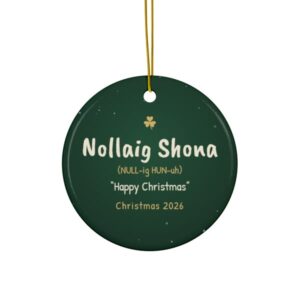
Nollaig Shona on your tree
Our 2026 ceramic Christmas ornaments have Irish words and how to say them: Nollaig Shona, Oíche Nollag and Daidí na Nollag.
See the Nollaig Shona ornament
From our own little Etsy shop. Or see all the Christmas ornaments.
Christmas in Irish: what Nollaig means
Nollaig means Christmas, and it’s also the Irish for December. Ó Dónaill gives Mí na Nollag (mee na NULL-ug), the month of Christmas.
Nollaig or Nollag?
When the word means “of Christmas”, it becomes Nollag. So Christmas Eve is Oíche Nollag, Christmas Day is Lá Nollag and Santa is Daidí na Nollag. “Oíche Nollaig” and “Daidí na Nollaig” are common mistakes online.
The two Christmases
Medieval Irish had a great Christmas and a little one, according to eDIL. Notlaic mór was 25 December. Notlaic becc, the little Christmas, was the Epiphany on 6 January.
Little Christmas survives, but it moves around. According to eDIL and the Royal Irish Academy, Nollaig Bheag means 6 January in Munster and New Year’s Day in Connacht and Ulster. The Epiphany is also Nollaig na mBan (NULL-ig na MON), Women’s Christmas, when tradition gives the women of the house a well-earned rest.
Happy Christmas and a Happy New Year in Irish
For a card that covers both, write Nollaig Shona agus Athbhliain faoi mhaise. Say it NULL-ig HUN-a AG-us AH-vleen fwee WASH-a.
Happy New Year in Irish: Athbhliain faoi mhaise
Word for word, athbhliain faoi mhaise isn’t quite “happy new year”. Ó Dónaill defines athbhliain as the coming year, and faoi mhaise as adorned or flourishing. So you’re wishing someone a flourishing year ahead, which is arguably better.
The mh sounds like v or w depending on the dialect, so you’ll also hear VASH-a.
focloir.ie also gives Bliain Úr Mhaith (BLEEN oor WAH), “a good new year”, using úr, the word for new you’ll hear most in Ulster. “Bliain Nua Shona” turns up on cards, but it’s a translation of the English, not the dictionary greeting. For toasts to see the year in, read my Irish New Year blessings and toasts.
Merry Christmas in Scottish Gaelic
If your roots are in the Highlands or islands, the greeting is Nollaig Chridheil, according to the LearnGaelic dictionary. Cridheil means cheerful or hearty, which is about as close as Gaelic gets to “merry”.
Happy New Year is Bliadhna Mhath Ùr, and Santa is Bodach na Nollaig, “the old man of Christmas”. Say Nollaig Chridheil roughly NOL-ik CHREE-al, with the ch as in loch, but check the LearnGaelic audio. It’s Scottish, not Irish, whatever the gift-shop cards say.
The Christmas candle in the window
Coinneal (KIN-yal) is the Irish for candle. In the 1930s, schoolchildren all over Ireland wrote down local customs for the Schools’ Collection, now free to read on dúchas.ie. The Christmas Eve candle turns up again and again.
At Boher, near Nenagh in Co. Tipperary, the youngest in the house lit a big candle for the window. It was said to invite the Virgin Mary in, and to light the way for anyone looking for lodging. At Ballyadams in Co. Laois, it went in the kitchen window at nightfall, with no blind drawn that night.
You’ll often read that the custom began in Penal times as a signal to priests on the run. It’s a popular explanation, but the Schools’ Collection accounts quoted here don’t mention it. There’s more on the candle in my Irish Christmas traditions.
A light for the emigrants
When Mary Robinson became President in 1990, she put a light in a window of Áras an Uachtaráin, the President’s home, as a welcome to the Irish abroad. Her successors have kept it lit, these days in an old Tilley lamp. If you’re reading this from Boston or Brisbane, it’s for you.
35 Christmas words in Irish
All 35 were checked on focloir.ie or teanglann.ie. The pronunciations are rough Munster-leaning guides, with the stressed syllable in capitals. Notice how often Nollag turns up: it’s the “Christmas” in Christmas tree, card and pudding.
| Irish | Say it | English |
|---|---|---|
| Nollaig | NULL-ig | Christmas (also December) |
| Oíche Nollag | EE-ha NULL-ug | Christmas Eve |
| Lá Nollag | law NULL-ug | Christmas Day |
| Daidí na Nollag | DAD-ee na NULL-ug | Santa Claus, Father Christmas |
| crann Nollag | krown NULL-ug | Christmas tree |
| bronntanas | BROHN-tan-us | present, gift |
| féirín Nollag | FAY-reen NULL-ug | Christmas present |
| cárta Nollag | KAWR-ta NULL-ug | Christmas card |
| carúl Nollag | ka-ROOL NULL-ug | Christmas carol |
| coinneal | KIN-yal | candle |
| réalta | RAYL-ta | star |
| aingeal | ANG-gyal | angel |
| sneachta | SHNAKH-ta | snow |
| fear sneachta | far SHNAKH-ta | snowman |
| cuileann | KIL-un | holly |
| eidhneán | eye-NAWN | ivy |
| drualus | DROO-a-lus | mistletoe |
| fleasc Nollag | flask NULL-ug | Christmas wreath |
| stoca Nollag | STUK-a NULL-ug | Christmas stocking |
| simléar | shim-LAYR | chimney |
| réinfhia | RAYN-ee-a | reindeer |
| carr sleamhnáin | kar shlyow-NAWN | sleigh |
| spideog | spid-YOHG | robin |
| mainséar | man-SHAYR | crib, nativity scene (US: crèche) |
| Aidbhint | AD-vint | Advent |
| Aifreann na Gine | AF-run na GIN-eh (g as in give) | Midnight Mass on Christmas Eve |
| turcaí | TUR-kee | turkey |
| maróg Nollag | ma-ROHG NULL-ug | Christmas pudding |
| pióg mhionra | pyohg VIN-ra | mince pie |
| pléascóg Nollag | playss-KOHG NULL-ug | Christmas cracker |
| Lá Fhéile Stiofáin | law AY-leh shtif-AWN | St Stephen’s Day (literally “the feast day of Stephen”) |
| Lá an Dreoilín | law un dryoh-LEEN | Wren Day, St Stephen’s Day (literally “the day of the wren”) |
| Nollaig na mBan | NULL-ig na MON | Women’s Christmas, 6 January |
| Oíche Chinn Bliana | EE-ha HEEN BLEE-un-a | New Year’s Eve (literally “the night of the year’s end”) |
| Lá Caille | law KAL-yeh | New Year’s Day |
A few words worth a second look
St Stephen’s Day, 26 December, is a public holiday in Ireland. Britain calls it Boxing Day. Ó Dónaill’s dictionary calls it Lá an Dreoilín, after the wren boys who went door to door in disguise. The official dictionary, focloir.ie, gives Lá Fhéile Stiofáin, the feast of St Stephen.
For American readers: a Christmas cracker is a paper tube two people pull apart with a bang, holding a paper hat, a joke and a small toy. Christmas pudding is a dark, steamed fruit pudding. A mince pie is filled with mincemeat, a sweet mix of dried fruit and spice.
Irish Christmas greetings and card messages
All of these come from the dictionaries except the first. That one adds go léir (guh LAYR), meaning “all”, to the standard greeting.
Nollaig Shona daoibh go léir!
Happy Christmas to you all! Good for a family card or a group chat.
Nollaig faoi shéan agus faoi shonas duit!
A prosperous and happy Christmas to you! This is Ó Dónaill’s version. Say it NULL-ig fwee HAYN AG-us fwee HUN-us ditch.
Nollaig mhór mhaith duit!
A great, good Christmas to you! Say it NULL-ig vore VAH ditch.
Beannachtaí na Féile!
Season’s Greetings! The safe one for a work card or a mixed crowd. Say it BAN-ukh-tee na FAY-leh. For Christmas greetings, swap in Beannachtaí na Nollag (na NULL-ug).
Go mbeirimid beo ar an am seo arís
May we live to see this time next year. This is Ó Dónaill’s spelling; my blessings page uses the everyday spoken form, Go mbeire muid beo. Say it guh MER-im-ij byoh er un OWM shuh a-REESH.
Merry Christmas in Irish FAQ
How do you say Merry Christmas in Irish Gaelic?
Say Nollaig Shona duit (NULL-ig HUN-a ditch) to one person, or Nollaig Shona daoibh (NULL-ig HUN-a DEEV) to a group. In Ireland the language is simply called Irish, or Gaeilge.
How do you say Happy Christmas in Irish?
The same way as Merry Christmas: Nollaig Shona duit to one person, Nollaig Shona daoibh to a group. Irish doesn’t separate merry and happy.
Is it Nollaig Shona duit or Nollaig Shona dhuit?
Both are correct. Duit is the standard spelling, said ditch. Dhuit is a common spoken form, said roughly GHITCH.
What is Santa called in Irish?
Daidí na Nollag (DAD-ee na NULL-ug), literally the “Daddy of Christmas”. focloir.ie also gives San Nioclás.
How do you say Happy New Year in Irish?
Athbhliain faoi mhaise (AH-vleen fwee WASH-a). Add duit for one person or daoibh for a group.
What is the Irish for St Stephen’s Day?
focloir.ie gives Lá Fhéile Stiofáin (law AY-leh shtif-AWN). Ó Dónaill gives Lá an Dreoilín, the day of the wren.
More Irish Christmas reading
- 20 Irish Christmas Blessings
- 18 Irish Christmas Traditions, From the Candle in the Window to the 12 Pubs
- Nollaig na mBan: Women’s Christmas in Ireland
- Irish New Year Blessings and Toasts
- A Christmas Childhood by Patrick Kavanagh
- 25 Easy Irish Greetings (With Pronunciation)
- Happy Halloween in Irish: Say It Right (+35 Words)
- Wren Day: the wren boys and St Stephen’s Day
- Christmas in Ireland: a visitor’s guide
Love this? Save it to your Pinterest board for later.
Watch: Irish Christmas videos
- 8 Irish Christmas videos that went viral around the world
- The little Irish pub Christmas ad that beat John Lewis
- The Late Late Toy Show’s most magical moments
- Glen Hansard’s Christmas Eve busk on Grafton Street
A little bit of Ireland in your inbox every Friday ☘️
The free Weekly Dose of Irish: an Irish joke, a Celtic symbol, an Irish fact, a poem and the week’s best articles in one short email. Join 9,600+ readers.
Free. One short email every Friday. Unsubscribe any time.