
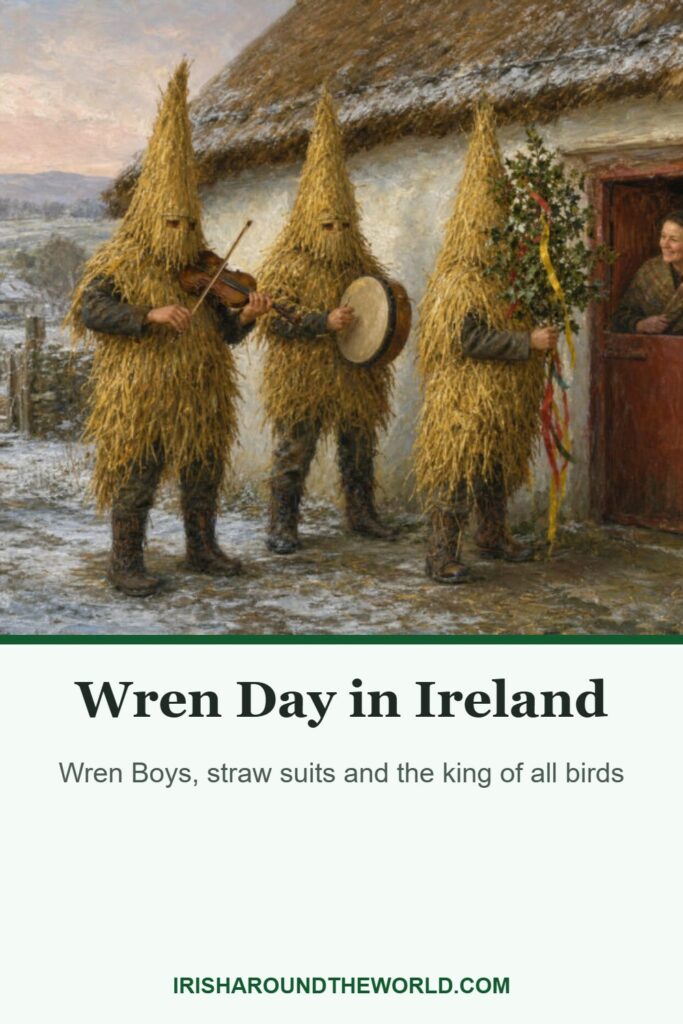
Wren Day is St Stephen’s Day, 26 December, called Lá an Dreoilín (law un DROH-leen) in Irish. Wren boys in straw suits, masks and old clothes go door to door with music and a rhyme, asking for “a penny to bury the wren”. Long ago a real wren was caught or killed. Today no bird is harmed. Dingle in Co. Kerry has the best-known parade.
Picture a frosty morning on 26 December, a century ago in rural Ireland. The Christmas dinner is eaten, the fire is lit, and there’s a knock at the door. Outside stands a gang in straw and masks, with a fiddle, a drum and a holly bush tied with ribbons.
They chant a rhyme about a tiny bird, dance a few steps on the kitchen floor and hold out a hand for coins. These are the wren boys, and this is Wren Day.
I gave the wren boys a few lines in my roundup of Irish Christmas traditions. Here’s the full story: the legends, what the records show, and where you’ll still see it.
Jump to:
- What is Wren Day?
- Who are the wren boys?
- The old wren hunt, and the wren today
- The wren boys’ song
- Why hunt the wren? Three legends
- How old is Wren Day?
- Where to see Wren Day in Ireland
- The wren in the Isle of Man and Wales
- Other St Stephen’s Day traditions
- St Stephen’s Day or Boxing Day?
- Wren Day FAQ
- More Irish Christmas reading
What is Wren Day?
Wren Day is the popular name for St Stephen’s Day, 26 December, the day after Christmas.
The custom is so tied to the date that it’s in the dictionary. Ó Dónaill’s Irish-English Dictionary, on teanglann.ie, gives Lá an Dreoilín simply as St Stephen’s Day.
How to say Lá an Dreoilín
Say it law un DROH-leen. Lá is day, and dreoilín is the wren, a tiny brown bird with a cocked-up tail. In Munster the stress can slide to the end, closer to dryoh-LEEN. The teanglann.ie site has audio in all three main dialects.
The same dictionary gives Lucht an Dreoilín (lukht un DROH-leen, with the ch as in loch) for the wren boys, literally “the wren people”.
The more formal Irish name for the day is Lá Fhéile Stiofáin (law AY-leh shtif-AWN), the feast of Stephen. You’ll find both names, with more festive words, in my guide to Merry Christmas in Irish.
Why is it called St Stephen’s Day?
26 December is the feast of St Stephen in the Western churches. Christian tradition calls him the first martyr. The Acts of the Apostles says he was stoned to death outside Jerusalem. A legend, which I’ll come to below, ties the wren to his day.
Who are the wren boys?
The wren boys were groups of boys and young men who went out on St Stephen’s Day in disguise. The folklorist Kevin Danaher, in The Year in Ireland (1972), describes them going door to door with music, song and dance.
The custom was once found across most of Ireland, except northern Ulster. Depending on the place, the groups were called wran boys, strawboys or mummers. Mummers are masked folk players.
My 77-second reel tells the story of the wren boys, the rhyme and one tiny bird.
Straw suits, masks and old clothes
In Dingle in 1929, the French scholar Marie-Louise Sjoestedt saw wren boys in inside-out jackets, women’s clothes, paper hats and ribbons, as RTÉ Brainstorm reports.
Sligo and Leitrim accounts on sligoheritage.com mention old calico trousers and “false faces” for masks. In Kerry today, the straw suit is the showpiece.
House to house with music
Music was whatever came to hand. In Dergvone, Co. Leitrim, a pupil wrote that the boys danced and recited the rhyme to a mouth-organ.
One member carried the wren on its bush. In Dromcollogher, Co. Limerick, that boy was also the treasurer. Both accounts come from the Schools’ Collection, folklore written down by schoolchildren in 1937 to 1939.
The wren dance
The pennies weren’t for sweets, at least not in the old days. They paid for a night out called the wren dance, the wren ball or, in Sligo and Leitrim, a “Join”. It could be days or weeks later, with the givers invited.
A pupil in Granagh, Co. Limerick described “a Great Night” in a farmer’s barn. People danced “from dark to day light” to a piper or fiddlers, with tea, bread and porter. Porter is a dark beer, much like stout.
By the 1930s, that pupil wrote, only small boys went out, splitting a few shillings for sweets.
Bad luck for a stingy house
A house that turned the wren boys away risked bad luck. According to the Sligo accounts, the wren might be buried opposite the door, and no luck would come in for a twelvemonth.
Lady Wilde tells a similar story in Ancient Legends, Mystic Charms and Superstitions of Ireland (1887). If nothing was given, she writes, the wren was buried on the doorstep.
The old wren hunt, and the wren today
Yes, the wren was once real. Boys caught or killed a wren and carried it on a holly bush, a pole or in a little box.
In Lisvernane, in Tipperary’s Glen of Aherlow, boys hunted the wren with sticks on the eve of the feast. They tied it to a holly bush dressed with coloured ribbons. Next morning, the strongest boy carried the bush from house to house.
The fake wren
A real bird was hard to get. One Sligo account says “the group that could boast a real wren were out on their own”. Others made do with a cork stuck with feathers, or a decorated box with hay or moss inside.
In Dergvone, a dead wren was “supposed” to lie in the box, though only sometimes was a real bird inside. And in Dingle in 1929, Sjoestedt saw locals gather round a figure made to represent a wren, tail and wings included.
No bird is harmed today
Today no wren is hunted, caught or killed. Groups carry a fake wren or none at all. Wild birds in Ireland, the wren included, are protected under the Wildlife Act 1976, as amended in 2000, says the National Parks and Wildlife Service.
The wren boys’ song
Every county seemed to have its own version of the rhyme. Here’s the one most people know. “Wran” is the old local way of saying wren.
The wran, the wran, the king of all birds,
St Stephen’s Day was caught in the furze.
Up with the kettle and down with the pan,
Give us a penny to bury the wran.
Furze is gorse, the spiny shrub with yellow flowers that covers Irish hillsides. That line hardly changes. Nearly everything else does.
How the rhyme changes from place to place
In Dromcollogher, the singer “followed my wren through frost and snow”. In Dergvone, the wren is a “she”, and “although she is small her family is great”.
Some versions borrow a cheeky couplet that lets the poorer houses off lightly:
If you haven’t a penny, a halfpenny will do,
If you haven’t a halfpenny, God bless you!
The Dromcollogher account notes that each group sang a different version. So if your grandmother’s rhyme doesn’t match this one, she isn’t wrong.
Why hunt the wren? Three legends
Why chase the smallest bird in the hedge? Folklore offers three answers. They’re stories told to explain the custom, not history, and they don’t agree.
The wren that betrayed St Stephen
The story goes that St Stephen hid from his enemies in a bush. A wren gave him away by chattering or flapping its wings beside him. So, the legend says, the wren is hunted on his feast day.
The Bible tells it differently. In the Acts of the Apostles, Stephen is tried and stoned, not found in a bush.
The wren on the drum
In the Dromcollogher account, Irish fighters were about to ambush the Danes, as old Irish stories call the Vikings. A wren landed on a drum, and the noise warned the Danes. The Irish killed the wren and put it on a holly bush.
Lady Wilde sets the story in Cromwell’s time, with wrens tapping on Irish drums and waking the English soldiers.
How the wren became king of all birds
This one is a fable, and it explains the first line of the rhyme. In a Schools’ Collection version from Na Garráin (Garranes), Co. Cork, the birds agreed that whoever flew highest would be king.
The eagle soared above them all. But the wren had hidden under his wing. When the tired eagle began to drop, the wren flew out above him and was proclaimed king of the birds.
Versions of this fable turn up far beyond Ireland, as far back as ancient Greece.
How old is Wren Day?
Nobody knows. Many pages state flatly that Wren Day is a pagan or druid festival. There’s no written evidence of druids hunting wrens.
The Irish Examiner said in 2025 that the origins are unknown, though some believe they’re pagan. Dingle wren men told the Irish Times in 2023 that they believe it was pagan. That’s a fair belief, but it’s a belief.
Detailed descriptions mostly date from the 1800s on. Mr and Mrs S. C. Hall wrote about Cork boys chasing wrens in 1841, and Patrick Kennedy about Wexford in 1867. Before that, the trail goes thin.
Disguise and house-to-house visiting turn up at another festival too, as you’ll see in how the Irish invented Halloween.
The “druid bird” story
You’ll often read that dreoilín comes from draoi éan, “druid bird”. A medieval Irish glossary guessed as much, but a guess isn’t proof. The Electronic Dictionary of the Irish Language (dil.ie) lists dreän as the Old Irish word for the wren.
Where to see Wren Day in Ireland
Wren Day has faded in most of Ireland, but it survives in pockets and some towns have revived it. Check local listings before you travel.
Dingle, Co. Kerry
Dingle (in Irish, Daingean Uí Chúis) is the place to go. RTÉ has called Dingle one of the remaining strongholds of Wren Day.
The Irish Times describes four wren groups in the town. They are the Green and Gold, Goat Street, John Street (Sráid Eoin) and the Green and White, based on the quays.
Each group is led by a hobby horse, with musicians and bands behind. In Kerry, the hobby horse is known as the Láir Bhán (white mare).
The Irish Times says the straw suits, skirts, capes and hats are made over several weeks from oat straw. Locals don’t say strawboys, by the way. They ask if you’ll “carry straw”.
The parade starts around lunchtime and takes about two hours, the paper says. Then the groups go from pub to pub late into the evening. Dingle is also a fine stop on my Wild Atlantic Way route, if you fancy a winter trip.
Other places that keep the Wren
- Limerick city: Trad Folkin’ Rocks brought the Wren back to the streets on 26 December 2025. It raised money for the Mid-West Simon Community and Milford Care Centre (Irish Examiner).
- Co. Cork: the Irish Examiner names Carrigaline and Ballydehob among places where the Wren continues.
- Dublin: Sandymount Green has a long-running Wren Boys festival on St Stephen’s Day, which RTÉ covered in 2025.
- North Leitrim: the Roskilmanor Wren Boys, founded in 1982, have raised over €160,000 for charities, RTÉ reports.
- Co. Mayo: children in Dooega, on Achill, still go out on “the dreoilín” with an artificial bird, says the Western People.
One common mix-up: Listowel’s All-Ireland Wrenboys Championship in Co. Kerry isn’t at Christmas. It’s held with the Listowel Races in September (Limerick Leader).
The wren in the Isle of Man and Wales
The Isle of Man has Hunt the Wren, Shelg yn Dreean in Manx Gaelic, on 26 December. Groups dance a wren through the streets on a decorated wren pole. Culture Vannin, the Manx heritage body, stresses that today’s bird is “just a replica”.
Wales had Hela’r Dryw (HEL-ar DREW), hunting the wren. The bird was carried in a decorated “wren house”, mostly around Twelfth Night in early January rather than on 26 December. The Welsh folk music scholar Phyllis Kinney describes four men in 19th-century Tenby carrying the wren house on poles, groaning as if it weighed a ton.
Other St Stephen’s Day traditions in Ireland
Most Irish people won’t meet a wren boy on 26 December. For them, St Stephen’s Day is a lazy, sociable day after the big one.
The races
It’s a big day for horse racing. Leopardstown’s four-day Christmas Festival in Dublin opens on St Stephen’s Day. Limerick Racecourse also holds a Christmas meeting starting on 26 December. Check both for 2026 dates before you book.
Leftovers, visiting and a walk
It’s a day for cold turkey sandwiches and whatever’s left of the Christmas cake. In Cork, cold spiced beef, sliced thin, is the classic. Nobody counts the slices.
Families call to neighbours and relations they didn’t see on Christmas Day. Plenty take a walk to shake off the dinner. Then St Stephen’s night begins, and the pubs fill up.
St Stephen’s Day or Boxing Day?
Same date, different names. The Republic of Ireland calls 26 December St Stephen’s Day. Northern Ireland and the rest of the UK call it Boxing Day.
Is St Stephen’s Day a public holiday?
Yes. St Stephen’s Day is one of Ireland’s 10 public holidays, according to Citizens Information. In 2026 it falls on a Saturday.
There’s no automatic Monday off in the Republic. Instead, workers get a paid day off within a month, an extra day’s annual leave or an extra day’s pay, says Citizens Information.
Northern Ireland has a substitute Boxing Day bank holiday on Monday 28 December 2026, says gov.uk. So the North gets a Monday off that the Republic doesn’t. Nobody said it was fair.
Wren Day FAQ
What is Wren Day in Ireland?
Wren Day is St Stephen’s Day, 26 December. Wren boys in straw suits and masks go door to door with music, asking for money “to bury the wren”. It’s strongest today in Dingle, Co. Kerry.
Why do the Irish hunt the wren?
Nobody knows the real origin. Folklore offers legends: the wren betrayed St Stephen, or a wren on a drum warned enemy soldiers of an Irish ambush. There’s no evidence it began as a druid rite.
How do you pronounce Lá an Dreoilín?
Say it law un DROH-leen. Dreoilín means wren, and teanglann.ie has audio in all three main dialects.
Do the wren boys still kill a wren?
No. A real wren was once caught or killed, but no bird is harmed today. Groups use a fake wren or none, and wild birds in Ireland are protected under the Wildlife Act 1976.
What do the wren boys sing?
The best-known rhyme starts “The wran, the wran, the king of all birds” and asks for a penny to bury the wran. The words vary by county.
Is St Stephen’s Day the same as Boxing Day?
It’s the same date. The Republic calls 26 December St Stephen’s Day, a public holiday, while Northern Ireland and Britain say Boxing Day.
More Irish Christmas reading
- 18 Irish Christmas Traditions, From the Candle in the Window to the 12 Pubs
- Irish Spiced Beef: How to Cook It, and a Home-Cured Cork Recipe
- Irish Christmas Cake Recipe: A Classic Whiskey Fruit Cake
- Merry Christmas in Irish: Nollaig Shona Duit
- Nollaig na mBan: Women’s Christmas in Ireland
- 10 Irish Christmas Blessings
- Irish Mythological Creatures: 23 Fairies, Monsters and Death Omens
Love this? Save it to your Pinterest board for later.
A little bit of Ireland in your inbox every Friday ☘️
The free Weekly Dose of Irish: an Irish joke, a Celtic symbol, an Irish fact, a poem and the week’s best articles in one short email. Join 9,600+ readers.
Free. One short email every Friday. Unsubscribe any time.