The most valuable Irish coins are a handful of rare dates. The 1943 florin made €8,000 hammer at Whyte’s in 2023. A 1985 20p trial piece made €7,200 in 2015. 1943 half crowns have made €120 worn to €1,800 near-mint at Whyte’s. Grade decides the price. Almost every euro coin in your change is worth face value.
Most of us have a jar of old Irish coins somewhere. A few punts, a half crown from a grandparent, a bag of euro coins from the last holiday.
Today I break down the rare Irish coins and valuable old Irish coins worth money. This time every price comes with a source and a date.
I have rewritten this guide, as the old version had undated dollar figures and some wrong mintages. Thanks again to the Ireland Coins website, which kindly let me share its information in the original.
Jump to:
- The first Irish coins
- Real sale prices
- The 1943 florin
- The 1985 20p
- Other dates worth checking
- Decimal coins
- Irish euro coins
- The 1999 €1 myth
- Is your coin valuable?
- Selling and exchanging
- FAQ
The first Irish coins: Yeats, Metcalfe and the farm animals
The Coinage Act, 1926 gave the new Free State the power to issue its own coins. A committee chaired by W.B. Yeats then chose the designs.
According to the Central Bank of Ireland, the committee picked native animals because farming mattered so much to the economy.
The English sculptor Percy Metcalfe won the design competition. The coins were struck at the Royal Mint in London. They went into circulation on 12 December 1928.
Every coin carried the harp on the other side. It was adapted from the Brian Ború harp in Trinity College Dublin. Collectors call them the “Barnyard” coins, a nickname rather than an official name.
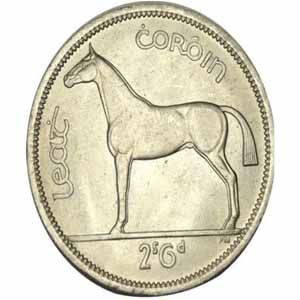
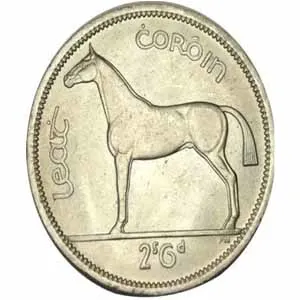
The horse on the Irish half crown, Percy Metcalfe’s design
| Coin | Animal |
|---|---|
| Farthing | Woodcock |
| Halfpenny | Sow and piglets |
| Penny | Hen and chicks |
| Threepence | Hare |
| Sixpence | Wolfhound |
| Shilling | Bull |
| Florin (two shillings) | Salmon |
| Half crown | Horse |
From 1939, after the 1937 Constitution, the coins read “Éire” instead of “Saorstát Éireann”. Then the silver went. The shilling was .750 silver up to 1942, and the florin and half crown up to 1943. All three were cupro-nickel from 1951.
The most valuable Irish coins: real sale prices
All the sales below are from Whyte’s in Dublin. Their “price realised” is the hammer price. The buyer also pays a premium, which Whyte’s lot pages give as 24% plus VAT. The rate has changed over the years.
Catalogue ranges come from John Stafford-Langan’s catalogue at irishcoinage.com. His pre-decimal prices date from 2017. His 2025 notes say top-grade prices have risen since.
| Coin | Year | Why it is wanted | Example sale or value, with source |
|---|---|---|---|
| Florin | 1943 | Last silver year; almost all melted | €8,000 hammer, Fine/about Fine, Whyte’s, 13 May 2023 |
| 20p | 1985 | Trial pieces for testing machines, never issued | €7,200 hammer, about uncirculated, Whyte’s, 17 October 2015 |
| Half crown | 1943 | Last silver year; most melted | €1,800 hammer, about uncirculated, Whyte’s, 14 September 2013 |
| Halfpenny | 1985 | Mostly melted when the coin was withdrawn | €1,150 hammer, choice uncirculated, Whyte’s, 6 April 2019 |
| Penny (error) | 1968 | Struck in nickel-brass instead of bronze | €1,050 hammer against an estimate of €180 to €220, with a copy of a 1975 Royal Mint letter, Whyte’s, 13 June 2015 |
| Half crown | 1937 | Only about 40,000 struck | €520 hammer, extremely fine, Whyte’s, 9 September 2017 |
| Shilling | 1937 | Only about 100,000 struck | €140 hammer, good very fine, Whyte’s, 9 March 2014 |
| Half crown “mule” | 1961 | Struck with the wrong, older reverse | Catalogue €8.50 (Fine) to €1,250 (gem), irishcoinage.com |
| Proof set | 1928 | The first Free State coins, 6,001 sets | Usually €380 to €900 hammer at Whyte’s, 2018 to 2025. One in a silver-embossed box made €4,000 on 18 April 2026, against an estimate of €500 to €600. |
| Penny and half crown | 1938 | Trial strikes; two pennies and one half crown known | Rarely offered; one of each is in the National Museum of Ireland |
Prices change, and every one depends on condition. Treat the table as a record of past sales, not a promise.
1943 florin value: what it is worth
This is the big one. It is the rarest Irish coin issued for circulation.
According to irishcoinage.com, the decision to drop silver came before the 1943 florins were released. Most were sent back to the Royal Mint and melted. A small number escaped, and nobody noticed until 1968.
Whyte’s lot notes say it is believed one £100 bag of 1,000 coins went into circulation. They recorded about 50 in collections in 2017 and about 60 in 2023.
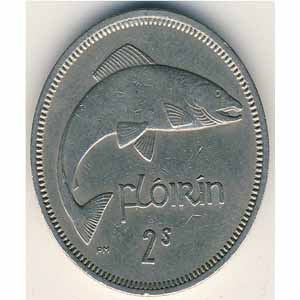
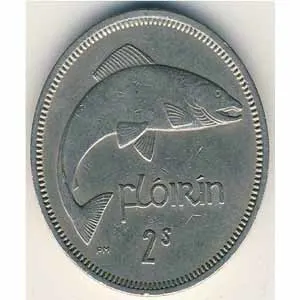
The salmon on the Irish florin. Check the date: only 1943 is the great rarity.
So what is a 1943 florin worth? Real results from Whyte’s:
- €7,500 hammer, graded VG10 by NGC, 21 April 2012
- €7,500 hammer, Fine/very good, 9 September 2017
- €8,000 hammer, Fine/about Fine, 13 May 2023
Notice those are all worn coins. The 2017 catalogue runs from €4,500 in Fine to €22,500 in choice uncirculated, and top grades have risen since.
He also warns that fakes exist. Buy one only from a dealer or auction house that stands behind it.
The 1985 20p trial piece
The Irish 20p did not go into circulation until October 1986. Before that, 1985-dated coins were struck so phone boxes and vending machines could be set up for it.
Whyte’s lot notes, citing Central Bank sources, say about 500 went to companies, and fewer than 50 were never returned.
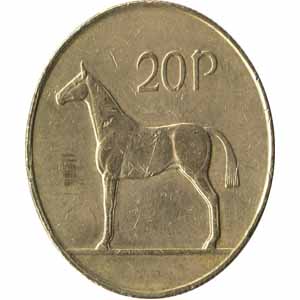
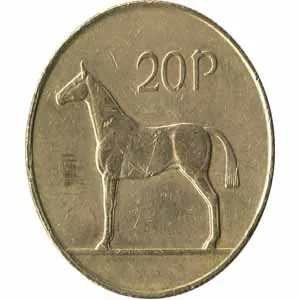
The horse on the Irish 20p, issued from 1986. Only the 1985 date is the rarity.
The sales at Whyte’s:
- €7,200 hammer, about uncirculated, 17 October 2015
- €4,800 hammer, 14 May 2016
- €5,400 hammer, extremely fine, 6 April 2019
You may have seen claims of €20,000 for this coin. I found no sale anywhere near that. The 2019 lot note recorded only about ten in private hands.
Other dates worth checking
1943 half crown
It shares the florin’s story, but more escaped. Grade makes a huge difference. At one Whyte’s sale on 9 September 2017, an about uncirculated coin made €1,400. A scratched and knocked one in the same sale made €120.
1937 half crown, shilling and florin
The irishcoinage.com catalogue says these were struck in small numbers: about 40,000 half crowns, 100,000 shillings and 150,000 florins. Top-grade pieces are scarce, and the catalogue says the 1937 half crown is probably rarer than the 1943 in uncirculated grades.

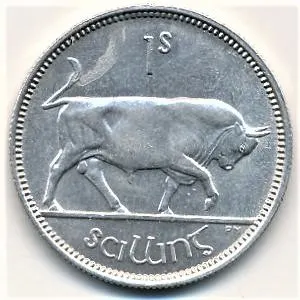
The bull on the Irish shilling
The 1961 “mule” half crown
Some 1961 half crowns were struck with the older 1928 to 1937 reverse by mistake.
Look at the horse’s tail. On the normal coin it has seven hairs with straight sides. On the mule it is bell-shaped with eight hairs. The catalogue says the variety is easy to find worn but scarce in extremely fine or better.
1938 penny and half crown
These are trial strikes, never issued. Two pennies and one half crown are known, and the National Museum holds one of each. The catalogue says the only privately held 1938 penny was sold through Spink in London in 2002. The price was not published.
The 1971 decimal coins
Decimal Day was 15 February 1971. Gabriel Hayes designed the birds on the halfpenny, penny and twopence, taken from early manuscript art. The 5p and 10p kept Metcalfe’s bull and salmon, and the 50p took the woodcock.
The 5p and 10p arrived early, in 1969, and the 50p in 1970. Later came the 20p in 1986 and the red deer £1 in 1990. The last Irish pound coins were dated 2000, including a Millennium £1 showing the Broighter boat.
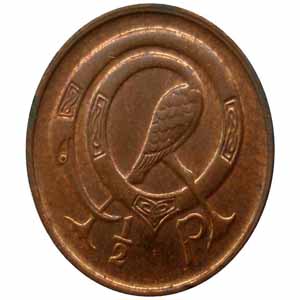
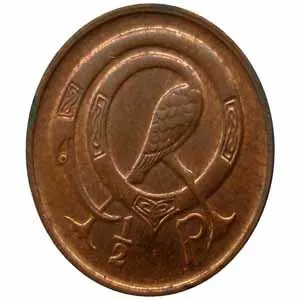
Gabriel Hayes’s bird on the decimal halfpenny
Two to look for:
- 1985 halfpenny. Most were melted after the coin was withdrawn in 1987. The catalogue suggests about €100 in extremely fine, and says more have surfaced than once thought.
- 1986 halfpenny, 10p and 50p. Mainly struck for the 1986 Central Bank specimen set. Whyte’s has sold these packs for €240 to €650 hammer between 2012 and 2021.
The catalogue is blunt about the rest. Circulated decimal coins generally are not worth more than their exchange value.
Irish euro coins: are any worth money?
Irish euro coins carry a harp designed by Jarlath Hayes, with “Éire” and the year. They have been dated from 2002.
The 2002 1c alone ran to about 404 million, according to the mintage tables at euro-coins.info. A coin from your pocket is worth face value.
A few years had tiny runs, mainly for Central Bank collector sets. The same tables give these rough figures:
- 2015: 1c and 2c, about 41,000 each
- 2017: 1c, 2c, 20c and 50c, about 17,000 each
- 2018: 1c and 2c, about 26,000 each
- 2019: several denominations, about 9,000 each, in sets only
- 2020: 1c and 10c, about 10,000 each
These are mainly wanted in the sealed sets. There is no reliable published sale of a loose one, so I won’t guess a price.
Ireland’s €2 commemoratives are worth knowing too. The ECB lists national issues for the 2016 Easter Rising (4.5 million coins), the 2019 First Dáil (1 million) and 2023, 50 years in the EU (500,000).
Ireland also joined the shared issues of 2007, 2009, 2012, 2015 and 2022. With runs that size, a circulated one is still worth €2.
Euro error coins do exist. Get any suspected error checked by a dealer before you get excited.
Is a 1999 €1 coin worth €2,000?
No. This story did the rounds online, and an earlier post on this site wrongly repeated it.
The claim was that a 1999 French €1, with the tree design, was worth up to €1,800. France dated its first euro coins 1999. Mintage tables at euro-coins.info put its 1999 €1 run at roughly 300 million coins.
I found no auction result to back the big figures. An ordinary 1999 French €1 is worth one euro. If a story says a common coin is worth thousands, look for a sold price from a named auction house.
How to tell if your coin is valuable
- Check the date first. 1943, 1937, 1938, 1985 and 1986 are the ones to watch, plus the 1961 mule half crown.
- Check the grade. Collectors use Fine, Very Fine, Extremely Fine and Uncirculated. A worn coin can be worth a fraction of a crisp one.
- Look for errors. Wrong metal, wrong design or a double strike can matter. Damage after minting does not count.
- Do not clean it. Cleaning leaves marks that collectors spot straight away.
Where to sell, and the Central Bank exchange
Selling a rare coin
For a genuine rarity, use an established auction house with a coin department. Whyte’s in Dublin sells Irish coins regularly, and its past results are public. Adam’s, Spink and Noonans are other names to approach. Ask about seller’s fees before you consign.
Stafford-Langan says plainly that a seller may get significantly less than his catalogue figures.
eBay asking prices versus sold prices
Anyone can list a 1943 florin at €50,000. That tells you nothing. Check sold listings or, better, auction results.
The catalogue also warns about coins in plastic slabs graded higher than they deserve. Fake slabs exist too.
Exchanging old punts at the Central Bank
The Central Bank of Ireland exchanges old Irish pound coins at IR£1 = €1.269738. Its form covers pre-decimal coins too, from the farthing up.
You can send coins by registered post from within Ireland. You can also book an appointment at North Wall Quay, Dublin 1, on +353 1 224 5969. Some retail banks may submit an application for you.
The rules are strict. There is a 10kg limit, and payment goes to a bank account, not cash. Applications worth over IR£150 need ID, proof of address and evidence of where the coins came from.
One warning. The Central Bank pays face value only. A 1943 florin was worth two shillings, which comes to about 12.7 cent. Send that one to auction instead.
If you are lucky enough to find one of the most valuable Irish coins, then please comment and let me know.
Irish coins FAQ
What is the rarest Irish coin?
The 1938 penny and half crown trial strikes, with three known between them. Of coins issued for circulation, the 1943 florin is the rarest, with about 60 recorded.
How much is a 1943 florin worth?
Worn examples made €7,500 to €8,000 hammer at Whyte’s between 2012 and 2023. Better grades are worth more. Get it authenticated, as fakes exist.
How much is a 1985 Irish 20p worth?
Whyte’s has sold examples for €4,800 to €7,200 hammer between 2015 and 2019. It was a trial piece, and only about ten are recorded in private hands.
Are Irish euro coins worth anything?
Coins from circulation are worth face value. Low-mintage years such as 2015, 2017 and 2019 are mainly sought in sealed collector sets.
Can I still exchange old Irish coins?
Yes. The Central Bank of Ireland still exchanges them at IR£1 = €1.269738, by post or appointment, with no deadline stated on its website.
Are Irish silver coins worth more than face value?
Shillings dated 1942 or earlier, and florins and half crowns dated 1943 or earlier, are .750 silver. So even common dates have some metal value.
More Irish symbols and history
- The Irish harp, the symbol on Irish coins
- The 10 best Irish poets, including W.B. Yeats
- Irish symbols in modern day life
- The Irish flag and what it means
- Facts about Ireland
- 10 Irish inventions
A little bit of Ireland in your inbox every Friday ☘️
The free Weekly Dose of Irish: an Irish joke, a Celtic symbol, an Irish fact, a poem and the week’s best articles in one short email. Join 9,600+ readers.
Free. One short email every Friday. Unsubscribe any time.
George O Brien
Friday 20th of January 2023
How much is a 1928 florin worth
Irish Around The World
Thursday 26th of January 2023
Hard to say better to get them valued at a reputable coin place
ger
Friday 4th of February 2022
2 pence icoin year 1979 queen elizabeth any value plese
Annemarie
Thursday 16th of September 2021
I have loads of old cions some on this list need looking at and willing to sell them