
To My Darling Daughter Betty is one of those short Irish poems that immediately impact you when you read it. Tom Kettle wrote “To My Daughter Betty” on 4 September 1916, in the field on the Somme during the First World War, when Ireland was part of the United Kingdom.
He was sent out to fight the war and didn’t know if he would ever see his wife or daughter again. Over 200,000 Irishmen fought across the world, and 49,400 died. He was killed five days later, on 9 September 1916, leading his men at Ginchy. The incredible poem To My Daughter Betty comes in at number 73 on the top 100 Irish poems list. If you would like to get a new Irish poem straight to your inbox every Friday, subscribe here for free.
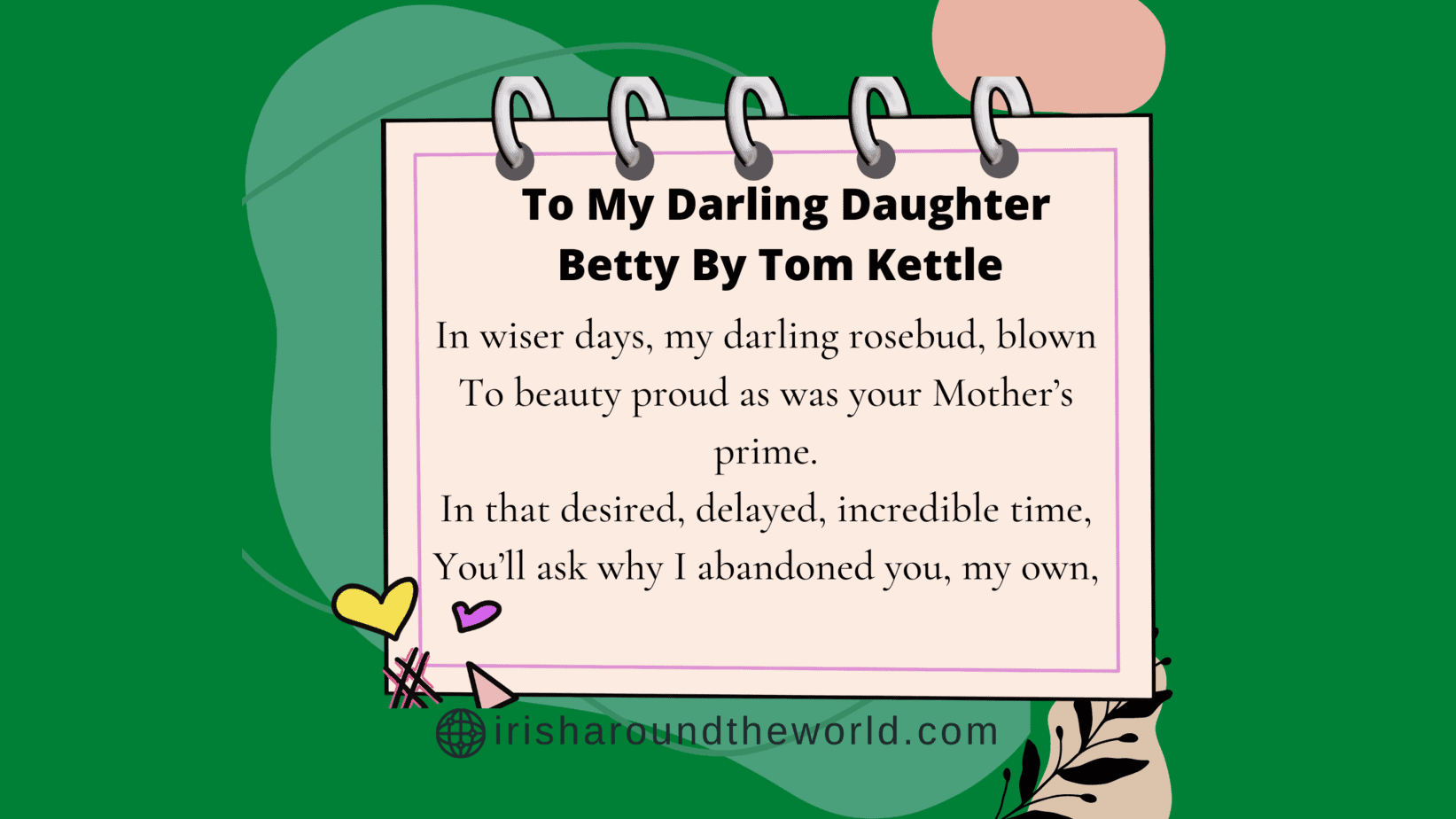
To My Daughter Betty By Tom Kettle
They are dated ‘In the field, before Guillemont, Somme, Sept. 4, 1916’.
To beauty proud as was your Mother’s prime.
In that desired, delayed, incredible time,
You’ll ask why I abandoned you, my own,
And the dear heart that was your baby throne,
To die with death. And oh! they’ll give you rhyme
And reason: some will call the thing sublime,
And some decry it in a knowing tone.
So here, while the mad guns curse overhead,
And tired men sigh with mud for couch and floor,
Know that we fools, now with the foolish dead,
Died not for flag, nor King, nor Emperor,
But for a dream, born in a herdsman’s shed,
And for the secret Scripture of the poor.
To My Daughter Betty: meaning and analysis
Tom Kettle (1880 to 1916) was a barrister, economist, UCD professor and Irish Parliamentary Party MP for East Tyrone. A Home Ruler, he joined the Royal Dublin Fusiliers believing the war was being fought for the freedom of small nations. The Easter Rising, and the killing of his brother-in-law Francis Sheehy-Skeffington by a British officer during that week, left him torn. He wrote this sonnet to his little daughter, Betty, knowing he might not come home.
What it means
Kettle imagines Betty grown up, asking why her father left her and her mother to die in a foreign war. People will give her reasons: some will call it noble, and some will sneer. His answer is the last six lines. He and “the foolish dead” did not die for flag, king or emperor, but “for a dream, born in a herdsman’s shed” (the birth of Christ in the stable) and for “the secret Scripture of the poor”. In other words, for faith and for ordinary people, not for any empire.
Form
It’s a Petrarchan sonnet: an eight-line octave rhyming ABBAABBA, which asks the question, then a six-line sestet rhyming CDCDCD, which answers it. The “mad guns” overhead and the men sleeping in mud make the turn all the more powerful.
Key themes
- Fatherhood: a letter in verse to a child he may never see again.
- Conscience: explaining a choice others will judge.
- Memory of the Irish in the First World War: a part of Irish history that was overlooked for decades.
More Irish poems
- The Mother by Pádraig Pearse
- Father and Son by F.R. Higgins
- A Prayer for My Daughter by W.B. Yeats
- Ireland’s top 100 Irish poems
Love this? Save it to your Pinterest board for later.
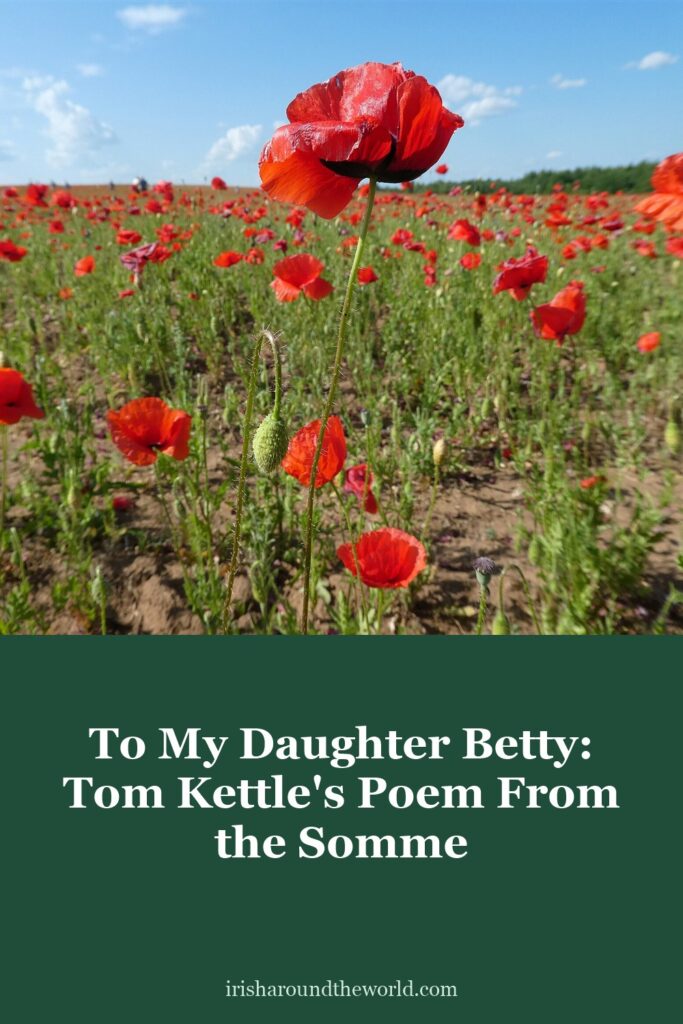
Pin photo: Legendary poppy field in Pavy by Ekaterina Borisova, CC BY-SA 4.0, via Wikimedia Commons.
A little bit of Ireland in your inbox every Friday ☘️
The free Weekly Dose of Irish: an Irish joke, a Celtic symbol, an Irish fact, a poem and the week’s best articles in one short email. Join 9,600+ readers.
Free. One short email every Friday. Unsubscribe any time.