
This weeks poem from my list of top 100 Irish poems is number 97 titled “The Host Of The Air” by W.B. Yeats
What is the poem “The Host Of The Air” about?
This fantastic poem by W. B. Yeats tells the story of a man falling asleep while working beside a lake.
This poem is an English version of an old Gaelic (Irish) ballad which the poet heard sung and translated in Ballisodare, County Sligo.
“The host of the air” means the fairy host: the sídhe, the otherworld people of Irish folklore, who were said to travel on the wind and steal away brides and young people. Host here means a crowd or an army, not the bread of the Mass.
Now let’s get to the top Irish poem. If you would like to get a new poem straight to your inbox every week you can subscribe here to my weekly Irish poem.


THE HOST OF THE AIR
by: William Butler Yeats (1865-1939)
O’Driscoll drove with a song
The wild duck and the drake
From the tall and the tufted reeds
Of the drear Hart Lake.
And he saw how the reeds grew dark
At the coming of night-tide,
And dreamed of the long dim hair
Of Bridget his bride.
He heard while he sang and dreamed
A piper piping away,
And never was piping so sad,
And never was piping so gay.
And he saw young men and young girls
Who danced on a level place,
And Bridget his bride among them,
With a sad and a gay face.
The dancers crowded about him
And many a sweet thing said,
And a young man brought him red wine
And a young girl white bread.
But Bridget drew him by the sleeve
Away from the merry bands,
To old men playing at cards
With a twinkling of ancient hands.
The bread and the wine had a doom,
For these were the host of the air;
He sat and played in a dream
Of her long dim hair.
He played with the merry old men
And thought not of evil chance,
Until one bore Bridget his bride
Away from the merry dance.
He bore her away in his arms,
The handsomest young man there,
And his neck and his breast and his arms
Were drowned in her long dim hair.
O’Driscoll scattered the cards
And out of his dream awoke:
Old men and young men and young girls
Were gone like a drifting smoke;
But he heard high up in the air
A piper piping away,
And never was piping so sad,
And never was piping so gay.

The Host of the Air: meaning and analysis
Yeats included the poem in The Wind Among the Reeds (1899), the book most full of the fairy lore he gathered around Sligo.
What it means
O’Driscoll is out on Hart Lake at dusk, driving the wild ducks from the reeds and daydreaming about his bride, Bridget. He hears piping and sees young men and girls dancing, with Bridget among them, wearing “a sad and a gay face”. They offer him red wine and white bread. In Irish folklore, if you eat or drink the food of the fairies, you belong to them.
Bridget pulls him away from the food to a table of old men playing cards. Lost in the game, he doesn’t notice when the handsomest young man there carries her away. He scatters the cards and wakes, and everyone is gone “like a drifting smoke”. Only the piping is left in the air. The suggestion is that the fairies have taken Bridget for good, and that in saving him she lost herself.
Form
A ballad in four-line stanzas rhyming ABCB, with the piper’s lines (“And never was piping so sad, / And never was piping so gay”) at the start and the end, like the chorus of an old song.
Key themes
- Fairy abduction: one of the most common stories in Irish folklore.
- Love and loss: a moment’s distraction costs him everything.
- Dream and reality: the line between the two blurs.
More Irish poems
- The Ballad of Father Gilligan by W.B. Yeats
- The Second Coming by W.B. Yeats
- The best Irish poets
- Ireland’s top 100 Irish poems
Love this? Save it to your Pinterest board for later.
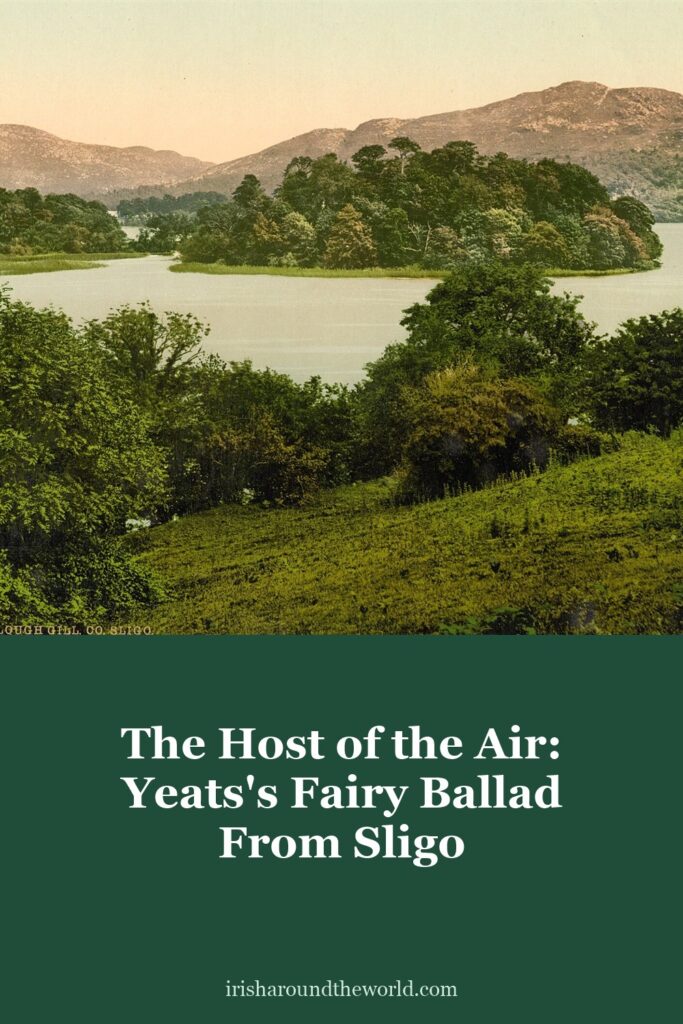
Pin photo: Lough Gill, Co. Sligo, photochrom c. 1890 to 1900, Library of Congress (public domain).
A little bit of Ireland in your inbox every Friday ☘️
The free Weekly Dose of Irish: an Irish joke, a Celtic symbol, an Irish fact, a poem and the week’s best articles in one short email. Join 9,600+ readers.
Free. One short email every Friday. Unsubscribe any time.