
St Brendan the Navigator was a Kerry monk, born about 484 near Tralee, who founded Clonfert in Co. Galway and died around 577. His fame rests on the Navigatio, a Latin voyage tale written centuries later. Did he reach America? Nobody can say. Tim Severin showed a leather boat could do it in 1976 and 1977, but the Norse are the first proven Europeans there.
Ask most people about St Brendan the Navigator and you’ll hear one claim. An Irish monk in a leather boat beat Columbus to America by nearly a thousand years.
It’s a great story, and part of it may even be true. Here’s the real Brendan, the medieval book about him and the man who tested it.
Jump to:
- Who was St Brendan the Navigator?
- The Navigatio: the voyage tale
- The island that was a whale, and other stops
- How scholars read the Navigatio
- Did St Brendan discover America?
- The Brendan Voyage: Tim Severin’s leather boat
- St Brendan’s Isle and Columbus
- Where to follow St Brendan in Ireland today
- St Brendan FAQ
- More Irish saints, myths and places
Who was St Brendan the Navigator?
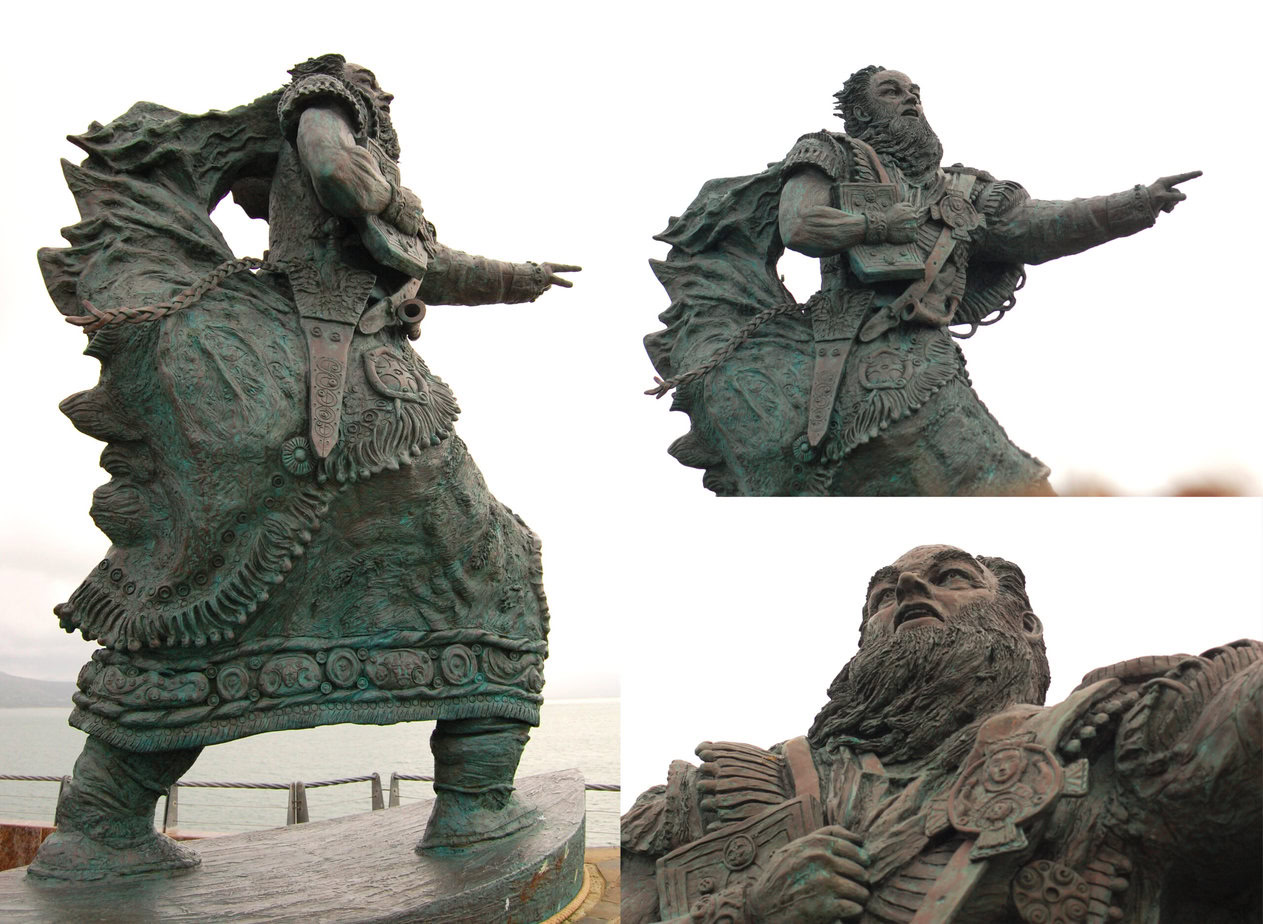
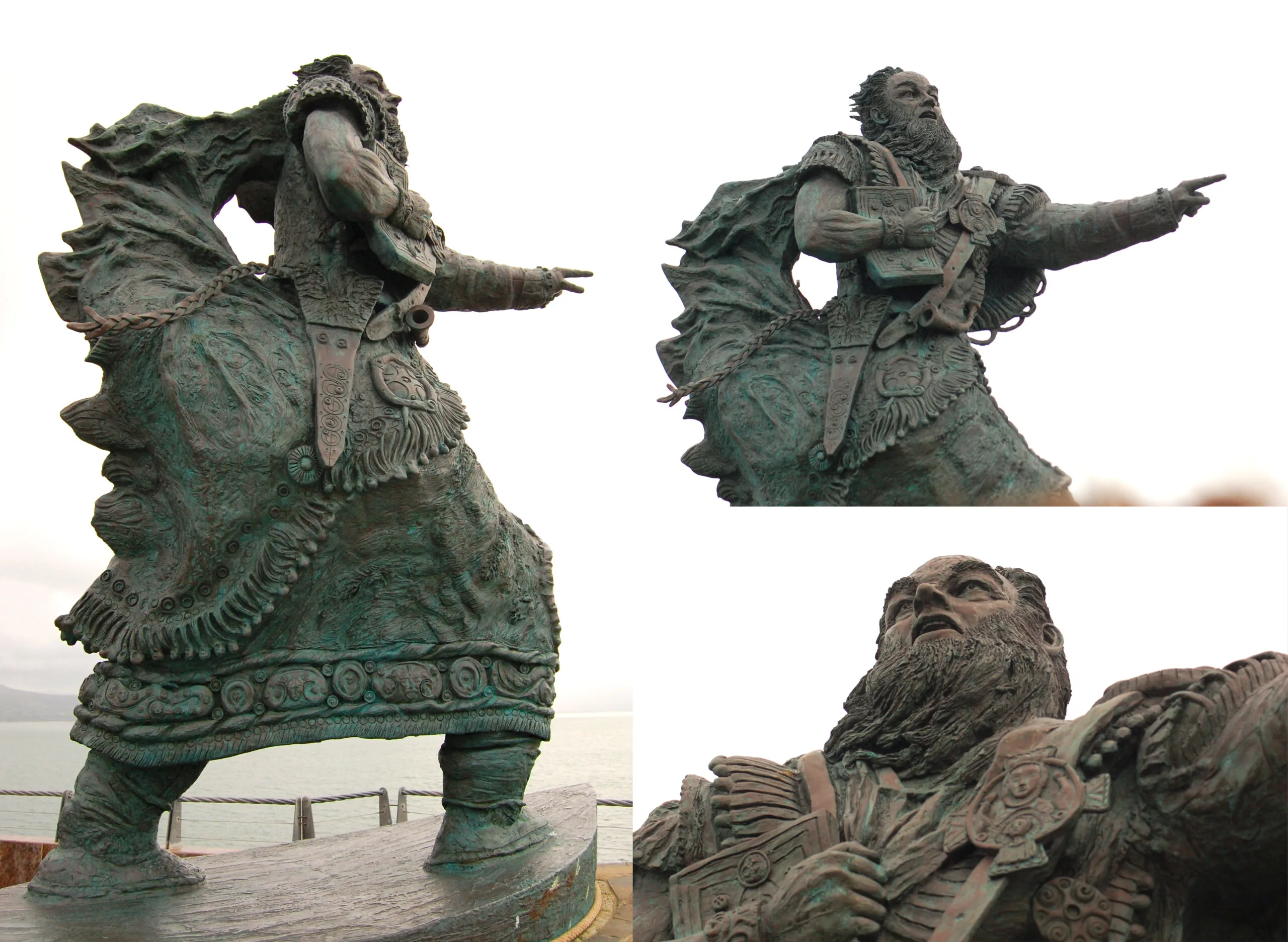
Three views of a bronze statue of St Brendan, book in hand, pointing out to sea.
Brendan, or Brénainn in Old Irish, was born about 484 near Tralee in Co. Kerry. Some sources say 486. Fenit claims him as its own.
He came from the territory of the Ciarraige Luachra in north Kerry, according to the Dictionary of Irish Biography. His father was called Findlug.
His medieval Lives say St Íte (Ita) guided him as a child and a bishop called Erc ordained him. He is also said to have studied under St Jarlath of Tuam.
A founder of monasteries
Brendan’s real life’s work was founding monasteries. Houses linked to him include:
- Ardfert, Co. Kerry, near his birthplace.
- Annaghdown, on Lough Corrib in Co. Galway. Tradition says it began as a women’s community led by his sister Bríg.
- Clonfert, Co. Galway, Cluain Fearta in Irish, his most famous house. Sources give its founding as 558, 561 or 564, so “about 560” is the honest answer.
He also travelled to Scotland, Wales and Brittany. Adomnán’s Life of Columba, written in the late 600s, records him visiting Colum Cille in the Hebrides. That is probably the earliest surviving mention of him.
His death and burial
His Lives say he died at Annaghdown while visiting his sister. The annals disagree, giving 577 or 583. Britannica settles on about 578, and around 577 is the usual figure.
His Lives say he had asked to be buried at Clonfert, and his body was carried there. That’s where he lies today, by tradition.
Don’t mix him up with Brendan of Birr, another sixth-century saint. This page is about Brendan of Clonfert, the Navigator.
The Navigatio: the voyage tale
Almost everything people “know” about Brendan’s sailing comes from one book. It’s the Navigatio Sancti Brendani Abbatis, “The Voyage of St Brendan the Abbot”.
It was written in Latin prose long after he died. Britannica dates it to somewhere between the mid-8th and early 10th centuries. The Dictionary of Irish Biography leans to the late 8th century, by an Irishman at home or on the Continent.
Either way, the author was writing two to three and a half centuries after Brendan’s death.
The tale was a medieval bestseller, translated into many languages and copied all over Europe.
It belongs to the immram, the Irish genre of island-hopping voyage tales.
The island that was a whale, and other stops
In the story, a monk called Barrind visits Brendan and tells him of a Promised Land of the Saints, far out in the ocean. Brendan decides to find it.
He builds a currach, a light boat of wicker ribs covered in cow hides tanned in oak bark. Fourteen monks sail with him, plus three latecomers who beg to come.
Jasconius, the island that moved
The monks land on a bare island and light a fire to cook. The island starts to move, and they scramble back to the boat.
In Denis O’Donoghue’s 1893 translation, Brendan explains it was “the largest of all that swim in the ocean”. Its name is Jasconius, and it’s forever trying to make its head and tail meet.
The whale becomes a friend. For seven Easters running, they say Mass on its back.
For more sea beasts, see my guide to Irish mythological creatures.
The Paradise of Birds
Next comes an island where a tree is covered in white birds. They sing the monastic hours of prayer, right on cue.
One bird explains that they fell from heaven with Lucifer but never consented to his rebellion. So they are angels of a sort, stuck between heaven and hell. A bird tells Brendan his voyage will last seven years.
More wonders
- The island of Ailbe: a silent community of 24 monks, with crystal altars and lamps lit by a fiery arrow.
- The crystal pillar: a huge clear column in the sea, wrapped in a net like silver. They find a chalice and paten there.
- The island of smiths: a dark, smoking island where a smith hurls burning slag at the boat.
- Judas on a rock: they meet Judas Iscariot, who is given rest from hell every Sunday.
After seven years they pass through a ring of darkness. They reach the Promised Land: full of fruit trees, where night never falls. Then they sail home, and Brendan dies soon after.
How scholars read the Navigatio
A map of the monk’s year
The voyage runs in a loop. Every year the monks land in the same places on the same feast days.
| Feast | Where the monks spend it |
|---|---|
| Holy Thursday | The Island of Sheep, where their steward feeds them |
| Easter | On the back of Jasconius the whale |
| Easter to Pentecost | The Paradise of Birds |
| Christmas | With the silent community of Ailbe |
That’s why many scholars read it as a picture of monastic life and the Church year.
A memory of real seas
The other reading looks for real places. On this view:
- The crystal pillar is an iceberg.
- The island of smiths is a volcano, perhaps in Iceland.
- The islands of sheep and birds could be the Faroes.
- The Promised Land might be America, or the Canaries, or the Azores.
The Dictionary of Irish Biography allows that it may preserve folk memory of Irish voyages north. My own take: both readings can be true at once.
Did St Brendan discover America?
The short answer: there is no evidence that he did. There is also no proof that he didn’t.
T. J. Oleson weighed it up in the Dictionary of Canadian Biography. Brendan or others may have crossed, he wrote, but “there is no real evidence for this view”. If they did, they left no trace.
Irish monks did reach Iceland
An Irish scholar called Dicuil finished a geography book in 825. He tells of Irish clerics who spent time on an island in the far north around 795. They marvelled that the summer sun barely set.
Later, the Icelander Ari Thorgilsson wrote his Book of the Icelanders before 1133. He says Christian men called papar lived in Iceland before the Norse came. They left, he says, leaving behind Irish books, bells and croziers.
Neither writer links these monks to Brendan. But they show Irish monks really did sail the North Atlantic.
The Norse were first, as far as we know
The first proven Europeans in the Americas were the Norse. Their site at L’Anse aux Meadows in Newfoundland is a UNESCO World Heritage Site.
A 2021 study in Nature dated wood cut there by the Norse to the year 1021, using a burst of radiation preserved in the tree rings. That’s 471 years before Columbus.
So “what year did St Brendan discover America?” has no answer. There is no year.
The Brendan Voyage: Tim Severin’s leather boat
In the 1970s the explorer and writer Tim Severin decided to test the legend. He built a 36-foot currach by hand, using traditional materials and methods: a wooden frame covered in leather hides.
After sea trials in Courtmacsherry Harbour, west Cork, the boat Brendan left Brandon Creek on the Dingle Peninsula in 1976.
RTÉ gives the route like this:
- North by the Hebrides and the Faroes
- On to Iceland
- Past Greenland
- Landfall on Peckford Island, Newfoundland, in June 1977
The whole trip was about 7,200km.
Severin’s book, The Brendan Voyage, became an international bestseller. Shaun Davey later wrote an orchestral suite of the same name.
What did it prove? That a sixth-century-style boat could cross the Atlantic. It doesn’t show that anyone did.
Severin died at home in Timoleague, west Cork, in 2020. The boat is on show at Craggaunowen in Co. Clare. Craggaunowen is seasonal and closed until 2027, so check craggaunowen.ie first.
St Brendan’s Isle and Columbus
For centuries, sailors and map makers believed in an Atlantic island named after Brendan. It drifted about on maps, often placed near the Canaries or the Azores.
Britannica says that in Columbus’s day people believed it had been sighted from the Azores. It was most likely a mirage.
The Canary Islanders still call such a ghostly glimpse of land San Borondón. Several official searches went looking for it. One, in 1721, found nothing, and sightings carried on for decades after.
You’ll often read that Columbus studied Brendan’s voyage or carried his maps. There’s no reliable source for that. What’s on record is narrower: belief in the isle was alive in his time.
Where to follow St Brendan in Ireland today
Mount Brandon, Co. Kerry
Mount Brandon, Cnoc Bréanainn, is named after him. At 952 metres it’s the highest peak in Ireland outside the MacGillycuddy’s Reeks.
Tradition says Brendan and his monks kept a hermitage on the summit. A holy well and the ruins of a small oratory are still there.
The Saints’ Road climbs from the Ballybrack car park, past 14 Stations of the Cross. Check the weather first, as cloud comes in fast off the Atlantic.
Cosán na Naomh, the Saints’ Path
Cosán na Naomh is an old pilgrim path on the Dingle Peninsula. The Irish Times describes it as about 18km from Ventry, taking about five hours.
It passes Gallarus Oratory and the 12th-century church at Kilmalkedar, which is linked to Brendan. The traditional goal is Brandon itself.
Nearby is Brandon Creek, Severin’s starting point and, by tradition, Brendan’s. It’s all on the Wild Atlantic Way.
Fenit and Ardfert
At Fenit, near Tralee, a large bronze Brendan stands on Great Samphire Island in the harbour, pointing west out to sea.
Ardfert Cathedral, a few kilometres inland, marks the place where he founded a monastery. The OPW opens it in the summer season only (March to September in 2026), so check heritageireland.ie before you go.
Clonfert and Loughrea, Co. Galway
St Brendan’s Cathedral at Clonfert, now Church of Ireland, sits where his monastery stood. Its Romanesque doorway, from around 1200, is often counted among the finest carved doorways in Ireland.
Discover Ireland says it is kept locked, with the key at the house to the right of the cathedral.
The Catholic diocese’s Cathedral of St Brendan is in Loughrea, built between 1897 and 1902. Its Celtic Revival glass is well known, and its carvings include work by the sculptor Michael Shortall.
His feast day is 16 May. He is patron of the dioceses of Kerry and Clonfert, and popular tradition adds sailors, travellers and, fittingly, whales.
St Brendan FAQ
Did St Brendan discover America?
There’s no evidence he did. Tim Severin’s leather currach showed it was possible, nothing more. The Norse at L’Anse aux Meadows, around 1021, are the first Europeans proven to have reached America.
Where did St Brendan sail from?
Tradition says Brandon Creek, Cuas an Bhodaigh, on the Dingle Peninsula in Co. Kerry. No early source confirms it, but Severin chose the same spot in 1976.
Did St Brendan go to Iceland?
We don’t know. Some read the smiths’ island in the Navigatio as Icelandic volcanoes. What is recorded is that Irish monks reached Iceland by about 795, according to Dicuil.
When is St Brendan’s feast day?
16 May.
What is St Brendan the patron saint of?
By tradition, sailors, mariners, travellers and whales, plus the dioceses of Kerry and Clonfert.
Where is St Brendan buried?
At Clonfert, Co. Galway, as he wished. He died at Annaghdown around 577.
More Irish saints, myths and places
- The Real Story Behind St Patrick’s Day
- Irish Mythological Creatures
- Celtic Gods and Goddesses
- The Wild Atlantic Way
- Facts About Ireland
- Celtic Symbols and Their Meanings
A little bit of Ireland in your inbox every Friday ☘️
The free Weekly Dose of Irish: an Irish joke, a Celtic symbol, an Irish fact, a poem and the week’s best articles in one short email. Join 9,600+ readers.
Free. One short email every Friday. Unsubscribe any time.