The Dara knot is a round Celtic-style knot named after the oak. In Irish the tree is dair, and “Dara” means “of the oak”, as in Kildare. Today it stands for strength and endurance. The knotwork method is early medieval. But I found no Dara knot before the internet age. The earliest mention I could find online is from 2008, and nobody knows who designed it.
The Celtic Dara knot is one of the most popular Irish symbols of strength. It turns up on pendants, rings and a fair few forearms.
Most websites call it ancient. Almost none of them give a source.
So I went looking. The short version: the oak story is real, and the knot is young. Neither fact should stop you wearing it.
Jump to:
- What the Celtic Dara knot looks like
- What “Dara” means, and how to say it
- The oak in early Ireland
- Is the Dara knot ancient? The honest history
- The real knotwork behind it
- Dara knot meaning today
- Dara knot vs shield knot, trinity knot and tree of life
- Dara knot tattoos and jewellery
- Dara knot FAQ
- More Celtic knots and symbols
What the Celtic Dara knot looks like
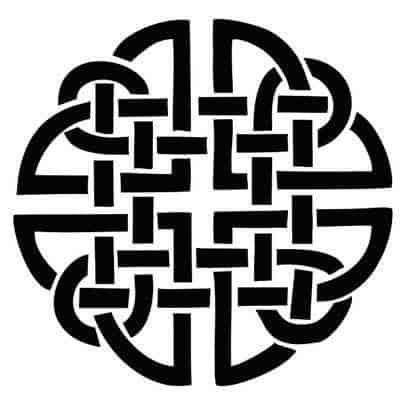
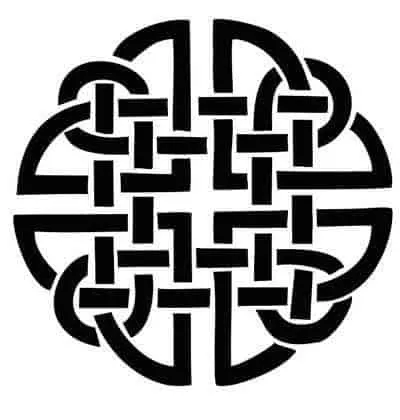
The Dara knot as it is usually drawn today: a woven centre with four rounded lobes. A modern design built with medieval knotwork methods.
The version most people know is a roughly round knot. It has a woven, basket-like square in the middle.
From that centre, the bands loop out into four rounded arms. The bands pass over and under each other in turn, and there are no loose ends.
People say the bands look like the roots of an oak. That’s where the meaning comes from.
There is no single official Dara knot. Jewellers sell quite different designs under the same name, which is a clue to its age.
What “Dara” means, and how to say it
Most sites say the name comes from doire, “oak tree”. Close, but not quite.
Ó Dónaill’s standard Irish-English dictionary gives two separate words:
- dair is the oak tree itself. It’s a feminine noun, and also the name of the ogham letter D.
- doire means an oak wood, or more loosely a wood, grove or thicket.
“Dara” is closest to the first. The Dictionary of the Irish Language (eDIL) says the old genitive was daro. In the Annals of Ulster, daro (as in Cell Daro) runs until 918. After that it becomes dara or darach.
So “Dara” literally means “of the oak”. You still see it in Cill Dara, the Irish name for Kildare.
How to pronounce it
These are rough guides only.
- Dara: DAR-a
- dair: roughly “dar”, with a soft, light r at the end
- doire: roughly DIR-eh or DERR-eh, which is where “Derry” comes from
- Cill Dara: kill DAR-a
For the real thing, teanglann.ie has recordings of dair and doire in Ulster, Connacht and Munster Irish.
The oak in early Ireland
This is the part of the story that is properly old.
Oak in Irish place-names
Three famous places named after oaks:
- Kildare is Cill Dara, “church of the oak”, says the official placenames database, logainm.ie. It’s the home of St Brigid.
- Derry was first Daire Calgaich, “the oak wood of Calgach”. It later became Derry Columcille, after the monastery traditionally founded by Colum Cille. That’s according to P.W. Joyce’s Irish Names of Places.
- Durrow, in Co. Offaly, was Dairmag, “plain of the oaks”. Colum Cille is said to have founded a monastery there too.
A medieval Life of Colum Cille says he lived under a great oak at Kells. When it fell, a man tanned his shoes with its bark and got leprosy for his trouble.
Hold on to Durrow. The Book of Durrow, kept for centuries at Durrow, is one of the earliest great knotwork manuscripts. Where it was made is still argued over.
That’s the nearest thing to a real link between the oak and the knot. It just took 1,300 years to reach the jewellery counter.
Lords of the wood: oak in the brehon laws
Early Irish law, often called the brehon laws, took trees very seriously.
Dr Fergus Kelly of the Dublin Institute for Advanced Studies is the expert here. He wrote “The use of Ireland’s woodland in medieval times”.
Kelly explains that an eighth-century law text, Bretha Comaithchesa, ranks 28 trees and shrubs in four groups of seven. The top group are the airig fedo, the “lords of the wood”.
The lords are oak, hazel, holly, yew, ash, Scots pine and wild apple. You’ll often see them called the “noble trees”, which is a fair paraphrase.
Some details from Kelly:
- Damaging a lord of the wood cost two milch cows and a three-year-old heifer. A “commoner” of the wood cost one milch cow.
- A legal commentary says the oak was valued for “its acorns and its use for woodwork”.
- A commentator of about the 12th century reckoned one oak could fatten one pig in a good acorn year.
- Strip bark from someone else’s oak and you owed an ox-hide. You also had to plaster the wound with clay, cow-dung and fresh milk until it healed.
- Irish oak even went into the roof of Salisbury Cathedral, dated by tree rings to 1222.
So the oak was a working tree as much as a revered one. It fed pigs, tanned leather and roofed cathedrals.
Druids and the oak
You’ll read that the druids worshipped the oak. The main source is Pliny the Elder, writing around AD 77.
He says druids held nothing more sacred than mistletoe growing on an oak. Pliny himself linked their name to the Greek word for oak. But he was writing about Gaul, not Ireland.
The word “druid” may mean something like “oak knower”, but scholars hedge that. So do I. For more, see my guide to druid symbols.
Is the Dara knot ancient? The honest history
No, as far as I can tell. Here’s what I checked.
What I looked for
- Artefacts: I found no early medieval object, manuscript or carved stone identified as “the Dara knot”. No museum or scholarly source I could find names one.
- The classic books: George Bain’s Celtic Art: The Methods of Construction (1951) is the book most credited with reviving Celtic knotwork as a craft. My search of its scanned text found no “Dara”, no “doire” and no oak.
- Printed books: Google Books Ngram has no data for “Dara knot” up to 2022. “Celtic knot”, “trinity knot” and “shield knot” all register.
The earliest mention I found: 2008
The oldest dated use I could find is a page on the symbolism site whats-your-sign.com. The Internet Archive first captured it on 23 September 2008.
The author said a reader had emailed asking what it meant, so the name was already around. She admitted she didn’t know who created it.
She tied it to the Irish word for oak (giving doire, the oak-wood word) and to Kildare. She also passed on the idea, already around, that the knot looks like oak roots. That reading is now repeated almost everywhere.
No fixed design
The picture on that 2008 page wasn’t the round knot at all. It was a long horizontal knotwork border.
In 2018 the same site swapped it for a different, four-looped knot.
The round, basket-weave version shown above is the one most people know now. Even this site has used it since 2019. An ancient symbol would have a settled shape. This one was still finding its feet a few years ago.
The jewellery wave
Most of the pages I checked that now rank for “Dara knot” were first archived between 2019 and 2024. Many call it ancient. None I found gives a source.
My best guess is that the name grew up in jewellery and tattoo circles in the 1990s or 2000s. I couldn’t pin down a first use or an inventor. If you own a pre-2008 catalogue showing one, I’d love to see it.
The real knotwork behind it
The Dara knot may be new, but it’s built the old way.
Interlace wasn’t part of the earliest Celtic art. The pre-Christian La Tène style used spirals and curves. J. Romilly Allen, in Celtic Art in Pagan and Christian Times (1904), says interlace arrived with Christianity from “foreign sources”.
Allen traced it to the simple plait, common on Roman mosaic floors. Craftsmen then broke and rejoined the plait to make knots, mainly between AD 600 and 800. The Dara knot is built exactly this way.
The masterpieces followed:
- The Book of Durrow (Trinity College Dublin), around 650 to 700, with interlace carpet pages.
- The Lindisfarne Gospels (British Library), around 700 to 720.
- The Tara Brooch (National Museum of Ireland), late seventh or early eighth century, said to have been found at Bettystown, Co. Meath, in 1850.
- The Book of Kells (Trinity College Dublin), made “close to the year 800”, Trinity says. It was probably begun on Iona, at least in part.
Bain called interlace “a symbol of continuity”, and an unbroken line “probably a symbol of Eternity”. That’s likely the root of every “no beginning, no end” meaning online. My guide to the Celtic knot and its meanings goes deeper.
Dara knot meaning today
Today’s meanings are:
- Strength, like an oak that stands for centuries.
- Endurance and inner resilience, the idea that your strength is in your roots, out of sight.
- Wisdom and leadership, from the oak’s long life and high status.
All of these come from that 2008 web page and the jewellery copy that followed. None comes from a medieval source.
That doesn’t make them wrong. The oak really did head the lords of the wood, and Kildare really was named after one.
Meaning is something people give a symbol, not something dug out of a bog.
Dara knot vs shield knot, trinity knot and tree of life
| Symbol | Shape | Documented early? | Meaning today |
|---|---|---|---|
| Dara knot | Round knot, woven centre, four looped arms | No. Earliest mention I found is 2008. Designer unknown | Oak, strength, endurance |
| Shield knot | Square knot with four corners | Four-cornered knots exist in early insular art. The name is modern | Protection |
| Trinity knot (triquetra) | Three interlaced points, often with a circle | Yes. Triquetra knots appear in insular manuscripts and metalwork, including the Book of Kells | The Holy Trinity (a later reading), love, eternity |
| Celtic tree of life | Tree with knotted branches and roots in a circle | Sacred trees are well documented. The knotted roundel design is modern | Life, family, connection |
Want a documented early shape? The shield knot or triquetra have more history. If it’s the oak you love, pick the Dara knot. See my guides to the Celtic shield knot, the trinity knot and the Celtic tree of life.
Dara knot tattoos and jewellery
NPR reported in 2014 that Celtic knot tattoos took off in the United States in the 1970s and 1980s. The Dara knot came much later.
Tips for a Dara knot tattoo
- Check the over and under. In good knotwork every band passes over, then under, then over again. Ask your artist to check it before the needle comes out.
- Give it room. The woven centre is dense. Too small and the lines blur over the years.
- Pick a round space. The shape suits a shoulder, upper arm, calf or the back of the neck.
- Make it yours. There’s no fixed design, so adding an acorn or a date breaks no rule.
Buying Dara knot jewellery
You’ll find Dara knot pendants, earrings, rings and cufflinks.
If a seller calls it “ancient” or “worn by the Celts”, that’s marketing, not history. Judge the piece on its craft and its metal. For a gift with a documented story, the Claddagh ring is hard to beat.
Dara knot FAQ
What does the Dara knot mean?
Today it stands for strength, endurance and inner resilience, inspired by the oak and its roots. These meanings are modern, first written down online around 2008.
Is the Dara knot ancient?
Not as far as I can find. There’s no known early medieval example, and the name doesn’t register in Google’s book data. The knotwork method is early medieval, but the design and name look late 20th or early 21st century.
What does Dara mean in Irish?
“Dara” means “of the oak”. The tree is dair, and doire means an oak wood. You can still see it in Cill Dara, Kildare, the “church of the oak”.
Is the Dara knot a pagan symbol?
Not historically. Interlace in Ireland came in with Christianity and filled gospel books like Durrow and Kells. Some modern pagans use the Dara knot, and that’s a modern choice like any other.
What’s the difference between the Dara knot and the shield knot?
The Dara knot is round with a woven centre and stands for strength. The shield knot is square with four corners and stands for protection. Four-cornered knots have early examples, while the Dara knot doesn’t.
Can I wear a Dara knot if I’m not Irish?
Of course. Celtic knotwork has been borrowed and shared for 1,400 years. If you love the oak and what it stands for, that’s reason enough.
More Celtic knots and symbols
- The Celtic Knot and Its Meanings
- The Celtic Shield Knot
- The Triquetra, or Trinity Knot
- The Celtic Tree of Life
- Celtic Symbols and Their Meanings
- St Brigid’s Cross
- Druid Symbols
A little bit of Ireland in your inbox every Friday ☘️
The free Weekly Dose of Irish: an Irish joke, a Celtic symbol, an Irish fact, a poem and the week’s best articles in one short email. Join 9,600+ readers.
Free. One short email every Friday. Unsubscribe any time.