
Druid symbols are signs now linked with the druids, such as the Awen, the oak, the triskele and the shield knot. The catch: the ancient druids wrote nothing down, so nobody can name a symbol they used. Only the oak, mistletoe and the “serpent’s egg” are tied to druids by an ancient writer, Pliny. Most of the rest are older than the druids, later, or modern.
Search for druid symbols and you’ll find lists of ten, twenty, even thirty “ancient” signs. Each comes with a meaning. Almost none come with a source.
This page used to be one of those lists. I’ve rebuilt it with the real age of every symbol and where it came from.
Did the ancient druids have symbols?
The awkward bit is this. The druids left no writing of their own.
That was a choice. Julius Caesar says so in book 6 of his Gallic War. Pupils learned huge numbers of verses by heart, and some trained for 20 years.
The druids thought it wrong to write their teaching down, though they used Greek letters for ordinary accounts. Caesar says they wanted to keep their teaching from ordinary people, and feared writing would make students lazy about memory. Teachers today might sympathise.
So everything we know comes from outsiders: Roman writers first, then Irish monks centuries later. None of them describes a druid symbol.
When a website says a sign was “the druids’ symbol of protection”, ask where it got that.
What the Roman writers tell us
Julius Caesar
In Caesar’s account, druids led worship and sacrifice in Gaul and judged most disputes. Their harshest punishment was barring someone from the sacrifices.
They met once a year in the land of the Carnutes, thought to be the centre of Gaul. Their teaching was believed to have started in Britain. They taught that the soul passes into another body after death. Caesar was writing about people he was conquering, so read him with care.
Pliny the Elder
Pliny gives the most famous druid scene, in his Natural History of about AD 77. The druids, he says, held nothing more sacred than mistletoe, as long as it grew on an oak.
They chose oak groves and used oak branches in every rite.
The mistletoe was gathered on the sixth day of the moon. A priest in white climbed the tree and cut it with a golden sickle. It fell into a white cloak, and two white bulls were sacrificed.
A drink of mistletoe was believed to make barren animals fertile and cure all poisons. Pliny ends with a dry remark about the awe people feel for trifles.
Tacitus and Anglesey
Tacitus describes the Roman attack on Mona, now Anglesey, in about AD 60 or 61. The Britons lined the shore. Druids stood around them, raising their hands to the sky and pouring out curses.
Women in black ran between the ranks with torches. For a moment the soldiers froze. Then they attacked, and the sacred groves were cut down.
In Gaul, according to the historian Suetonius, the emperor Claudius had already abolished the druid religion.
Druids in Ireland
Rome never conquered Ireland, so the druid lived on longer here, at least in memory. The Old Irish word is druí, meaning a magician or wizard. Modern Irish has draoi, and draíocht, magic.
Our druid stories were written down by Christian monks, centuries later. So they’re literature, not reports.
- Cathbad is the druid of King Conchobar’s court in the Ulster Cycle, and in some versions his father. In the Táin he says whoever takes up arms that day will be famous for ever. The price, in the tellings, is a short life. The boy Cú Chulainn asks for weapons on the spot.
- Mug Ruith is the blind druid of Munster. In the saga The Siege of Knocklong, he drives Cormac mac Airt’s invading army out of the province.
- Lochru and Lucet Máel are King Lóegaire’s druids at Tara in Muirchú’s Life of Patrick. Patrick lit his Easter fire at Ferta Fer Féicc, a spot later tradition puts on the Hill of Slane. The druids warned that it must be put out that night, or it never would be. Neither druid ends well.
Muirchú wrote in the late 7th century, two centuries after Patrick, with a point to make.
Early Irish law still mentions the druid, but he’d come down in the world. According to Fergus Kelly’s A Guide to Early Irish Law (1988), the poet (fili) had largely taken his place.
There’s real evidence of sacred trees, too. The annals record that in 982 Máel Sechnaill cut down the sacred tree of Magh Adhair in Co. Clare, where the Dál gCais kings were inaugurated. You don’t fell a rival’s tree unless it means something.
How modern Druidry began
Most of today’s druid symbols come from the revival, not the Iron Age.
In London in November 1781, the Ancient Order of Druids was founded in a tavern off Oxford Street. It was a fraternal society, not a priesthood.
Then came Iolo Morganwg, the bardic name of Edward Williams (1747 to 1826), a Glamorgan stonemason. He held the first Gorsedd of the Bards on Primrose Hill in London on 21 June 1792.
Iolo was a gifted poet and a busy forger of “medieval” texts. A good deal of what passes for druid lore traces back to his desk.
In 1964 Ross Nichols founded the Order of Bards, Ovates and Druids, known as OBOD. Philip Carr-Gomm led it from 1988 to 2020. Since then its Chosen Chief has been Eimear Burke, who led the Kilkenny Druid Grove.
In 2010 the Druid Network was registered as a charity in England and Wales. The Charity Commission accepted druidry as a religion for charity law purposes.
Druid symbols and meanings, one by one
The oak, mistletoe and acorn
This is the best-evidenced druid symbol of all. Pliny ties the druids to the oak and its mistletoe directly.
He even thought the word druid came from the Greek drys, oak. He was half right. The word isn’t Greek, but most modern scholars think it does contain the old Celtic word for oak. It probably meant something like “oak-knower”. Either way, the oak is the safest choice here.
Ah, the faithful acorn. No ancient source mentions it with the druids. But it’s the oak in miniature, so it borrows the oak’s story fairly.
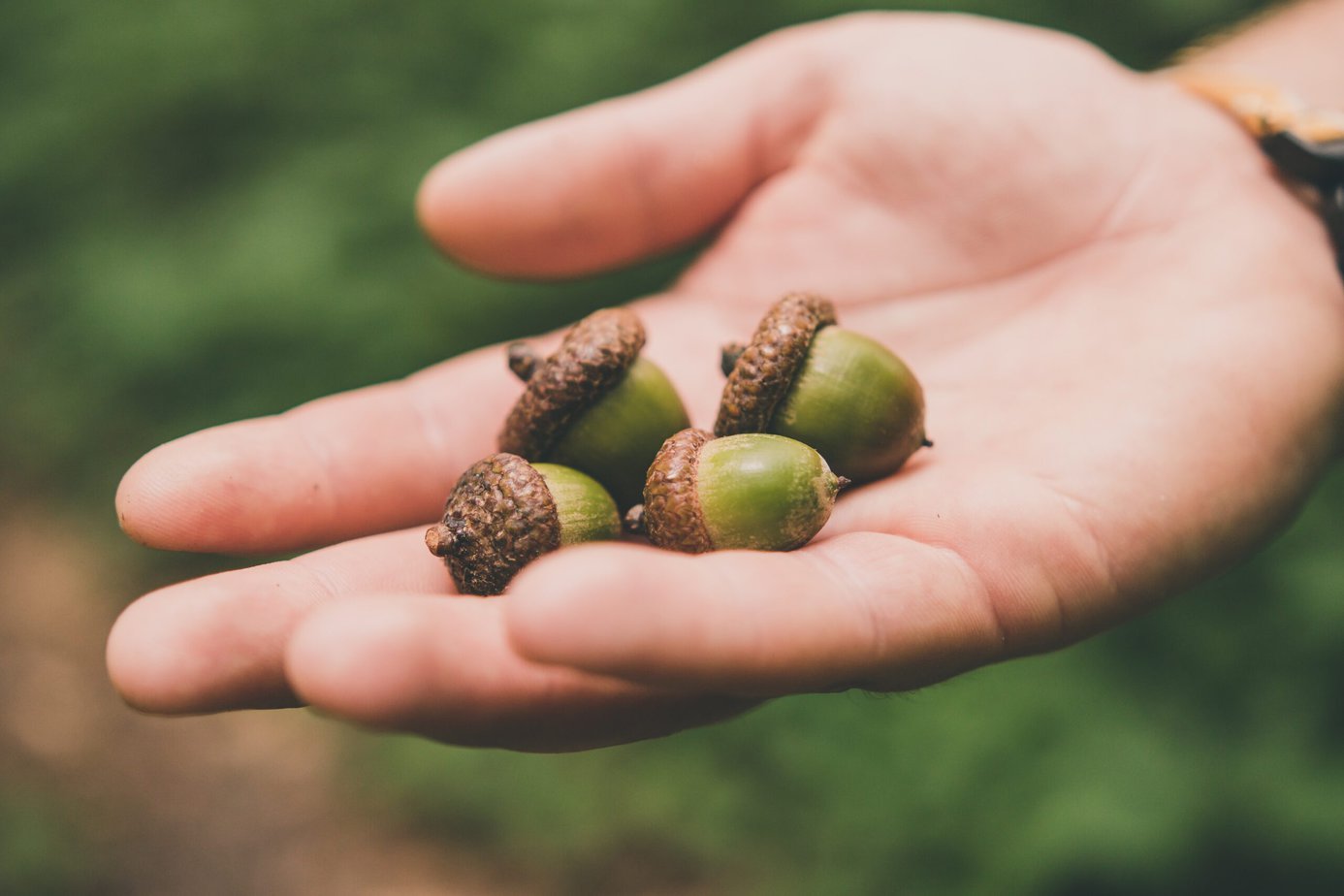

Acorns are the oak in miniature. No ancient writer names the acorn as a druid symbol, but the oak behind it is genuinely druidic.
The serpent’s egg
Pliny also describes the anguinum, or serpent’s egg. Snakes supposedly made it from foam, and you caught it in a cloak before galloping off.
Pliny says he saw one: round, apple-sized, with a cup-marked shell. Around 1700 the Welsh scholar Edward Lhuyd suggested it was a fossil sea urchin.
Pliny says the druids praised it for winning lawsuits and access to rulers. Yet Claudius put a Roman knight to death for carrying one into court.
The triskele
The triple spiral at Newgrange was carved about 3200 BC. That’s thousands of years before any druid.
It’s Neolithic, not Celtic, and nobody knows what it meant. More on my triskelion page.
The sun wheel
The wheel is a genuine Iron Age Celtic religious sign. Gauls offered small metal wheels, and statuettes show a god holding a wheel and a thunderbolt.
Scholars often link him to Taranis, whose name means thunder and whom the poet Lucan mentions in the 1st century AD. No inscription proves the link.
Whether the wheel meant the sun is interpretation. Nothing ties it to the druids in particular.
Ogham
Ogham is an early Irish alphabet of strokes cut along an edge. It emerged around the 4th century AD, and about 400 inscribed stones survive. Most are in Munster, especially Cork and Kerry.
Most carry a man’s name and his father’s. Hardly a secret druid code.
Medieval scholars said every letter was named after a tree. Modern scholars think only a handful of the original names really were trees.
The triquetra
This three-pointed knot turns up in Irish and Anglo-Saxon art from around the 7th century, including the Book of Kells. Its first meaning is unknown. The Trinity reading is Christian, and “land, sea and sky” is modern. See my triquetra page.
The Celtic cross
A Christian cross with a ring. Irish high crosses date from about the 8th to the 12th century, and nobody knows for sure why the ring is there. Calling it a druid sun cross has no evidence behind it. More on my Celtic cross page.
The Awen
Three rays under three dots, often inside circles. It’s the main symbol of modern Druidry and OBOD’s emblem.
Iolo Morganwg devised it to stand for Love, Justice and Truth. It was first seen in public on a proclamation scroll in Cardiff in 1833, after his death. The word awen, poetic inspiration, is far older. Full story on my Awen page.
The pentagram, or “druid’s foot”
The pentagram’s nickname, the “druid’s foot”, is a mix-up of sounds.
The German Drudenfuß means the foot of a Drude, a night demon or witch from German folklore. The star was a protective sign against these spirits. In Goethe’s Faust (1808), the devil can’t leave Faust’s study because one is drawn on the threshold.
The tree of life and the rowan
The round knotwork tree on today’s pendants is a modern design. What early Ireland really had was the bile, a sacred tree at royal sites like Magh Adhair. See my tree of life page.
Rowan has a long place in Irish and British folk belief as a guard against witches and fairies. It’s folklore, though. No ancient writer links the rowan to druids.
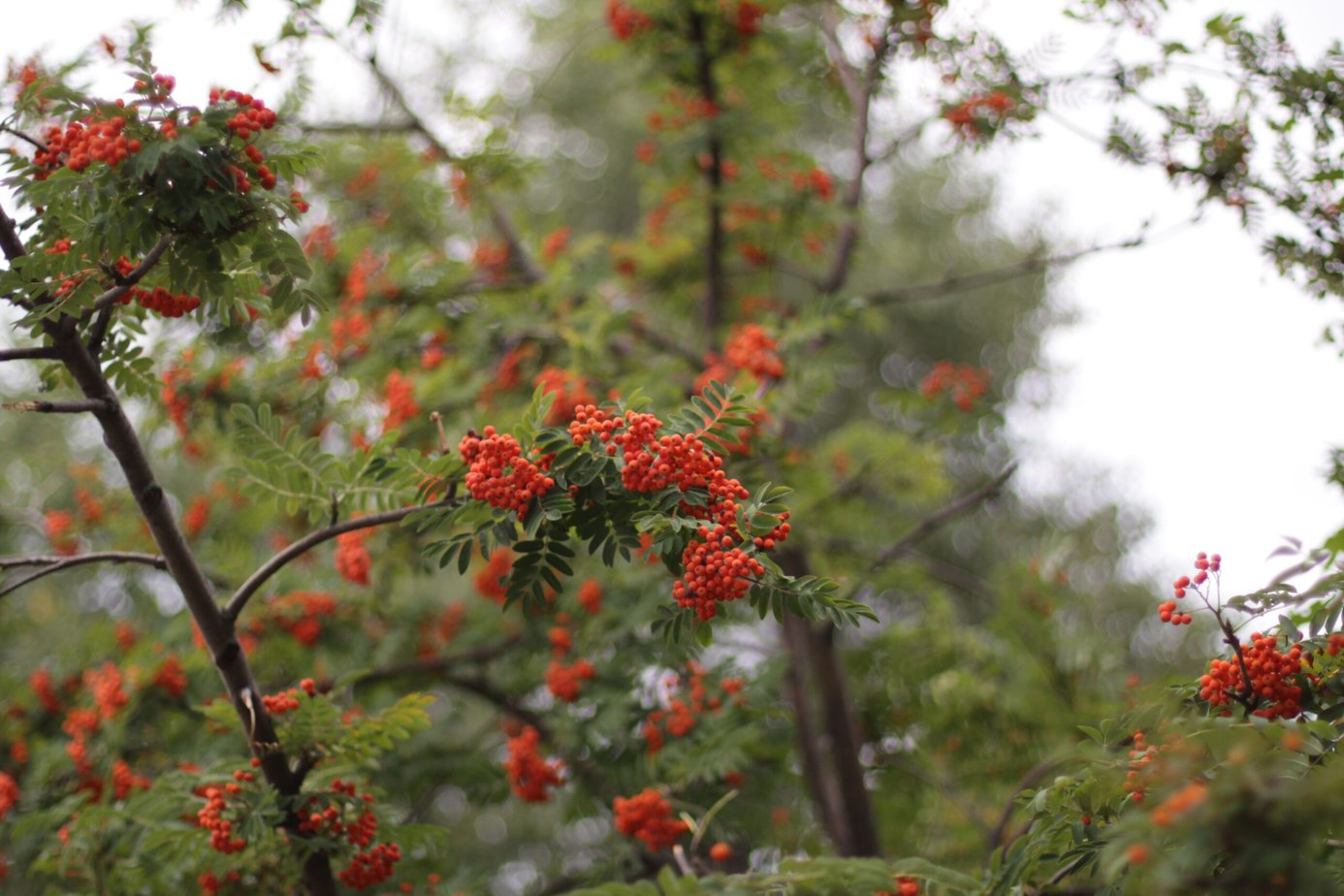
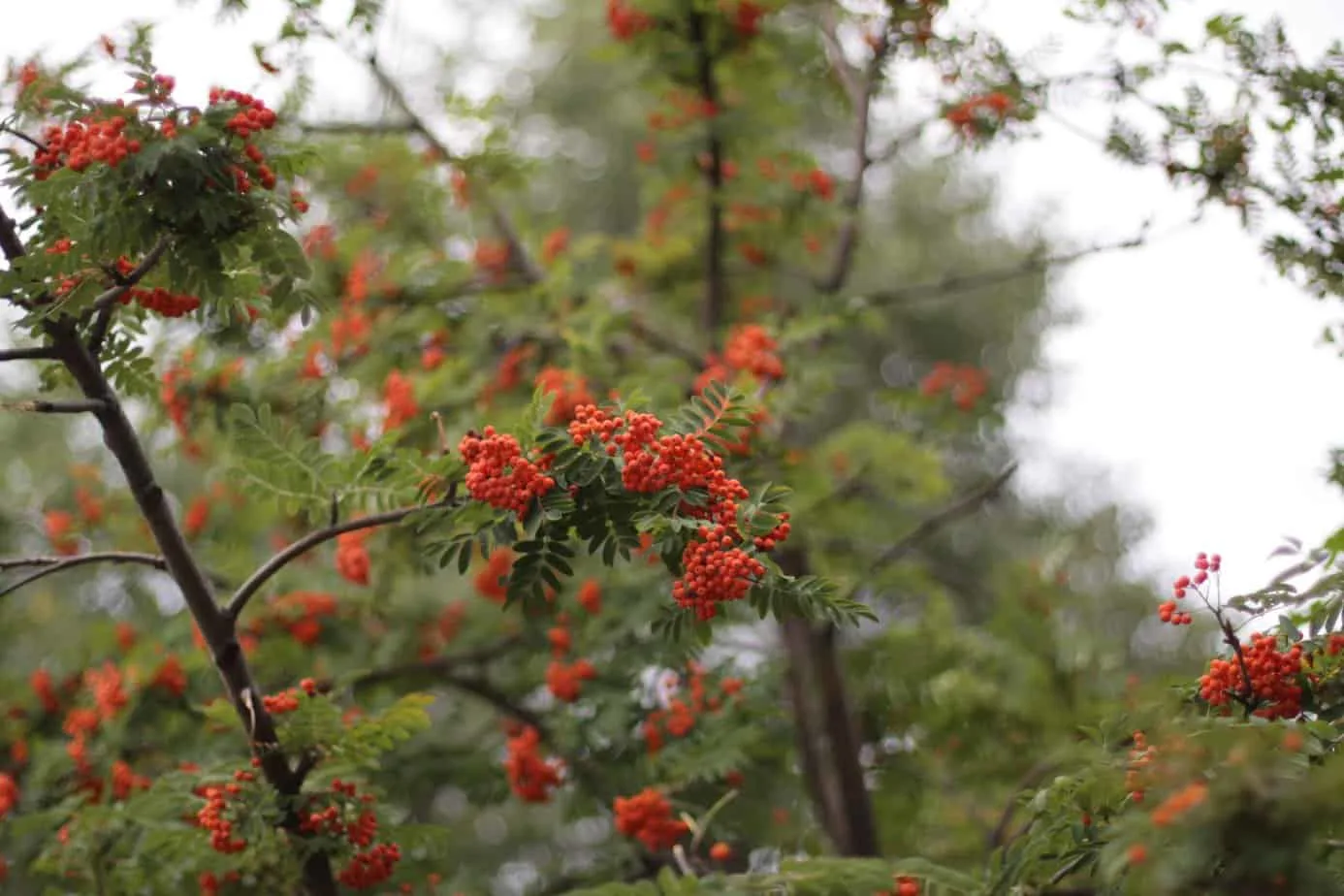
Rowan, or mountain ash. Folk belief made it a protective tree, but no ancient writer ties it to the druids.
The shield knot and the Dara knot
Four-cornered knots appear on carved stones from about the 8th to the 11th century. But I can’t trace the name “shield knot” or its protection meaning before the 1990s. Details on my shield knot page.
The Dara knot takes its name from dair, the Irish for oak. The oak story is real. I can’t find the knot itself before 2008.
Modern druid sigils
The “Druid Sigil”, a circle crossed by two upright lines, belongs to the Reformed Druids of North America, founded in 1963. Its origin is uncertain, and it isn’t an ancient protective sign.
The harp and the Green Man turn up on these lists too. Neither is a druid symbol; see my Irish harp and Green Man pages.
Druid symbols at a glance
| Symbol | Real age | Where it comes from | Used for today |
|---|---|---|---|
| Triskele | About 3200 BC | Newgrange | Irish identity, cycles |
| Pentagram | About 3000 BC | Mesopotamia; “druid’s foot” from German | Protection |
| Oak and mistletoe | Recorded about AD 77 | Pliny the Elder | Strength |
| Serpent’s egg | Recorded about AD 77 | Pliny the Elder | Druid lore, curiosity |
| Acorn | Modern association | Oak symbolism | Growth, potential |
| Wheel | Iron Age | Gaulish votive wheels | Sun, seasons |
| Ogham | About 4th century AD | Irish memorial stones | Names, tree lore |
| Triquetra | About 7th century AD | Christian art | Trinity, love |
| Celtic cross | 8th to 12th century | Irish high crosses | Faith, heritage |
| Rowan | Folk tradition | Irish and British folklore | Protection |
| Awen | Public by 1833 | Iolo Morganwg | Inspiration |
| Druid Sigil | 1960s or later | Reformed Druids of North America | Druid identity |
| Shield knot | Name from 1990s | Modern | Protection |
| Dara knot | About 2008 | Modern | Strength |
| Knotwork tree of life | Modern | Jewellery design | Family, roots |
Druid symbols for protection and strength
Protection: no symbol has ancient evidence as a druid protection sign. The shield knot carries that meaning today, but it’s modern. Rowan is real folk protection. The Drudenfuß was a genuine charm, only German rather than druid.
Strength: the oak is your best bet, with Pliny behind it. The acorn and the Dara knot are modern ways to wear the same idea.
Choosing a druid symbol for a tattoo or pendant
A modern symbol isn’t a fake one. It only becomes a problem when someone sells it as 3,000 years old.
- Want something truly ancient? Choose an oak leaf, acorn or mistletoe sprig. Or the Newgrange spiral, knowing it’s older than the druids.
- Love the Awen? Wear it, knowing it’s the emblem of a living modern religion.
- Buying jewellery? Treat “ancient druid symbol” on a label as marketing unless a source is given.
Druid symbols FAQ
Can anyone name a symbol the ancient druids used?
Not with certainty. The druids chose not to write their teaching down. Only the oak, mistletoe and Pliny’s serpent’s egg are firmly tied to them.
Are Celtic symbols the same as druid symbols?
Not really. Celtic druid symbols is a modern label. Most Celtic knots are Christian-era art, and the Newgrange spiral is far older than any druid.
What is the main symbol of Druidry today?
The Awen, three rays under three dots. Iolo Morganwg devised it, and it was first seen in public in 1833.
What is the druid symbol for protection?
There’s no proven ancient one. Modern choices include the shield knot and the rowan.
What is the druid symbol for strength?
The oak, which Pliny linked to the druids around AD 77. The acorn and the modern Dara knot both draw on it.
Were the druids Irish?
Druids are recorded in Gaul, Britain and Ireland. Irish sagas and law texts remember the druí, but Christian scribes wrote them centuries later.
More Celtic symbols to read
I hope these druid symbols and meanings have helped you learn more about the ancient druids, and the modern ones. Read my top 20 Celtic symbols post, where I go into more detail.
- Top 20 Celtic Symbols and Their Meanings
- The Awen Celtic Symbol
- The Triskelion, or Triskele
- The Dara Knot
- The Celtic Shield Knot
- The Celtic Gods
A little bit of Ireland in your inbox every Friday ☘️
The free Weekly Dose of Irish: an Irish joke, a Celtic symbol, an Irish fact, a poem and the week’s best articles in one short email. Join 9,600+ readers.
Free. One short email every Friday. Unsubscribe any time.