The Celtic motherhood knot is a heart-shaped or rounded interlace, often two hearts woven together, with a dot or small heart for each child. It stands for the unbroken bond between a mother and her children. It is a modern design, most likely late 20th or early 21st century, with no known inventor. The knotwork craft behind it is genuinely old.
Search for a Celtic knot for a mother and child and this is the one you’ll find. It’s on pendants, Mother’s Day cards and a fair few forearms.
It’s a lovely design. It’s also a young one, and plenty of the pages selling it skip that part.
Here’s where it came from, what it means and how to get one right. Nobody here is trying to sell you a necklace.
Jump to:
- What the Celtic motherhood knot looks like
- Celtic motherhood knot meaning
- Is the Celtic motherhood knot really ancient?
- Why it looks so Celtic
- Variations for one, two or three children
- Motherhood knot vs look-alikes
- Mother’s Day dates: Ireland, the UK and the US
- Genuinely old symbols to pair it with
- Is there a Celtic symbol for family?
- Tips for gifts and tattoos
- Celtic motherhood knot FAQ
- More Celtic symbols
What the Celtic motherhood knot looks like
There’s no official version. Most designs share the same bones, though.
- A heart or rounded shape drawn in interlace. Often it’s two hearts woven together, one bigger than the other.
- Dots or small hearts for the children. They sit inside the knot or just outside it, usually one per child.
- One line, or close to it, weaving over and under itself with no obvious start or finish.
The usual reading is simple. The big heart is the mother, the small one is the child, and the woven line is the bond between them.
Celtic motherhood knot meaning
The meaning people give it is a mother’s love that never ends. The line has no beginning and no end.
Because each child gets a dot or a heart, it doubles as a family portrait you can wear. That’s a big part of the appeal for mothers and grandmothers.
That meaning comes from jewellers, tattoo artists and wearers, not from any old text. It’s no less real for that. It just isn’t 1,200 years old.
Is the Celtic motherhood knot really ancient?
Short answer: no.
- No early examples. I found no museum object, manuscript, carved stone or early metalwork that shows it.
- No trace in print. Google’s Ngram Viewer, which counts phrases across millions of books, has no data for “Celtic motherhood knot” up to 2022.
- A web-era name. The earliest dated example I found is a 2012 shop listing.
Who designed it?
I can’t name a single inventor. The common dotted-heart version seems to have spread as a tattoo design with no credit attached.
One good dated clue comes from Walker Metalsmiths, a Celtic jeweller in the US. In an April 2017 blog post, they said a Celtic motherhood tattoo design was already popular.
Its lines were too thin to make in metal. They also weren’t comfortable selling someone else’s design. Their staff drew their own Mother’s Knot in March 2017.
So by 2017 the design was well known, and a Celtic jeweller treated it as someone else’s work without naming anyone.
The other named design comes from the Irish Jewelry Company in Rockville Centre, New York. It sells a copyrighted Celtic Mothers Knot credited to its founder, Jennifer Derrig.
The Wayback Machine shows a Celtic Mothers Knot ring on sale by September 2012. The listing described a stylised holy trinity with a parent and child embrace. Her company’s own blog calls it a modern adaptation of old knotwork, so fair play to her.
It’s a branded design, not the common dotted heart. It’s still the only named designer I could find.
Claims I couldn’t stand up
Some sites say the knot appears in early Christian manuscripts. Others link it to honouring the goddess Brigid. One shop says it became popular “in the 1900s”.
None gives a source, and I found no evidence for any of it.
Why it looks so Celtic
If it’s modern, why does it look like it fell out of the Book of Kells? It borrows two things, and only one is Celtic.
The knotwork is real tradition
Interlace reached Irish and British art in the 7th century, adapted from late Roman patterns. J. Romilly Allen traced this in Celtic Art in Pagan and Christian Times (1904).
A 7th-century Gospel fragment in Durham Cathedral Library is usually cited as the earliest true knotwork in an Insular manuscript. The Book of Kells is full of it. Trinity College Dublin says it was made close to the year 800.
In Irish art, knotwork arrives with Christianity. The earlier La Tène Celts favoured spirals, trumpet shapes and key patterns.
The heart isn’t Celtic at all
The heart shape as a love symbol first appears in medieval Europe. The usual starting point is a miniature in the Roman de la poire, from around 1250, now in the Bibliothèque nationale de France.
Scholars argue over whether that drawing really shows a heart. Pierre Vinken’s The Shape of the Heart (2000) follows how the shape spread from there.
George Bain made modern knots possible
George Bain’s Celtic Art: The Methods of Construction (1951) showed how to draw old knotwork step by step. It also showed how to build new ones.
Its 1972 reissue put it into the hands of craftspeople and jewellers. Aidan Meehan’s Celtic Design books, from 1991, carried the method on.
Once anyone could build a knot, anyone could build a heart with a dot for each child. That’s very likely the toolkit behind the motherhood knot.
Variations for one, two or three children
There’s no rulebook, so the count is up to you.
- One child: two interlaced hearts, the smaller one tucked inside or below the larger. This is the Celtic motherhood knot with two hearts you’ll see on most pendants.
- Two or three children: one heart for the mother, plus a dot or small heart for each child.
- Mother and daughter: two linked hearts or loops of near equal size. These are artists’ adaptations, not a separate old symbol.
- Grandmothers: some designs add an outer loop, or extra dots for the grandchildren.
- Trinity knot based: a triquetra worked around a mother and child, like the Irish Jewelry Company and Walker Metalsmiths designs.
Motherhood knot vs look-alikes
| Symbol | What it looks like | How old | The evidence |
|---|---|---|---|
| Motherhood knot | Interlaced heart, dots or hearts for children | Modern, on sale by 2012 | No early examples; tattoo and jewellery designs |
| Celtic love knot | Two interlocking hearts or loops | Modern | Jewellery-trade design |
| Triquetra (trinity knot) | Three pointed, interlaced loops | Early medieval, from the 7th century | Book of Kells, about 800 |
| Claddagh | Two hands holding a crowned heart | About 1700 onwards | Surviving Galway rings |
| St Brigid’s cross | Woven rushes or straw, usually four arms (three-armed and diamond types too) | Folk custom, widely recorded in the 1930s Schools’ Collection | Over 300 in the National Museum of Ireland |
The love knot is the one most often confused with it. My Celtic love knot page covers it.
Mother’s Day dates: Ireland, the UK and the US
This catches out families on both sides of the Atlantic every year.
Ireland and the UK keep Mothering Sunday, the fourth Sunday of Lent. That’s three weeks before Easter Sunday, so it moves. In 2026 it was 15 March. In 2027 it’s Sunday 7 March.
The US uses the second Sunday in May. Anna Jarvis organised the first official services in 1908, in Grafton, West Virginia, and in Philadelphia. Woodrow Wilson signed the national proclamation on 9 May 1914. In 2027 it’s Sunday 9 May.
If you’re in Boston buying for a mam in Cork, order by early March and allow for the post.
Families with a foot in both countries get two goes a year. Lucky mothers.
Genuinely old symbols to pair it with
Want something with real age beside it? Try these.
The trinity knot
The triquetra turns up in Insular art from the 7th century, including the Book of Kells. Christians read it as the Holy Trinity.
Some families now read the three loops as mother, father and child. That reading is modern, but the shape is old. My triquetra page has the full story.
St Brigid’s cross
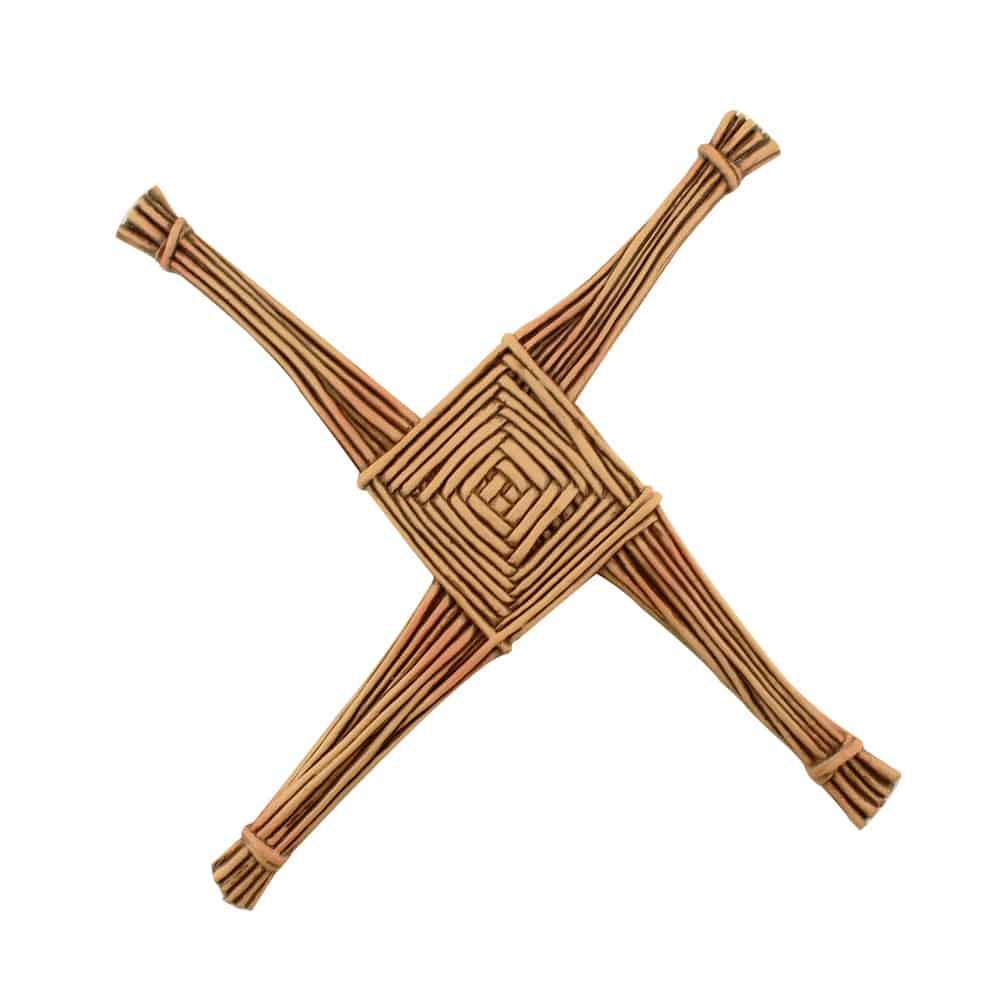
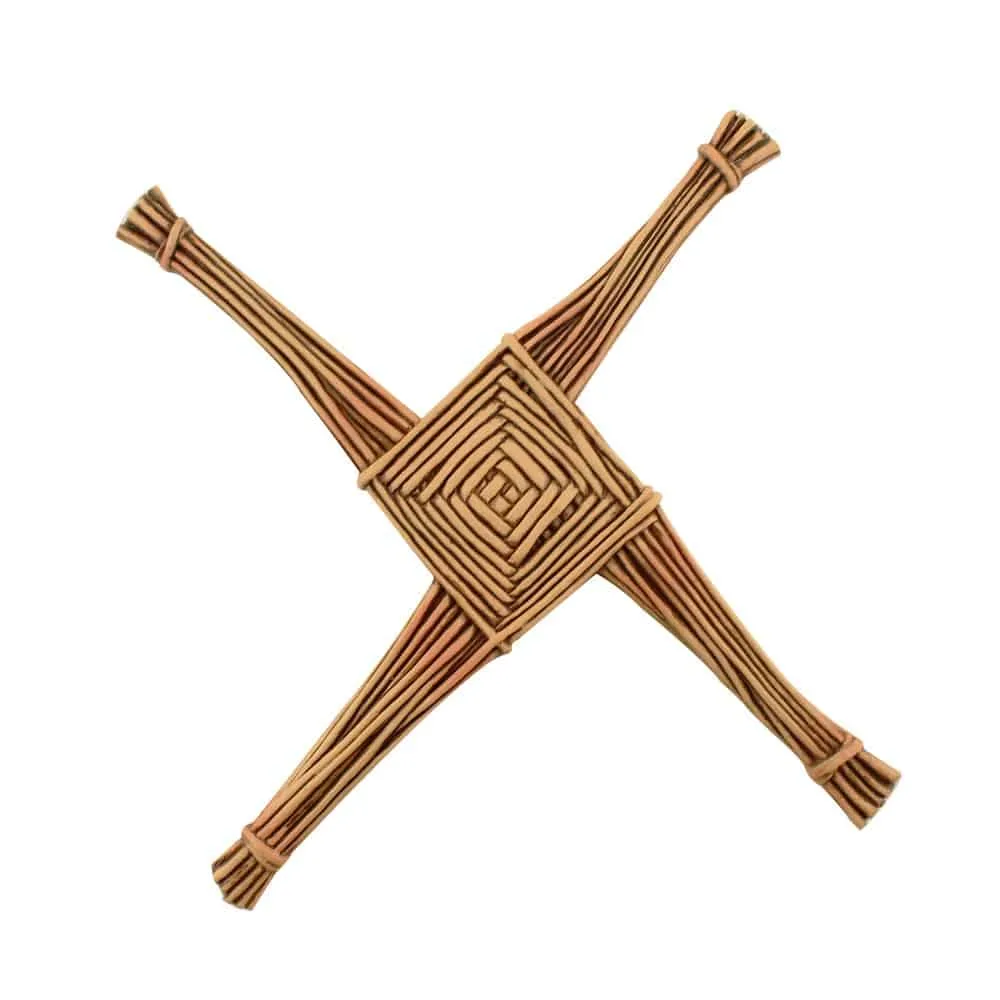
A St Brigid’s cross, traditionally woven from rushes or straw for her feast on 1 February.
Brigid is often called a patron of midwives and newborns. That comes from Catholic tradition and popular devotion, so treat it as tradition rather than history.
The strongest written link to mothers is Scottish. Alexander Carmichael’s Carmina Gadelica (1900) gathered prayers in the Hebrides. It calls Bride the aid-woman of Mary and the foster-mother of Christ.
It also records that when a woman was in labour, the midwife stood in the doorway and asked Bride to come in.
In Ireland, her crosses were hung in homes and sheds for her protection. The National Museum of Ireland holds over 300 of them.
Since 2023, Ireland has had a St Brigid’s Day bank holiday, the first named after a woman. More on my St Brigid’s cross page.
Is there a Celtic symbol for family?
Honest answer: there isn’t a single ancient Celtic symbol for family.
- The motherhood knot, for a mother and her children. Modern design, modern meaning.
- The trinity knot, read as parents and child, or three generations. Old shape, modern reading.
- The Celtic tree of life, for roots and branches. The family meaning is modern.
- The triskele, three spirals, sometimes read as three people. The spiral itself is ancient. The family reading isn’t.
Pick the shape you love and give it your own meaning. That’s how they all got their meanings.
Tips for gifts and tattoos
- Check the over and under. A proper knot alternates: over, under, over, under. Cheap designs sometimes break the pattern or let a strand just stop.
- Thin lines blur. Fine interlace can fill in on skin as the years go by. Walker Metalsmiths hit the same problem in metal. Go a bit bigger, or a bit simpler.
- Count the dots before the needle starts. Then count them again. Then ring someone who’ll tell you straight.
- Leave room for more. If the family might grow, ask for space for another dot. Nobody wants to explain why the youngest isn’t on Mam’s arm.
Celtic motherhood knot FAQ
What does the Celtic motherhood knot mean?
It represents a mother’s love that never breaks, drawn as one continuous line. The larger heart is the mother, and each dot or small heart is a child. The meaning is modern.
Is the Celtic motherhood knot an ancient symbol?
No. I found no museum object, manuscript or carving that shows it. It’s a modern design, most likely late 20th or early 21st century, built with old knotwork methods.
Who invented the Celtic motherhood knot?
Nobody can be credited with the common version. A US jeweller noted in 2017 that it was already a popular tattoo design. The Irish Jewelry Company’s Celtic Mothers Knot, credited to Jennifer Derrig, is a separate branded design.
What is the Celtic mother daughter knot?
It’s usually two linked hearts or loops of similar size. It’s an artist’s adaptation of the motherhood knot, not a separate old symbol. Many people also use the two-heart motherhood knot for a mother and daughter.
What is the Celtic symbol for family?
There’s no single ancient one. People use the motherhood knot, the trinity knot, the tree of life or the triskele. Each family meaning is modern, even where the shape is old.
When is Mother’s Day in Ireland compared with the US?
Ireland and the UK keep Mothering Sunday, the fourth Sunday of Lent: 7 March in 2027. The US keeps the second Sunday in May: 9 May in 2027.
More Celtic symbols
- Celtic Symbols and Their Meanings
- The Celtic Knot and Its Meanings
- The Triquetra, or Trinity Knot
- The Celtic Love Knot
- St Brigid’s Cross
- Claddagh Ring Meaning
- The Celtic Tree of Life
A little bit of Ireland in your inbox every Friday ☘️
The free Weekly Dose of Irish: an Irish joke, a Celtic symbol, an Irish fact, a poem and the week’s best articles in one short email. Join 9,600+ readers.
Free. One short email every Friday. Unsubscribe any time.