An American wake was an all-night farewell held in rural Ireland on the night before a son or daughter left for America. It was also called a live wake, a farewell supper or bottle night. Neighbours ate, drank, sang and danced, and towards dawn the crying and keening began, as at a wake for the dead, because families didn’t expect to see the emigrant again. It was known by the 1830s and faded in the 20th century.
Picture a crowded country kitchen in Ireland, more than a century ago. A fiddler is playing by the fire, there’s food and drink on the table, and the dancing has gone on for hours. Then, a couple of hours before daybreak, a mother starts to cry out, and the whole room joins her.
Nobody in the house has died. A son or daughter is leaving for America in the morning. This is the American wake.
I’ve written about what the Irish built in the United States in my piece on the Irish diaspora in America. This is the other end of that story: the last night at home, what came after, and how to find your own emigrant ancestor.
Jump to:
- What was an American wake?
- What happened on the night
- The convoy and the station
- The ports, from Queenstown to Liverpool
- How many people left?
- After the wake: letters, money and returns
- Why the American wake faded
- Echoes of the American wake today
- How to find your emigrant ancestor
- American wake FAQ
- More Irish heritage reading
What was an American wake?
An American wake was a farewell for an emigrant, held in the family home on the night before they left. The emigrant’s parents usually hosted it, says the historian Kerby Miller in his entry in the Encyclopedia of Irish History and Culture.
It went by several names. Miller lists the live wake, the farewell supper and bottle night. Kevin Kenny and Maddalena Marinari, editors of Rituals of Migration (NYU Press, 2025), add the parting spree and American bottle night. In parts of Roscommon and Monaghan it was simply “the Spree”.
Miller says it was mainly a Catholic custom, and strongest in the west, where the old ways lasted longest.
Why was it called a wake?
A wake is the old Irish custom of sitting up all night with the dead before a funeral. The National Museum of Ireland explains that waking the dead meant watching over them, and that emigrants were waked in much the same way.
The name wasn’t a joke. For many rural Catholic families, Miller explains, emigration was “death’s equivalent”. Once someone sailed, they were gone for good.
So the American wake copied the old wake’s odd blend of sorrow and celebration, with food, drink, prayers, games, songs, dancing and keening. Keening is the ritual lament of Irish wakes, caoineadh (KEEN-yuh) in Irish; the English word keen comes from the Irish verb caoin, to lament. There’s more on keening women in my guide to the banshee.
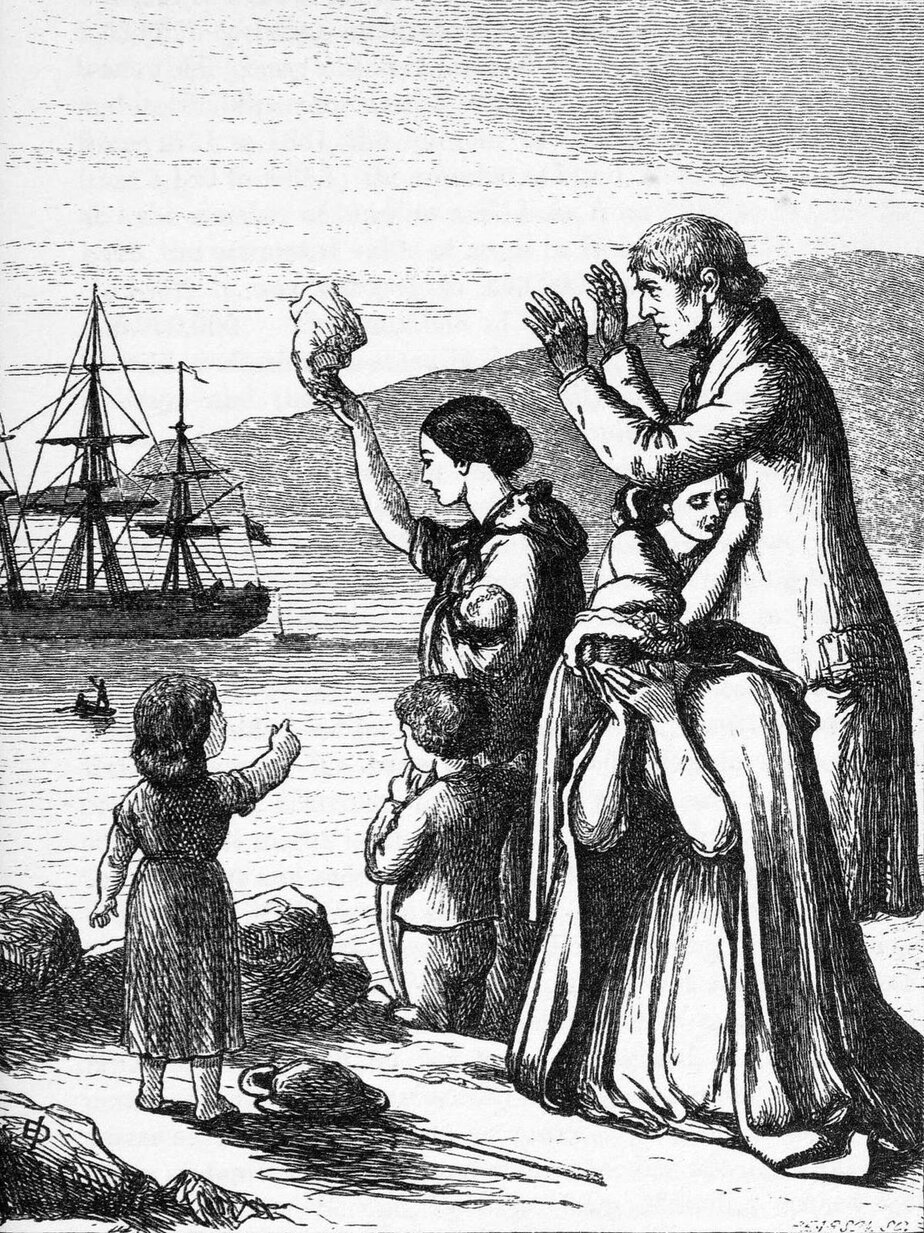
Emigrants leave Ireland, wood engraving after Henry Doyle, from M. F. Cusack, An Illustrated History of Ireland (1868). Public domain, via Wikimedia Commons
Did it start in the Famine?
You’ll sometimes read that the American wake began during the Great Famine of the late 1840s. That’s a myth. The National Museum of Ireland says it was known from the 1830s, and Miller agrees it predates the Famine. Most surviving descriptions, though, come from the decades either side of 1900.
What happened on the night
Some of the best descriptions come from the Schools’ Collection, folklore written down in Irish schools in 1937 to 1939 and now online at dúchas.ie (© National Folklore Collection, UCD).
Calling to every house
In the last days at home, Kenny and Marinari write, the emigrant did the rounds of the neighbours, asking each house to the farewell.
Pat Owens, a Roscommon man, composed a farewell poem, later recorded as Ballagh Lake, at his own American wake. In it, he takes his walking stick and sets off to visit every house in the townland (the smallest Irish land division, often just a few farms). He names the hills, groves and friends he’s leaving, and ends by getting ready for the eight o’clock train at Carrick station.
In the 1930s, a boy named Joseph Rhatigan brought the poem to Kilmore school, Co. Roscommon. He had it from his grandmother, then well over 80.
Food, drink, music and dancing
In the Kilmore account, relatives and friends feasted, sang and danced through the night. In Ballynacally, Co. Clare, the whole neighbourhood was asked to a dance at the emigrant’s home. A Schools’ Collection account of Broomfield, near Castleblayney in Co. Monaghan, insists the send-off stayed cheerful: everyone felt the parting, but the fun went on.
Near Millstreet, Co. Cork, a teacher recalled a farewell song, a favourite at American wakes about 40 years earlier, that says goodbye to local places one by one. It was the last song sung before the emigrant left for the station, and he remembered people weeping.
The keening before dawn
Then the mood broke. In Kilmore, a couple of hours before daybreak, the parents, and above all the mother, began to cry aloud. Relatives joined in, then friends, in what the account calls “a terrible chorus of cries”. It went on for more than an hour.
In Ballynacally, it was a handful of older women who began the wailing as dawn approached.
Songs of exile and duty
Miller argues that the songs of the American wake worked like a staged conversation. Some, voicing parents, priests and politicians, scolded emigrants for leaving their old folk, and Ireland, behind. Others answered back, casting the young as grieving exiles forced out by landlords and British rule, who promised to send money home and keep the faith.
That painful night may, he suggests, help explain why the Irish abroad sent home so much money and stayed so loyal to church and cause.
The convoy and the station
The convoy
At first light, the wake moved out onto the road. Kenny and Marinari call this ritual, which they also trace in Italy, the convoy. Family and neighbours walked the road with the emigrant, whose belongings might be a bundle or a trunk on a donkey cart.
The old people went only as far as the crossroads, or another spot agreed beforehand. There they said goodbye, and stood watching until the emigrant was out of sight.
Convoy is an old Scots and Ulster word for walking someone part of their way, says the Dictionary of the Scots Language.
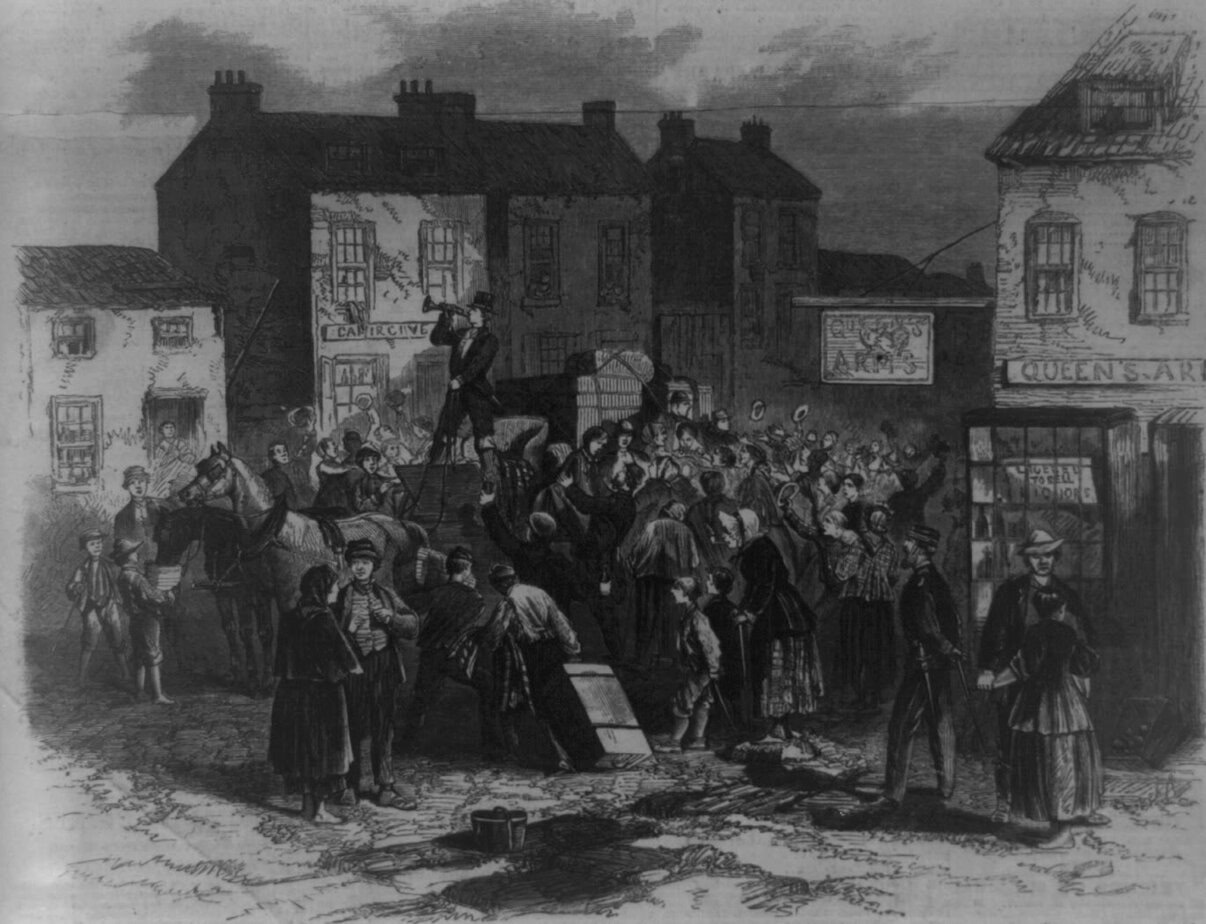
Irish emigrants leaving their home for America: the mail coach from Cahirciveen, County Kerry. Frank Leslie’s Illustrated Newspaper, 20 January 1866. Library of Congress Prints and Photographs Division
Tears at the railway station
In Kilmore, the whole company saw the emigrant off on the eight o’clock train, and sometimes the crying started all over again on the platform.
An account from Cnoc Cairn (Knockcarron) school in east Co. Limerick, near Emly, remembers the live wakes as lively nights. The next morning was different: the keening at the local station carried for miles.
The American Funeral
In Gneevgullia, in east Kerry, a Schools’ Collection account says that long ago, on the morning an emigrant left, about ten horse-drawn carts would travel in procession to the railway station. The neighbours had a name for that too: the American Funeral.
The ports, from Queenstown to Liverpool
The National Museum of Ireland sets out the main routes:
- Up to the 1830s: most sailed from Belfast, Dublin and Derry, often to Canada first.
- From the 1830s: many crossed to Liverpool and sailed on to New York, Philadelphia or Boston. In 1851, up to 15 ships a day left Liverpool for America. Limerick and Sligo sent large numbers too, and in the Famine years so did small harbours like Westport and Kinsale.
- After 1858: transatlantic steamers began calling at Irish ports, so emigrants could sail direct from Cobh, Galway or Belfast instead of going via Liverpool.
Cobh, once Queenstown
Cobh (say Cove), in Cork Harbour, was renamed Queenstown for Queen Victoria’s visit in 1849, and its republican council restored the old name in 1920, the Irish Examiner reports.
The Cobh Heritage Centre says that of the more than 6 million people who emigrated from Ireland between 1848 and 1950, about 3 million left from Cobh. One was Annie Moore, who sailed with her two brothers and became the first immigrant processed at Ellis Island, on 1 January 1892. There’s more on the town in my facts about Cork.
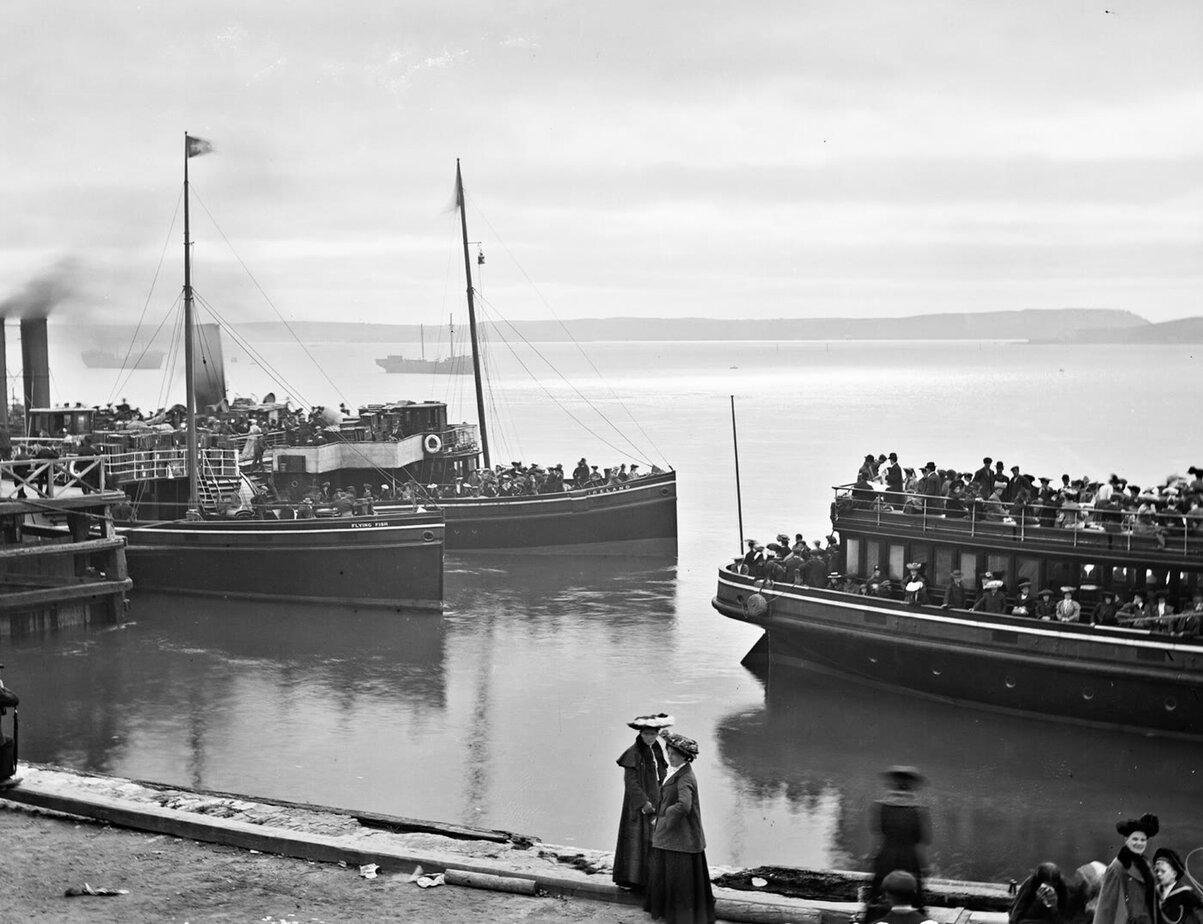
Emigrants leaving, Scott’s Quay, Queenstown, about 1891 to 1900s. Robert French, Lawrence Photograph Collection, National Library of Ireland (L_CAB_05258)
How many people left?
Over 6 million Irish people crossed the Atlantic between the end of the Napoleonic Wars in 1815 and the First World War, writes the historian Irial Glynn for European History Online. Ireland’s population, almost 8.5 million in the mid-1840s, had fallen to 4.4 million by 1911.
Most emigrants were young and single. Before 1850, men outnumbered women about two to one, Glynn says. After the Famine, Irish women and men crossed in roughly equal numbers, and about half of Irish women in America went into domestic service. An American wake was as likely to be for a daughter as a son.
After the wake: letters, money and returns
The American letter
For the family left behind, the emigrant now lived in letters. When an American letter arrived, Kenny and Marinari write, family and neighbours gathered for the news and checked the envelope for dollars or a prepaid ticket.
In 1864, a London Daily News writer, quoted by the National Museum of Ireland, said such letters, usually with passage money inside, drew the crowds to New York and were almost all a Cork or Galway countryman knew of America.
Remittances and prepaid tickets
Britain’s Colonial Land and Emigration Commissioners recorded about £4.35 million sent home from North America through banks and merchants between 1848 and 1852 alone. They thought most of it came from Irish emigrants, and that much more went home privately.
By historian Arnold Schrier’s reckoning, Irish Americans sent more than $260 million home in the second half of the 1800s.
Much of the money came as prepaid tickets, which drove chain emigration: one sibling went, then paid for the next. And Kenny and Marinari point out that women, who emigrated as often as men, were the likelier of the two to send money home.
Missing friends
From 1831 to 1921, the Boston Pilot ran a “Missing Friends” column for people searching for lost relatives, later published as The Search for Missing Friends.
Did anyone come home?
Most never came home to stay. Historians traditionally put Irish returns from the US at about 6 to 10 per cent. One widely cited estimate for 1907 to 1914 is 6.7 per cent, against nearly 58 per cent for Italians, as economic historians Alan Fernihough and Cormac Ó Gráda note.
Newer research suggests the old figures are too low. David Fitzpatrick found official counts for 1912 and 1913 in which arrivals into Ireland equalled about 14 per cent of departures, still below the British rate. His later work on censuses and US passport applications turned up more returnees again, genealogist Fiona Fitzsimons writes in History Ireland.
By the 1860s, steam had cut the cost, danger and length of the voyage. Some went home out of homesickness, others to marry, care for family or take up an inheritance.
Those who came back were the “returned Yanks”, a stock figure in Irish writing. In 1955 the Irish Folklore Commission circulated Schrier’s questionnaire on emigration, answered by people in their 70s and 80s, and his 1958 book reports a claim that a Yank ran every bar in Killarney. A 2025 study of those replies by Críostóir Mac Cárthaigh finds attitudes more nuanced than the show-off stereotype.
Why the American wake faded
Nobody recorded the last American wake. By the late 1930s, Schools’ Collection accounts already describe it in the past tense: an old custom in Kilmore, long ago in Gneevgullia, some 40 years back around Millstreet.
Exactly why it faded isn’t clear, but the world changed. Cheaper crossings made a visit home more realistic. From the mid-1920s, US quotas and then the Great Depression turned Irish emigration towards Britain, which had no travel restrictions, Glynn notes. A goodbye that might not be forever probably looked less like a death.
Echoes of the American wake today
- The name lives on. Cork-born poet Greg Delanty called his 1995 poetry collection American Wake (Blackstaff Press).
- The places remain. The Cobh Heritage Centre tells the Queenstown story inside the town’s restored Victorian railway station, with a statue of Annie Moore and her brothers outside.
- The family grew. The US Census Bureau says 32.4 million Americans, 9.5 per cent of the population, claimed Irish ancestry in 2024.
- The road runs both ways now. If a grandparent was born on the island of Ireland, you may be able to become an Irish citizen. See my guide to Irish citizenship by descent.
It’s also the opposite of the Irish goodbye, slipping out of a party without a word. The American wake was a goodbye nobody could miss.
How to find your emigrant ancestor
If your people came from Ireland, there may have been a night like this for one of them. Here’s how to trace who left.
- Start at home. Gather letters, photos, obituaries and older relatives’ memories. Note every Irish place name, however it’s spelled.
- Find the place in American records. Census returns, naturalisation papers, death certificates, church registers and gravestones can name a county, parish or townland. The parish unlocks Irish records.
- Search arrival records. The Statue of Liberty & Ellis Island Foundation’s arrival records search is free and covers New York and other US ports.
- Move to Irish records. Civil records, Catholic parish registers and the 1901, 1911 and 1926 censuses are free online. My guide to Ancestry DNA kits lists where to find each.
- Read the letters. The Irish Emigration Database holds over 33,000 records, mainly emigrant letters from about 1780 to 1920, compiled by the Centre for Migration Studies in Omagh. It’s strongest for Ulster families.
- Read what the neighbours wrote. If the parish is in today’s Republic, look up its school on dúchas.ie. You might find what local children recorded in the 1930s, perhaps even an American wake.
- Use your surname and DNA. Many surnames cluster in particular counties, as my guide to Irish surnames shows, and a DNA test can connect you with cousins whose families stayed.
American wake FAQ
What is an American wake?
An all-night farewell held in rural Ireland before someone emigrated to America. It mixed music, dancing, food and drink with crying and keening, like a wake for the dead.
Why was it called an American wake?
Because families didn’t expect to see the emigrant again. To many rural Catholics, historian Kerby Miller explains, emigration was a kind of death, so the farewell copied the wake for the dead.
What were the other names for an American wake?
A live wake, farewell supper, bottle night, parting spree or simply the Spree. In one part of Kerry, the morning procession to the station was the American Funeral.
Did American wakes start in the Famine?
No, that’s a myth. The National Museum of Ireland says the American wake was known from the 1830s, before the Famine.
Did Irish emigrants ever come home?
Most never came home to stay. Older estimates put permanent returns from the US below one in ten, though newer research suggests more came back.
Love this? Save it to your Pinterest board for later.
A little bit of Ireland in your inbox every Friday ☘️
The free Weekly Dose of Irish: an Irish joke, a Celtic symbol, an Irish fact, a poem and the week’s best articles in one short email. Join 9,600+ readers.
Free. One short email every Friday. Unsubscribe any time.
More Irish heritage reading
- The Irish Diaspora: Influence and Impact on Modern America
- Irish Citizenship by Descent: How to Claim It Through a Grandparent
- How Do Ancestry DNA Kits Work? Accuracy and Irish Roots
- What Is a Banshee? Bean Sí Meaning in Irish Folklore
- Caoineadh Airt Uí Laoghaire: A Famous 18th-Century Keen
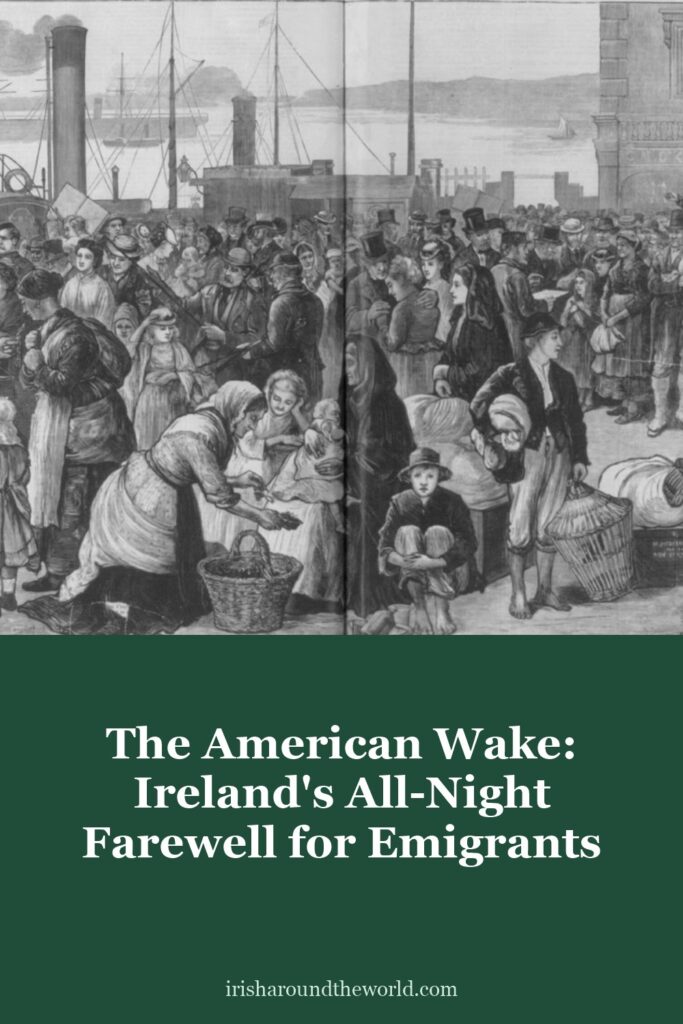
Featured image: Emigrants leaving Queenstown (Cobh) for New York, Harper’s Weekly, 1874. Library of Congress, public domain.