Hedge schools were small, fee-paying schools run by local masters in 18th- and 19th-century Ireland. They spread after a 1695 law banned Catholics from teaching, and kept growing after Catholics were allowed to teach legally in 1782. Some classes really did meet outdoors, but most used cabins, barns or chapels. Pupils learned reading, writing and arithmetic, and sometimes Latin. By 1824 about 9,000 “pay schools”, most of them hedge schools, taught nearly 400,000 children. The national schools, set up in 1831, slowly replaced them.
In the 1770s an English farming writer named Arthur Young toured Ireland, recording farms, rents and manners. One thing caught his eye: scholars at their lessons in the ditches.
These were the hedge schools. By the 1820s, pay schools, most of them hedge schools, taught about seven in ten Irish schoolchildren.
My guide to famous Irish poets mentions that Brian Merriman taught in a hedge school. Here’s the full story: the laws, the myths, the lessons and the money.
Jump to:
- What were hedge schools?
- The Penal Laws that banned Catholic teachers
- Were they really held under hedges?
- What did hedge schools teach?
- The hedge schoolmasters, poets included
- How were hedge schools paid for?
- How many hedge schools were there?
- Why did hedge schools disappear?
- Hedge school myths, checked
- The legacy of the hedge schools
- Hedge schools FAQ
- More Irish history reading
What were hedge schools?
A hedge school was a small private school run by one master, who lived on the fees parents paid him. There was no state money, no inspector and no set curriculum.
The big government inquiry of the 1820s counted them as “pay schools”. Most pupils were Catholic, but not all.
Hedge school in Irish
In Irish, a hedge school is scoil chois claí (skull khish KLEE, with the kh like the ch in loch), “the school beside the ditch”, or scoil scairte, “the school in the thicket”. Ó Dónaill’s Irish-English Dictionary, on teanglann.ie, gives both.
A note for American readers: in Ireland a “ditch” usually means a raised bank of earth, often with a hedge along the top, not a trench.
The Penal Laws that banned Catholic teachers
The Penal Laws shut Ireland’s Catholic majority out of power, property and the professions. Education was one of their targets.
Even earlier, a 1665 Act of Uniformity required every schoolmaster to conform to the Church of Ireland, the Anglican state church, and hold a licence from one of its bishops.
1695: the teaching ban
The key law came in 1695: An Act to restrain Foreign Education (7 Will. III c.4). Its first aim was to stop Catholic families sending children to colleges abroad.
Section 9 went further. It declared that “no person whatsoever of the popish religion shall publickly teach school”. Teaching in private houses was banned too, except for the household’s own children. The penalty was £20 and three months in prison, without bail.
The act was frank about why. It said Catholic schools kept many of the natives “ignorant of the principles of true religion”, out of step with the laws, and not “using the English habit or language”. Habit here means dress.
1709: a bounty on schoolmasters
The ban didn’t work. A 1709 act (8 Anne c.3) complained that Catholics were still keeping schools, and that when prosecuted they simply moved to another county and opened again.
So the law raised the stakes. A Catholic teacher now faced the same penalties as a banned friar, which could mean transportation overseas. Anyone whose information convicted a Catholic schoolmaster could claim a £10 reward, charged to the Catholics of that county.
In practice, enforcement was patchy. The Ulster Historical Foundation notes that the authorities generally ignored hedge schools unless they got in the way.
1782 and 1792: legal at last
An act of 1782 (21 & 22 Geo. III c.62) finally let Catholics teach legally, with strings attached. A Catholic master had to take the oath of allegiance, get a licence from the local Church of Ireland bishop, and take no Protestant pupils.
In 1792 a further relief act (32 Geo. III c.21) dropped the licence. So the schools’ busiest years, the 1820s, came long after the ban had gone.
Were they really held under hedges?
Sometimes, yes. The best eyewitness is Arthur Young, who toured Ireland from 1776 to 1778. In A Tour in Ireland (1780), he wrote that hedge schools “might as well be termed ditch ones, for I have seen many a ditch full of scholars”.
In the early 1840s, the writers Mr and Mrs S. C. Hall explained the name differently: in fine weather, they said, the school simply moved outdoors.
William Carleton, who went to hedge schools himself in Co. Tyrone, said the open-air school was only a stopgap until a schoolhouse could be built. William Shaw Mason’s parish survey of Maghera, Co. Derry, published in 1814, gave a grimmer origin: the schoolhouses there were sod huts built into the roadside ditches, which is why they were called hedge schools.
Mostly, the school had a roof of some kind. The historian Tony Lyons, writing in History Ireland, lists hedges, riverbanks and overhanging rocks, but also mud huts, barns, chapels and people’s homes.
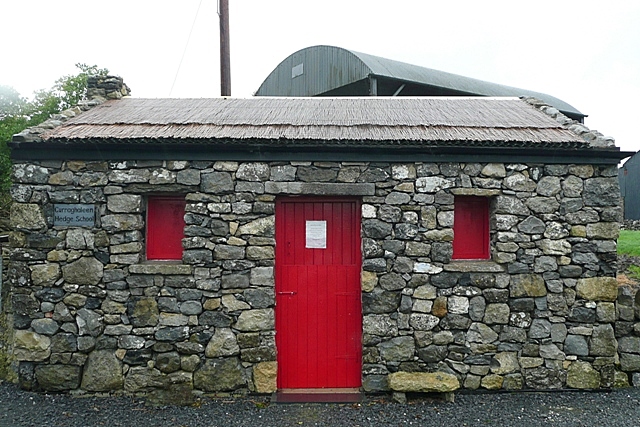
Curraghaleen, Co. Roscommon: a preserved barn marked as a hedge school. Photo: Graham Horn, CC BY-SA 2.0, via Wikimedia Commons
Folk memory adds more. A Schools’ Collection account from Co. Meath, part of the folklore written down by schoolchildren in 1937 to 1939, describes up to twenty scholars taught in a forge at Killallon. An account from Ballylongford, Co. Kerry, remembers a hut of logs and rushes beside a hedge.
The lookout boy: memory or myth?
Folk accounts such as the one from Ballylongford say one pupil kept watch for soldiers while the others learned.
The danger was real on paper, as the 1709 bounty shows. But treat the lookout as folk memory, written down generations later. The schools were most numerous in the 1820s, decades after teaching became legal.
What did hedge schools teach?
The basics: reading, writing and arithmetic. A government report of 1812 found that, “except in a very few instances”, teaching went no further than that.
Some masters offered far more. Lyons notes that many taught Latin and mathematics, and a few taught Greek. In the 1750s the historian Charles Smith claimed to have met good Latin scholars in Kerry who didn’t understand English. Lyons cautions that some later observers found such rural learning hard to find.
Ambitious masters also taught subjects that paid: book-keeping, land surveying, navigation and gauging, which meant measuring casks for the excise.
The books: sums and highwaymen
There were no set textbooks. For sums, many pupils used Gough’s or Voster’s arithmetic, which the Halls called the standard arithmetic books of Ireland. For reading, children brought whatever the family had, often cheap chapbooks or pirated editions of English books, as Antonia McManus describes in The Irish Hedge School and Its Books, 1695-1831.
Those chapbooks worried the authorities. In evidence to the education commissioners, published in 1825, Henry Cooke, later a famous Presbyterian leader, recalled growing up on tales like the History of Captain Freney, a highwayman.
The commissioners’ 1825 report, as quoted by Tony Lyons, complained that young minds were being corrupted in ways that could “incite the lawless and profligate adventure”.
Irish or English?
Where Irish was the language of home, it was the language of the lesson too. The Co. Meath account recalls a master who always explained things in Irish.
But parents wanted English, the language of fair and market. By about 1800, Lyons writes, English was steadily replacing Irish in the classroom. My guide to English words from Irish shows how Irish words slipped into English anyway, and here’s how to learn Irish online.
The hedge schoolmasters, poets included
The master was a big figure in his parish. Besides teaching, he read leases for neighbours, measured land and translated, Lyons writes. McManus adds roles such as scribe, land surveyor and parish clerk.
Some pupils paid nothing. These “poor scholars” were travelling students, often hoping to become priests. The Halls describe farmers and cottagers taking them in as they went in search of learning, a strap of books over the shoulder.
Some masters were fine Irish-language poets, heirs of the old Gaelic learning who taught to make a living.
Eoghan Rua Ó Súilleabháin (c.1748-1784)
Eoghan Rua, “Red Owen”, from near Killarney, was perhaps the most popular poet in 18th-century Munster, according to the Dictionary of Irish Biography. He spent years as a wandering farm labourer, teaching or copying manuscripts when he could.
Tradition says the clergy closed an early school of his because of his womanising. By 1782 he was serving with the Royal Navy, possibly press-ganged (forced into service), and was at the Battle of the Saints in the Caribbean.
Back home, he sent the local priest a poem in English listing his skills, then opened a school at Knocknagree, just over the Cork border. He died there in June 1784, weeks after being hurt in a tavern brawl in Killarney.
Brian Merriman (c.1749-1805)
Merriman wrote the great comic poem Cúirt an Mheán Oíche (The Midnight Court). In the 1770s he kept a school at Knocknageeha in east Clare. Later he farmed and taught near Feakle for about twenty years, winning two prizes for his flax crop in 1796.
Around 1802 he moved to Limerick, where he taught mathematics until his death in 1805.
Donnchadh Rua Mac Conmara (c.1715-1810)
Probably born in Co. Clare, Mac Conmara was a fine Latin scholar who taught in Co. Waterford and Co. Cork from about 1740.
He did cross the Atlantic, probably between 1745 and 1756: one of his songs, mixing English and Irish lines, is set in St John’s, Newfoundland. His best-known song, “Bánchnoic Éireann Óighe” (“The Fair Hills of Holy Ireland”), may have been written there.
How were hedge schools paid for?
Parents paid by the subject. The 1812 report found average yearly fees of 10 shillings for reading, 17 shillings and fourpence with writing added, and £1 6s once arithmetic came in. Twenty shillings made a pound.
Cash was scarce, so many families paid in kind. The Halls listed sods of turf (peat, the fuel of rural Ireland), a basket of potatoes, eggs, or a roll of butter at Christmas and Easter. McManus mentions sides of bacon.
A Schools’ Collection account from near Charleville, Co. Cork, recalls each child bringing a sod of turf for the fire and twopence each morning for the master.
How many hedge schools were there?
The best count comes from a royal commission, the Commissioners of Irish Education Inquiry. In 1824 they asked the clergy of every parish, Protestant and Catholic, to list the schools around them.
Their Second Report, published in 1826, counted 11,823 schools with 560,549 pupils. The biggest group by far was the pay schools: 9,352 of them, teaching 394,732 children. The historian John Coolahan describes most of these pay schools as hedge schools.
The figures rest on local returns, so treat them as approximate, but about seven in ten pupils were at pay schools.
And they weren’t only Catholic. Carleton remembered his Tyrone hedge school holding up to 200 pupils, “Protestant and Catholic, Presbyterian and Methodist, boys and girls”.
Why did hedge schools disappear?
In 1831 Edward Stanley, the British government’s Chief Secretary for Ireland, set out a national school system in a letter to the Duke of Leinster. A government board would fund and inspect schools, with approved books and trained teachers. Irish was not a national school subject, Coolahan notes, even where it was the only language people spoke.
At first, most Catholic bishops welcomed the system. Bishop James Doyle of Kildare and Leighlin wrote in 1831 that the trained-teacher rule would help in “suppressing hedge schools”.
The hedge schools died slowly. Yolanda Fernández-Suárez, in a 2006 study in Estudios Irlandeses, notes that the 1841 census put only about a third of schoolchildren in national schools.
The Famine hit them hard. By the 1861 census, she reports, national schools outnumbered hedge schools for the first time. Yet police returns for an educational census in 1868 still listed 204 hedge schools in Munster, Leinster and Connacht, three of Ireland’s four provinces. Ulster wasn’t covered.
She also found a photograph from north Co. Mayo, taken around 1894. Its handwritten caption reads “Hedge School near Gorick. In use 1892, now replaced by Government School”. She thinks Gorick is Corrick, in Erris.
Hedge school myths, checked
- Myth: classes were always held outdoors. Some were. Most met in cabins, barns, chapels or homes.
- Myth: hedge schools were illegal throughout. Catholic teaching was legal from 1782, and the schools peaked in the 1820s.
- Myth: a lookout always watched for redcoats. It’s a strong folk memory, but there’s little evidence it was routine.
- Myth: every master taught Latin and Greek. Many taught Latin, but most pupils got only reading, writing and arithmetic.
- Myth: only Catholics went. Protestant and Presbyterian children attended too.
- Myth: they vanished in 1831. More than 200 were still counted in 1868, not including Ulster, and one in Co. Mayo was still in use in 1892.
More myths? See my Irish myths debunked.
The legacy of the hedge schools
The hunger for learning travelled with the emigrants. John Hughes was born in 1797 near Clogher, Co. Tyrone. According to the Dictionary of Irish Biography’s entry on him, the novelist William Carleton was his contemporary at parish and hedge school.
Hughes emigrated in 1817 and worked as a labourer and gardener in Maryland before he was admitted to study for the priesthood at Emmitsburg.
In 1850 he became the first Archbishop of New York. The DIB credits him with laying the foundations of the city’s free parochial (parish) school system, though it reached only a fraction of Catholic children in his lifetime. “In our age, the question of education is the question of the church,” he said in 1857.
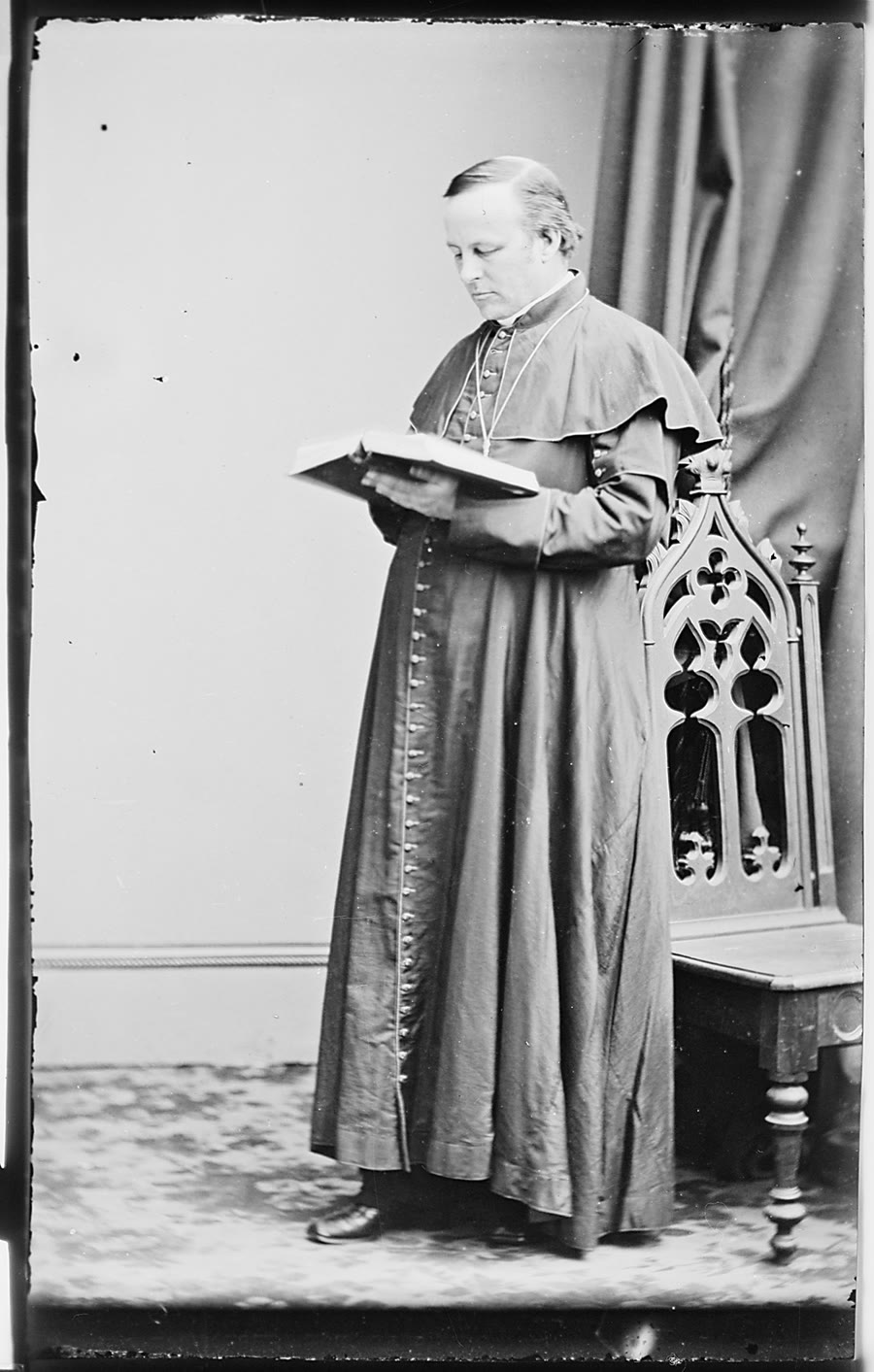
Archbishop John Hughes, Mathew Brady studio, before 1864. U.S. National Archives (NAID 530239, 111-B-6166A), public domain, via Wikimedia Commons
For the bigger picture, see the Irish diaspora and its impact on America.
The hedge schools live on in literature too. Carleton based the master in his comic story “The Hedge School” on one of his own teachers.
Brian Friel’s play Translations, first staged in Derry’s Guildhall on 23 September 1980, is set in August 1833 in a hedge school in Baile Beag, a fictional Donegal townland (a small rural district). The Ordnance Survey, Britain’s mapping agency, is arriving to map the place and rename it in English, and a new national school is on the way.
Hedge schools FAQ
What was a hedge school?
A small, fee-paying school run by a local master in 18th- and 19th-century Ireland. They spread under the Penal Laws, which banned Catholics from teaching from 1695.
Were hedge schools illegal?
For Catholic teachers, yes, for a long time. From 1665 every schoolmaster needed a Church of Ireland bishop’s licence, and a 1695 act banned Catholics from teaching outright. An act of 1782 let Catholics teach under licence, and the licence was dropped in 1792.
Why were they called hedge schools?
Some classes met outdoors by hedges and ditch banks, as Arthur Young saw in the 1770s. Most, though, met in cabins, barns or chapels.
When did hedge schools end?
They declined after the national schools began in 1831 and after the Famine, but a few lasted much longer. One in Co. Mayo was still in use in 1892.
Love this? Save it to your Pinterest board for later.
A little bit of Ireland in your inbox every Friday ☘️
The free Weekly Dose of Irish: an Irish joke, a Celtic symbol, an Irish fact, a poem and the week’s best articles in one short email. Join 9,600+ readers.
Free. One short email every Friday. Unsubscribe any time.
More Irish history reading
- Irish History in 6 Minutes
- Famous Irish Poets, in Order
- The Midnight Court by Brian Merriman
- The Irish Diaspora in Modern America
- English Words From Irish
- How to Learn Irish Online
- 20 Myths About Ireland
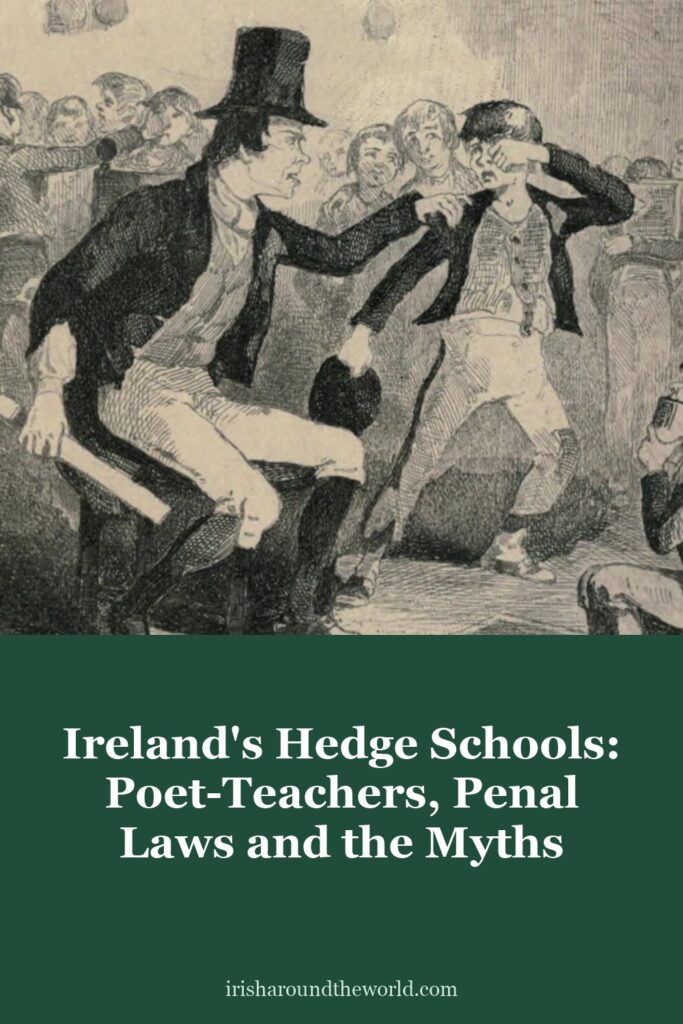
Featured image: “Matt Kavanagh, exercising his vocation”, an illustration for William Carleton’s story “The Hedge School”, Traits and Stories of the Irish Peasantry (Dublin, 1843), via Internet Archive. Public domain.