Ogham (said roughly OHM in Irish) is the oldest way of writing Irish: an alphabet of 20 letters made from one to five strokes or notches along a line, usually the edge of a standing stone. Over 400 ogham stones survive. About 360 are in Ireland, mostly in Kerry, Cork and Waterford, and the others are in Britain and the Isle of Man. Most date from roughly the 4th to 7th centuries and record a man’s name, often with his father or kin group. The “tree alphabet” idea came later, and is only partly true.
Near the entrance to the Gap of Dunloe in Co. Kerry, a curve of tall stones stands on a bed of gravel. Look along their edges and you’ll see rows of short grooves, like tally marks left by someone counting sheep.
They aren’t tallies. They’re names, cut around 1,500 years ago in ogham, the oldest surviving form of written Irish.
The script pops up in my guides to Celtic gods and druid symbols. Here’s how it works, what the stones say, the truth about the “tree alphabet”, where to see them, and a chart for writing your name.
Jump to:
- What is ogham?
- How ogham works
- How old is ogham, and who invented it?
- How many ogham stones are there?
- What do ogham stones say?
- Ogham in the old stories
- The tree alphabet: fact and myth
- Ogham letter chart
- How to write your name in ogham
- Ogham today
- Where to see ogham stones
- Ogham FAQ
- More Irish heritage reading
What is ogham?
Ogham is an alphabet created for a very early stage of Irish, which linguists call Primitive Irish. It isn’t a language but a script, like the Roman alphabet we use for English. Its letters are bundles of lines and notches cut along a central line, usually the corner of a stone.
In Modern Irish the word is spelled ogham and rhymes with home: (OHM). Old Irish spelled it ogam, with a soft, throaty g. Many English speakers say (OG-um), but as the Maynooth scholar David Stifter points out on the OG(H)AM project’s blog, no native speaker of Irish ever said it that way. The word even survives in an idiom: Ó Dónaill’s dictionary gives d’aon oghaim, on purpose.
How ogham works
The script has 20 basic letters in four groups of five. Each group is an aicme (AK-myuh), a family or class, plural aicmí, named after its first letter:
- Aicme beithe: B, L, F, S, N. One to five strokes on one side of the line.
- Aicme húatha: H, D, T, C, Q. One to five strokes on the other side.
- Aicme muine: M, G, NG, Z, R. One to five strokes slanting across the line.
- Aicme ailme: A, O, U, E, I. One to five notches on the line itself (short strokes across it in manuscripts).
In the old terms, recorded by the Ogham in 3D project at the Dublin Institute for Advanced Studies, the stemline was the druim, the back, and the letters were feda, trees.
On a stone you normally start at the bottom left of one face, read up the edge, across the top and down the other side, with plenty of exceptions. Manuscripts turned the line on its side, running left to right, as most charts do now.
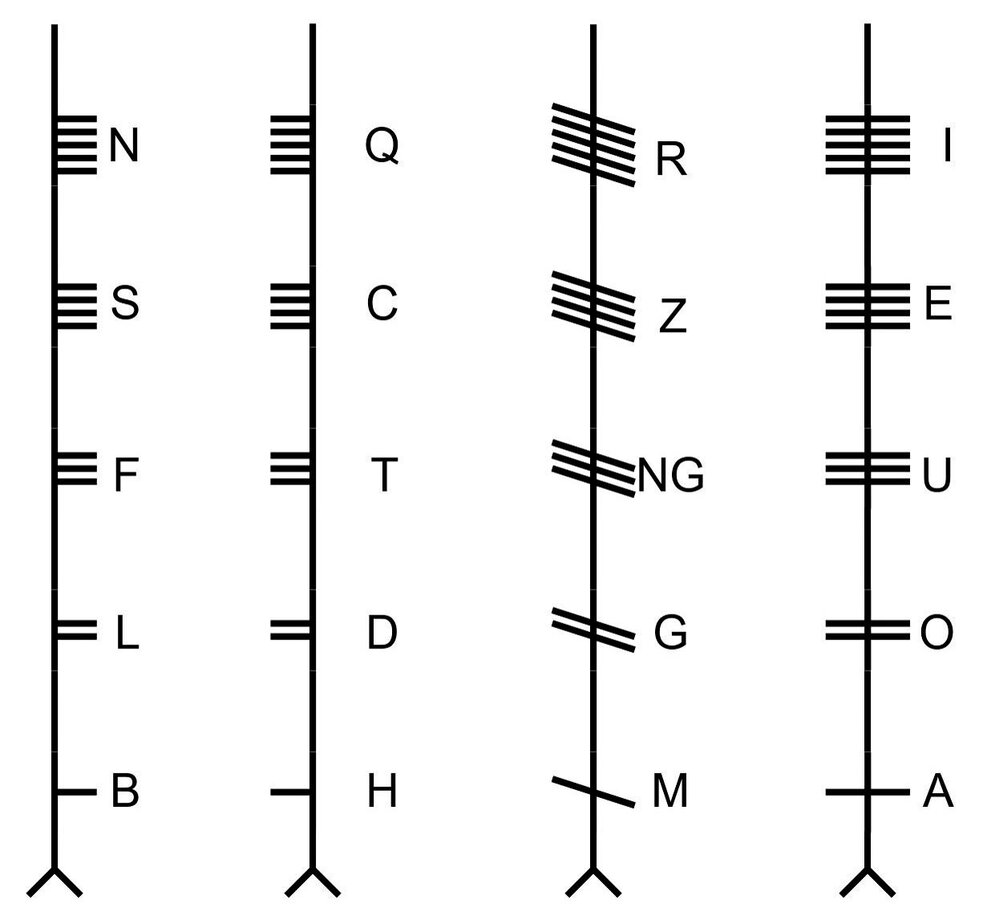
The 20 ogham letters in their four groups, read from the bottom up (vowels drawn as short strokes across the line, as in the manuscripts). Chart: Runologe, CC BY-SA 4.0 (https://creativecommons.org/licenses/by-sa/4.0/), via Wikimedia Commons
The manuscripts list a fifth group of extra letters, the forfeda. Only one, an X shape, is common on the stones, even some of the oldest, usually for a K sound, as in KOI (here). The manuscripts also added a letter for P, a sound the earliest Irish lacked.
How old is ogham, and who invented it?
Nobody knows for certain. Few sites have been excavated, so scholars date the inscriptions by their language, which changed fast. The Heritage Council’s guide, Ogham Stones in Ireland by Dr Nora White, follows one name across three stones, from LUGUDECCAS at Ardmore, Co. Waterford, to LUGUDECA and then LUGUDEC. By the 8th century it was written Luigdech.
On that evidence the stones run from roughly the 4th to the 7th century. When the script itself was invented is less clear: Stifter suspects the 4th century, while some scholars argue for earlier.
The Ogham in 3D team thinks it most likely developed in Ireland for the sounds of Primitive Irish. Many scholars see a link with the Latin alphabet, though it isn’t simply a Latin cipher.
Its purpose is debated too. Eoin MacNeill and James Carney argued for a secret script, devised by Irish scholars or druids to hide messages from Roman Britain. Damian McManus of Trinity College Dublin and others look instead to Ireland’s first Christian communities.
The legend of Ogma
Medieval scholars had their own answer. In Lebor Ogaim, the Book of Ogam, the inventor is Ogma son of Elatha, of the Tuatha Dé Danann, who made it to prove his cleverness and to keep learning among the learned. Ogma was its father, the tract says, and his hand or knife its mother.
The first thing ever written in ogham, it adds, was seven Bs on a birch rod, warning Lug son of Ethliu that his wife would be carried off seven times into the fairy world, or another land, unless birch guarded her. Hence B comes first.
Auraicept na nÉces, the scholars’ primer, tells it more plainly: seven birches warn Lug that his wife will be taken unless he watches her. Stifter cautions that no real link between Ogma and the script can be proven.
How many ogham stones are there?
More than 400 survive, about 360 of them in Ireland, Nora White writes for Maynooth University. They crowd into the south-west: Kerry alone has about a third, and the Dingle Peninsula about 60.
Beyond Ireland, the stones mark parts of Britain, and the Isle of Man, settled by the Irish after Roman rule collapsed: chiefly Wales, Scotland, Devon and Cornwall. Most of the Welsh ones are bilingual, Latin across the face and ogham up the edge.
At Bridell, Pembrokeshire, a 5th-century stone remembers NETTASAGRI MAQI MUCOI BRIACI, one of a cluster pointing to early Irish settlers, says the Royal Commission on the Ancient and Historical Monuments of Wales. Scottish ogham is mostly later and thought to be largely Pictish.
In Ireland:
- About 40% were later reused as building stone, mostly in souterrains (underground passages), especially in Cork.
- More than 40% stand at or near early church sites.
- The tallest, overlooking Ballycrovane Harbour in west Cork, is 4.7 m (over 15 ft) high.
In 2024 the Guardian reported a new find: an 11 cm (4 in) stone a teacher had dug up while weeding his Coventry garden. Its inscription probably names a Mael Dumcail, and Professor Katherine Forsyth of Glasgow judged the script early, most likely 5th or 6th century.
What do ogham stones say?
Don’t expect poems or prophecies. Almost every inscription is a name, nearly always a man’s. No known Irish stone commemorates a woman, though Wales has a couple.
The names are in the possessive form, with a word like stone understood: “(the stone) of X, son of Y”. A few formula words do most of the work:
- MAQI: son, Modern Irish mac.
- AVI: grandson or descendant, Modern Irish ó.
- MUCOI: descendant or kin, followed by an ancestor’s name.
- KOI: here, like hic iacit (here lies) on British stones.
Real examples, read by Ogham in 3D:
- Coolmagort (the Dunloe stones), Co. Kerry: DEGO(S) MAQI MOCOI TOICAKI, read, with a query, as “of Daig son of the descendant of Toicacas”.
- Ballintaggart, near Dingle: one stone remembers TRIA MAQA MAILAGNI, the three sons of Máelán. Two name the MUCOI DOVVINIAS (once spelled DOVINIAS), descendants of Duibne, who gave their name to Corca Dhuibhne, the Dingle area’s Irish name.
- Arraglen, Mount Brandon: QRIMITIR RONANN MAQ COMOGANN, the priest Rónán (ROH-nawn), son of Comgán. QRIMITIR comes from the Latin presbyter.
- Kilmalkedar, Co. Kerry: ANM MAILEINBIR MACI BROCANN, the name of Máel-Inbir son of Broccán. Traces of an older inscription survive lower down on a third edge.
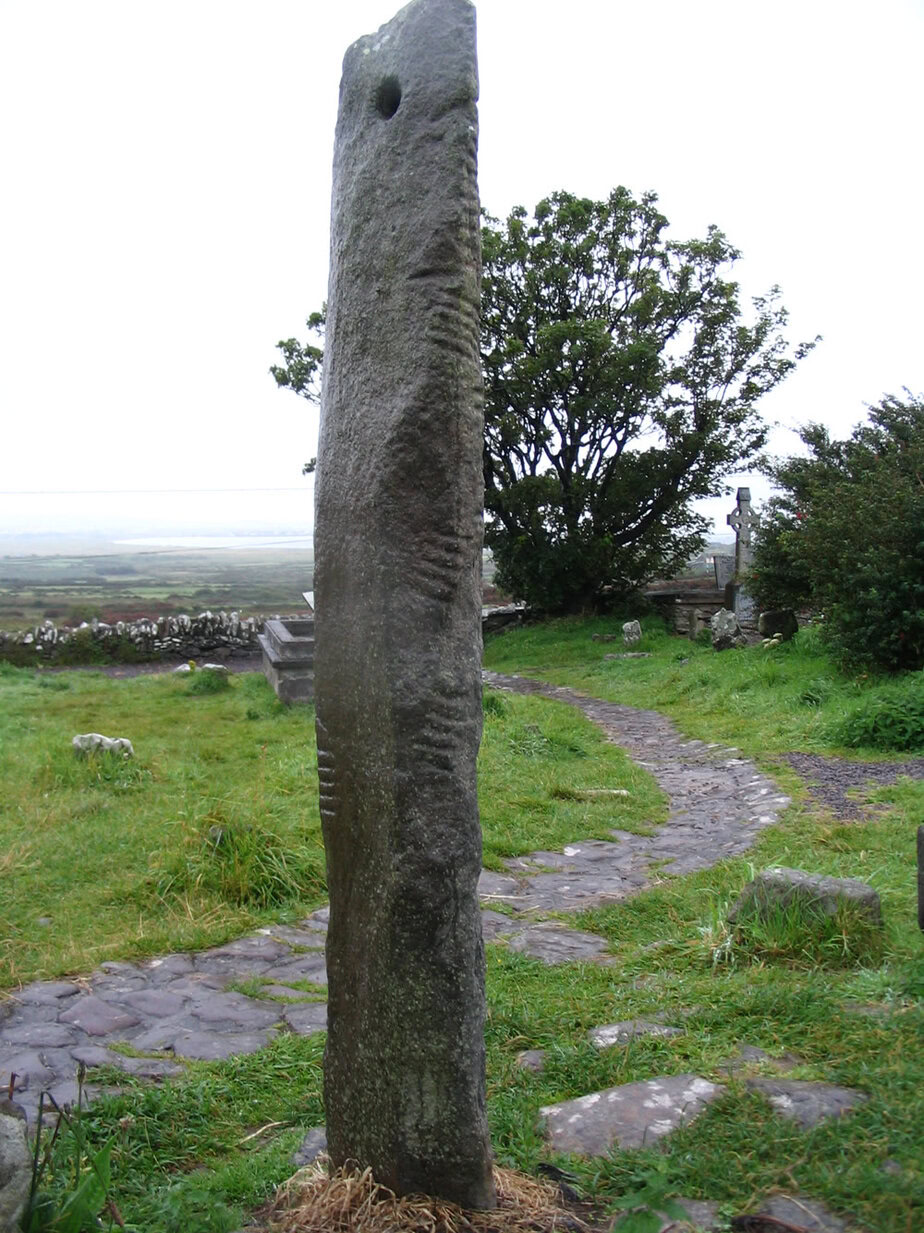
The Kilmalkedar ogham stone, Co. Kerry, with its hole near the top and ogham strokes along the edge. Photo: Patrice78500, public domain, via Wikimedia Commons
MAQI is the ancestor of Mac, and AVI of Ó: another Ballintaggart stone, CUNAMAQQI AVI CORBBI, is read as Conmac Uí Chuirb. The Heritage Council traces surnames like MacMahon and O’Neill to this habit, and my guide to Irish surnames picks up the story.
What were ogham stones for?
Probably memorials, and perhaps grave markers, though there’s no direct proof. Quite a few stand near old townland (a small rural land unit) or parish boundaries, and later Irish law texts suggest a stone could count as evidence in a land dispute.
Ogham in the old stories
In the Táin Bó Cúailnge, Cú Chulainn cuts an oak sapling with one blow, twists it into a ring, carves ogham on it and forces it over a standing stone. When Queen Medb’s army arrives, Fergus reads the message: nobody passes until one of them matches the feat. (I follow Joseph Dunn’s 1914 translation.)
In the Children of Lir, the four children’s names are cut in ogham on their grave. Scholars think the script was probably cut on wood as well as stone, but wood rarely survives.
The tree alphabet: fact and myth
Ogham is often sold as the Celtic tree alphabet. There’s a real medieval idea behind that, buried under modern invention.
The real part. In Old Irish, fid meant a tree and also a letter, and the Electronic Dictionary of the Irish Language notes that each letter was called after a tree. Lebor Ogaim and the Auraicept give a key in which every letter is a tree or plant: beithe, birch, dair, oak, coll, hazel and so on. Dair is also the oak in the Dara knot.
Even the medieval writers hedged. Some say, the tract reports, that the letters were named after the 25 noblest scholars of the legendary Fénius Farsaid’s school; others, after the trees of the forest. See George Calder’s 1917 edition, Auraicept na n-Éces.
The myth. That the letters were all trees from the start. McManus studied the oldest evidence, especially the Bríatharogam or “word ogham”, riddling clues to each letter. He concluded that only six of the 20 names certainly meant trees, eight at most if ailm meant pine and idad yew. Muin seems to have meant the neck, gort a field and ruis redness. Medieval compilers, it seems, then fitted trees to the rest.
In the word ogham credited to Morann mac Main, for instance, birch is “faded trunk and fair hair”, in Calder’s translation.
And the “Celtic tree calendar”, giving each tree a month? It isn’t in the medieval texts. The English poet Robert Graves devised it in The White Goddess (1948).
Ninety-three ways to write ogham
Lebor Ogaim also lists playful variants, 93 by eDIL’s count: bird ogham, colour ogham, cow ogham, even the names of the Norse runes. Calder edited the copy in the late 14th-century Book of Ballymote, sold in 1522, says Irish Script on Screen, for 140 milch (dairy) cows.
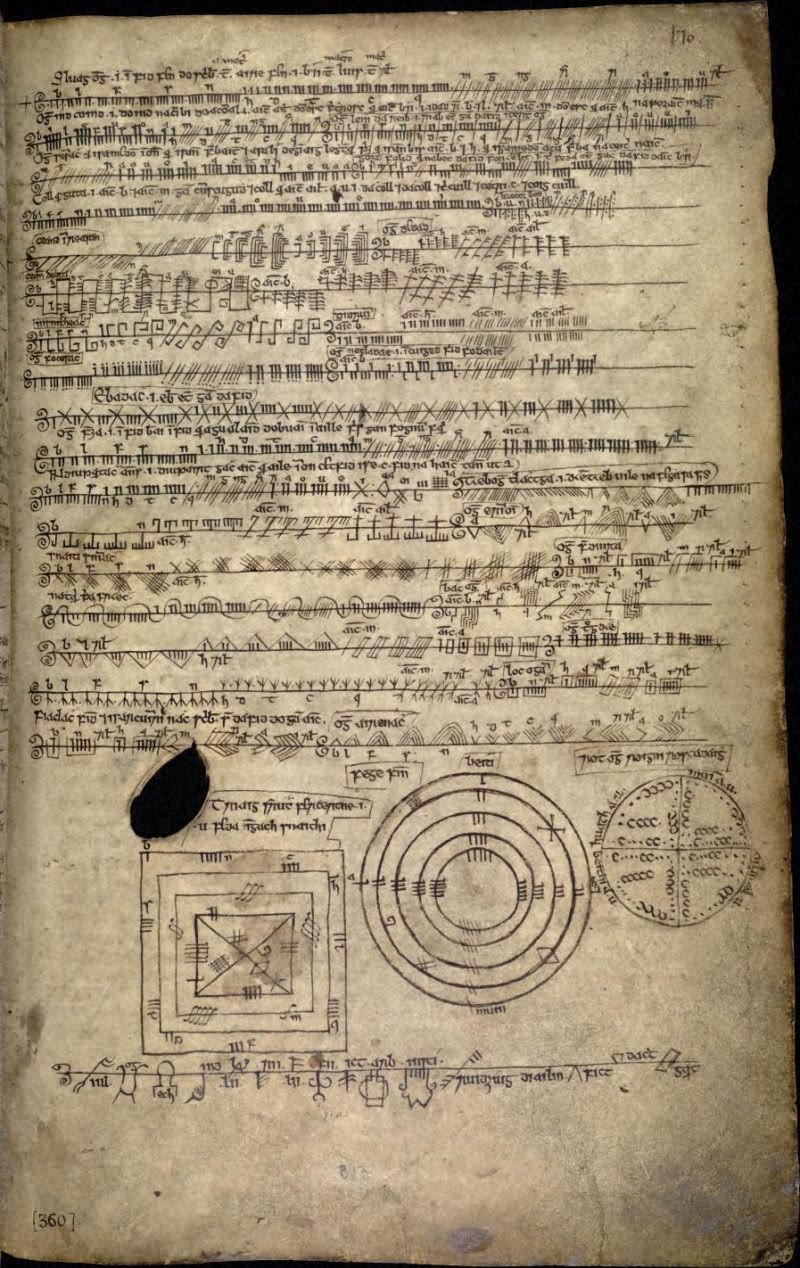
A page of ogham variants from Lebor Ogaim in the Book of Ballymote (late 14th century), Royal Irish Academy MS 23 P 12, fol. 170r. Public domain, via Wikimedia Commons
Ogham letter chart
The 20 original letters, their Old Irish names and probable meanings, after Ogham in 3D and McManus. Drawing notes assume an upright line read upwards; the symbols are shown sideways, so “right” becomes below the line. Boxes mean your device lacks an ogham font.
| Letter | Ogham | How to draw it (upright line) | Name | Meaning |
|---|---|---|---|---|
| B | ᚁ | 1 stroke, right | beithe | birch (tree) |
| L | ᚂ | 2 strokes, right | luis | flame, or a plant |
| F (V) | ᚃ | 3 strokes, right | fern | alder (tree) |
| S | ᚄ | 4 strokes, right | sail | willow (tree) |
| N | ᚅ | 5 strokes, right | nin | unclear |
| H | ᚆ | 1 stroke, left | úath | uncertain; whitethorn in the medieval key |
| D | ᚇ | 2 strokes, left | dair | oak (tree) |
| T | ᚈ | 3 strokes, left | tinne | bar of metal |
| C | ᚉ | 4 strokes, left | coll | hazel (tree) |
| Q | ᚊ | 5 strokes, left | cert | bush |
| M | ᚋ | 1 slanting, across | muin | neck, upper back |
| G | ᚌ | 2 slanting, across | gort | field |
| NG | ᚍ | 3 slanting, across | gétal | slaying |
| Z | ᚎ | 4 slanting, across | straif | sulphur |
| R | ᚏ | 5 slanting, across | ruis | redness |
| A | ᚐ | 1 notch | ailm | uncertain, perhaps pine |
| O | ᚑ | 2 notches | onn | ash (tree) |
| U | ᚒ | 3 notches | úr | earth, clay |
| E | ᚓ | 4 notches | edad | unknown |
| I | ᚔ | 5 notches | idad | unclear, perhaps yew |
H, NG and Z are later, Latin-based labels for letters whose first sounds are uncertain.
How to write your name in ogham
- Spell it by sound. The 20 letters were made for early Irish, so there’s no J, K, P, V, W, X or Y, and no way to mark a fada.
- Swap the missing letters. There’s no official rule. Common choices: C for K (or the stones’ X-shaped K), F for V or W (its original sound), B for P, I or G for J, CS for X and I for Y.
- Draw the stemline and add the letters in order, bottom to top or left to right, with a small gap between each.
- Add feather marks if you like. Unicode includes ᚛ and ᚜ to mark the start and end of a line of text.
So Aoife (EE-fa) is A, O, I, F, E: ᚛ᚐᚑᚔᚃᚓ᚜. Ciarán (KEER-awn) is C, I, A, R, A, N: ᚛ᚉᚔᚐᚏᚐᚅ᚜. Ogham in 3D’s alphabet page has a free converter.
Thinking of an ogham tattoo?
- Settle your spelling. English names have no single correct form, so choose your swaps and have someone who reads ogham check the design.
- Watch the spacing. Two Bs set too close together read as an L.
- Check the stencil isn’t flipped. On an upright line, a mirror image swaps the sides, so B, L, F, S, N turn into H, D, T, C, Q. On a horizontal line it reverses the order. Upside down, both happen.
Ogham today
The script never really died. It stayed in the training of Irish and Scottish poets into the later Middle Ages, and an Irish manuscript of 1849, found in Scotland, holds medical charms written wholly in ogham, the Heritage Council notes.
Unicode added ogham in version 3.0, in September 1999. The Irish passport design launched in October 2013 featured it across its pages, TheJournal.ie reported. Stifter notes it’s still used in Ireland, even for English words, and it’s one of the modern symbols of Ireland.
Where to see ogham stones
- Dunloe Ogham Stones, Co. Kerry: eight stones by the road to the Gap of Dunloe. Seven were found in 1838 in a souterrain on the Dunloe Castle estate and moved here in 1940.
- Kilmalkedar, Co. Kerry: an early church site near Dingle, with the Máel-Inbir stone by the church path and an “alphabet stone” carved with the Latin alphabet.
- Ballintaggart, near Dingle: nine stones in a circular enclosure on a low hill between Dingle Harbour and Trabeg.
- Arraglen, Mount Brandon: the priest Rónán’s stone, high on the Brandon pilgrimage route. Go only in good weather, ideally with a local guide, the Heritage Council advises.
- Ardmore, Co. Waterford: two stones inside the ruined cathedral at St Declan’s early church site, including LUGUDECCAS.
- University College Cork: the Stone Corridor holds 28 stones, all but one from Co. Cork, the largest collection on public display.
- National Museum of Ireland, Kildare Street, Dublin: two stones on display, the Heritage Council’s 2021 guide says, including one from Killeen Cormac, Co. Kildare, carved in ogham and Latin.
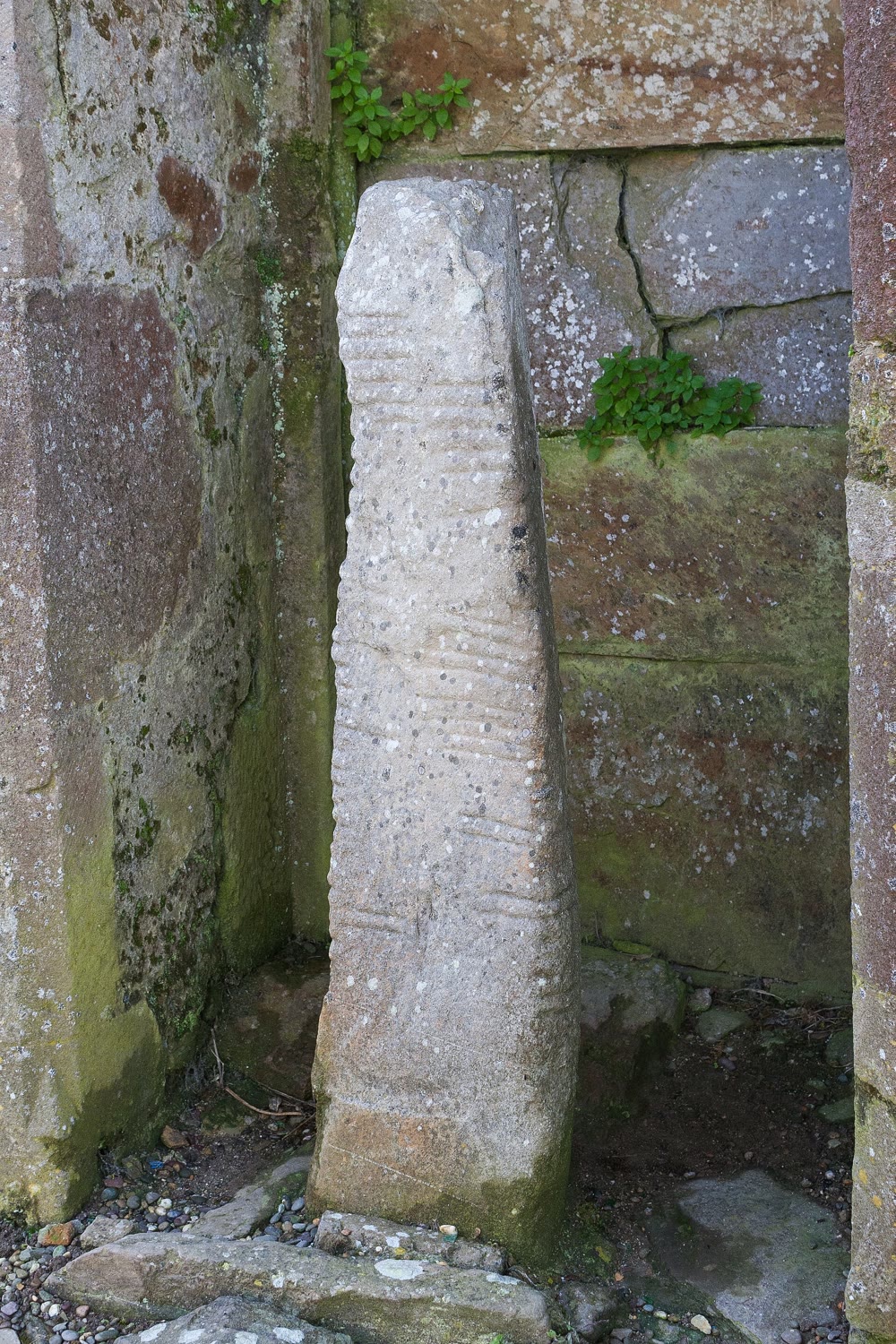
The LUGUDECCAS stone in a niche in the cathedral wall at Ardmore, Co. Waterford. Photo: Andreas F. Borchert, CC BY-SA 4.0 (https://creativecommons.org/licenses/by-sa/4.0/), via Wikimedia Commons
The Historic Environment Viewer at archaeology.ie maps others, and Ogham in 3D has 3D models of many. Ask landowners before crossing private land, and never chalk or paint the grooves, stand on the stones or scrape off moss.
Ogham FAQ
How do you pronounce ogham?
In Irish it rhymes with home: (OHM). Many English speakers say (OG-um).
Is every ogham letter named after a tree?
No. Medieval scholars gave every letter a tree, but McManus’s research suggests only six of the 20 names certainly began as trees. The “tree calendar” comes from Robert Graves, in 1948.
Did the druids invent ogham?
Nobody knows, and there’s no direct evidence for druids. Theories range from a secret script made by scholars or druids to an alphabet for Ireland’s first Christians.
Love this? Save it to your Pinterest board for later.
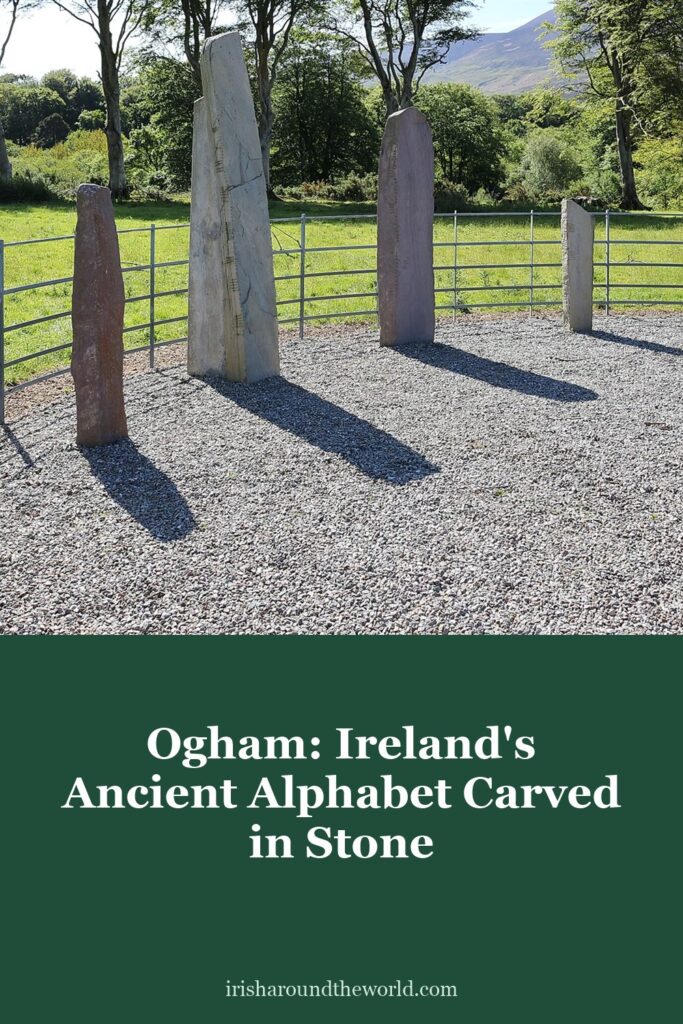
Pin image: the Dunloe Ogham Stones, Co. Kerry. Photo: Robert Linsdell, CC BY 2.0, via Wikimedia Commons.
A little bit of Ireland in your inbox every Friday ☘️
The free Weekly Dose of Irish: an Irish joke, a Celtic symbol, an Irish fact, a poem and the week’s best articles in one short email. Join 9,600+ readers.
Free. One short email every Friday. Unsubscribe any time.
More Irish heritage reading
- Celtic Gods and Goddesses: 15 Irish Deities and Their Stories
- Druid Symbols and Meanings: What’s Old and What’s Modern
- Irish Surnames: Meanings, Origins and the Top 100 Names
- Symbols of Ireland: 12 Irish Symbols and Where to See Them
- Cú Chulainn, the Legendary Hound of Ulster
Featured image: the Dunloe Ogham Stones at Coolmagort, near the Gap of Dunloe, Co. Kerry. Photo: Robert Linsdell, CC BY 2.0, via Wikimedia Commons.