The Children of Lir, Oidheadh Chlainne Lir in Irish, is the legend of four children turned into swans by their jealous stepmother, Aoife. Fionnuala, Aodh, Fiachra and Conn spend 900 years as swans: 300 on Lough Derravaragh, 300 on the Sea of Moyle and 300 off Erris in Co. Mayo, keeping their human voices. When the spell breaks they are withered old people, who are baptised and die. The written tale is probably late medieval.
Picture a lake in the Irish midlands, edged with reeds. Four white swans are singing on the water, and they’re singing in Irish. Along the shore, crowds have camped just to listen. They’ll keep coming back for 300 years.
That’s one of the gentler moments in the Children of Lir, one of the saddest stories in Irish mythology. It has a jealous stepmother, a sister who shelters her brothers under her wings through storms at sea, and an ending that still catches readers off guard.
I’ve covered the gods behind tales like this in my guide to Celtic gods. Here’s the full story, retold from the first printed Irish text, plus where it happens and how old it really is.
Jump to:
- What is the Children of Lir?
- The story of the Children of Lir
- Where the story happens
- How old is the Children of Lir?
- One of the Three Sorrows of Storytelling
- Where the versions differ
- Swans in Irish folklore
- The names: Fionnuala, Aodh, Fiachra and Conn
- The Children of Lir today
- Children of Lir FAQ
- More Irish mythology reading
What is the Children of Lir?
The Children of Lir is an Irish legend about the four children of Lir, a lord of the Tuatha Dé Danann, the godlike people of early Irish story. It belongs to the Mythological Cycle, the group of tales about them.
Oidheadh, the first word of the Irish title, is a later form of aided, which the Electronic Dictionary of the Irish Language defines as a violent death or grim fate.
Lir’s name looks like ler, an old word for the sea, and the sea god Manannán is called mac Lir, son of Lir. But here Lir is simply lord of Sídh Fionnachaidh, a fairy hill in south Co. Armagh.
The story of the Children of Lir
This retelling follows Eugene O’Curry’s 1863 edition of the Irish text, in my own words. University College Cork’s Irish Sagas Online sets the Irish beside his translation.
Lir, Aobh and the four children
After their defeat at the battle of Tailtiu, the Tuatha Dé Danann chose Bodb Dearg, son of the Dagda, as their king. Lir had expected the crown, and he walked out in a huff. Bodb refused to let his people burn Lir’s house.
When Lir’s wife died, Bodb made peace by offering him one of his three foster-daughters. Lir chose the eldest, Aobh. She bore twins, Fionnuala and Aodh, then twin boys, Fiachra and Conn, and died giving birth to them. Bodb then gave Lir her sister, Aoife.
Aoife’s jealousy
At first Aoife loved the children. Everyone did. But jealousy grew in her, and she kept to her bed for most of a year, pretending to be ill.
Then she set out by chariot with the four children. Fionnuala didn’t want to go: she had dreamed Aoife meant them harm. On the road, Aoife ordered her servants to kill them. They refused. She drew a sword herself, but couldn’t strike.
The spell at Lough Derravaragh
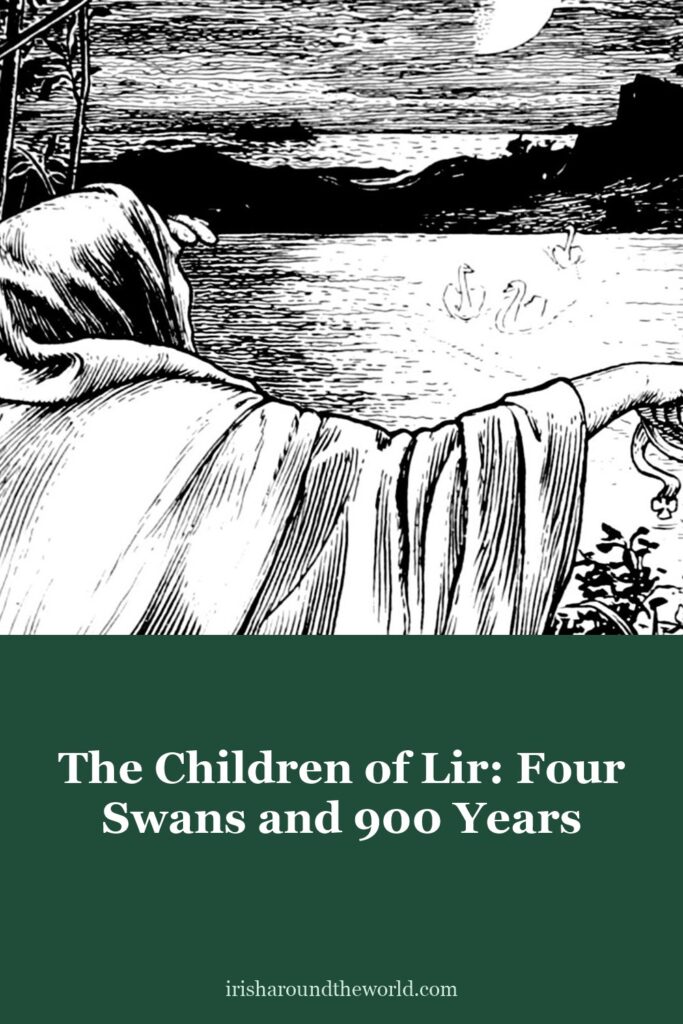
At Loch Dairbhreach, now Lough Derravaragh in Co. Westmeath, she sent the children to swim. Once they were out on the water, one blow of her druid’s wand turned them into four white swans.
Fionnuala demanded to know when it would end. Aoife named the sentence: 300 years on Lough Derravaragh, 300 on Sruth na Maoile, the sea between Ireland and Scotland, and 300 at Iorras Domhnann and the island of Inis Gluaire. And no release until a woman of the south married a man of the north: Deoch of Munster and Lairgnén of Connacht. Connacht sounds western, but it lay in Conn’s Half, the old northern half of Ireland.
Then she relented a little. They could keep their speech, their Irish and their reason, and sing music so sweet it would lull anyone to sleep.
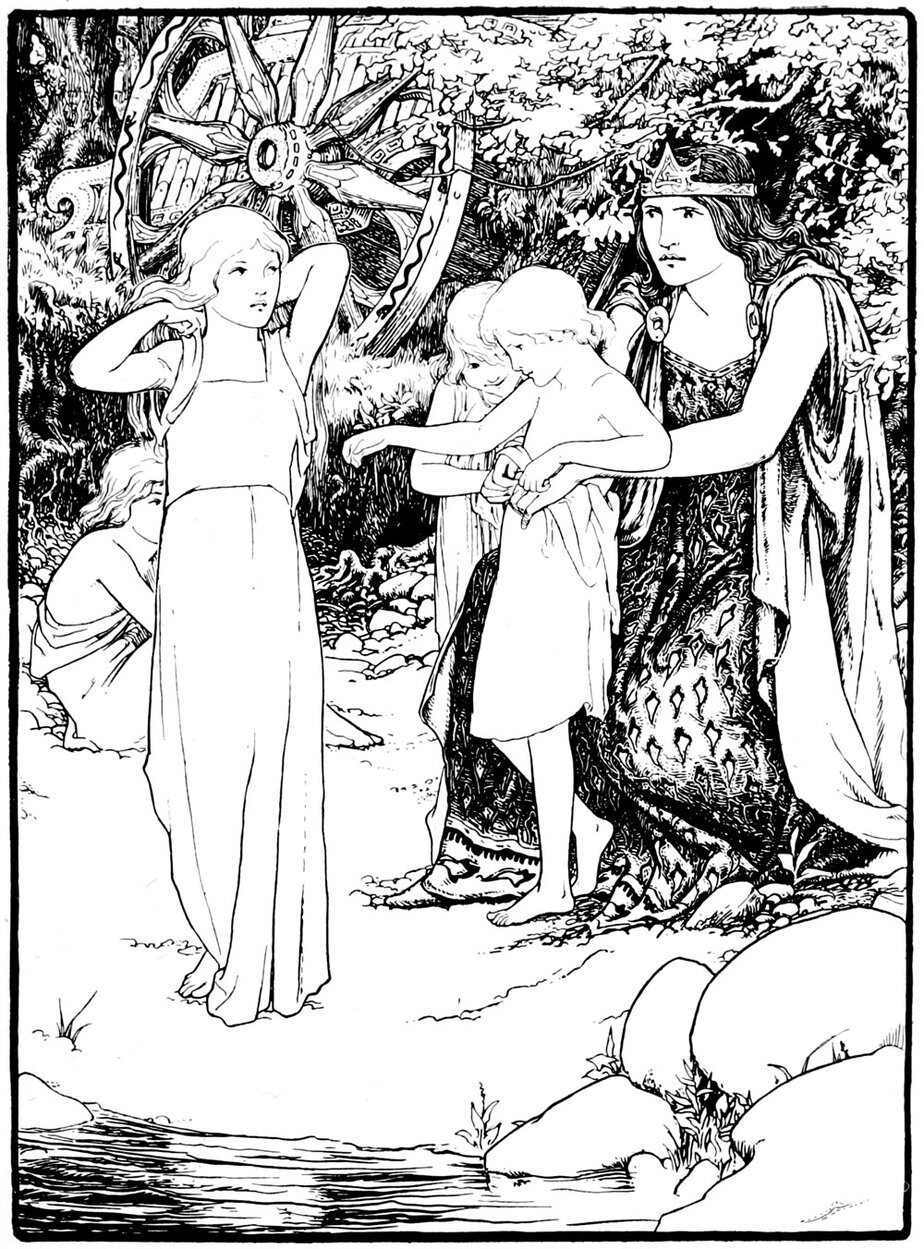
Aoife brings the children to the lake. The Children of Lir, by John D. Batten, from Joseph Jacobs, More Celtic Fairy Tales (1894). Public domain, via Wikimedia Commons
When Bodb Dearg learned the truth from Lir, he asked Aoife what shape she would most hate to wear. A demon of the air, she said. He struck her with his own wand, and the tale says she’s a demon of the air still.
From Lough Derravaragh to the Sea of Moyle
The Lough Derravaragh years were the good ones. The Tuatha Dé Danann and the Milesians, the newcomers who now ruled Ireland, camped along the shore to hear the swans. When the swans finally flew north, the text says, the people proclaimed that no swan should ever be killed.
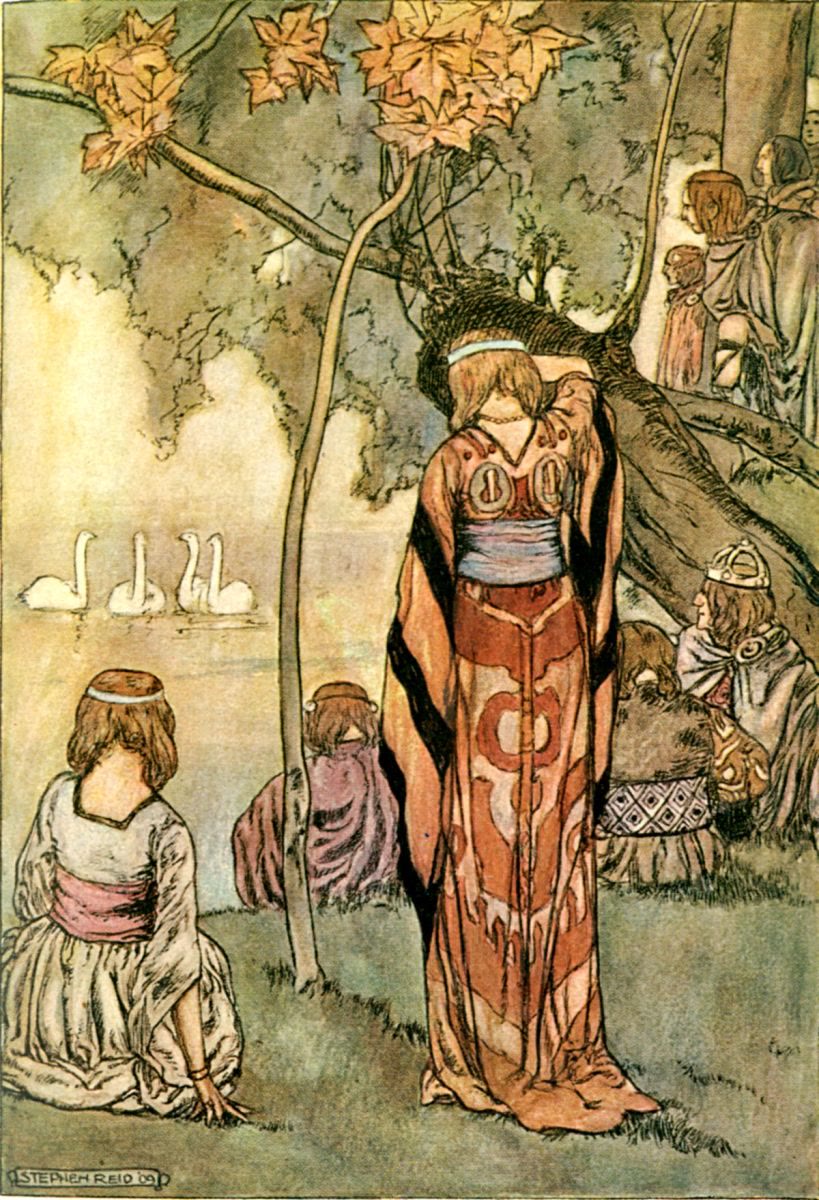
They made an encampment and the swans sang to them. Stephen Reid, from T. W. Rolleston, The High Deeds of Finn and Other Bardic Romances of Ancient Ireland (1910). Public domain, via Wikimedia Commons
The cold sea between Antrim and Scotland was the worst of it. One night a storm scattered them. Fionnuala waited alone on Carraig na Rón, the Seal Rock, until her brothers came back one by one: Conn drenched, Fiachra too frozen to speak, and Aodh last, dry and unruffled.
She sheltered Aodh against her breast, with Fiachra under her right wing and Conn under her left. Another night the sea froze, and when they tore themselves off the rock they left skin and feathers behind.
Erris and the empty hill
Their last 300 years were spent off Iorras Domhnann, today Erris in Co. Mayo. There a young man named Aibhric befriended them, and the tale says it was he who later put their adventures in order and told them. It’s the story’s way of naming its own source. On a night of ice, Fionnuala urged her brothers to trust in the God who made heaven and earth, and after that no storm troubled them.
When the 900 years were over, they flew home to Sídh Fionnachaidh. They found only bare green mounds and nettles: no house, no fire, no father.
The bell and the ending
By now Patrick had brought Christianity to Ireland. A holy man named Mochaomhóg came to Inis Gluaire, and the swans heard his bell ringing for early prayers. The brothers were terrified. Fionnuala told them it was the sound that would end their suffering.
Mochaomhóg brought them ashore and linked them in pairs with silver chains. But the prophecy had come true: Lairgnén was king of Connacht, and his wife was Deoch of Munster. Deoch demanded the wonderful birds, and when the cleric refused, Lairgnén came himself and dragged them from the altar.
The moment he touched them, their feathers fell away. In their place stood three withered old men and a thin old woman. Nine centuries had caught up with them.
Fionnuala asked the cleric to baptise them quickly, because death was near, and to bury them with Conn at her right, Fiachra at her left and Aodh before her face. They were baptised, they died, and their names were cut in ogham on their stone.
Where the story happens
Lough Derravaragh, Co. Westmeath
Lough Derravaragh lies about 12 km (7 miles) north of Mullingar. Its Irish name is usually explained as the lake of the oaks: dairbre is an old Irish word for an oak or oak wood. There’s more on it in my guide to the most beautiful lakes in Ireland.
It’s still a place for swans. The National Parks and Wildlife Service lists it as a Special Protection Area for wintering waterbirds, whooper swans among them.
A 1930s account from Clonmellon school, recorded for the National Folklore Collection’s Schools’ Collection, gives the lake a folk origin. The witch of Westmeath asked to borrow the Galway witch’s lake, promising it back on Monday. The Galway witch rolled it up and sent it across country, and it was spread out at Derravaragh. The proof, the story says, is a hole in Galway that matches the lake exactly.
The Sea of Moyle
Sruth na Maoile is the sea between north Antrim and Scotland. P. W. Joyce explained that the name comes from the Mull of Kintyre, the Scottish headland across the water. At Ballycastle, Co. Antrim, Malcolm Robertson’s sculpture of four swans in flight looks out over it, pictured at the top of this page. For more sea shape-shifters, see the selkie.
Erris and Inishglora, Co. Mayo
Iorras Domhnann is Erris, in north-west Mayo, and Inis Gluaire is Inishglora, a little island some five miles (8 km) west of Belmullet. The tale calls it Inis Gluaire of Brendan, after St Brendan the Navigator.
An Irish Tourist Association survey in the early 1940s, summarised by Mayo County Council, listed St Brendan’s oratory and other monastic ruins there, and the supposed grave of the Children of Lir.
How old is the Children of Lir?
You’ll often read that the Children of Lir is 2,000 years old. There’s no evidence for that. Oral stories can’t be dated, but the written tale is far younger.
- 1526: the earliest mention is “The history of clane lyre” in the library list of Gerald, ninth Earl of Kildare, printed by the historian Eleanor Hull.
- 1600s or 1700s: the oldest known copy of the full tale is in the National Library of Scotland. Its paper points to the early 17th century, but the Irish Script on Screen catalogue names its scribe as the Roscommon scholar Charles O’Conor of Belanagare (1710 to 1791), which would make it 18th-century.
- 1863: the first printed edition, Eugene O’Curry’s Irish text and translation, appeared in The Atlantis, the Catholic University of Ireland’s journal, the year after his death.
James Carney argued in 1955 that the tale could not be much older than that 1526 list. Caoimhín Breatnach, in the journal Ériu in 1999, found its language and themes close to 15th-century Irish religious writing. O’Curry, judging by its verse, thought it considerably older, so “late medieval” is the best estimate, not a certainty.
The ending borrows real people, too. In the tale, Lairgnén is a son of Colmán, and Deoch is the daughter of Fíngen, king of Munster. Irish annals record a Laidgnén son of Colmán, king of Connacht, who died in 655, and a Fíngen son of Áed, king of Munster, who died around 619: about two centuries after Patrick.
One of the Three Sorrows of Storytelling
The tale is grouped with two other tragedies as Trí Truagha na Scéalaíochta, the Three Sorrows of Storytelling:
- Oidheadh Chlainne Lir: the Children of Lir.
- Oidheadh Chlainne Uisnigh: the sons of Uisneach, the story of Deirdre.
- Oidheadh Chlainne Tuireann: the sons of Tuireann, sent on a deadly quest by the god Lugh after they kill his father.
When the three were first grouped is debated. The oldest known manuscript that puts them together is 18th-century, and the scholar Gerard Murphy thought the grouping was made then. James Carney suggested instead that the Lir tale might have been written to complete a set with the other two.
Where the versions differ
- What breaks the spell. In O’Curry’s text, Aoife’s curse names only the 900 years and the marriage of Lairgnén and Deoch; Fionnuala later ties their release to the new faith and the cleric’s bell. P. W. Joyce’s retelling in Old Celtic Romances (1879) writes the coming of Patrick and “the voice of the Christian bell” into the curse itself.
- The ending. A 2015 Utrecht University undergraduate thesis found that five children’s versions, from 1993 to 2014, all soften it. Two leave the deaths out, and in one the children live long, happy lives with their father. The other three reunite them with their parents after death.
- The grave. In the prose, Aodh lies before Fionnuala’s face; in her poem, in her arms. Joyce, who calls the cleric Kemoc, has her ask to be buried as she sheltered them at sea, and adds that they were buried standing. O’Curry’s text makes no such link.
- Aoife’s fate. The text makes her a demon of the air forever, yet the 1940s Erris survey recorded a place near Binghamstown said to be the stepmother’s grave.
Scholars disagree about the ending, too. Carney found it odd that innocent children suffer for 900 years only to die. Breatnach replied that this is the point: it’s a religious tale, and the reward for their suffering is heaven.
Swans in Irish folklore
The feeling behind that swan law was real. In 1894 Joseph Jacobs wrote that the belief was still alive in Ireland, citing a man named Connor Griffin who killed eleven swans and soon lost his son, his goods and his wife.
A 1930s Schools’ Collection account from Burt, Co. Donegal, says some people held that killing a swan brought bad luck, since the birds might be people under a spell, like the swans of Lir.
Today the law agrees: wild birds, swans included, are protected under the Wildlife Act 1976, says the National Parks and Wildlife Service. Whooper swans fly in from Iceland each winter; Ireland hosts up to a fifth of Europe’s wintering whoopers, the Irish Times has reported. Yeats counted 59 at Coole in The Wild Swans at Coole.
The names: Fionnuala, Aodh, Fiachra and Conn
The meanings below come mostly from Rev. Patrick Woulfe’s Irish Names and Surnames (1923).
- Fionnuala (fin-OO-la): from fionn, fair, and guala, shoulder. The older spelling is Fionnghuala. It was anglicised as Finola and often shortened to Nuala.
- Aodh: fire. An ancient, very common name, a favourite of the O’Neills and O’Donnells, now anglicised as Hugh.
- Fiachra (FEE-ukh-ra): Woulfe gives no meaning but lists eight Irish saints of the name. The best known, patron saint of gardeners, settled near Meaux in France. Paris cabs, fiacres, are named after the Hôtel Saint-Fiacre, which first hired them out.
- Conn: from an old word for sense or reason, and common among the O’Neills.
- Aoife (EE-fa): simply “an ancient Irish name” to Woulfe. The wicked stepmother hasn’t hurt it: see my guide to pronouncing Irish girl names.
The Children of Lir today
The Garden of Remembrance, Dublin
Dublin’s Garden of Remembrance, in Parnell Square, opened on the 50th anniversary of the 1916 Rising, and Heritage Ireland says it’s dedicated to “all those who gave their lives in the cause of Irish freedom”.
Its centrepiece is Oisín Kelly’s bronze, The Children of Lir, dated 1971 by the National Inventory of Architectural Heritage. Human figures sink as swans rise above them. Kelly saw the transformation as a symbol of the Irish state’s painful birth, says the Royal Institute of the Architects of Ireland. Read it alongside Yeats’s Easter, 1916.
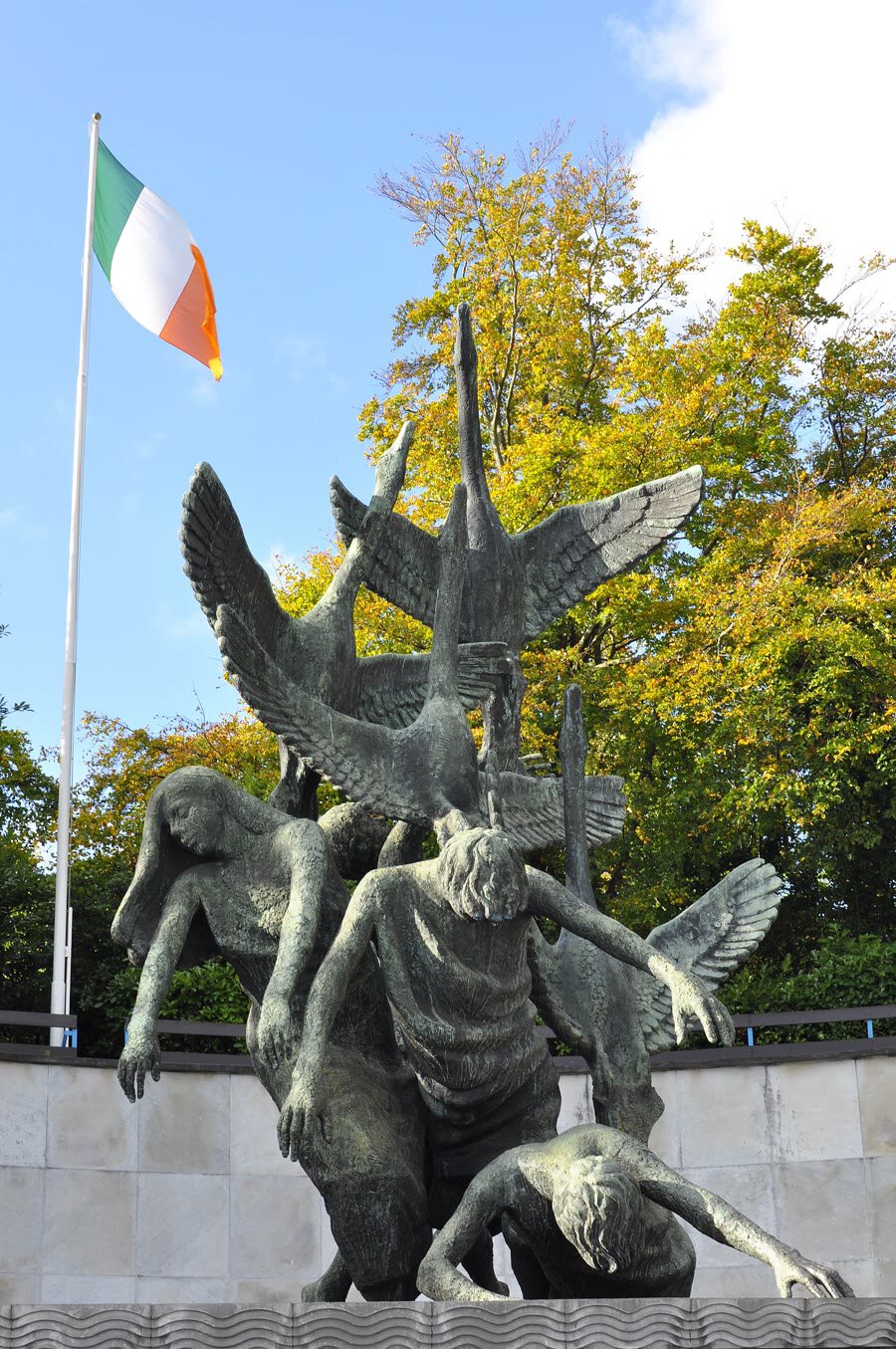
The Children of Lir by Oisín Kelly, Garden of Remembrance, Dublin. Photo: Alandavis ie, CC BY-SA 4.0, via Wikimedia Commons
In music and stained glass
- Thomas Moore: “The Song of Fionnuala”, which opens “Silent, O Moyle”, appeared in 1808 in his Irish Melodies.
- Wilhelmina Geddes: her eight-panel stained-glass window, The Fate of the Children of Lir (1929), belongs to National Museums NI.
- Hamilton Harty: his orchestral poem The Children of Lir, with a wordless soprano as Fionnuala, was first performed in 1939, with Harty conducting the BBC Symphony Orchestra.
Children of Lir FAQ
What is the story of the Children of Lir?
An Irish legend in which Aoife, jealous of her four stepchildren, turns them into swans for 900 years. When the spell ends they are very old people, who are baptised and die.
How long were the Children of Lir swans?
Nine hundred years: 300 on Lough Derravaragh, 300 on the Sea of Moyle and 300 off Erris and Inishglora in Co. Mayo.
Who turned the Children of Lir into swans?
Their stepmother Aoife, who was also their aunt. Bodb Dearg punished her by making her a demon of the air.
Is the Children of Lir a true story?
No, it’s a legend, probably written in the late Middle Ages. But the places are real, and the king in the ending shares his name and family with a real 7th-century king of Connacht.
Where are the Children of Lir buried?
Local tradition says on Inishglora, a small island off Erris in Co. Mayo.
Love this? Save it to your Pinterest board for later.
A little bit of Ireland in your inbox every Friday ☘️
The free Weekly Dose of Irish: an Irish joke, a Celtic symbol, an Irish fact, a poem and the week’s best articles in one short email. Join 9,600+ readers.
Free. One short email every Friday. Unsubscribe any time.
More Irish mythology reading
- Celtic Gods and Goddesses: 15 Irish Deities and Their Stories
- Irish Mythological Creatures: 23 Fairies, Monsters and Death Omens
- Selkie Mythology: The Seal People of Irish and Scottish Folklore
- St Brendan the Navigator: Did an Irish Monk Really Reach America?
- The Wild Swans at Coole by W. B. Yeats
Featured image: illustration by John D. Batten for “The Fate of the Children of Lir” in Joseph Jacobs, More Celtic Fairy Tales (1894). Public domain, via Wikimedia Commons.