Of all the symbols of Ireland, the harp is the main one. It’s the State emblem, on every Irish coin, the passport and the President’s seal. The shamrock is the other official State emblem, and the tricolour is the national flag. Popular symbols like the Claddagh ring, St Brigid’s cross, the Celtic cross and the wolfhound have no official status, but you’ll see them everywhere.
You may have seen my article on Celtic symbols. That one is about knots, spirals and what they meant (or didn’t).
This one is about the national symbols of Ireland, and the ones Ireland actually uses today. The ones on your coins, your passport, the rugby jersey and the tail of a plane.
Some are official and protected by law. Others are pure habit. Here is which is which.
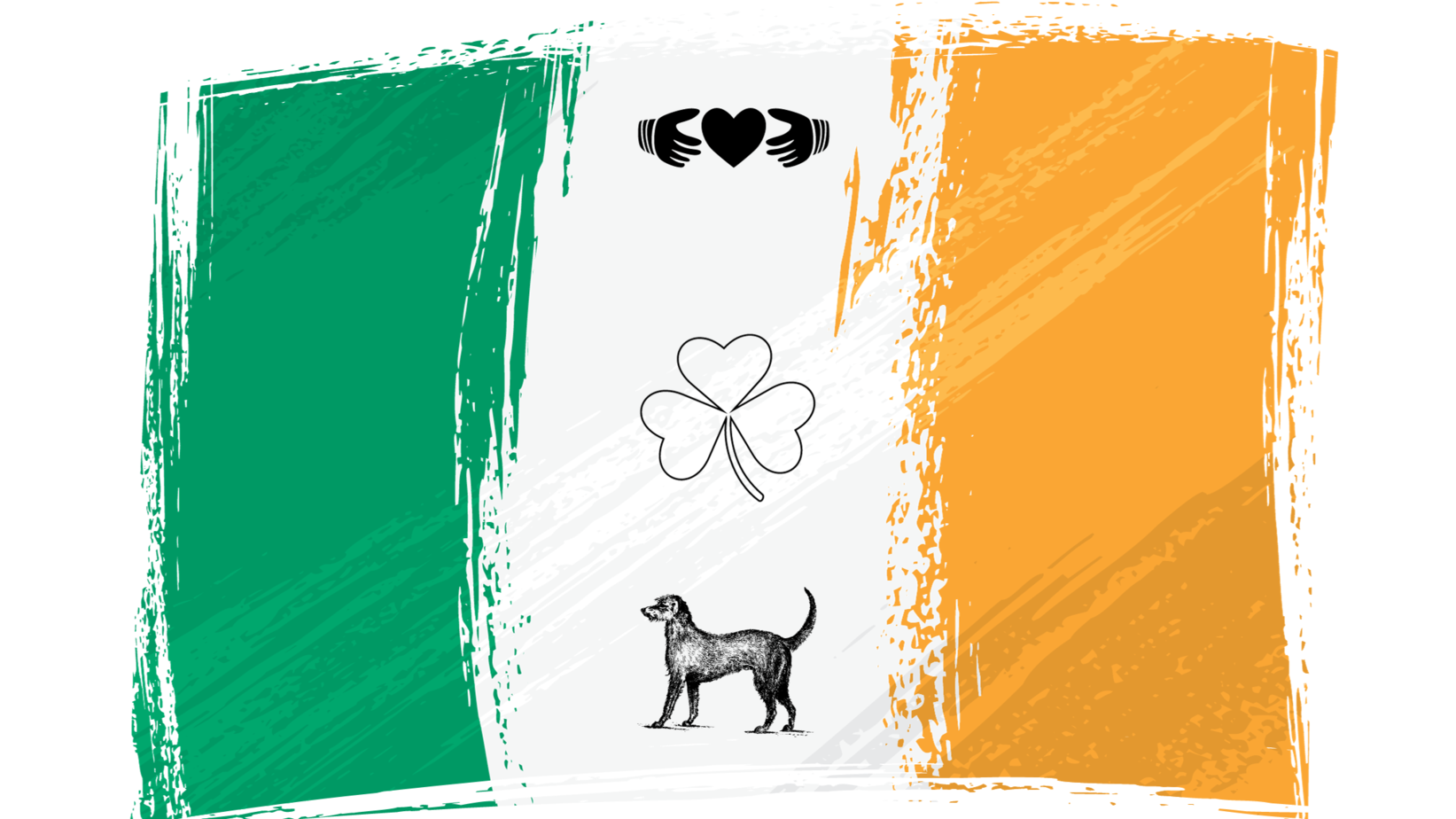
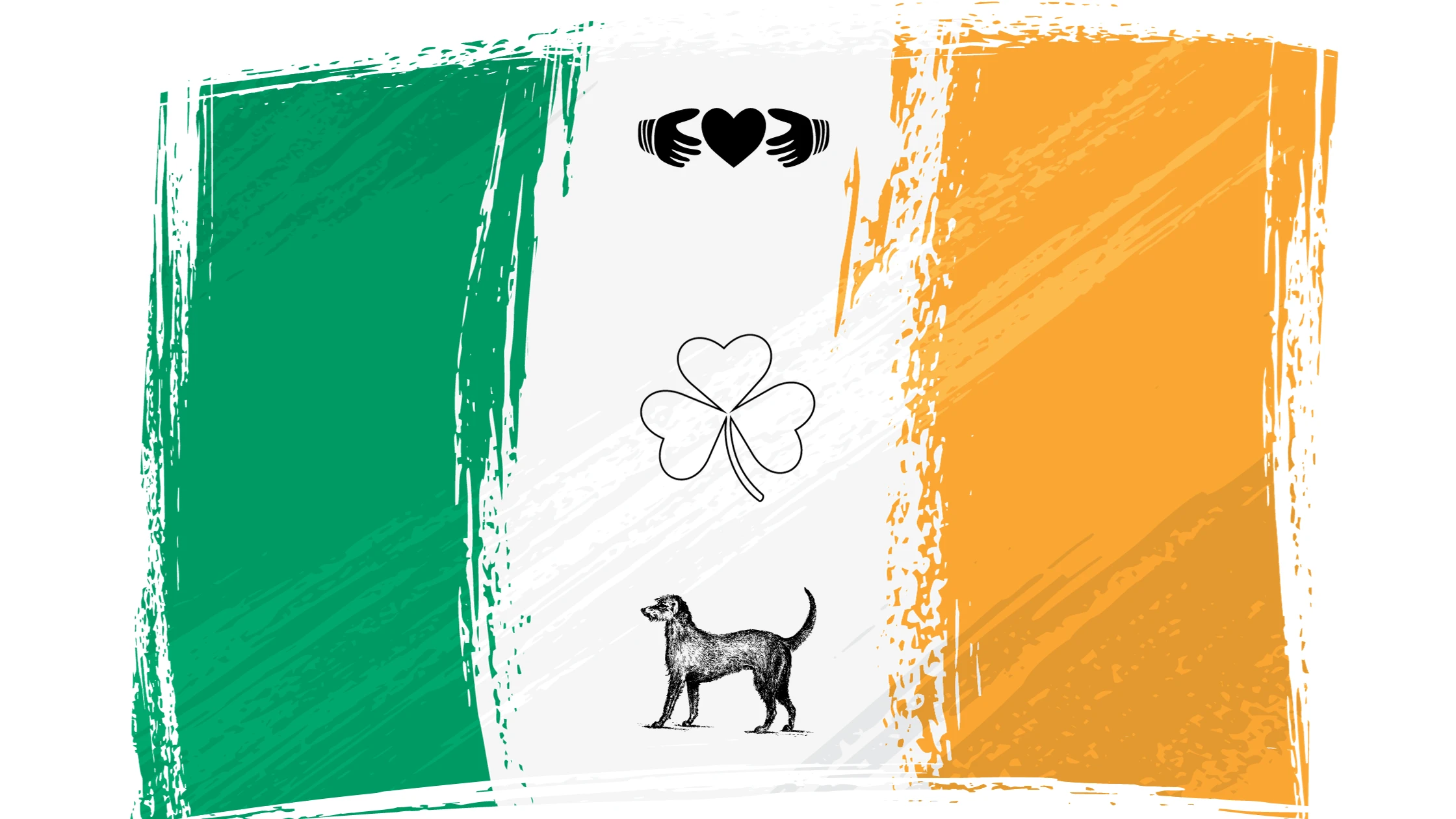
Three symbols you will meet all over Ireland: the Claddagh, the shamrock and the wolfhound
Official symbols of Ireland vs popular ones
Ireland has very few official symbols. The Department of Enterprise, Trade and Employment lists two State emblems: the harp and the shamrock.
Under the Trade Marks Act 1996, you need the Minister’s consent to use either in a trade mark. The national flag isn’t a State emblem, but the Constitution protects it.
Apart from the Irish language, which the Constitution names, everything else here is popular, not official, whatever the tea towels say.
1. The harp: the State emblem
The Department says Ireland is the only country with a musical instrument as its national emblem.
The harp was first recorded as the arms of Ireland in the Wijnbergen roll, a medieval roll of arms compiled around 1270 to 1285.
The official harp is modelled on the medieval harp in Trinity College Dublin. People call it the Brian Boru harp, but it can’t have been his. Brian Boru died in 1014. The Department dates the harp to the 14th century, and some scholars put it in the early 1400s.
Where you see the harp today
- Coins. The harp has been on every Irish coin since 1928, when Percy Metcalfe adapted the Trinity harp for the Free State. On euro coins it’s on the national side, not the back.
- The passport. The harp sits on the cover.
- Seals. It’s the main element of the seals of the President and every government minister.
- The Presidential Standard. A gold harp on blue flies at Áras an Uachtaráin.
Why the Guinness harp faces the other way
Guinness got there first. The brewery first put a harp on its bottle labels in 1862 and registered it as a trade mark in 1876.
When the State moved to register its harp with the World Intellectual Property Organization in 1984, officials feared Guinness would object. So it registered a harp facing one way only, the opposite way to Guinness, the Irish Times reported from released State papers.
The easy test: on the Guinness harp, the straight soundbox is on the left. On the State harp, it’s on the right. There’s more on the instrument in my piece on the Irish harp.
2. The shamrock: the other State emblem
The word comes from the Irish seamróg, “young clover”. Surveys in 1893 and 1988 found lesser trefoil (Trifolium dubium) the most common pick, but far from the only one.
Tradition says St Patrick used the three leaves to explain the Trinity. Patrick’s own writings never mention it. The Department says the shamrock was first recorded as a St Patrick’s Day badge in the 17th century.
The first printed link with the Trinity came from the botanist Caleb Threlkeld in 1726. Even he called it a current tradition, notes Dublin’s Edward Worth Library.
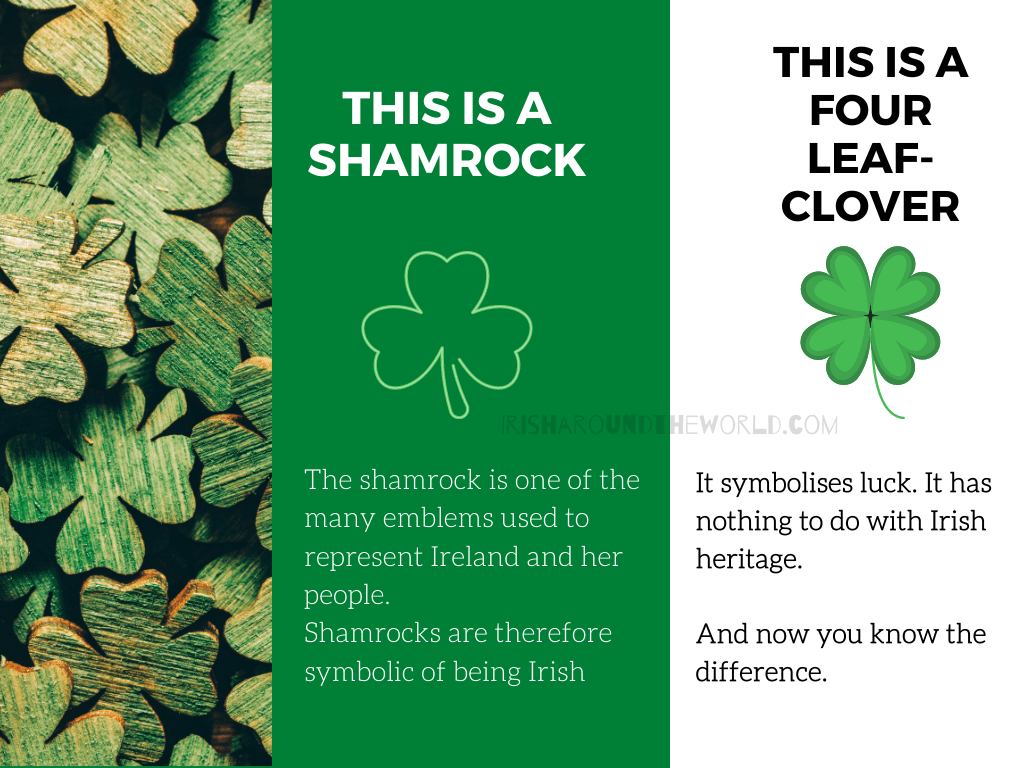
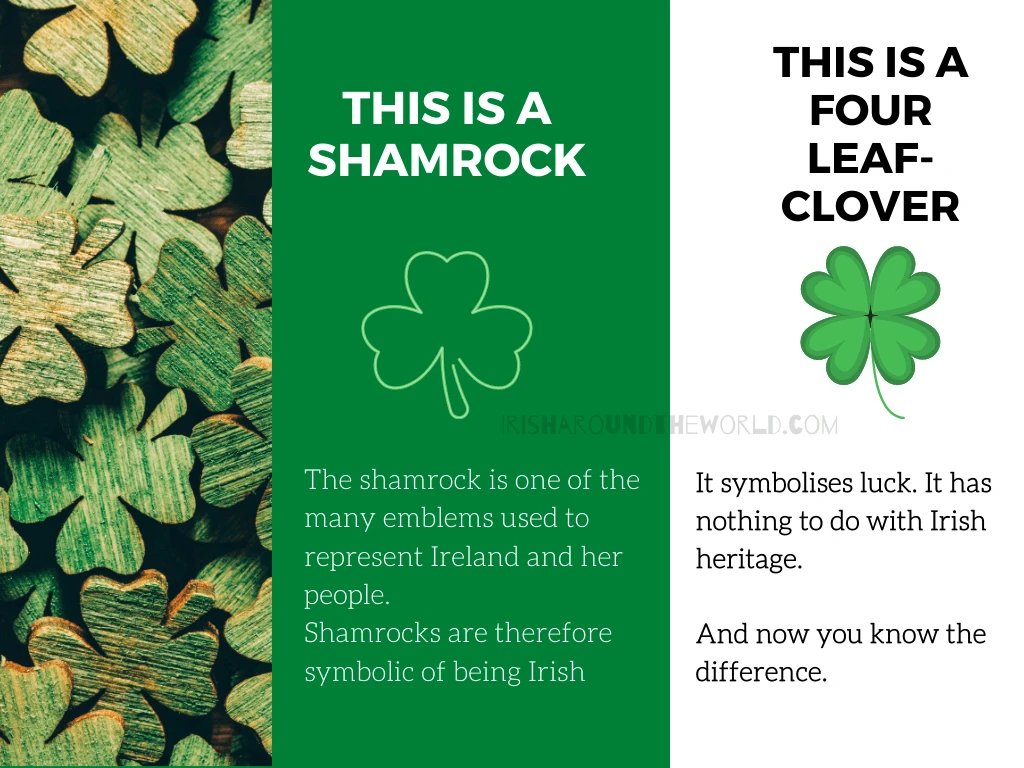
A shamrock has three leaves; the four-leaf clover is a different symbol of luck.
And no, the four-leaf clover is not a shamrock. It’s a separate luck charm with no link to St Patrick.
Where you see the shamrock today
- Aer Lingus. A big green shamrock went on the tail fins in 1965, as the airline moved to jets. A white shamrock came in with the 1974 livery, and it was redrawn in 2019.
- Rugby. Shamrocks have been on the Ireland jersey since the early days. The team represents the whole island, so the shamrock does a job the tricolour can’t.
- The Defence Forces. The Department says it is displayed on the uniforms of Irish troops serving abroad.
- Clubs, pubs and brands. From Shamrock Rovers to Irish pubs worldwide. And let’s not forget the very blog you are reading!
More on the plant and the legend in my shamrock article.
3. The tricolour: the national flag
Article 7 of the 1937 Constitution is short and clear: “The national flag is the tricolour of green, white and orange.”
The Government’s flag guidelines give the official story. On 7 March 1848, Thomas Francis Meagher of Young Ireland flew a tricolour from 33 The Mall in Waterford. It stayed up for a week.
The next month, Meagher brought a tricolour from Paris to a meeting in Dublin. He said the white stood for a lasting truce between the Orange and the Green.
Even the guidelines mention earlier tricolours, in 1830 and 1844.
For decades the green flag with a gold harp was the nationalist banner. The tricolour’s big moment came at Easter 1916, flying over the GPO. It became the Free State flag in 1922, and today flies over public buildings and in every football crowd.
4. St Brigid’s cross
St Brigid’s cross is woven from rushes or straw. Families traditionally hung a new one in the house around St Brigid’s Day, 1 February, to protect it from fire and harm.
Telefís Éireann adopted a Brigid’s cross symbol in its early years, and it stayed in the RTÉ logo until 1995.
Since 2023, Brigid has her own bank holiday. It falls on the first Monday in February, or on 1 February when that’s a Friday. The Government called it the first Irish public holiday named after a woman.
5. The Claddagh ring
The Claddagh ring shows two hands holding a crowned heart, and it has a properly documented past.
The National Museum of Ireland dates the earliest examples to around 1700. The design is often credited to Richard Joyce, a Galway goldsmith. He is said to have learned his trade as a captive of Algerian corsairs, though the museum calls that one story.
The idea belongs to the much older fede rings, with clasped hands, going back to Roman times.
The link with the Claddagh, the old fishing village beside Galway city, dates from the mid-19th century. The village was declared an “unhealthy area” in 1927, and its thatched cottages were demolished over the next few years.
How you wear it, says Britannica, can show if you’re single, taken or married. My Claddagh ring guide explains it.
6. The Celtic cross
The Celtic cross is a cross with a ring around the crossing. Ireland’s stone high crosses are the real, old thing.
Muiredach’s Cross at Monasterboice, Co. Louth, probably dates to the early 900s. Its inscription asks a prayer for a Muiredach, most likely the abbot who died in 923.
Those medieval crosses were, as a rule, public monuments, not grave-markers. The name “Celtic cross” and the habit of putting one on a grave come from the 19th-century Celtic Revival.
You’ll often read that the ring is a pagan sun symbol. That’s a popular theory, nothing more. More in my Celtic cross article.
7. The Irish language
A language is an odd symbol, but in Ireland it does the job of one.
Article 8 of the Constitution makes Irish the national language and the first official language. Regulations under the Official Languages Act 2003 require public bodies’ signs to be in Irish, or in Irish and English.
Road signs come under separate traffic rules, but they are bilingual too, with the Irish place name in italics above. In the Gaeltacht, place names appear in Irish only.
8. Ogham
Ogham is the oldest way of writing Irish, in strokes and notches cut along the edge of a stone.
There are roughly 400 Ogham inscriptions on stone, most of them in Ireland, and the oldest go back to at least the 5th century. Kerry and my own county of Cork hold well over half of Ireland’s stones.
You’ll hear Ogham called the Celtic tree alphabet, with Druids attached. The tree names for the letters come from medieval manuscripts, centuries after the stones. The stones themselves say nothing about Druids.
9. Book of Kells lettering
The Book of Kells, from around 800, is written in a script called Insular majuscule. It’s on show at Trinity College Dublin.
That look still shapes Irish design. Gabriel Hayes based the 1971 decimal ½p, 1p and 2p on old manuscript ornament. Euro coins spell Éire in Gaelic-style lettering.
The “Celtic” fonts on pub signs are a different thing. They’re modern display fonts, loosely based on Insular script and the older Gaelic type, cló Gaelach.
10. The pint of Guinness
A drink isn’t a national symbol. But ask anyone abroad to name something Irish, and the pint comes up fast.
Arthur Guinness took a 9,000-year lease on St James’s Gate in Dublin in 1759. The Guinness Storehouse there is one of Ireland’s busiest visitor attractions.
The pint carries the harp, so it’s a symbol wearing a symbol.
11. The colour green (and St Patrick’s blue)
Green feels like Ireland’s colour now.
It wasn’t always so. St Patrick’s blue, a sky blue, is usually traced to the Order of St Patrick, founded in 1783. Blue survives on the Presidential Standard.
Green belonged to the nationalists. The official flag guidelines trace the green flag with a harp to the 1640s, the Volunteers of the 1780s and the United Irishmen of 1798.
12. The Irish wolfhound
I saved the best for last! The Irish wolfhound is a huge old hunting hound that, by most breed histories, nearly died out in the 19th century. It has no official status.
- Coins. A wolfhound was on the Free State’s 1928 sixpence, in an animal series chosen by a committee chaired by W.B. Yeats.
- The Irish Guards. This British Army regiment has had a wolfhound mascot since 1902, says the UK Government.
- Rugby. Ireland’s second team has often played as the Ireland Wolfhounds, a name brought back in 2010.
- The passport. Passports issued since 26 June 2026 carry the wolfhound on their pages. It was one of the public’s favourites in a consultation that drew over 15,000 responses, RTÉ reported.
Three from my old list are gone. The Celtic knot now lives in my Celtic knot guide. As far as naturalists can tell, Ireland had no snakes for Patrick to banish.
And the cheerful, lucky leprechaun owes more to American advertising than to Irish folklore. There he was a crabby, solitary shoemaker minding his crock of gold.
Symbols of Ireland at a glance
| Symbol | Official or popular | Where you see it today |
|---|---|---|
| Harp | Official State emblem | Coins, passport, seals, Presidential Standard |
| Shamrock | Official State emblem | Aer Lingus, rugby jersey, troops abroad |
| Tricolour | National flag (Article 7) | Public buildings, football crowds |
| St Brigid’s cross | Popular | Homes on 1 February, RTÉ logo until 1995 |
| Claddagh ring | Popular | Wedding and friendship rings |
| Celtic cross | Popular | Graveyards, medieval high crosses |
| Irish language | Official (Article 8) | Road signs, the Gaeltacht |
| Ogham | Popular | Old stones, especially in Cork and Kerry; jewellery |
| Manuscript lettering | Popular | Book of Kells, euro coins, pub signs |
| Pint of Guinness | Popular | St James’s Gate, pubs worldwide |
| Green | Popular | Team jerseys, St Patrick’s Day |
| Wolfhound | Popular | Irish Guards mascot, new passport pages |
Irish symbols FAQ
What is the national symbol of Ireland?
The harp. It’s the State emblem, on every Irish coin, the passport and official seals. The shamrock is the other State emblem.
Is the shamrock an official symbol of Ireland?
Yes. The Department of Enterprise lists the harp and the shamrock as the State emblems.
Why does the Guinness harp face the other way?
Guinness registered its harp as a trade mark in 1876. When the State registered its harp internationally in 1984, it chose one facing the opposite way to avoid objections.
What do the colours of the Irish flag mean?
Green stands for the older Irish nationalist tradition and orange for the followers of William of Orange. The white stands for a lasting truce between them.
Does Ireland have a national animal or flower?
Not officially. The shamrock is a State emblem but not formally a national flower. The wolfhound is the popular pick for a national animal.
More Irish symbols to read about
- Celtic Symbols and Their Meanings
- The Celtic Knot and Its Meanings
- Druid Symbols
- The Irish Harp
- The Shamrock and St Patrick’s Day
- The Claddagh Ring Meaning
- The Irish flag: meaning and history
- Irish Round Towers: Bell Towers, Viking Hideouts or Fire Temples? The Real Story
A little bit of Ireland in your inbox every Friday ☘️
The free Weekly Dose of Irish: an Irish joke, a Celtic symbol, an Irish fact, a poem and the week’s best articles in one short email. Join 9,600+ readers.
Free. One short email every Friday. Unsubscribe any time.