Grosse Île is a small island in the St Lawrence River, 48 km (30 miles) east of Quebec City, that was the quarantine station for the port of Quebec from 1832 to 1937. In 1847, when ships packed with Famine emigrants arrived sick with typhus, 5,424 people were buried there, Parks Canada says, and more than 5,000 others had already died at sea. A granite Celtic cross raised in 1909 overlooks the graves. Today it is a Parks Canada historic site, open in summer and early autumn.
On the highest point of a small wooded island in the St Lawrence stands a granite Celtic cross, about 14 metres (46 feet) tall. Below it, near the shore, small white crosses stand over the mass graves of 1847.
This is Grosse Île, the quarantine island downriver from Quebec City. For many Irish families in Canada and the United States, it’s where the Famine story stops being history and becomes personal.
I’ve covered the wider disaster in my guide to the Irish potato famine, and the night of farewells before an emigrant left home in the American wake. Here’s what happened at Grosse Île, what the cross really says, the truth about the orphans, and how to visit or search for an ancestor.
Jump to:
- What is Grosse Île?
- Canada’s quarantine station, 1832 to 1937
- 1847: the year of the fever
- How many died at Grosse Île?
- The Celtic cross and its three inscriptions
- The orphans of Grosse Île
- How it became the Irish Memorial
- Visiting Grosse Île
- How to search for an ancestor
- Irish words for the Famine years
- Grosse Île FAQ
- More Irish heritage reading
What is Grosse Île?
Grosse Île (grohss EEL) is an island in the St Lawrence, about 2.9 km (1.8 miles) long and 1 km (0.6 mile) wide. It’s one of 21 islands in the Isle-aux-Grues archipelago. In English it’s often written Grosse Ile, without the accent, or Grosse Isle in older sources.
From 1832 to 1937, ships bound for the port of Quebec had to stop there so doctors could check passengers for disease. Between the early 1800s and the First World War, more than four million immigrants landed at Quebec, then Canada’s main port of entry, Parks Canada says. The island is now Grosse Île and the Irish Memorial National Historic Site.
Canada’s quarantine station, 1832 to 1937
The station opened in 1832 to keep cholera out of the colony. It failed: cholera reached Quebec City and Montreal in 1832 and 1834 and killed thousands, The Canadian Encyclopedia notes.
Around 1830, about 30,000 immigrants a year were landing at Quebec, roughly two-thirds of them from Ireland, writes Parks Canada, which describes the station’s first years as rushed and improvised.
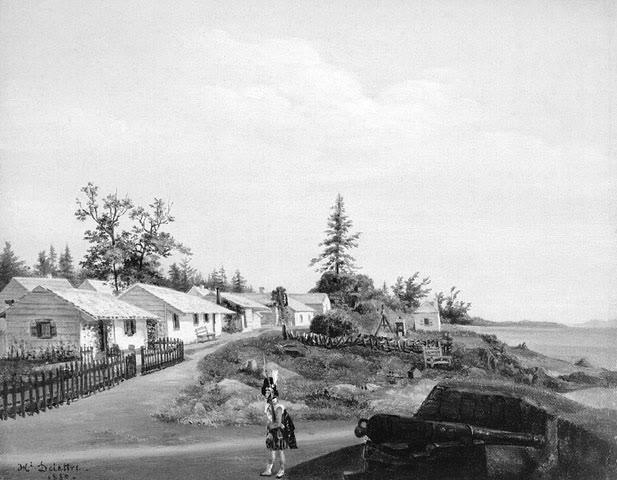
The quarantine station at Grosse Île in 1850, painted by Henri Delattre. Library and Archives Canada (Acc. No. 1983-121-1), CC BY 2.0, via Wikimedia Commons
Dr George Mellis Douglas took charge in 1836. Later, Dr Frederick Montizambert, superintendent from 1869 to 1899, modernised it: he separated the sick from the healthy and disinfected ships and luggage.
The station closed in 1937. During the Second World War the island was used for secret bacteriological research, and from 1957 to 1984 it held animals in quarantine.
1847: the year of the fever
In a normal year, 25,000 to 30,000 newcomers arrived. In 1847, Black ’47, nearly 100,000 people sailed for Canada, most of them fleeing the Famine. Parks Canada counts 90,150 reaching the port of Quebec that season.
Parks Canada’s history of 1847 lists 398 ships inspected at Grosse Île. The main ports of departure were Liverpool (73 ships), Limerick (50), Cork (33), Glasgow (29), Dublin (27), Sligo (26), Bremen (24) and Belfast (21). A crossing normally took about 45 days, but 26 ships that sailed in 1847 took more than 60.
Many passengers were already weak from hunger. Many carried typhus, a fever spread by lice that thrived in crowded, filthy holds, which is why it was called ship fever. By 20 May, says the Dictionary of Canadian Biography, 30 ships from Ireland had brought 12,519 people, and more than 1,200 had died at sea or on arrival.
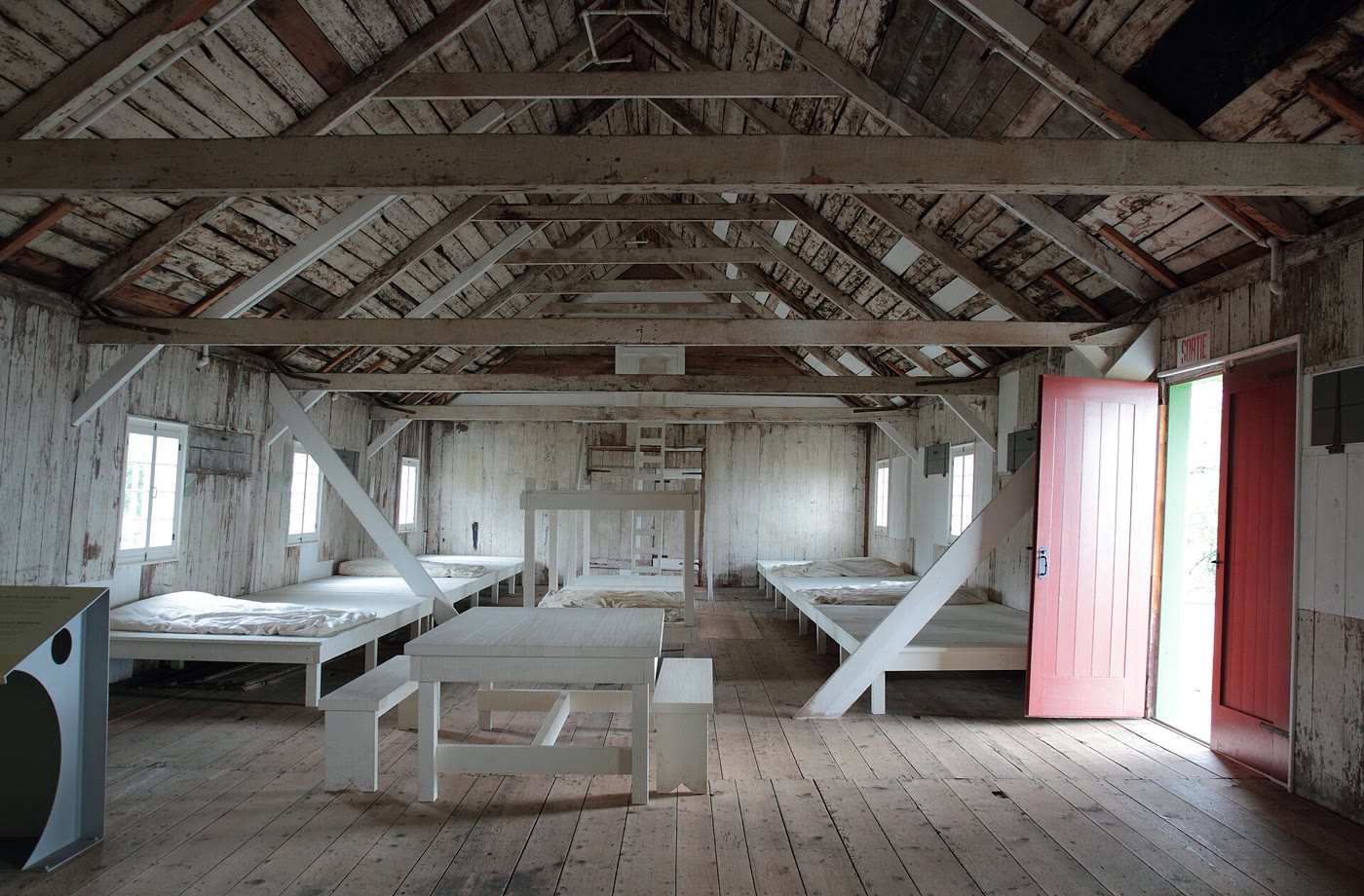
Douglas added about 50 beds to the hospital’s 200, but at the peak it held up to 2,500 patients. Quarantine usually lasted about six days; some ships were held for more than 20.
The fever struck the doctors and nurses too. Citing the island’s records in 1998, President Mary McAleese said 22 of the 26 doctors caught typhus and four died, and that 22 of the 76 nurses who fell ill died. The doctors’ monument names the four assistant medical officers who died in 1847, the first of them Dr Benson of Dublin, on 27 May.
How many died at Grosse Île?
Parks Canada puts the island’s burials in 1847 at 5,424. It’s the number Dr Douglas and his fellow doctors carved on the monument they raised after the epidemic, for the people who fled “pestilence and famine” in Ireland in 1847 and found only a grave in America.
Yet the island’s hospital and chapel registers record only 3,238 to 3,253 deaths or burials that year. The higher figure comes from the monument and from a note added to one register about 50 years later, which says the rest died on ships in quarantine or while landing, before they could be recorded. Dr Douglas’s own report for 1847 says nothing about the 5,424.
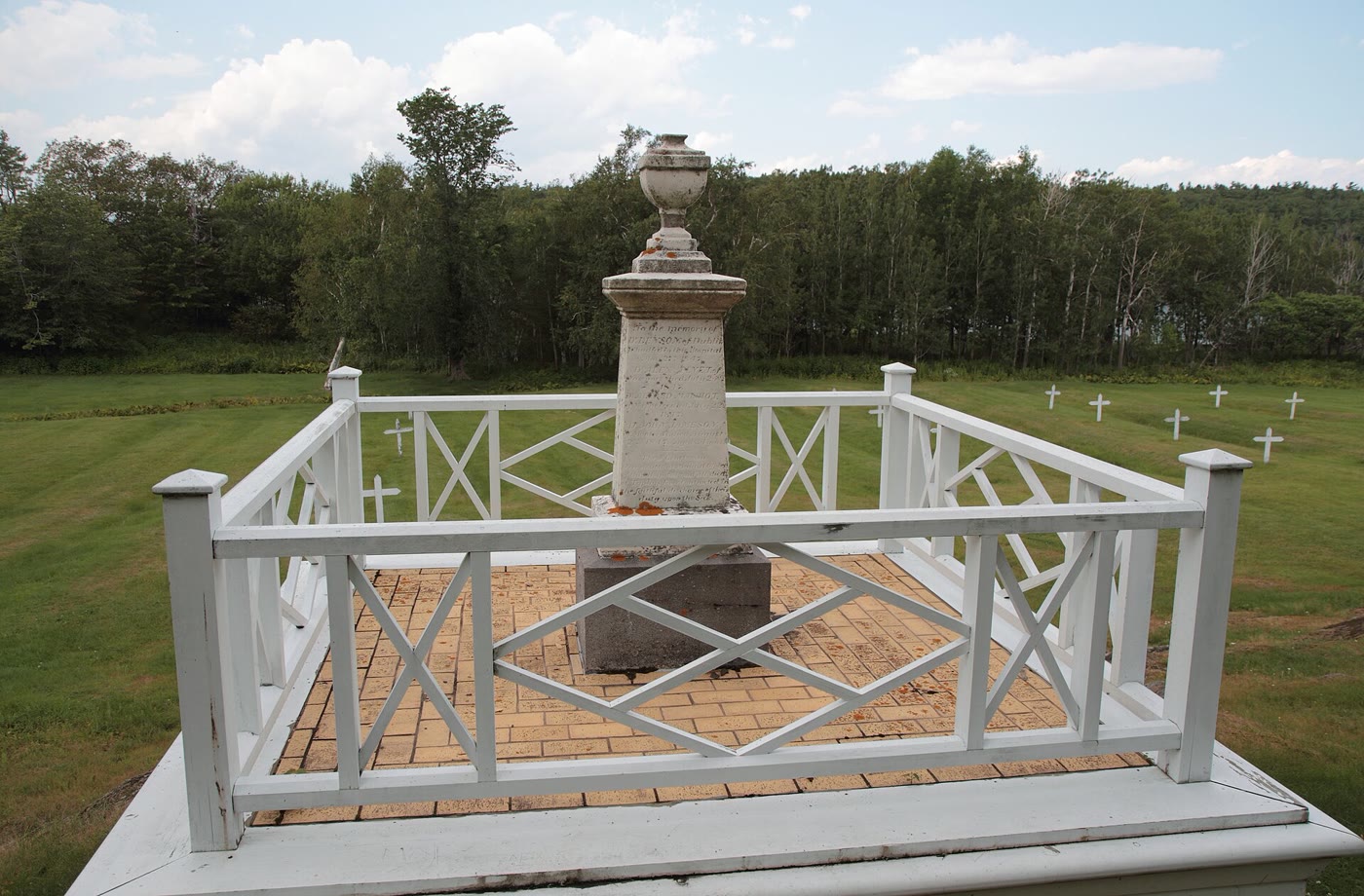
The monument raised by Dr Douglas and the station’s doctors after the 1847 epidemic, with the white crosses of the Irish cemetery behind. Photo: Cephas, CC BY-SA 3.0, via Wikimedia Commons
Grosse Île was only part of the toll:
- At sea: more than 5,000 people died on the crossing in 1847, Parks Canada says.
- Inland: typhus travelled with the survivors. Montreal lost more than 3,800 migrants in 1847, Toronto over 1,100 and Kingston about 1,400, The Canadian Encyclopedia reports. Montreal’s Black Rock, raised by bridge workers in 1859, marks the graves of 6,000 who died of ship fever in 1847 and 1848.
- In all: roughly one in six of the 1847 emigrants to British North America were dead before 1848, the same source says. Estimates of Canada’s typhus deaths that year run from about 17,300 to 20,000.
You’ll see bigger numbers online. A souvenir book printed for the 1909 unveiling of the cross claimed the dead on Grosse Île alone exceeded 10,000. Parks Canada’s figures don’t support it. Official sources and registers list about 7,500 burials across the station’s whole 105 years, most of them from 1847.
The Celtic cross and its three inscriptions
The Ancient Order of Hibernians, an Irish Catholic fraternal society with branches in the United States and Canada, decided at its 1908 national convention in Indianapolis to build a memorial. The result is a granite Celtic cross about 14 m (46 ft) tall on Telegraph Hill, the island’s highest point, looking over the Irish graves.
It was designed by Jeremiah Gallagher, a Quebec civil engineer and a founder of the city’s AOH branch, and cut from Stanstead granite by the Fallon brothers of Cornwall, Ontario. So says J. A. Jordan’s 1909 souvenir book.
The cross was unveiled on 15 August 1909, the Feast of the Assumption, by the Pope’s representative in Canada. Seven river steamers carried a crowd the book put at 8,000 to 9,000. Ringed crosses became an emblem of Irishness in the 19th-century Celtic Revival, as I explain in my guide to the Celtic cross.
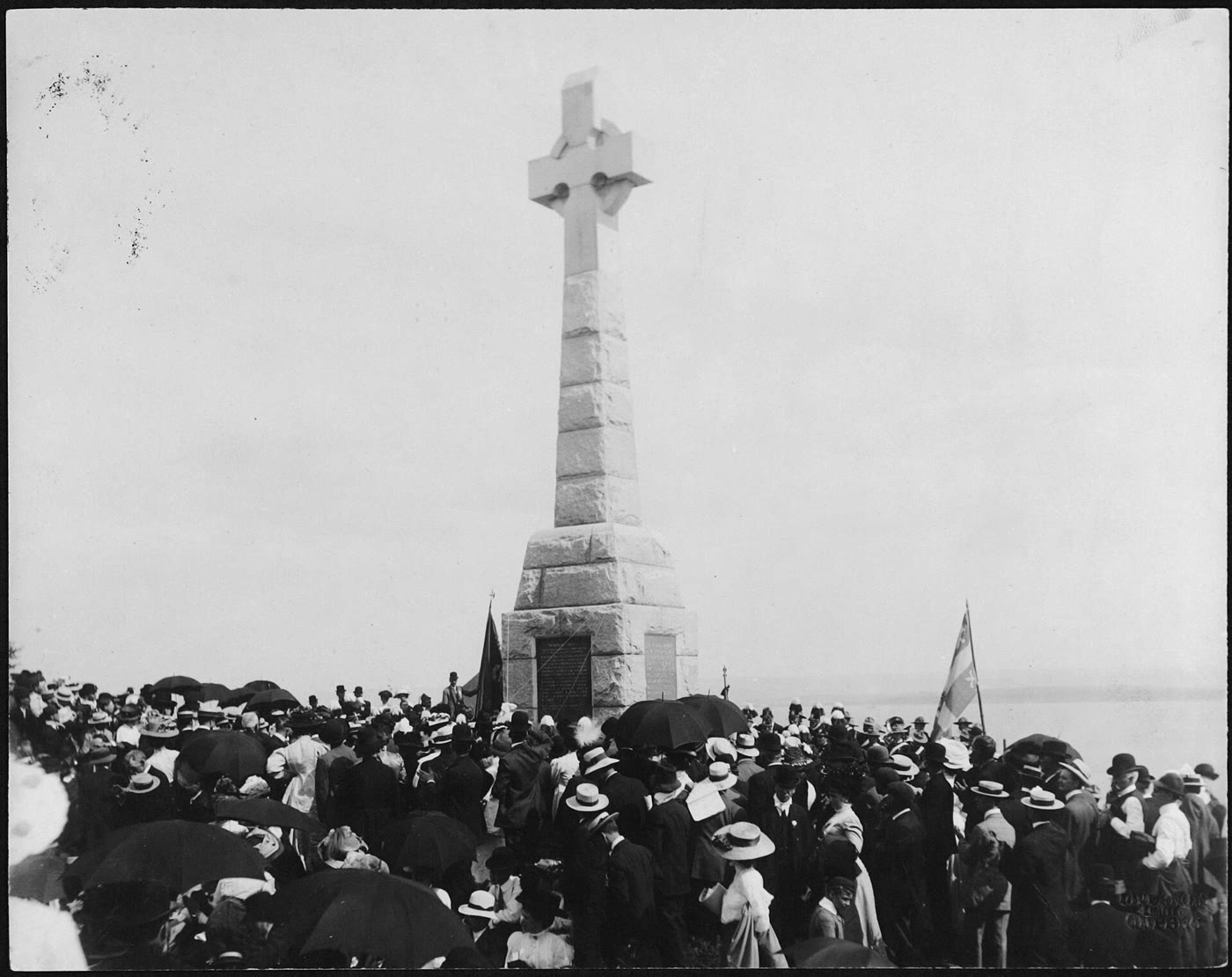
Crowds at the unveiling of the Celtic cross by the Ancient Order of Hibernians, Grosse Île, 1909. Studio Livernois, Bibliothèque et Archives nationales du Québec (P560,S1,P1006). Public domain, via Wikimedia Commons
The pedestal has four dark panels. Three carry an inscription in Irish, English and French, and they don’t say quite the same thing:
- English: to the memory of thousands of Irish emigrants “who, to preserve the faith, suffered hunger and exile in 1847-48”, and who died of fever on the island.
- French: much the same, but adding that they were consoled and strengthened by the Canadian priest, with a line from the Psalms about those who sow in tears reaping in joy.
- Irish: the sharpest of the three. In the 1909 book’s translation, thousands of the children of the Gael were lost here “fleeing from foreign tyrannical laws and an artificial famine”. It ends: God save Ireland.
The fourth panel names the Catholic priests who served the fever victims of 1847 and 1848, marking those who caught the fever and those who died of it.
The book records speeches that day in English, French and Irish. Remembering a Memory, a documentary produced by the Concordia University historian Ronald Rudin, says the Irish and French ones pointed to a shared heritage. The 2009 centenary was held in English only.
The orphans of Grosse Île
In an ordinary season the quarantine station saw perhaps ten children arrive with no one to look after them. Within a month of the 1847 season opening it had more than 100, the historian Patrick Donovan writes in The Canadian Encyclopedia. By the end of that year, thousands of children across British North America had been orphaned. There’s no exact count: many went to new homes without paperwork.
In 1847 the word covered any child who depended on charity. So an “orphan” might have a mother sick in hospital or a father still in Ireland: more than a third of Quebec City’s Famine orphans had a parent alive.
Priests and charities moved fast. Quebec City found homes for 453 orphans within a few months, President McAleese noted, and more than half went to French Canadian Catholic families, many in rural parishes. The 1909 book repeats a story that Father Harper of Saint-Grégoire made three trips to the island, bringing back 30 orphans for his parishioners each time.
Did they keep their Irish surnames?
Often, yes, though not for the reason the legend gives. In the popular version, French Canadian parents adopted the children and kept their names out of respect for their Irish roots. A 1990s Heritage Minute on Canadian television spread that story widely.
Historians have since challenged it. Canada’s first adoption law came in New Brunswick in 1873, and Quebec had none until 1924. The orphans were placed out informally, with no legal tie, so they kept their own names. When the census taker called, about two in three were listed as something other than a son or daughter. Most families took them in for the work they could do, so older children were in demand. Other orphans did take new names: the 1909 book claimed most had lost their original surnames.
Still, many found real homes. Daniel Tighe was 12 when his widowed mother joined the assisted emigration from the Mahon estate at Strokestown, Co. Roscommon, and sailed on the Naomi. She and his brothers died on the voyage; only Daniel and his nine-year-old sister Catherine survived. The two were taken in by the Coulombe family of Lotbinière, and he eventually inherited their farm. His descendants spell the name Tye, and the free app for the 165 km (about 100 mile) National Famine Way, from Strokestown to Dublin, follows the walk through his eyes.
How it became the Irish Memorial
Canada declared Grosse Île a national historic site in 1974, and Parks Canada has run it since 1993. In the early 1990s, campaigners including Action Grosse Île fought plans they saw as turning it into a “Canadian Ellis Island”, as their historian Michael Quigley put it in History Ireland. Ellis Island is where Annie Moore became the first immigrant processed, in 1892.
On St Patrick’s Day 1996, Canada’s heritage minister, Sheila Copps, announced a memorial to the Irish dead, and the site has carried its present name since that year.
- 1994: President Mary Robinson visited and spoke of four-year-old Ellen Keane, remembered as the first to die there in 1847.
- 1998: Lucienne Cornet’s glass memorial was unveiled near the western cemetery, engraved with the names of immigrants, sailors and staff who died on the island or on the ships. Of the 7,553 people Parks Canada counts as buried there, 1,545 are still unknown.
- 25 May 1998: the site was twinned with the National Famine Museum at Strokestown Park.
- 11 October 1998: President Mary McAleese visited.
- August 2026: the island was added to the National Historic Sites of Canada Order, giving Parks Canada legal powers to protect it.
Visiting Grosse Île
In 2026, Parks Canada opened Grosse Île from 3 June to 10 October: daily from 19 June to 7 September, and Wednesday to Sunday either side. Check the Parks Canada site for next year’s dates.
- By boat: Croisières Lachance sails from the marina at Berthier-sur-Mer, on the south shore east of Quebec City. Expect a day trip of six to six and a half hours. Boats can start later than the site opens, so check sailing dates for a June trip.
- By air: Air Montmagny flies from Montmagny airport, by reservation at least 24 hours ahead.
Book through the carrier: its price includes Parks Canada entry. Under-18s get in free but still pay the carrier’s fare; book them by phone.
The guided visit, in English or French, takes in the Celtic cross and the Irish cemetery, then a little train runs to the village and the hospital sector. Don’t miss the lazaretto, built in 1847, the last building left from the station’s early years, says the Canadian Register of Historic Places. Not every part suits people with reduced mobility, Parks Canada warns, and river weather changes fast, so bring layers.
How to search for an ancestor
If your family story says someone died at Grosse Île, or passed through it, start here:
- The memorial list. Parks Canada publishes the names on the Memorial, grouped by period from 1832 to 1934.
- The Library and Archives Canada database. Immigrants at Grosse Île Quarantine Station, 1832 to 1937 holds 11,612 references to immigrants, sailors and staff who died at sea or on the island, or were buried there. A fire in 1878 destroyed many early records, so the list has gaps. Try spelling variants and the * wildcard: Fran* finds Frank and François.
- Church registers. The island’s Catholic and Anglican registers of baptisms, marriages and burials are held by Quebec’s national archives, BAnQ, and the Quebec Diocesan Archives at Bishop’s University.
- Ships’ lists. Very few Canadian passenger lists survive from before 1865, but Library and Archives Canada’s Immigrants before 1865 database (about 28,000 records) includes lists of emigrant orphans in Montreal and Quebec City.
- Expect name changes. Records are often in French, clerks guessed at spellings, and orphans sometimes took new surnames.
For the Irish end of the trail, see my guide to Irish surnames, and how Ancestry DNA kits can connect you with cousins.
Irish words for the Famine years
These come from Ó Dónaill’s Irish-English dictionary and Foras na Gaeilge’s English-Irish dictionary, focloir.ie:
- An Gorta Mór (un GOR-tuh MORE): the Great Famine. Gorta means hunger or famine.
- An Drochshaol (un DROKH-heel, or un DRUH-hayl in Munster): literally the bad life, or hard times, and in history the Famine. Bliain an Drochshaoil (BLEE-un un DROKH-heel) is the year of the Famine.
- Fiabhras dubh (FEE-uv-russ DUV): black fever, Ó Dónaill’s term for typhus. Fiabhras is closer to FEE-uh-vuh-russ in Munster, FEV-russ on the Aran Islands and FEE-oo-russ in Donegal; dubh is closer to DOO in Galway and Donegal. The modern medical word is tífeas (TEE-fuss).
- Plá is gorta (plaw iss GOR-tuh): pestilence and famine, the same pairing carved in English on the doctors’ monument.
Grosse Île FAQ
Where is Grosse Île?
In the St Lawrence River in Quebec, 48 km (30 miles) east of Quebec City, in the Isle-aux-Grues archipelago.
How many Irish died at Grosse Île?
Parks Canada gives 5,424 burials in 1847, most of them Irish Famine emigrants, though the island’s registers record only about 3,250. More than 5,000 more died at sea that year.
What does the Celtic cross at Grosse Île say?
Its Irish, English and French panels remember the emigrants of 1847 and 1848. The English and French speak of faith and exile; the Irish blames foreign laws and calls the Famine artificial.
Can you visit Grosse Île?
Yes, from about June to early October, by boat from Berthier-sur-Mer or by plane from Montmagny.
Were the Grosse Île orphans adopted?
Most were taken in informally, often by French Canadian farm families. Legal adoption didn’t exist yet, which is why many kept their Irish surnames.
Love this? Save it to your Pinterest board for later.
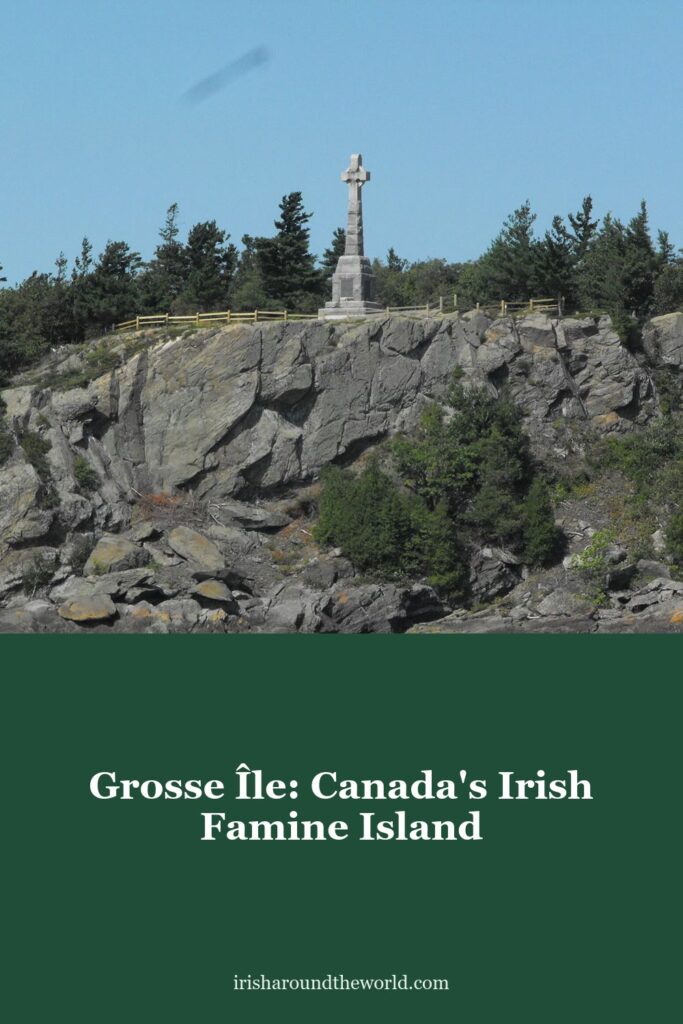
Pin image: the 1909 Celtic cross on Telegraph Hill, Grosse Île. Photo: Paul Sauve, CC BY-SA 3.0 (cropped), via Wikimedia Commons.
A little bit of Ireland in your inbox every Friday ☘️
The free Weekly Dose of Irish: an Irish joke, a Celtic symbol, an Irish fact, a poem and the week’s best articles in one short email. Join 9,600+ readers.
Free. One short email every Friday. Unsubscribe any time.
More Irish heritage reading
- The Irish Potato Famine (An Gorta Mór): Ireland’s Great Hunger, 1845 to 1852
- The American Wake: Ireland’s All-Night Farewell for Emigrants to America
- Annie Moore: Ellis Island’s First Immigrant and the Real Story of Her Life
- Irish Surnames: Meanings, Origins and the Top 100 Names in Ireland
- The Celtic Cross: Meaning, History and Ireland’s Great High Crosses
Featured image: the 1909 Celtic cross on Telegraph Hill, Grosse Île. Photo: Paul Sauve, CC BY-SA 3.0 (cropped), via Wikimedia Commons.