Newgrange, Sí an Bhrú in Irish, is a passage tomb in the Boyne Valley, Co. Meath, built around 3200 BC: centuries before the Great Pyramid of Giza or the stone circle at Stonehenge. A 19-metre passage leads to a cross-shaped chamber, and on a few mornings around the winter solstice, sunlight enters through a roof-box above the door. Medieval tales made it the home of the Dagda and Aengus Óg. Visits are by guided tour from the Brú na Bóinne Visitor Centre.
In 1699, workmen carting stone away from a grassy mound in Co. Meath uncovered a huge boulder carved with spirals. Behind it, a passage led deep into the hill.
That mound was Newgrange. It’s older than the pyramids, it runs all through Irish mythology, and its gleaming white front is one of the most argued-over restorations in Irish archaeology.
I’ve covered the solstice sunrise, and how to watch it live, in my Newgrange winter solstice guide. This is the bigger story, from the builders and the 1960s rebuild to the legends and how to visit.
Watch: Newgrange and the winter solstice sunrise in 30 seconds:
Jump to:
- What is Newgrange?
- How old is Newgrange?
- Inside the passage tomb
- The carved stones and the triple spiral
- The roof-box and the winter solstice
- The quartz wall: a rebuilt front
- Romans, road stone and 1699
- Knowth and Dowth
- Newgrange in Irish mythology
- How to visit Newgrange
- Newgrange FAQ
- More Irish heritage reading
What is Newgrange?
Newgrange is a Neolithic passage tomb: a long stone passage leading to a chamber, buried under a huge round mound and ringed by giant kerbstones. It stands on a ridge above a loop of the River Boyne, about 40 km (25 miles) north of Dublin as the crow flies.
With Knowth and Dowth, it’s one of three great mounds among about 40 passage tombs in that bend of the river, says the Office of Public Works (OPW), which manages the site. The area is called Brú na Bóinne (broo nuh BOH-nyuh), usually translated as the palace or mansion of the Boyne. UNESCO listed it as a World Heritage Site in 1993: nowhere else in Europe, it says, has so much prehistoric megalithic art of such importance.
Why is it called Newgrange?
A grange was a monastic farm, and Newgrange belonged to the lands of Mellifont Abbey, founded in 1142 as Ireland’s first Cistercian monastery. The official placenames database, logainm.ie, lists the name from the early 1540s, in a survey and a 1541 lease of Mellifont’s lands. The townland’s Irish form, not yet official, is An Ghráinseach Nua (un GHRAWN-shukh NOO-uh): the new grange.
The monument’s own Irish name is Sí an Bhrú (shee un VROO). Ó Dónaill’s dictionary gives sí as a fairy mound and brugh (broo) as an old literary word for a dwelling or mansion: the fairy mound of the Brú.
How old is Newgrange?
The OPW dates Newgrange to around 3200 BC, so it’s roughly 5,200 years old. Its builders were farmers; farming had reached Ireland around 4000 BC.
Older books, such as Michael Herity’s of 1974, dated Newgrange to about 2800 BC, the National Museum of Ireland notes. Calibrated radiocarbon dates pushed it back about four centuries.
Is Newgrange older than Stonehenge and the pyramids?
- The Great Pyramid of Giza was built for the pharaoh Khufu in Egypt’s 4th dynasty, which Britannica dates to about 2575 to 2465 BC. Newgrange is roughly 600 years older.
- Stonehenge began as a circular ditch and bank around 3000 BC, and its great stones went up around 2500 BC, says English Heritage. So Newgrange beats the first Stonehenge by about two centuries, and the famous stone circle by about 700 years.
Inside the passage tomb
From outside, Newgrange is a grassy mound about 80 to 85 metres (260 to 280 feet) across and 11 to 13 metres (36 to 43 feet) high: the OPW gives the lower figures, Britannica the higher.
The passage runs 19 metres (62 feet) into the mound, lined with upright slabs. It opens into a cross-shaped chamber with three recesses, under a corbelled roof: rings of overlapping slabs, each set a little further in, closed by one capstone about 6 metres (20 feet) up.
The builders hauled stone a long way, the OPW says. Most structural slabs are greywacke from around Clogherhead, north of Drogheda, probably moved by sea and river. The white quartz was brought from the Wicklow Mountains, and the sea-rolled granite cobbles from Dundalk Bay.
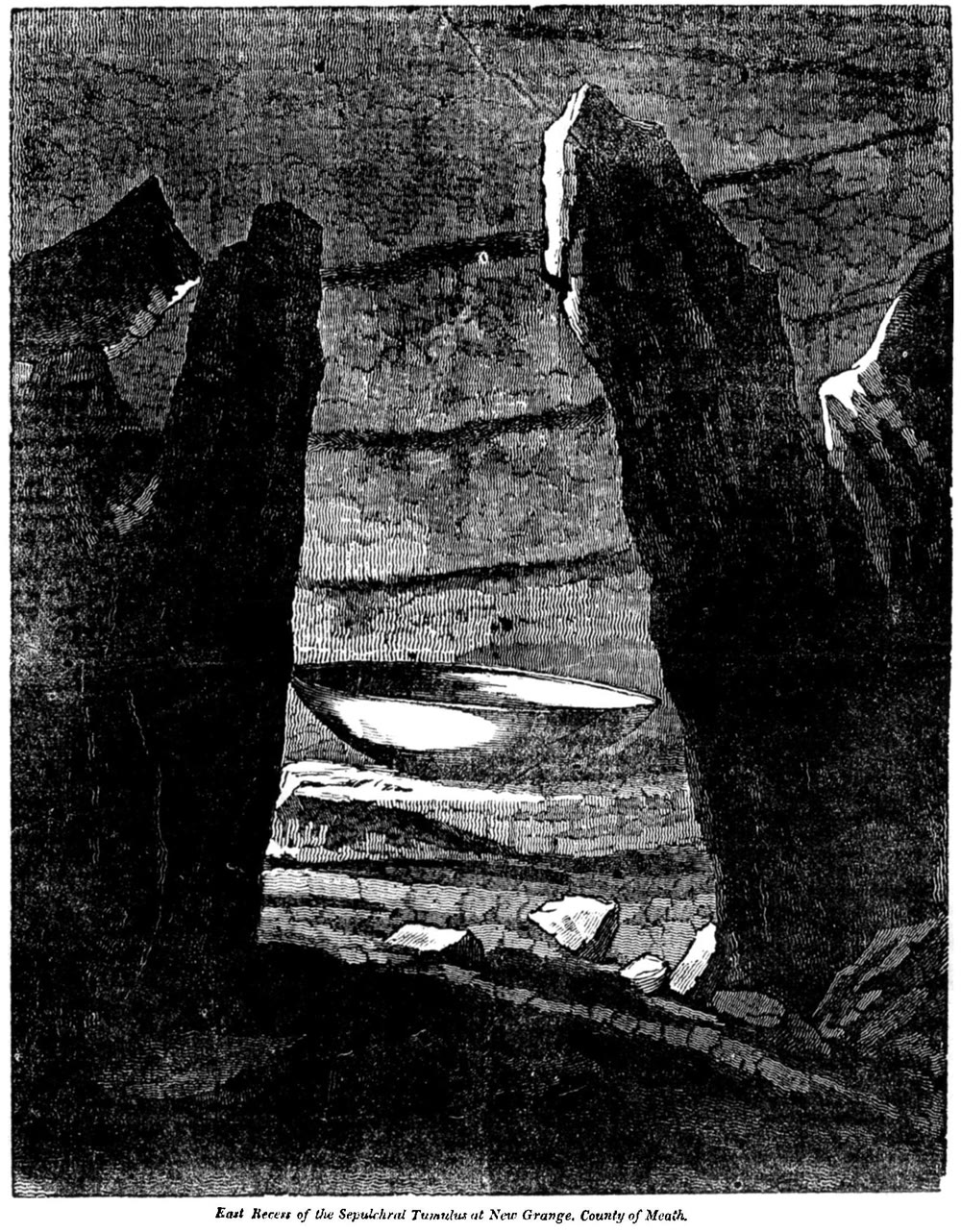
East recess of the sepulchral tumulus at New Grange, from The Dublin Penny Journal, vol. 1 (1833). Public domain, via Wikimedia Commons
Who was buried at Newgrange?
Four stone basins sit in the recesses, two of them in the largest, right-hand recess. Excavations found the remains of five people, the OPW says, with objects such as polished stone balls and bone and antler pins.
In 2020 a team led by Lara Cassidy of Trinity College Dublin reported in Nature that a man whose remains lay in the most elaborate recess was the son of first-degree relatives: brother and sister, or parent and child. Such unions are socially accepted almost only among elites such as god-kings, so the team saw signs of a Neolithic elite.
In 2025, archaeologists from University College Dublin and the University of York replied in Antiquity. They found no corroborating evidence for such an elite in settlement, diet or trade, and argued that one skull fragment from a chamber disturbed long before excavation can’t carry that weight. The DNA isn’t disputed; its meaning is.
The carved stones and the triple spiral
The OPW counts 116 decorated stones at Newgrange, including 39 of the 97 kerbstones. Spirals, zigzags and lozenges were pecked into the rock with stone tools. What they meant, nobody knows.
- The entrance stone (K1). The OPW ranks it among the finest works of Neolithic art in Europe. A groove down its centre lines up with the passage, and its carvings include the triple spiral now copied on jewellery and tattoos.
- Kerbstone 52. Directly opposite, at the back of the mound, with a matching groove marking the line of the passage.
- Stone C10. Inside, a smaller triple spiral on an upright at the front right of the end recess. The OPW calls the triple spiral unique to Newgrange.
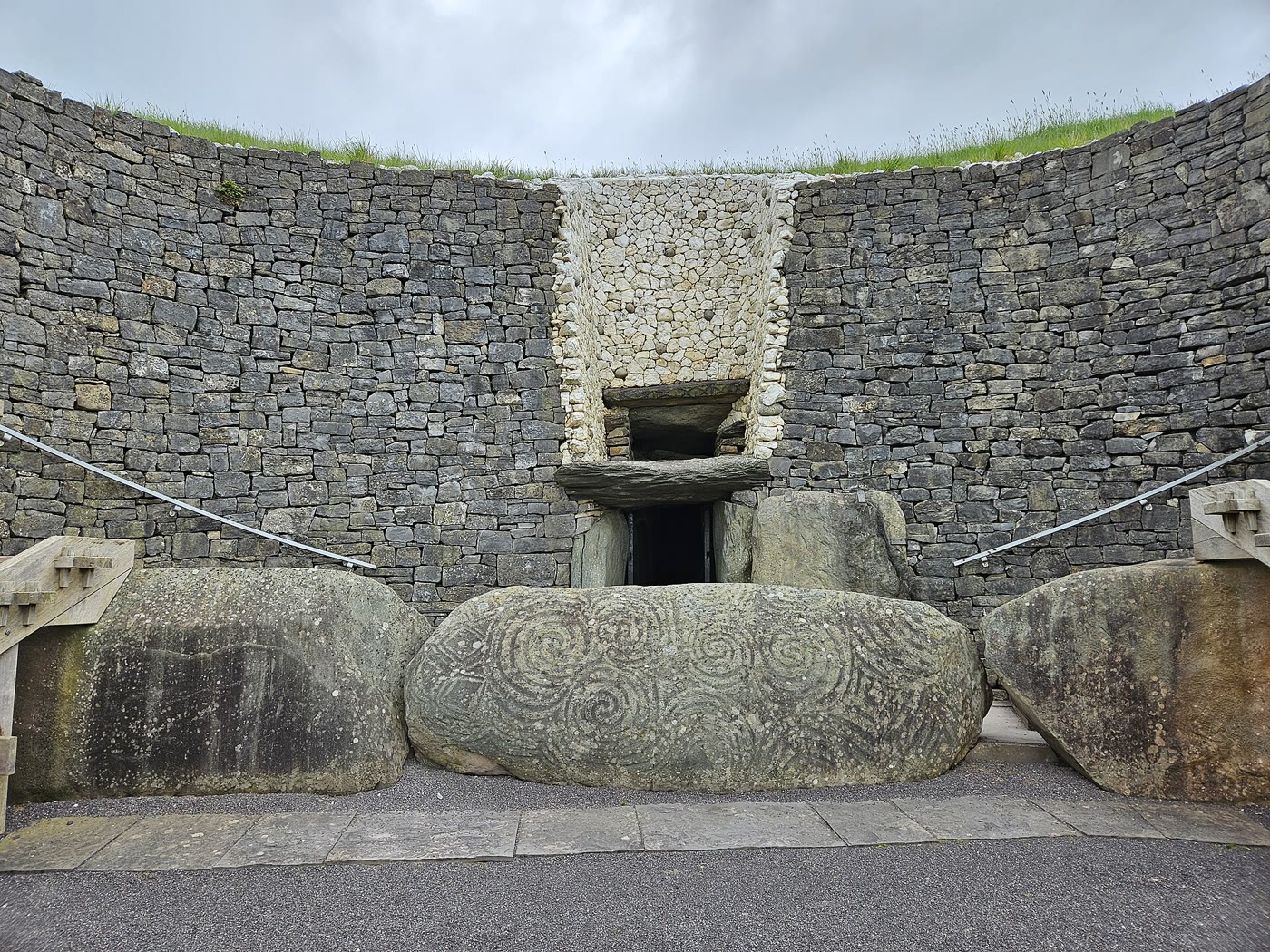
The entrance stone and roof-box at Newgrange, Co. Meath. Photo: MPhernambucq, CC BY-SA 3.0, via Wikimedia Commons
The triple spiral was carved more than two thousand years before anything we’d call Celtic art. My triskele guide follows the design from Newgrange to the flags of Sicily and the Isle of Man.
The roof-box and the winter solstice
Above the doorway sits the roof-box, a narrow slot under a carved lintel. Around the winter solstice the sun rises over Red Mountain, near Donore, and shines through it rather than the doorway, sending a beam up the passage to light the chamber floor. The OPW says the beam can appear on any morning between 18 and 23 December, for up to 17 minutes when the weather allows.
Writing in Nature in 1989, the astronomer Tom Ray found that the light now arrives about four and a half minutes after sunrise, but that when the tomb was built it entered at sunrise itself. He suggested the slot’s size may have been deliberate.
Who rediscovered the solstice light?
Michael J. O’Kelly, a University College Cork professor, dug at Newgrange for the OPW between 1962 and 1975. He had heard a local tradition that the sun once lit the triple spiral stone in the end recess, but suspected a mix-up with Stonehenge, he later wrote.
On 21 December 1967 he waited alone in the chamber at dawn, and the sun came in. The National Museum calls it the first time anyone had seen it since prehistoric times. Still, the archaeologist Robert Hensey notes that the astronomer Norman Lockyer had pointed out the solstice alignment in 1909.
Solstice-morning places in the chamber go to winners of a free OPW lottery: my solstice guide covers that and the live stream.
The quartz wall: a rebuilt front
The postcards won’t tell you this: the dazzling white wall on the front of Newgrange went up between 1967 and 1974.
O’Kelly found white quartz and rounded granite cobbles lying outside the kerb, took them for a fallen wall, and rebuilt it as a steep facade. The OPW says it used original stone found during the excavations. UNESCO’s listing adds that the passage roof was taken apart and reset with reinforcement so leaning uprights could be straightened.
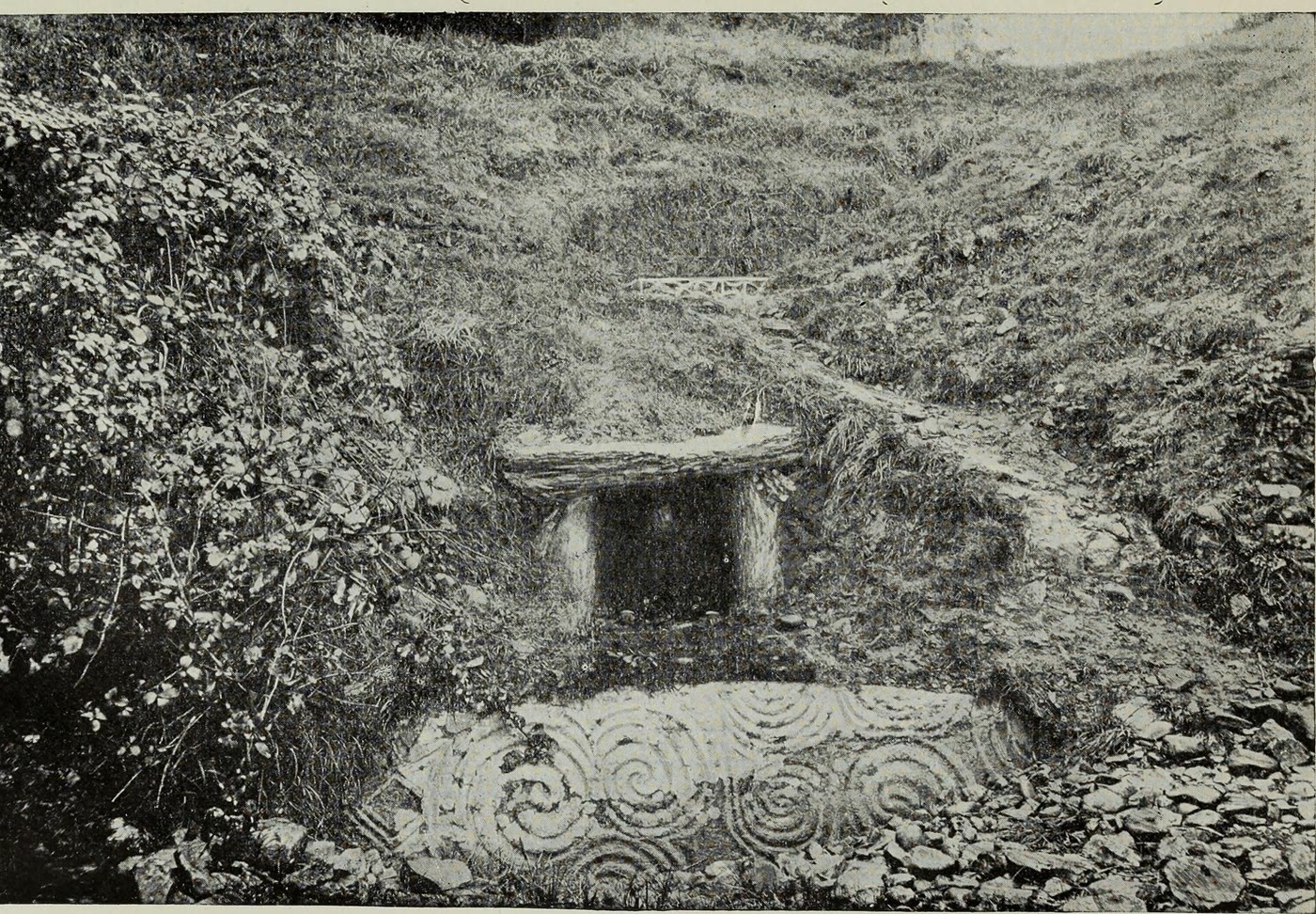
Entrance to the tumulus at New Grange before the 20th-century excavations. Photo: R. Welch, Belfast, from T. W. Rolleston, Myths and Legends of the Celtic Race (first published 1911). Public domain, via Wikimedia Commons
Not everyone agrees with it. In a 2008 book, the archaeologist Geraldine Stout and the historical geographer Matthew Stout said the wall rested on O’Kelly’s interpretation, not documentary evidence, and that the rebuild took “liberties”. They praised how openly he recorded his work, the Irish Times reported.
The Danish archaeologist Palle Eriksen goes further: he argues Newgrange never had a Neolithic wall, and the quartz lay flat in front of the entrance. At neighbouring Knowth, the quartz was laid out as settings around the entrances.
Even the roof-box has been challenged. In 2016 the archaeologist Michael Gibbons called it a 1960s fabrication. Four senior archaeologists, among them the National Museum’s Keeper of Irish Antiquities, replied in the Irish Times that it had been visible and photographed since at least the 1930s. O’Kelly did dismantle and reset it between 1964 and 1967, though.
Romans, road stone and 1699
Iron Age and Roman objects found around the mound, including Roman coins made into pendants, may have been offerings, the National Museum says.
The passage was opened again in 1699, when workmen taking stone for the landowner, Charles Campbell, uncovered the carved entrance stone. He wanted it for road-building, History Ireland says. The Welsh scholar Edward Lhuyd came to see it. In a letter of 15 December 1699, later printed by the Royal Society, he described creeping into a chamber about 20 feet high, with stone basins and bones. The carvings, he wrote, were spirals “like a Snake, but without distinction of Head and Tail”.
Knowth and Dowth
Knowth
Knowth (it rhymes with mouth), Cnóbha in Irish, is the biggest mound of the three, about 95 metres (310 feet) across and ringed by 18 smaller tombs, the OPW says. It holds two separate passage tombs, entered from the east and west.
With more than 380 decorated stones, Knowth has the biggest gathering of megalithic carving in Western Europe. George Eogan excavated it for nearly 40 years from 1962. You can tour Knowth from 1 March to 1 November, though not its chambers.
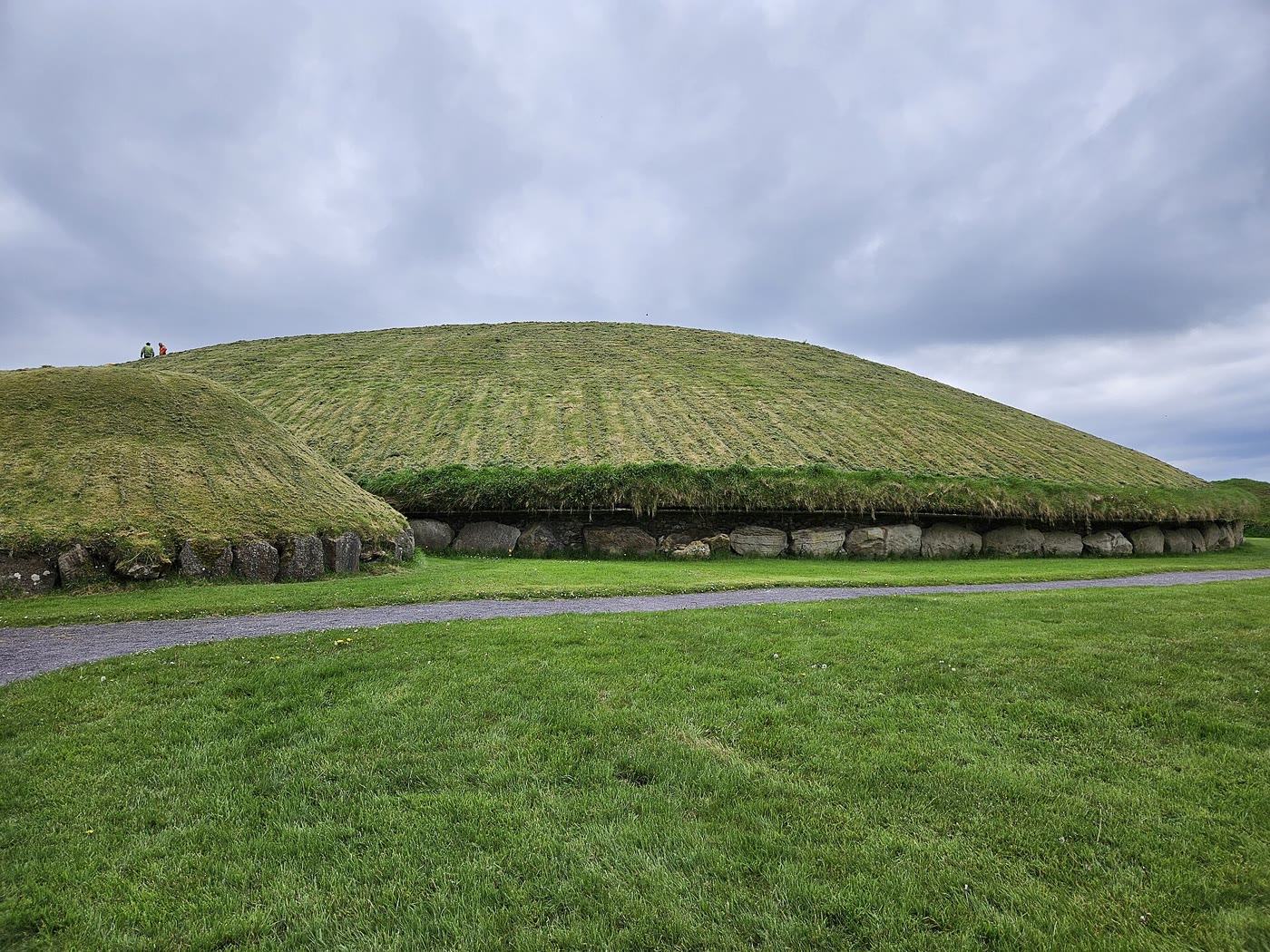
The great mound at Knowth with one of its smaller satellite tombs, Co. Meath. Photo: MPhernambucq, CC BY-SA 3.0, via Wikimedia Commons
Dowth
Dowth, Dubhadh in Irish, is about as big as Newgrange. In 1847 diggers tore into it hunting for a central chamber, and it was later quarried, the OPW says. Its southern passage faces the winter solstice sunset, and the low sun can light its chamber for about an hour. Dowth has no guided tours, but the OPW says its exterior can be reached directly from the N51.
In 2023 the State bought the 552-acre Dowth Hall estate, about a third of the World Heritage Site, for a new Boyne Valley (Brú na Bóinne) National Park, the National Parks and Wildlife Service announced. A masterplan for the park is being drawn up.
Newgrange in Irish mythology
In medieval tales, the Brú belongs to the Tuatha Dé Danann (TOO-uh-huh JAY DAN-un), the godlike people of early Irish story, and above all to the Dagda and his son Aengus Óg. In modern Irish he’s Aonghus Óg (roughly AYN-gus OHG in English, though Irish dialects vary a lot). Both feature in my guide to Celtic gods.
In the legends, mounds like this were the original sí, the fairy hills where the old gods withdrew, as I explain in my guide to fairy forts. A medieval place-name poem about the Brú, in Edward Gwynn’s translation, says simply that the mound “was built by the harsh Dagda”.
How Aengus won the Brú
This retelling follows Tochmarc Étaíne, the Wooing of Étaín, preserved in Lebor na hUidre (around 1100) and the Yellow Book of Lecan (late 1300s).
The Brú belongs to Elcmar, whose wife is Eithne, also called Boann, goddess of the River Boyne. The Dagda desires her. He sends Elcmar away and enchants him, so that nine months slip by like one long day, with no nightfall, hunger or thirst. Meanwhile Boann bears the Dagda a son. She calls him the Mac Óc, the young son, because he was conceived at daybreak and born before evening.
Years later, coached by the Dagda, Aengus walks into the Brú at Samhain (SOW-in), a time of peace, and frightens Elcmar into granting him kingship there for a day and a night. Next morning Elcmar wants it back. Aengus argues that the world is made of days and nights, so his kingship has no end. The Dagda upholds the bargain and gives Elcmar land at Cleitech instead.
In another tale, De Gabáil in t-Sída, the Taking of the Fairy Mound, Aengus plays the same trick on the Dagda himself.
Dowth and the stolen day
In the Dindshenchas, medieval lore explaining place names, King Bressal summons the men of Ireland to raise a tower like Nimrod’s, high enough to reach heaven. His sister promises to stop the sun so the work can be done in one endless day. Then Bressal sleeps with her, the spell breaks, and night falls. The builders go home, and she names the place Dubad: darkness.
The Nature team noted that their Newgrange finding echoes this legend, though they called a memory lasting thousands of years unlikely.
The burial place of kings
Medieval writers believed the pagan kings of Tara were buried at the Brú. The 17th-century historian Geoffrey Keating tells how Cormac mac Airt, a believer in the true God, asked not to be buried there. His people tried anyway, but the flooded Boyne carried his body off to Ros na Rí (ross nuh REE), Rossnaree, where he was buried. Keating spells it Ros na Ríogh.
Swans and a golden bier
In the Dream of Aengus, he and his love Caer fly to the Brú as two swans, their singing putting everyone to sleep for three days and nights. In Diarmuid and Gráinne, Aengus carries his dead foster-son there on a golden bier. Boann’s own story is in my Salmon of Knowledge article.
How to visit Newgrange
You can’t just drive up to Newgrange. All visits begin at the Brú na Bóinne Visitor Centre in Donore, where a shuttle bus takes tour groups to the monuments. Head straight to the monuments and you won’t get in, Heritage Ireland warns.
- Book ahead, and only through Heritage Ireland. Newgrange and Knowth are guided tour only and tickets are limited. No third party is authorised, and resold tickets aren’t valid.
- Watch the booking window. Tickets are released at midnight Irish time: 30 days ahead for tours between April and 1 November, and a week ahead for most winter dates.
- Everyone needs a ticket, young children included, and under-18s must come with an adult.
- Check the season. From 2 November to the end of February only the Newgrange tour runs, chamber included.
- No photos inside. The passage and chamber are low and narrow, and photography isn’t allowed. The monuments are outdoors with no shelter, so dress for Meath.
The visitor centre opens at 9am (9.30am in March and April) and closes between 4.15pm and 5.45pm. It’s closed from 24 to 27 December and on 1 January, and normal tours stop on solstice mornings. My guide to things to do in Dublin includes a day tour with Brú na Bóinne entry.
Newgrange FAQ
When was Newgrange built?
Around 3200 BC, which makes it about 600 years older than the Great Pyramid and about 700 years older than Stonehenge’s stone circle.
Do you need to book a Newgrange tour?
Yes. Tickets are limited, sold only through Heritage Ireland, and you can’t reach the monuments without one.
Is the white quartz wall at Newgrange original?
The stones were found at the site, but the steep wall is Michael O’Kelly’s reconstruction of 1967 to 1974. Some archaeologists think the quartz originally lay flat in front of the entrance.
Love this? Save it to your Pinterest board for later.
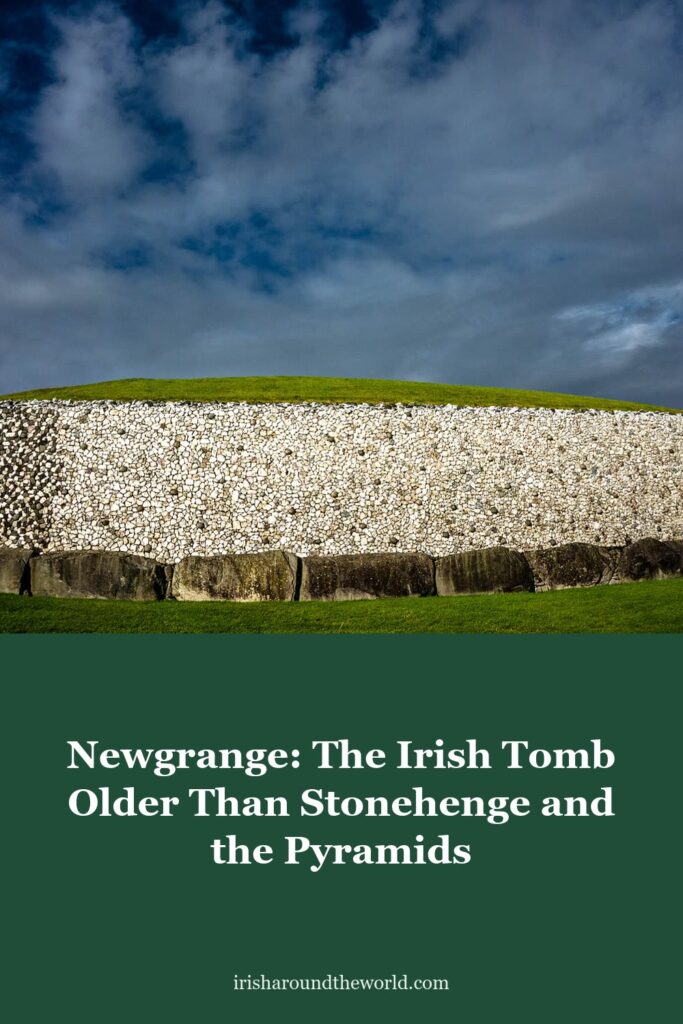
Pin image: “Newgrange Tomb – circa 3,200 BCE”, the quartz wall and kerbstones of Newgrange, Co. Meath. Photo: Eric Gross, CC BY 2.0, via Wikimedia Commons.
A little bit of Ireland in your inbox every Friday ☘️
The free Weekly Dose of Irish: an Irish joke, a Celtic symbol, an Irish fact, a poem and the week’s best articles in one short email. Join 9,600+ readers.
Free. One short email every Friday. Unsubscribe any time.
More Irish heritage reading
- Newgrange Winter Solstice: The 5,000-Year-Old Tomb That Lights Up for 17 Minutes
- Celtic Gods and Goddesses: 15 Irish Deities and Their Stories
- Triskele Meaning: The Triple Spiral from Newgrange to Today
- Diarmuid and Gráinne: Ireland’s Great Runaway Love Story
- Fairy Forts and Fairy Trees: The Irish Places You Never Disturb
- The Salmon of Knowledge: How One Burnt Thumb Made Fionn mac Cumhaill a Legend
Featured image: “Newgrange Tomb – circa 3,200 BCE”, the quartz wall and kerbstones of Newgrange, Co. Meath. Photo: Eric Gross, CC BY 2.0, via Wikimedia Commons.