
The Blarney Stone is a block of limestone in the battlements of Blarney Castle, about 8 km northwest of Cork city. Tradition says that kissing it gives you the gift of the gab. To reach it, you climb the tower, lie on your back and lean backwards over a gap in the parapet while an attendant holds you. Legends link the stone to a witch, a fairy queen, Robert the Bruce and the Holy Land, but a 2014 study of an old sample points to local rock. The word blarney was in print by the 1780s.
Picture the top of a tall stone tower in Co. Cork. You lie on your back, reach behind your head for two iron bars and let a stranger hold on to you. Then you tip your head backwards into a gap in the wall, with a long drop below, and kiss a block of grey stone.
People have done some version of this at Blarney Castle for well over 200 years. The castle draws around 460,000 visitors a year, The Irish Times reported in 2020.
My guide to things to do in County Cork covers the rest of the county. Here’s the stone itself: the kiss, the legends, the word it gave English and how to visit.
Jump to:
- What is the Blarney Stone?
- How kissing the Blarney Stone works
- Is it even the right stone?
- The legends: where did the stone come from?
- Where the word “blarney” comes from
- Blarney Castle: a short history
- Famous kissers, germs and a rude local joke
- The gardens: the Rock Close and the Poison Garden
- Visiting Blarney Castle
- Blarney Stone FAQ
- More Irish heritage reading
What is the Blarney Stone?
The Blarney Stone is a long block of stone in the battlements of Blarney Castle, a 15th-century tower house in the village of Blarney, about 8 km (5 miles) northwest of Cork city. In Irish it’s Cloch na Blarnan (KLOKH nuh BLAR-nun), according to the Foras na Gaeilge dictionary at focloir.ie.
The village is An Bhlarna (un VLAR-nuh), “little field” according to the Victorian place-name scholar P. W. Joyce, from blár, an open space or field.
Kiss the stone, the tradition goes, and you’ll never be stuck for words again. That’s the gift of the gab: fluent, charming, persuasive talk, not all of it strictly true. (Not to be confused with Blarney stones, the peanut-coated cake squares in my Blarney stones recipe.)
How kissing the Blarney Stone works
First, the climb. The tower has no lift, only narrow, steep stairs, so the castle says the stone isn’t accessible to wheelchair users.
At the top, the stone sits in the outer wall, just below the walkway, with an open gap between the two. You lie on your back with your head towards the gap, hold the iron rails fixed to the wall, and lean backwards and down until your lips meet the stone. An attendant holds you steady and helps you back up.
It looks alarming, but it’s over in seconds. Children can do it too, though for under-8s the castle leaves it to the staff on duty.
It used to be riskier. Samuel Lewis’s Topographical Dictionary of Ireland (1837) says few dared, because you had to be lowered to the stone on a rope from an unsafe battlement. When Winston Churchill came in July 1912, The Times reported that he climbed onto the parapet and kissed the stone while Sir James Long, chairman of the Cork Harbour Commissioners, held his legs.
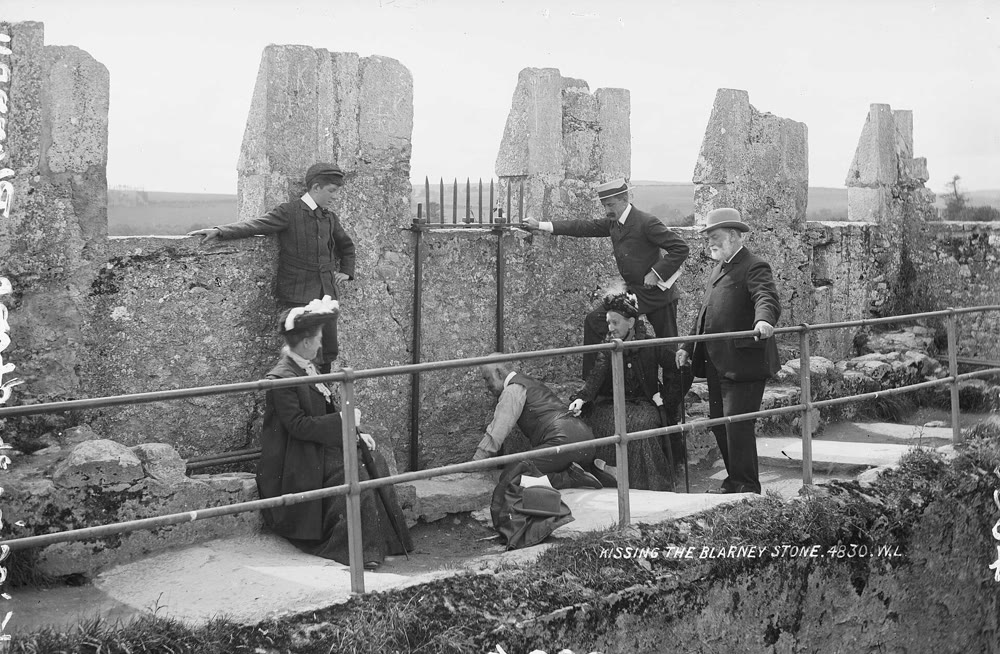
Visitors at the kissing spot on the battlements of Blarney Castle, about 1897. National Library of Ireland, Lawrence Collection (L_CAB_04830). No known copyright restrictions, via Wikimedia Commons
Is it even the right stone?
Early writers didn’t agree on which stone you were meant to kiss.
- 1785: Francis Grose’s slang dictionary describes a triangular stone at the very top of the castle, so hard to reach that getting there proved your nerve. Plenty of people, he adds, claimed the feat without doing it.
- 1837: Lewis puts it in the north-east corner, about 20 feet below the top, carrying a Latin inscription about the building of the castle.
- 19th century: a Cork guidebook, copied out by a Macroom pupil for the Schools’ Collection in the 1930s, says visitors were usually shown a stone dated 1703, while Blarney’s parish priest insisted the real one lay near the summit, reachable only with ropes.
- 2007: in Blarney Castle: Its History, Development and Purpose (Cork University Press), the archaeologist Mark Samuel and Kate Hamlyn argued that the stone kissed today only appears in the record from 1888, when a stone on the north face was picked because it was safer to reach. The older legends, they said, refer to a date-stone marked 1446 on the north-east corner, apparently the inscribed stone Lewis described, as History Ireland summed it up.
The castle rejected that theory, AFP reported in 2008. Either way, today’s stone has carried the legend for well over a century.
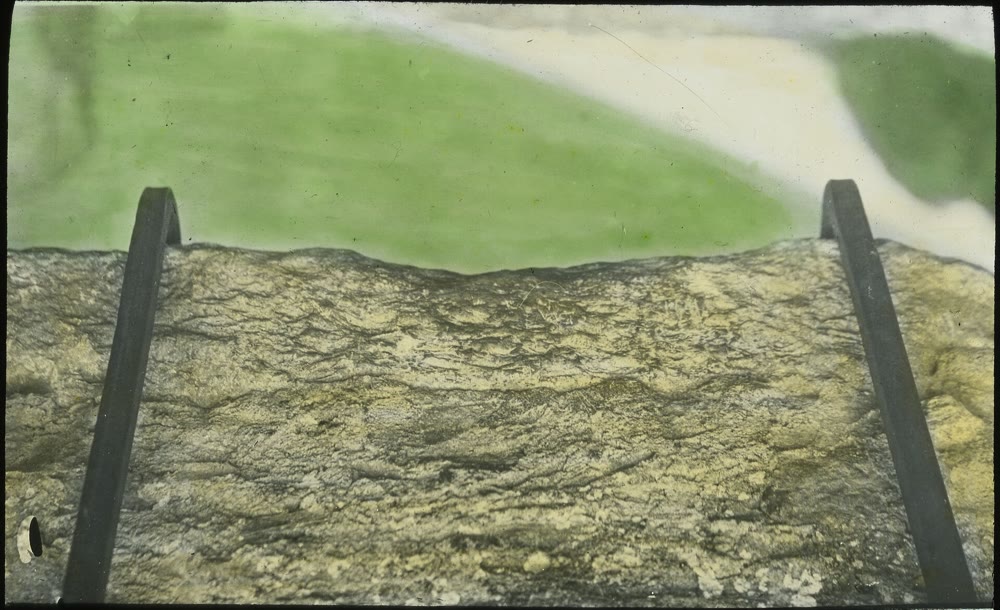
The Blarney Stone and its iron grips in 1913, on a hand-coloured lantern slide by Edmund F. Arras of Columbus, Ohio. Columbus Metropolitan Library, no known copyright restrictions, via Wikimedia Commons
The legends: where did the stone come from?
Nobody knows how the kissing custom started. All of these are legends, not history.
The woman in the river
The castle’s website tells of Cormac Láidir MacCarthy (roughly KOR-uh-muk LAW-jir; láidir means strong), who pulled a drowning old woman out of a river. She was a witch in disguise, and to thank him she revealed that a stone already in his castle held magic, if he kissed it.
A version written down by a Co. Cork pupil for the Schools’ Collection in the 1930s has no witch. A MacCarthy chief, riding home from a stag hunt west of Macroom, rescues a woman pilgrim stuck in the River Lee. She offers him power, wealth or eloquence. He already has the first two, so he picks eloquence, and she sends him to kiss the stone under the roof of Blarney Castle. His worried foster-brother has a sheet spread on the ground below, just in case.
The fairy queen and the lawsuit
In a version told in many guidebooks, Cormac Láidir was facing a lawsuit and turned to Clíodhna (KLEE-uh-nuh), the fairy queen of Munster folklore. Her advice: press your lips to the first stone you meet on the road to court. He did, spoke so well that he won, and had the lucky stone set into his castle. The castle’s website now tells a sadder tale, of a fairy queen whose tears over a dead chieftain soaked into the stone.
Robert the Bruce, Tara and the Holy Land
Another legend says a MacCarthy king sent soldiers to help Robert the Bruce beat the English at Bannockburn in 1314, and Bruce thanked him with a piece of the Stone of Scone, the inauguration stone of Scottish kings. There’s a snag: England’s Edward I had carried the Stone of Scone south in 1296, 18 years before Bannockburn.
A pupil at Blarney’s own school told the Schools’ Collection in the 1930s that the stone was said to be part of the Lia Fáil (LEE-uh FAWL), the Stone of Destiny on the Hill of Tara. Another story makes it the stone Jacob slept on when he dreamed of a ladder to heaven, carried home after the Crusades. And in the 1830s the Cork-born writer Francis Sylvester Mahony, as Father Prout, joked that the Phoenicians had brought it.
What the geology says
In 2014, staff at the University of Glasgow’s Hunterian museum found a 19th-century microscope slide cut from the stone. It shows limestone full of broken fossil shells. The curator, Dr John Faithfull, said in the university’s announcement that the slide makes a strong case for local Carboniferous limestone, roughly 330 million years old, and suggests no link with the sandstone Stone of Scone, now on show in Perth Museum in Scotland.
One wrinkle: the slide dates from about 1850 to 1880, before the 1888 switch Samuel and Hamlyn describe, so it may come from the older stone. Either way, the rock is almost certainly local.
Where the word “blarney” comes from
Blarney means flattering, coaxing or misleading talk, or plain nonsense. Merriam-Webster dates its first known use to 1780.
The earliest definition word historians cite is in Francis Grose’s Classical Dictionary of the Vulgar Tongue (London, 1785). There, someone who “has licked the Blarney stone” tells tall tales, and to tip the blarney means telling a marvellous story or a falsehood. In his 1788 edition, Grose added flattery.
The same dictionary already lists the gift of the gab, gab being slang for the mouth. So the phrase wasn’t born at Blarney. The stone just became the place to get it.
Did Queen Elizabeth I really coin it?
The famous story is built around a real man. Sir Cormac mac Dermond MacCarthy (1552 to 1616), lord of Muskerry, sat as Baron Blarney in the Irish House of Lords in 1585 and 1586. According to the Dictionary of Irish Biography, he kept finding excuses not to let a royal garrison into Blarney Castle, while swearing loyalty to Elizabeth I.
The story goes that one more of his excuse-filled letters was too much for the queen, who burst out that it was all Blarney and she would hear no more of it. The Dictionary of Irish Biography (DIB) repeats the tale with caution, as the reputed origin of the word rather than a proven one.
Be a little wary: the earliest uses dictionaries have found come from the second half of the 1700s, more than 150 years after Elizabeth died. The DIB suggests that folk memories of Cormac’s smooth talk probably blended with the stone’s legends some time in the 1700s. Blarney did have a reputation, though: around 1600, the poet Aonghus Ó Dálaigh (roughly AY-nus oh DAW-lee) complained that his visit there earned him nothing but flattery.
Irish words for blarney
Irish has its own. For blarney, focloir.ie offers béal bán (bayl BAWN), literally “white mouth”, and plámás (PLAW-mawss), soft talk, a word many Irish people use in English too. Ó Dónaill’s dictionary gives bua cainte (roughly BOO-uh KAN-chuh; in Munster Irish, closer to BOO-uh KINE-chuh) for the gift of speech. More in my guides to Irish slang words and English words from Irish.
Blarney Castle: a short history
The tradition, repeated by Thomas Crofton Croker in 1824 and by Lewis, is that Cormac Láidir MacCarthy, lord of Muskerry, built the castle in or around 1446, replacing earlier castles on the same rock. He died in 1494 and was buried at Kilcrea Friary, which he founded.
It’s an unusually big tower house, the fortified home of choice for Gaelic and Anglo-Irish lords from the 15th to the 17th century. The castle says it’s really two or more towers, one of them added in the 1500s, with walls about 18 feet (5.5 metres) thick at the base.
In 1646 the parliamentarian commander Lord Broghill took Blarney after battering the tower with a gun on the hill opposite, says the castle. After the Williamite War, Donough MacCarthy, 4th Earl of Clancarty, lost the estate for backing James II, and in the early 1700s it was bought by Sir James Jefferyes, governor of Cork.
In 1846 Louisa Jefferyes married Sir George Colthurst, and the Colthursts inherited the estate, says the University of Galway’s Landed Estates Database. The family still owns it. In 1874 they built Blarney House nearby, a Scots baronial mansion by the Belfast architect John Lanyon, a style rare in the south of Ireland.
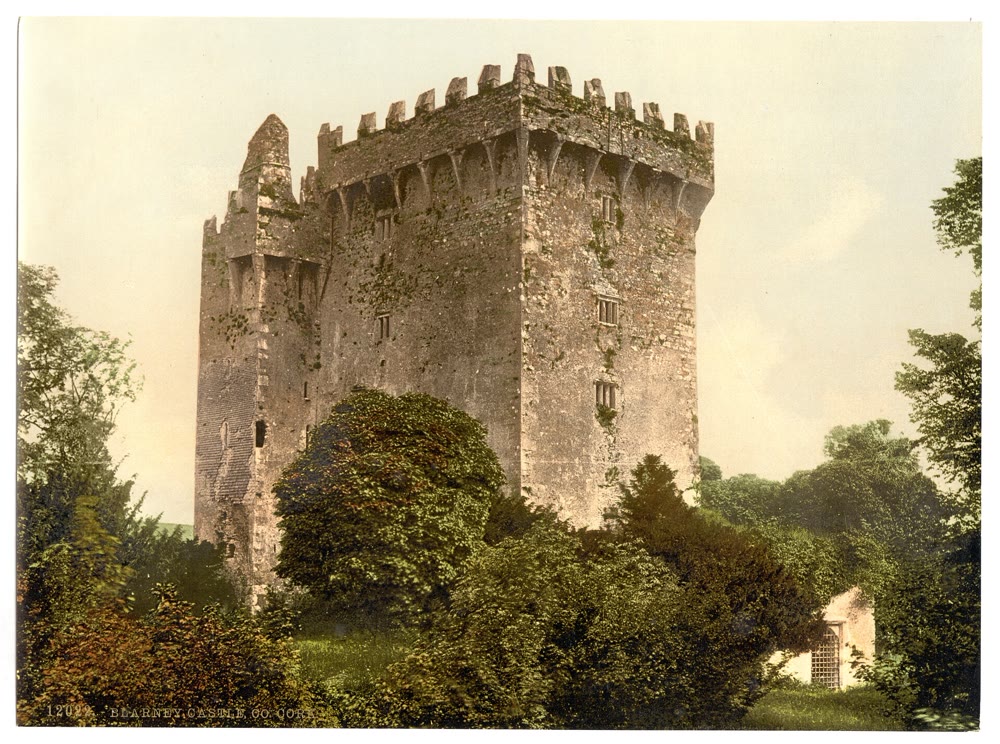
Blarney Castle in the 1890s, from a photochrom print. Library of Congress, public domain, via Wikimedia Commons
Famous kissers, germs and a rude local joke
One well-documented famous kiss is Winston Churchill’s, on 2 July 1912, when he was First Lord of the Admiralty. Newspapers in London, Washington and Hobart reported it, as the International Churchill Society’s magazine Finest Hour has traced. Laurel and Hardy visited on their 1953 trip to Cork, and the same magazine says Stan Laurel kissed the stone while Oliver Hardy declined.
Germs are the obvious worry. In 2009, TripAdvisor put the stone top of its list of the world’s germiest attractions. In March 2020 the castle suspended kissing because of Covid-19, a first in its history, said its owner, Sir Charles Colthurst. When kissing returned on 29 June 2020, the stone was being cleaned regularly with a WHO-approved product, the Echo reported. Ask on the day what’s in place now.
You may also hear the joke that locals sneak in at night and relieve themselves on the stone. The University of Southern California’s digital folklore archive files it as folklore, not fact: a dig at the tourist trade.
The gardens: the Rock Close and the Poison Garden
The grounds deserve as much of your time as the stone.
The Rock Close
The Rock Close, next to the castle, is a shady dell of mossy boulders and ancient yews, with a Witch’s Kitchen, a Druid’s Altar, a Witch Stone and the Wishing Steps. The castle describes it as the reputed site of a druidic settlement, but also says the Jefferyes family arranged some of it in the 1750s. In 1824 Croker found it hard to tell what was natural and what was designed, so enjoy the druids as atmosphere. The castle says the Wishing Steps grant a wish, if you do the ritual exactly right.
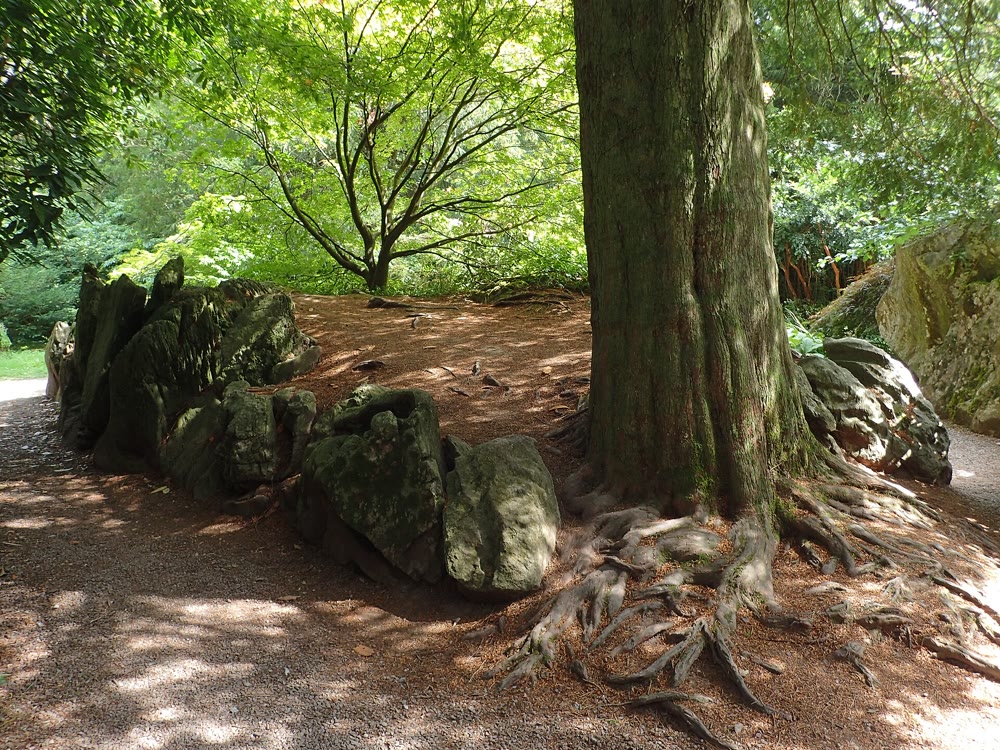
Moss-covered boulders beside an old tree in the Rock Close at Blarney Castle. Photo: Marathon, CC BY-SA 2.0, via Wikimedia Commons
The Poison Garden
Beside a stone wall that follows the line of the castle’s old defences, the Poison Garden is meant to teach rather than scare. It shows how plants from the wild and from ordinary gardens can harm us, and how many also give us medicines. The most dangerous, including deadly nightshade and wolfsbane, are kept in cages, says Discover Ireland.
There’s also a fern garden, a Himalayan valley of rhododendrons and a lake walk of about 45 minutes. The castle suggests allowing three hours in all.
Visiting Blarney Castle
These details were checked on the Blarney Castle website in October 2026, but prices and hours change, so check before you go.
- Getting there: by car, take the N20 Limerick road out of Cork and follow the signs for Blarney. Buses also run from the city; check the TFI Journey Planner.
- Opening hours: open all year except 24 and 25 December, from 9am to 5pm (November to March), 5:30pm (April and October) or 6pm (May to September), with last admission an hour before closing. On 26 December and 1 January, it’s 10am to 5pm.
- Tickets (2026): adult €24, student or senior (65 and over) €19, child aged 6 to 16 €12, family (two adults and two children) €65; children aged 5 and under go free. Buy online or on arrival. There are no timed slots, and tickets can’t be refunded, only moved to another date.
- Parking: a €2 flat fee. The car park closes at closing time, and the castle charges €50 to release a car after that.
- Access: the castle and stone aren’t wheelchair accessible, but part of the gardens is, and visitors with a disability get in free. Assistance dogs only; no bikes or drones.
Tips for the kiss
- Go early: with no timed tickets, arriving at opening time is the simplest way to beat the summer queue.
- Empty your pockets: anything that slips out as you lean back has a long way to fall.
- Make a day of it: pair Blarney with Cork city, Cobh or Kinsale. See my facts about Cork and my guide to famous Irish castles.
Blarney Stone FAQ
What happens if you kiss the Blarney Stone?
Tradition says you get the gift of the gab, a talent for fluent, persuasive talk. Results not guaranteed.
Is the Blarney Stone part of the Stone of Scone?
That’s a legend. The Stone of Scone was taken to England in 1296, and a 2014 study of a 19th-century slide cut from the Blarney Stone found local limestone, not the Scone stone’s sandstone.
How much does it cost to kiss the Blarney Stone?
It’s included in castle and gardens admission: €24 for adults in 2026.
What does blarney mean?
Flattering, coaxing or misleading talk, or nonsense. The word has been in print since at least the 1780s.
Love this? Save it to your Pinterest board for later.
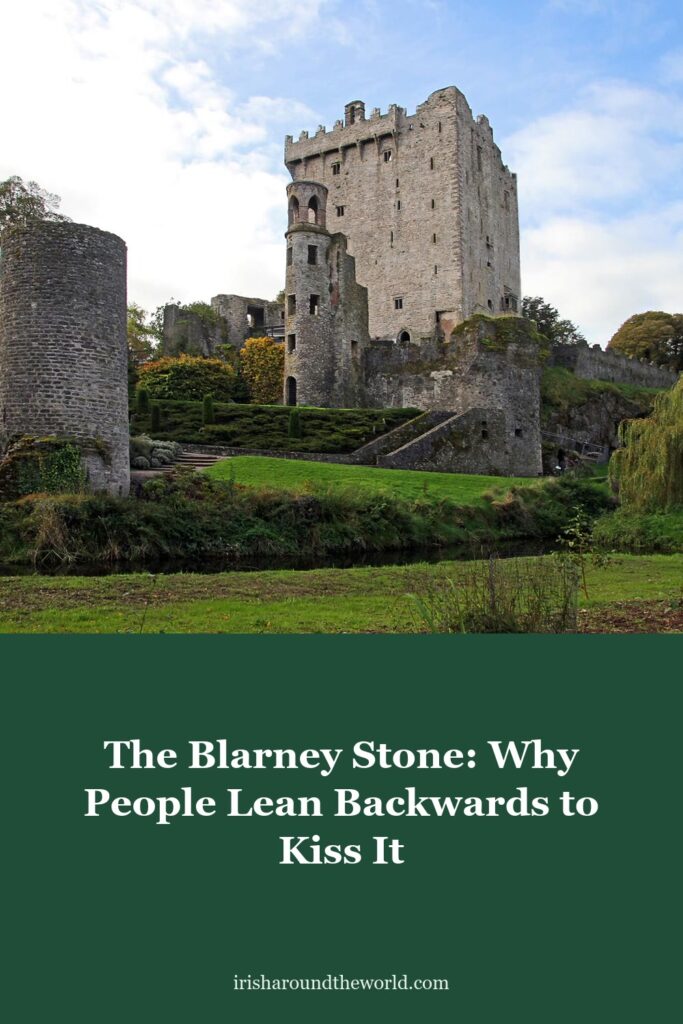
Pin image: Adapted from a photo by Gerd Eichmann, CC BY-SA 4.0, via Wikimedia Commons.
A little bit of Ireland in your inbox every Friday ☘️
The free Weekly Dose of Irish: an Irish joke, a Celtic symbol, an Irish fact, a poem and the week’s best articles in one short email. Join 9,600+ readers.
Free. One short email every Friday. Unsubscribe any time.
More Irish heritage reading
- Things to Do in County Cork: 10 Places a Corkonian Loves (2026)
- Facts About Cork, Ireland: Why We Call It the Real Capital
- 11 Famous Irish Castles: Their History, Legends and How to Visit
- The Hill of Tara: Ireland’s Hill of Kings, a Roaring Stone and a Hunt for the Ark
- Irish Slang Words and Phrases: What They Really Mean
- English Words From Irish: 27 You Use Every Day (and the Famous Fakes)
- The Giant’s Causeway: 40,000 Stone Columns, a Runaway Giant and How to Visit
Featured image: Blarney Castle in October 2017. Photo: Gerd Eichmann, CC BY-SA 4.0, via Wikimedia Commons.