The Hill of Tara, Teamhair in Irish, is a low ridge in Co. Meath remembered as the seat of Ireland’s high kings. People have used it for more than 5,000 years: its oldest visible monument, the Mound of the Hostages, is a Stone Age passage tomb. On the summit stands the Lia Fáil, the Stone of Destiny, which legend says cried out under the rightful king. The hill is an open site, free to visit all year.
Stand on the Hill of Tara on a clear day and the midlands roll away below you. There’s no palace here, just grassy rings and mounds, an old church and a few standing stones.
Then you hear the stories. Kings were made here, they say, and a stone screamed under the true one. St Patrick lit a fire in defiance of the king of Tara. And in Gone with the Wind, Scarlett O’Hara’s father, Gerald, is a County Meath man who calls his Georgia plantation Tara.
I’ve written about Niall of the Nine Hostages, one of the most famous kings of Tara in legend. Here’s the hill itself: what’s there, what the legends say, and how to visit.
Jump to:
- What is the Hill of Tara?
- The high kings of Tara
- The monuments on the Hill of Tara
- The Lia Fáil, the Stone of Destiny
- Kingship rituals and the Feast of Tara
- St Patrick and the Easter fire
- Daniel O’Connell’s monster meeting, 1843
- The British Israelites and the Ark of the Covenant
- The M3 motorway controversy
- Visiting the Hill of Tara
- Hill of Tara FAQ
- More Irish history and mythology reading
What is the Hill of Tara?
The Hill of Tara is a ridge about 2 km (1.2 miles) long between Navan and Dunshaughlin in Co. Meath, rising to about 155 m (510 ft). It isn’t high, but the archaeologist Conor Newman, in his 1997 survey for the Discovery Programme, describes views from the Wicklow Mountains to the Mourne Mountains.
Its Irish name is Teamhair (TYOW-er), and the hill is Cnoc na Teamhrach. Ó Dónaill’s dictionary gives teamhair as a word for an eminence or hill. A medieval glossary, Sanas Cormaic, explained the name as a height with a fine view, but the historian Edel Bhreathnach thinks it more likely meant a sacred space.
The site mattered from the late Stone Age, says the Office of Public Works (OPW), which cares for it, and rose to prominence in the Iron Age and early Christian period as the seat of the high kings.
The high kings of Tara: legend and history
In the early Middle Ages the kingship of Tara was usually held by the Uí Néill (ee NAYL), the dynasties that claimed descent from Niall. Later writers called each of them ardrí (ARD-ree), high king of all Ireland. Brian Boru, a Munster king, took the title from them in 1002.
How high was a high king? In 1958 the scholar D. A. Binchy concluded that the king of Tara was normally Ireland’s most powerful king, but that his rule over the provincial kings was largely fiction. The kings were inaugurated at Tara but didn’t live there, notes the Encyclopedia of Irish History and Culture.
Legends crowd the hill. Teach Chormaic, Cormac’s House, is named in tradition for the legendary king Cormac mac Airt, whose daughter flees her own betrothal feast at Tara in Diarmuid and Gráinne. In the tales of the Fianna, Fionn mac Cumhaill saves Tara from Aillén, a fairy who burned it every Samhain, as I tell in the Salmon of Knowledge.
The monuments on the Hill of Tara
More than 30 monuments are visible on the hill, almost all of them prehistoric, Newman’s survey found, and geophysics has revealed many more. The most startling, found in the late 1990s, is a huge ring-ditch flanked by some 300 timber posts, perhaps from about 2500 BC, the Discovery Programme reports. It’s about the size of Croke Park, Dublin’s 82,000-capacity stadium.
The names on the signs are medieval inventions, colourful explanations for older earthworks, University College Dublin’s archaeologists note.
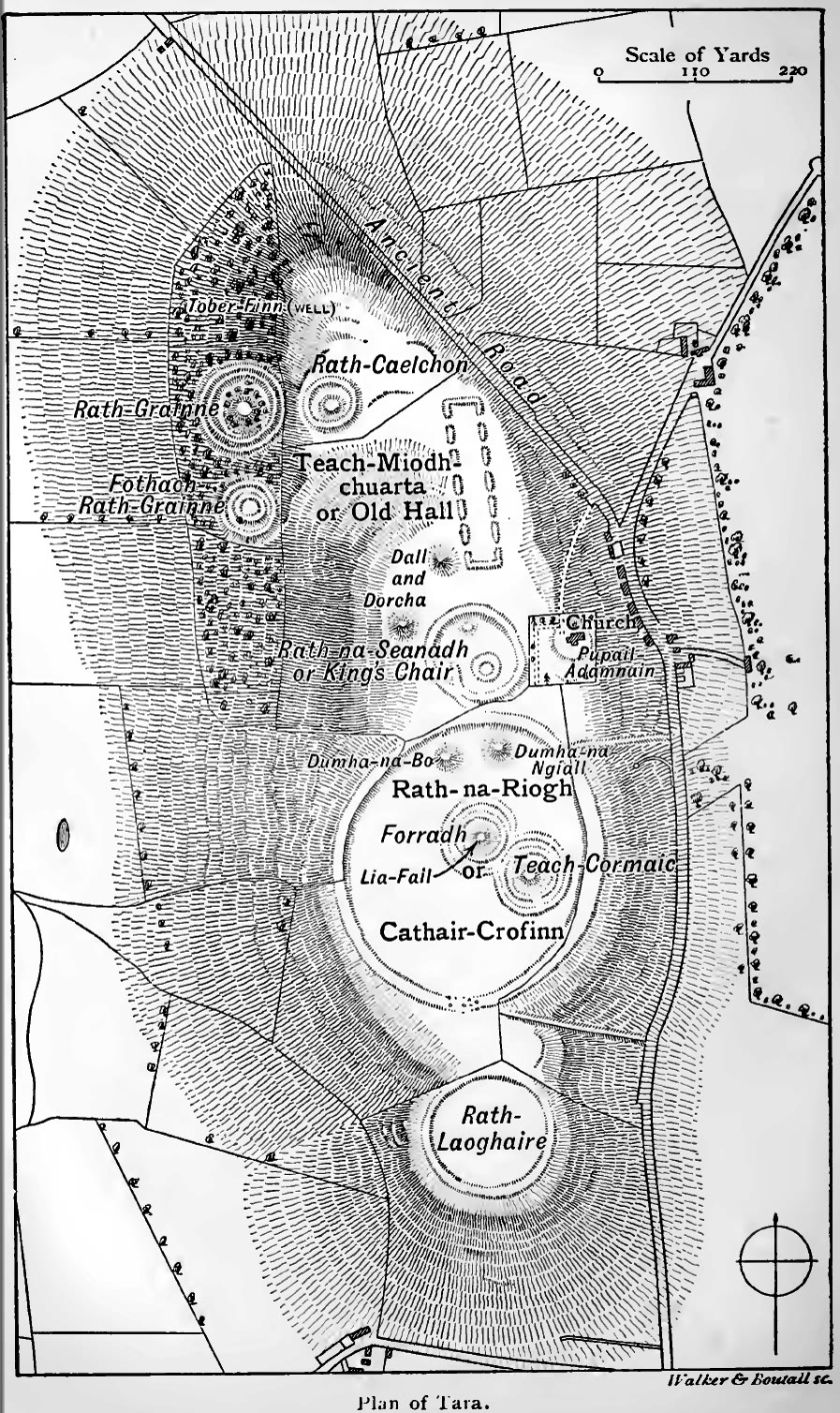
Plan of the Hill of Tara with its medieval names, from Wakeman’s Handbook of Irish Antiquities (1903). Public domain, via Wikimedia Commons
The Mound of the Hostages (Duma na nGiall)
The oldest visible monument is a small grassy mound with a doorway. Inside is a passage tomb, built in the centuries before 3000 BC, around the same time as Newgrange. When University College Dublin excavated it between 1955 and 1959, the tomb held the bones of more than 250 people, with dozens more in stone boxes outside its walls.
Radiocarbon dates put the first burials at about 3350 to 3100 BC, and the tomb stayed in use until about 1700 BC. The name suits the legend of Niall, but the tomb is thousands of years older than any king of Tara.
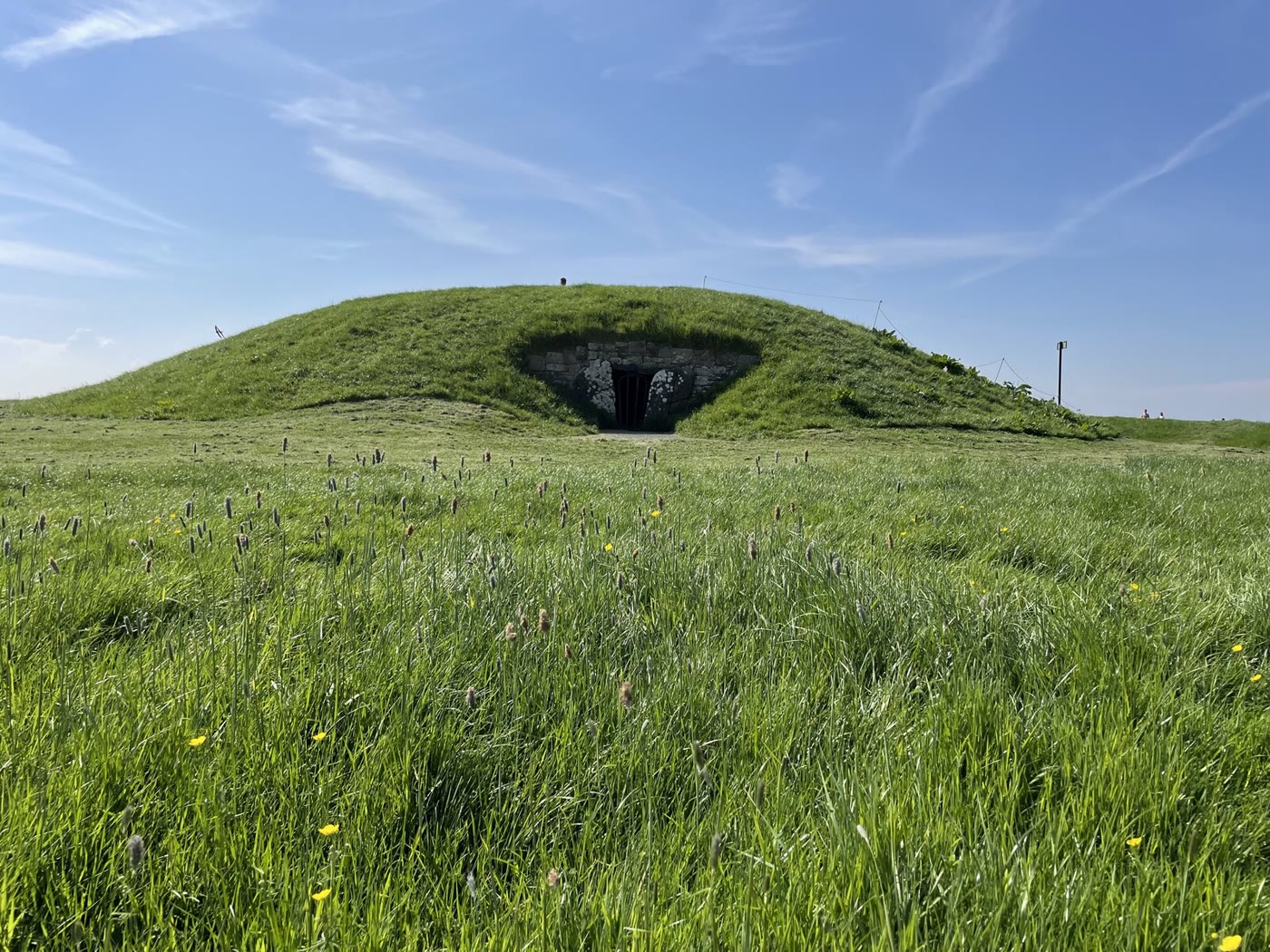
The Mound of the Hostages, a Stone Age passage tomb on the Hill of Tara. Photo: Nigel Thompson, CC BY-SA 2.0, via Wikimedia Commons
Ráith na Ríg, the Fort of the Kings
The biggest monument is Ráith na Ríg, the Fort of the Kings (Ráth na Ríogh, raw nuh REE, in later Irish). Its bank runs about 1 km (0.6 miles) around the summit, with the ditch inside it, like the royal sites of Navan Fort (Emain Macha) and Dún Ailinne.
A 1997 excavation found the ditch up to 3 m (10 ft) deep and 7 m (23 ft) wide, and dated the enclosure to the 1st century BC.
The Forradh and Teach Chormaic
Inside the Fort of the Kings, two earthworks sit side by side like a figure of eight: Teach Chormaic and the Forradh. Forradh comes from an old word for an earthen platform where spectators sat or stood, says the Electronic Dictionary of the Irish Language. Their dates are uncertain, though the OPW thinks the Forradh began as a prehistoric burial mound.
The Banqueting Hall (Teach Miodhchuarta)
On the northern slope, two parallel banks about 200 m (660 ft) long and 25 to 28 m (about 90 ft) apart run down the hill. Medieval writers saw a great feasting hall here, Tech Midchúarta, from mid, mead, and cúairt, a circuit, and the 12th-century Book of Leinster sets out who sat where.
Conor Newman argued in 2007 that it was really a sacred processional way to the summit, perhaps built as late as the early Middle Ages. The sign on the hill suggests a Stone Age ceremonial avenue instead. It has never been excavated.
The Rath of the Synods
Just north of the Fort of the Kings, partly within the churchyard, is the Rath of the Synods (Ráith na Senad), a multi-ringed enclosure. Seán P. Ó Ríordáin’s excavations in 1952 and 1953 found burials and Roman glass and pottery, mostly drinking vessels, from the 2nd to 4th centuries AD.
The Lia Fáil, the Stone of Destiny
On top of the Forradh stands a rounded pillar about 1.5 m (5 ft) high: the Lia Fáil (LEE-uh FAWL), the Stone of Destiny. Lia means a stone or pillar-stone, and Fál survives in Inis Fáil, an old name for Ireland that the 17th-century historian Geoffrey Keating traced to this stone.
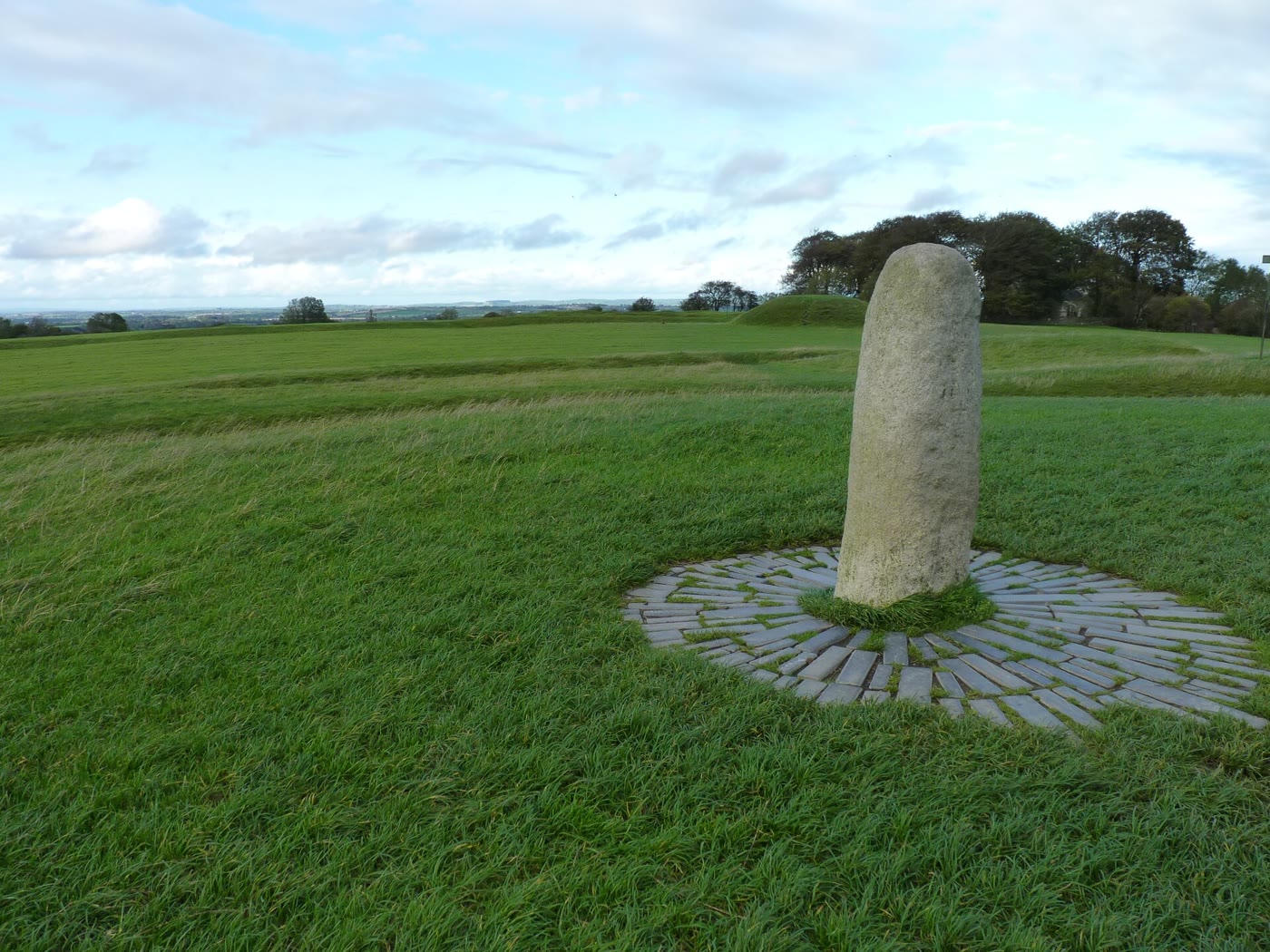
The Lia Fáil, or Stone of Destiny, on the Forradh, Hill of Tara. Photo: James Allan, CC BY-SA 2.0, via Wikimedia Commons
The legend of the roaring stone
In Cath Maige Tuired, the Second Battle of Mag Tuired, the Tuatha Dé Danann bring four treasures to Ireland: Lugh’s spear, Nuada’s sword, the Dagda’s cauldron and the Stone of Fál, said to cry out beneath each rightful king of Ireland. Keating gives Lugh both the spear and the sword.
In another tale, Baile in Scáil (The Phantom’s Frenzy), Conn of the Hundred Battles is keeping an early-morning watch on Tara’s ramparts when a stone screams under his foot. The whole plain of Brega hears it. His druids say each cry stands for one of his descendants who will be king.
Keating added that the stone fell silent when Christ was born, and repeated a Scottish claim that it became the Stone of Scone, Scotland’s coronation stone. P. W. Joyce rejected that in 1911, and rejected the Tara pillar too: coronation stones were small enough to stand on, he argued, and this one weighs over a ton.
Is it the real Lia Fáil?
Nobody can prove it. A medieval prose account placed the Fál beside the Mound of the Hostages, on its north side.
The pillar was moved to the Forradh to mark the grave of rebels killed in the Battle of Tara, during the 1798 Rebellion. The Discovery Programme says it came from beside the Mound of the Hostages in 1824. Joyce, who spoke to one of the men who moved it, said it came from the Forradh’s own ditch, about 1821.
The antiquarian George Petrie named the pillar as the Lia Fáil. In 2018 the Celtic scholar Grigory Bondarenko argued that the original shouldn’t be linked with standing stones at all, since a medieval gloss seems to picture a low, flat stone. The pillar may well be prehistoric, but its royal title may be a 19th-century guess.
Kingship rituals and the Feast of Tara
The Annals of Ulster record a Feast of Tara, feis Temro in Old Irish, held by Lóegaire son of Niall under 454. The last they record is Diarmait mac Cerbaill’s, entered under both 558 and 560.
What happened is debated. Ó Dónaill gives feis as a festival, with Feis Teamhrach (fesh TYOW-rukh) as the Tara Festival, but its older meanings include spending the night, sleeping together and marriage. The Annals of Connacht for 1310 even say a new king, installed at Carnfree in Roscommon, married the province.
Binchy argued that the real Feast of Tara was an ancient fertility rite that raised the new king to sacred status, dropped after Diarmait as a relic of paganism.
Scholars often link such rites with a symbolic marriage between king and land, which Irish tales picture as a woman: Conn meets the Sovereignty of Ireland in Baile in Scáil, and Niall has to kiss a hag at a well.
St Patrick and the Easter fire
The best-known Tara story comes from Muirchú’s Life of Patrick, written in the late 600s, about two centuries after the saint. Patrick chose to keep his first Easter in Ireland in the plain of Brega, camping at Ferta Fer Féic, the graves of the men of Féc.
That same night King Lóegaire was holding a pagan feast at Tara, which Muirchú calls their Babylon, and no fire could be lit before the king’s.
Patrick lit his Easter fire, and it blazed across the plain. The druids warned that if it was not put out that night, it would never go out. Lóegaire drove out with 27 chariots, but Patrick won every contest, and in the end the king gave way.
Later tradition put the fire on the Hill of Slane, about 16 km (10 miles) away and visible from Tara, and dated it to 433. Muirchú never names Slane, though, and where Ferta Fer Féic really was is uncertain.
Historians treat it as legend. Muirchú wrote for the church of Armagh, which wanted to lead the Irish church, and recast Patrick as a conquering hero on biblical lines, says Niamh Wycherley of Maynooth University.
Daniel O’Connell’s monster meeting, 1843
Daniel O’Connell declared 1843 the year of repeal, when the Act of Union would be undone. He held huge open-air “monster meetings” around the country, often at historic places, the Dictionary of Irish Biography notes. The most famous was at Tara on 15 August 1843.
Processions poured in from 18 surrounding towns, one carriage carrying a harper in old Irish costume, The Spectator reported. O’Connell told the crowd they stood where Ireland’s monarchs had been elected, and declared the Union void.
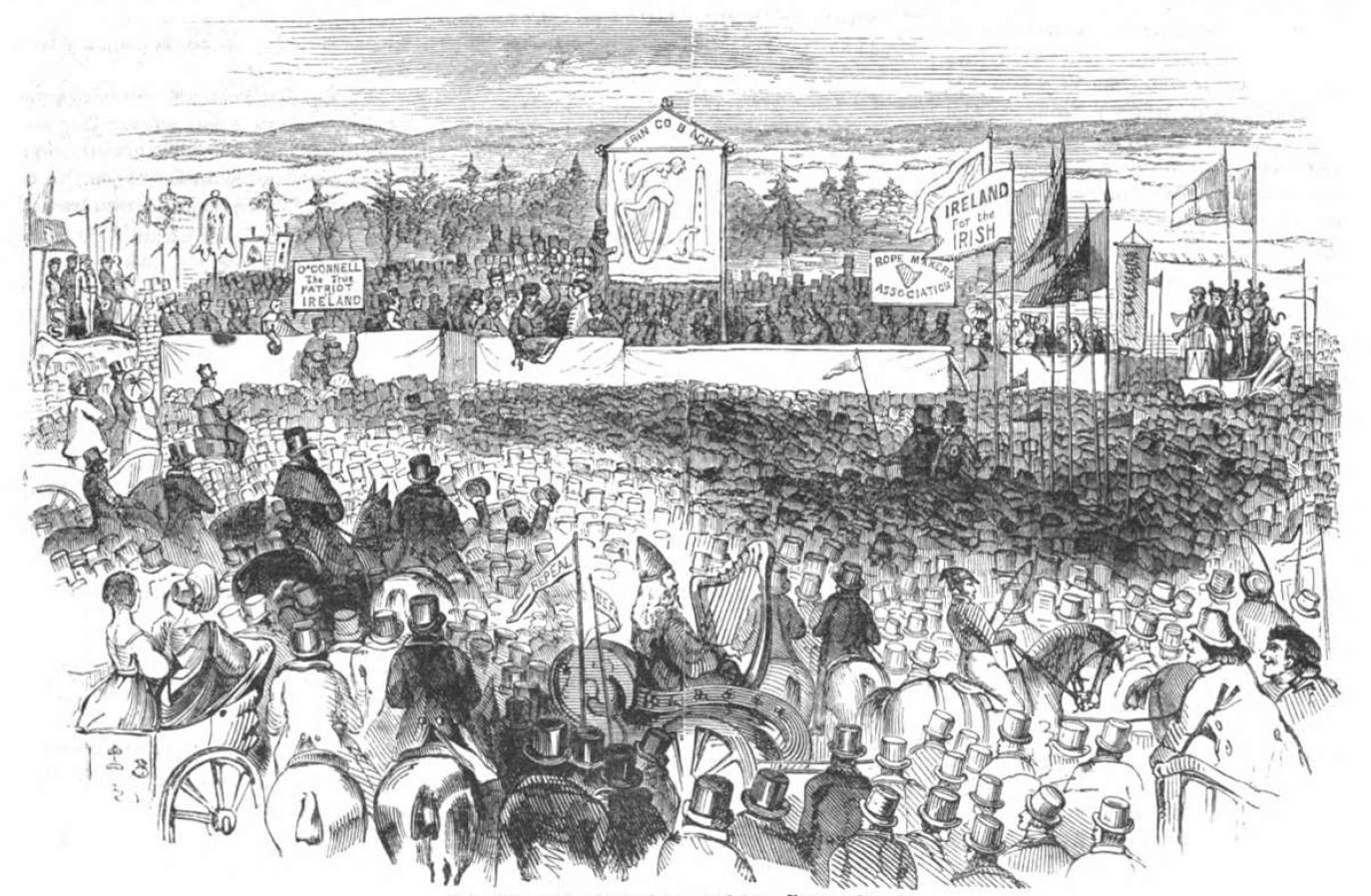
The repeal meeting on the Hill of Tara, 1843, as pictured by the Leipzig magazine Illustrirte Zeitung, 28 October 1843. Public domain, via Wikimedia Commons
How many came? Estimates at the time ran from 500,000 to over a million. The historian Gary Owens, in History Ireland, argues that pro-repeal figures for the monster meetings could be cut by as much as 75% and still be remarkable. Many at Tara, he adds, went home before the speeches began.
After a last huge rally at Mullaghmast, Co. Kildare, the government banned his Clontarf meeting, set for 8 October. O’Connell called it off to avoid bloodshed. He was convicted of sedition in 1844, and though the House of Lords overturned the verdict that September, the repeal campaign had lost its momentum.
The British Israelites and the Ark of the Covenant
In June 1899 Walton Adams and Charles Groom, of the British-Israel Association of London, began digging on the hill. Believing the British descended from the lost tribes of Israel, they hoped to find the Ark of the Covenant, said to hold the Ten Commandments.
The landowner, Briscoe, was a Freemason like them and let them dig, according to research by the archaeologist Mairéad Carew reported in The Irish Times. They cut rough trenches through the Rath of the Synods, UCD’s archaeologists note, and found no Ark.
Arthur Griffith attacked the diggers in his paper, the United Irishman. W. B. Yeats, Douglas Hyde and George Moore wrote to The Times in London, calling Tara perhaps the most sacred spot in Ireland.
In 1902 Maud Gonne brought a children’s excursion to the hill, where Briscoe had built a bonfire for Edward VII’s coronation. As she told Yeats in a letter, her party lit it for an independent Ireland instead and sang “A Nation Once Again”, to the fury of the police.
The digging stopped soon after. Carew’s book calls it the first press campaign to protect a national monument.
The M3 motorway controversy
The M3 motorway from Clonee to Kells was routed through the Tara-Skryne valley below the hill. An Bord Pleanála approved the route in 2003, and in 2005 the environment minister, Dick Roche, cleared the way for building once archaeological digs were done.
Opposition was fierce. Over 200 academics signed a letter to the Taoiseach (Irish prime minister), and the director of the National Museum objected to a planned interchange close to the hill. In 2007 the World Monuments Fund named Tara one of the world’s 100 most endangered heritage sites.
That same year, road archaeologists found what was probably a ritual site at Lismullin, in the valley beneath the hill: two circular enclosures, the larger about 80 m (260 ft) across, from between 1000 BC and AD 400. It was declared a national monument, then “preserved by record”: excavated in detail and built over. The motorway opened in 2010.
Visiting the Hill of Tara
The Hill of Tara is about 12 km (7.5 miles) south of Navan, just off the N3. From Dublin, take the M3, a toll road, to junction 7 and follow the signs. It’s an open site, free to walk at any time of year, says Discover Boyne Valley.
The OPW’s visitor centre, in St Patrick’s Church (built 1822, with a stained-glass window by Evie Hone), has an audio-visual show, and in season guides lead tours (€5 for an adult). The centre opens only in summer (daily from May to September in 2026), so check Heritage Ireland before you travel.
- Dress for the weather and uneven ground. Access for visitors with disabilities is limited.
- Keep dogs on a lead. Only assistance dogs may join tours or enter the visitor centre.
- Toilets and a gift shop are at the car park, just off the site.
- See the rag trees, hung with strips of cloth, a custom I cover in my guide to fairy forts. Please add nothing: in 2019 one toppled under the weight of its offerings.
- Make a day of it. Brú na Bóinne, home of Newgrange, is about 17 km (10.5 miles) away, and Trim Castle about 12 km (7.5 miles).
Hill of Tara FAQ
Why is the Hill of Tara important?
It was the seat of the kings of Tara, usually the most powerful kings in early medieval Ireland, and high kings were inaugurated there. Its oldest visible monument is over 5,000 years old.
Is the Hill of Tara free to visit?
Yes. The hill is free and open all year. Guided tours, when running, cost extra.
Was the Tara Brooch found at Tara?
No. It was reportedly found at Bettystown, on the Meath coast, in 1850. The Dublin jeweller George Waterhouse gave it the Tara name and used it to promote his copies, notes the National Library of Ireland.
Love this? Save it to your Pinterest board for later.
Pin image: the Hill of Tara from the air, with St Patrick’s Church among the trees. Photo: Alison Cassidy, CC BY-SA 4.0, via Wikimedia Commons.
A little bit of Ireland in your inbox every Friday ☘️
The free Weekly Dose of Irish: an Irish joke, a Celtic symbol, an Irish fact, a poem and the week’s best articles in one short email. Join 9,600+ readers.
Free. One short email every Friday. Unsubscribe any time.
More Irish history and mythology reading
- Niall of the Nine Hostages: The King Who Kissed a Hag, and the 3 Million DNA Claim
- Brian Boru: The High King Who Won the Battle of Clontarf and Lost His Life
- Celtic Gods and Goddesses: 15 Irish Deities and Their Stories
- Diarmuid and Gráinne: Ireland’s Great Runaway Love Story
- The Salmon of Knowledge: How One Burnt Thumb Made Fionn mac Cumhaill a Legend
- Newgrange Winter Solstice: The 5,000-Year-Old Tomb That Lights Up for 17 Minutes
- Fairy Forts and Fairy Trees: The Irish Places You Never Disturb
Featured image: the Hill of Tara from the air, with St Patrick’s Church among the trees. Photo: Alison Cassidy, CC BY-SA 4.0, via Wikimedia Commons.