
The Easter Rising, Éirí Amach na Cásca in Irish, was an armed rebellion against British rule that began in Dublin on Easter Monday, 24 April 1916. Rebels seized the General Post Office and other buildings, and Patrick Pearse read out the Proclamation of the Irish Republic in front of it. They surrendered on 29 April. About 485 people died, more than half of them civilians. The execution of 16 men afterwards turned many Irish people towards the rebels’ cause.
Around noon on Easter Monday 1916, a column of armed men and women set off from Liberty Hall in Dublin and took over the General Post Office. Soon afterwards, a schoolmaster and poet named Patrick Pearse stood outside and read out a declaration of an Irish Republic.
By Saturday, the heart of the city was in ruins and the rebels had surrendered. Much of the public was hostile to them. Then, over ten days in May, the British shot the leaders at dawn, a few at a time, and the mood of the country turned.
I’ve written about the poem these events inspired, Easter, 1916 by W. B. Yeats. This is the history behind it, and where to see it in Dublin today.
Jump to:
- What was the Easter Rising?
- The road to 1916: Home Rule, the IRB and the Volunteers
- The Aud, Casement and the countermand
- Easter Monday: the GPO and the Proclamation
- The garrisons: where the fighting happened
- Six days of fighting and the surrender
- The women of 1916
- The human cost
- The executions
- How the executions changed Ireland
- Where to see the Easter Rising in Dublin today
- Easter Rising FAQ
- More Irish history reading
What was the Easter Rising?
The Easter Rising was an armed rebellion against British rule, fought mostly in Dublin from 24 to 29 April 1916, to set up an independent Irish republic. It was planned in secret by the Irish Republican Brotherhood and fought by the Irish Volunteers, the Irish Citizen Army and the women of Cumann na mBan.
In Irish it’s Éirí Amach na Cásca (roughly AY-ree uh-MAKH nuh KAWS-kuh; in Connacht, amach sounds closer to uh-MAWKH), the uprising of Easter. Ó Dónaill’s dictionary also gives simply An tÉirí Amach, the Rising.
The road to 1916: Home Rule, the IRB and the Volunteers
For decades, most Irish nationalists wanted Home Rule: a Dublin parliament with limited powers, inside the United Kingdom. After the 1910 elections, John Redmond’s Irish Parliamentary Party held the balance of power at Westminster, and it finally looked likely.
Sir Edward Carson’s Ulster unionists set out to resist. In 1912 more than 200,000 men put their names to the Solemn League and Covenant against it, and the Ulster Volunteer Force followed in January 1913. Nationalists answered that November with the Irish Volunteers, under Eoin MacNeill.
Home Rule became law in 1914, with a plan to leave out some Ulster counties, but the First World War had begun and it was suspended. When Redmond urged Volunteers to enlist in the British Army, the movement split. About 170,000 followed him. About 10,000 stayed with MacNeill, and it was mainly they who rose in 1916, says the National Library of Ireland.
- The Irish Republican Brotherhood (IRB): a secret society founded on 17 March 1858 to win a republic, by force if need be. Its Military Council, formed in May 1915, planned the Rising without telling MacNeill or even the IRB’s own head.
- The Irish Citizen Army: set up by Jim Larkin and James Connolly in November 1913, during the Dublin Lockout, to protect workers from the police.
- Cumann na mBan (KUM-un nuh MAN), roughly the women’s association: founded on 2 April 1914 to support the Volunteers.
For the IRB, the war proved the old maxim: England’s difficulty was Ireland’s opportunity.
The Aud, Casement and the countermand
The plan relied on German guns. Sir Roger Casement, a former British consul honoured for exposing abuses in the Congo and Peru, had gone to Germany for arms. He got far less than he wanted and, convinced a rising without real German help was doomed, came home to try to stop it.
The arms ship, the Aud, arrived off Co. Kerry on Holy Thursday, 20 April, carrying 20,000 rifles, says Cobh Museum. No one met her. On Good Friday a German submarine landed Casement at Banna Strand, where he was soon arrested. Intercepted by the Royal Navy, the Aud was scuttled by her captain near the mouth of Cork Harbour.
Meanwhile MacNeill had discovered that the Volunteers’ Easter Sunday “manoeuvres” were cover for a rebellion. When he heard the guns were lost, he called them off in the Sunday Independent. The Military Council decided to go ahead anyway, at noon on Monday. Confused by the conflicting orders, Dublin’s battalions turned out at a fraction of their strength.
Easter Monday: the GPO and the Proclamation
The GPO on Sackville Street, now O’Connell Street, became the Provisional Government’s headquarters. Five of its seven members were inside, and the garrison, perhaps 350 strong, included the young Michael Collins and Seán Lemass.
Over the building flew a green flag lettered “Irish Republic”, alongside the green, white and orange tricolour. Then Pearse, as president of the Provisional Government, read the Proclamation outside.
The Proclamation and its seven signatories
Across its top, in Irish, is Poblacht na hÉireann (roughly POB-lukht nuh HAY-run; in Munster the stress moves to pob-LAKHT), the Irish Republic. It opens “Irishmen and Irishwomen” and guarantees “religious and civil liberty, equal rights and equal opportunities to all its citizens”.
Pearse drafted it, with ideas from Connolly and Thomas MacDonagh, says the National Library of Ireland. The printing was done at Liberty Hall on Easter Sunday, in two halves, because the printers were short of type.
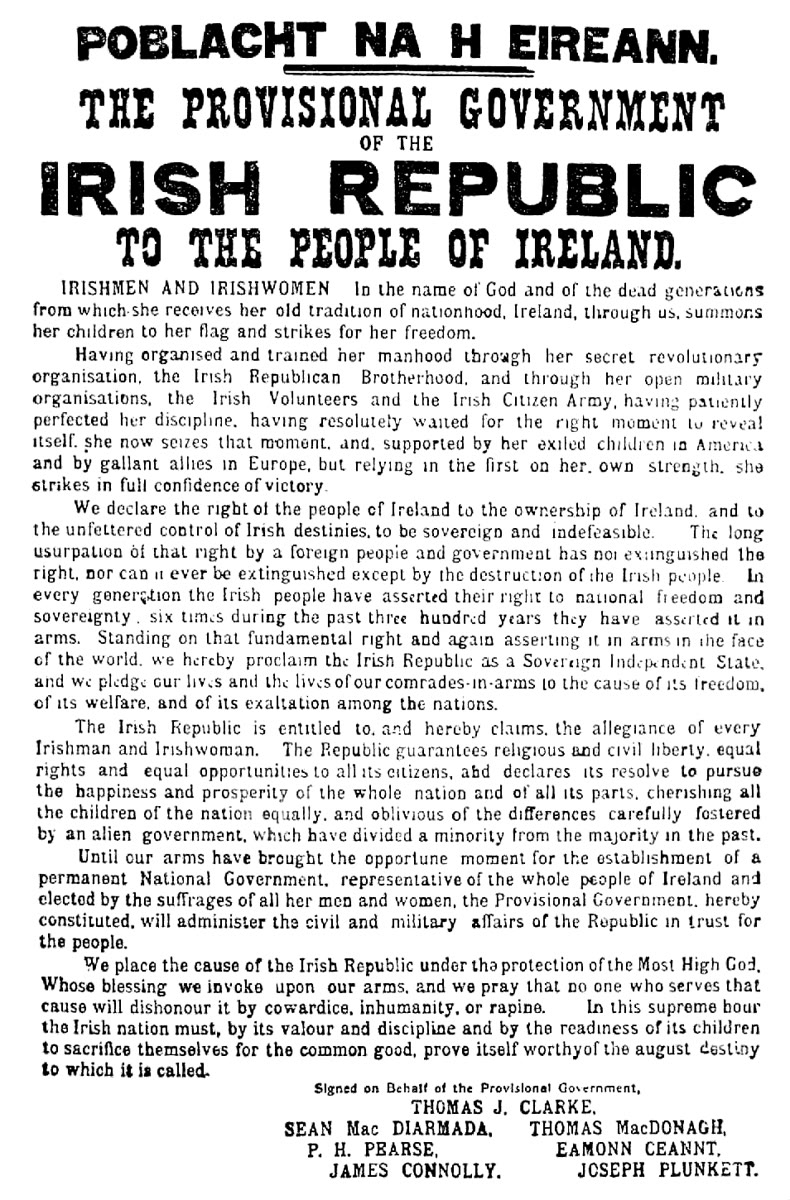
The signatories, in the order printed:
- Thomas J. Clarke: a veteran Fenian who had served 15 years in English prisons.
- Seán Mac Diarmada: the IRB’s chief organiser.
- Thomas MacDonagh: poet and university lecturer.
- P. H. Pearse: Pádraig Mac Piarais, founder of St Enda’s, an Irish-language school.
- Éamonn Ceannt: a Dublin Corporation clerk who taught Irish.
- James Connolly: trade union leader, who directed the fighting.
- Joseph Plunkett: poet, just out of hospital.
The garrisons: where the fighting happened
The rebels took strong buildings in a ring around the city centre, to block troops coming from the barracks and the port at Kingstown, now Dún Laoghaire.
- The Four Courts: Edward (Ned) Daly’s 1st Battalion, about 150 strong against a usual 400.
- Jacob’s biscuit factory: MacDonagh’s 2nd Battalion, with John MacBride. The British largely bypassed it.
- Boland’s Bakery: Éamon de Valera’s 3rd Battalion, guarding the railway and road from Kingstown. Only about 100 men reported.
- The South Dublin Union: a vast workhouse with about 3,200 residents, held by Ceannt’s 4th Battalion. A nurse, Margaretta Keogh, was killed there.
- St Stephen’s Green and the Royal College of Surgeons: the Citizen Army under Michael Mallin, with Constance Markievicz second in command. Machine guns in the Shelbourne Hotel drove them off the Green.
- City Hall: beside Dublin Castle. At the Castle gate, Citizen Army men shot dead an unarmed policeman, Constable James O’Brien, usually named as the first person killed in the Rising.
One of the biggest fights came on Wednesday at Mount Street Bridge. A few of de Valera’s men, seven of them in Clanwilliam House, held up troops marching in from Kingstown. More than 200 British soldiers were killed or wounded there, says the National Library.
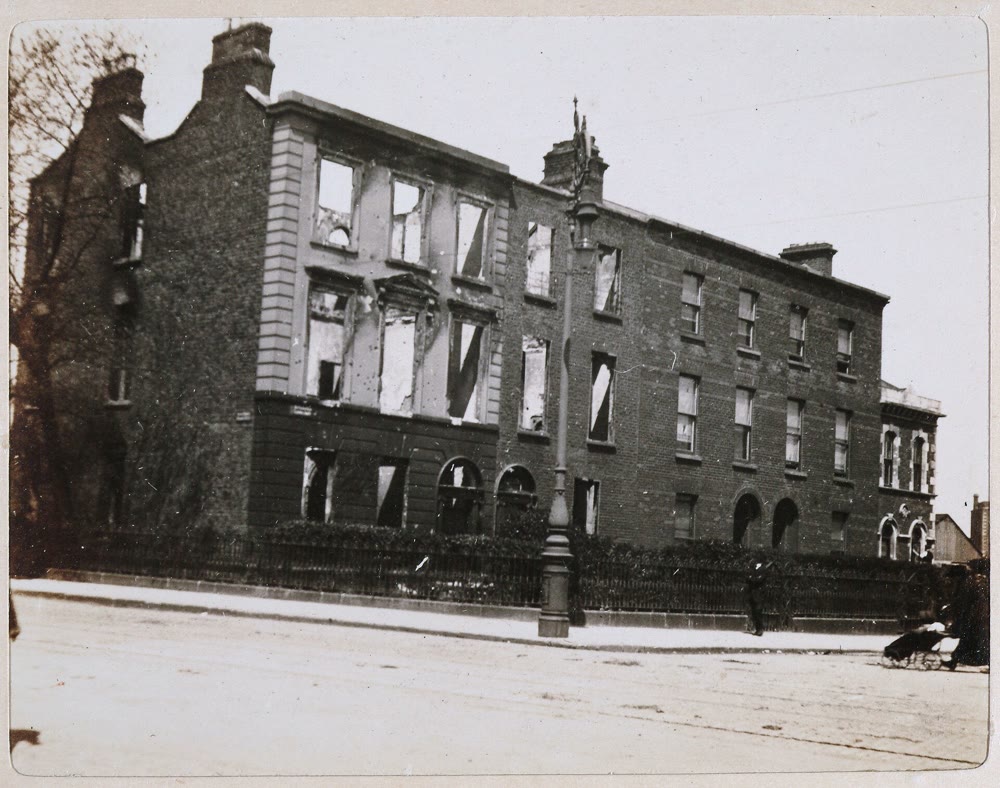
Clanwilliam Place at the corner of Mount Street, near Mount Street Bridge, photographed by Thomas Johnson Westropp on 18 May 1916. CC0, via Wikimedia Commons
Outside Dublin, Thomas Ashe’s Volunteers beat a larger police force at Ashbourne, Co. Meath, and Volunteers took over Enniscorthy in Co. Wexford.
Six days of fighting and the surrender
On Monday afternoon, Lancers charged down Sackville Street and were driven back by fire from the GPO. From Wednesday, artillery and the gunboat Helga on the Liffey shelled the area, and fires spread along the street. On Thursday Connolly was badly wounded in the ankle, but he kept directing operations from a stretcher.
On Friday evening, fire took hold of the GPO. The garrison escaped into Moore Street, and The O’Rahilly was fatally wounded leading a charge.
On Saturday morning the five leaders met in Hanlon’s fish shop at 16 Moore Street. Pearse wrote that they would negotiate to stop the killing of civilians and save their followers. At 12.45 p.m. Elizabeth O’Farrell of Cumann na mBan went out under a Red Cross flag to tell General William Lowe that Pearse wanted to talk terms.
Pearse surrendered unconditionally later that day. The surrender order, with the signatures of Pearse, Connolly and MacDonagh, didn’t reach some outposts until Sunday 30 April.
The women of 1916
For decades the women were barely mentioned, and the only firm figure was the 77 arrested afterwards. Using the Military Service Pensions files, historian Marie Coleman of Queen’s University Belfast puts the number involved closer to 250.
Most were in Cumann na mBan. They nursed the wounded, carried dispatches and moved arms, and they were in most of the main garrisons, says the Military Archives.
The Proclamation promised a government elected “by the suffrages of all her men and women”. No Irish woman could vote in a parliamentary election until December 1918.
Constance Markievicz
A daughter of the Gore-Booths of Lissadell House, Co. Sligo, Constance Markievicz was a Staff Lieutenant in the Citizen Army.
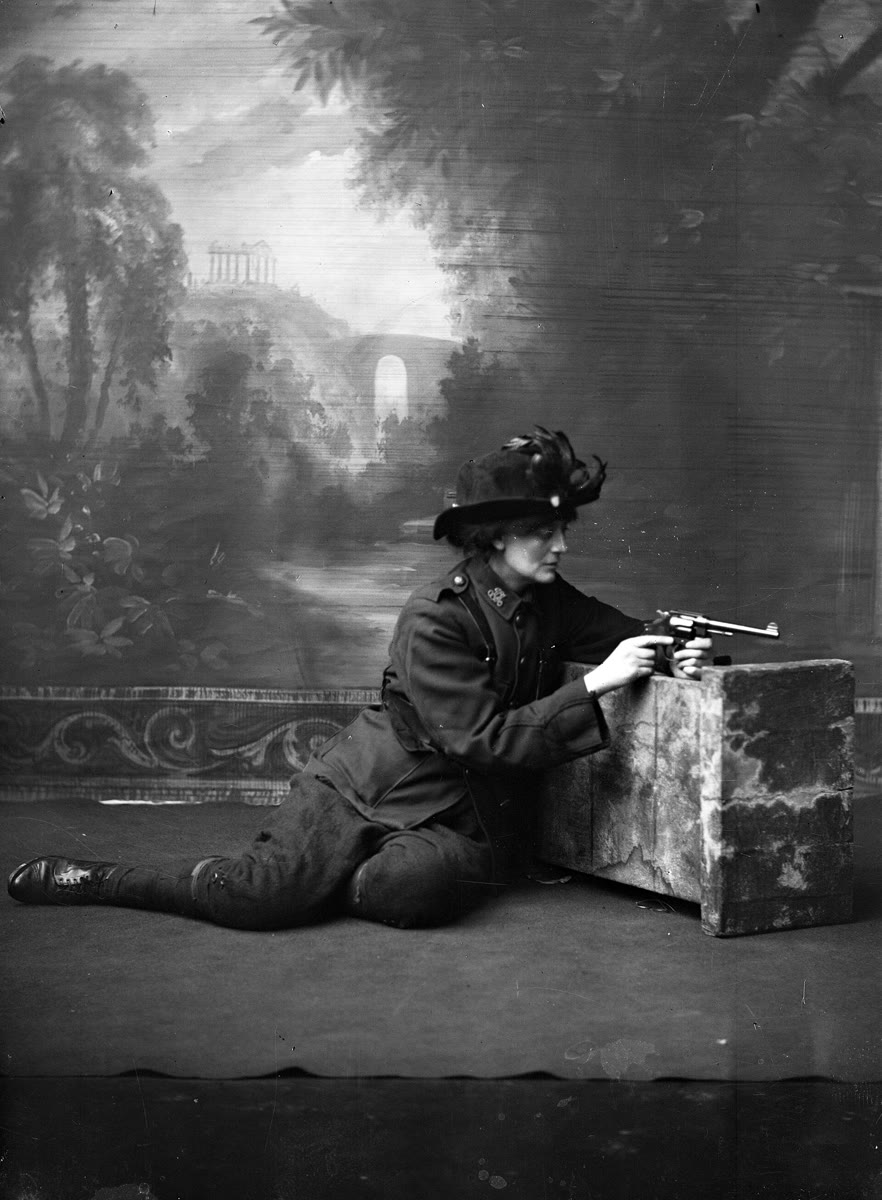
She was the only woman sentenced to death after the Rising, says the Central Statistics Office. It was commuted to life imprisonment, and she was freed in June 1917. In December 1918 she became the first woman elected to the House of Commons, though like the other Sinn Féin winners she refused to take her seat. In 1919 she became the Dáil’s Minister for Labour, the first Irish woman in a cabinet post.
Elizabeth O’Farrell: the nurse behind Pearse
After her walk to Lowe, the nurse Elizabeth O’Farrell carried the surrender order to other rebel positions, reaching de Valera’s garrison on the Sunday.
You’ll often read that she was airbrushed out of the famous photograph of Pearse’s surrender. The National Library’s caption is more cautious: the figure partly hidden behind Pearse is probably O’Farrell.
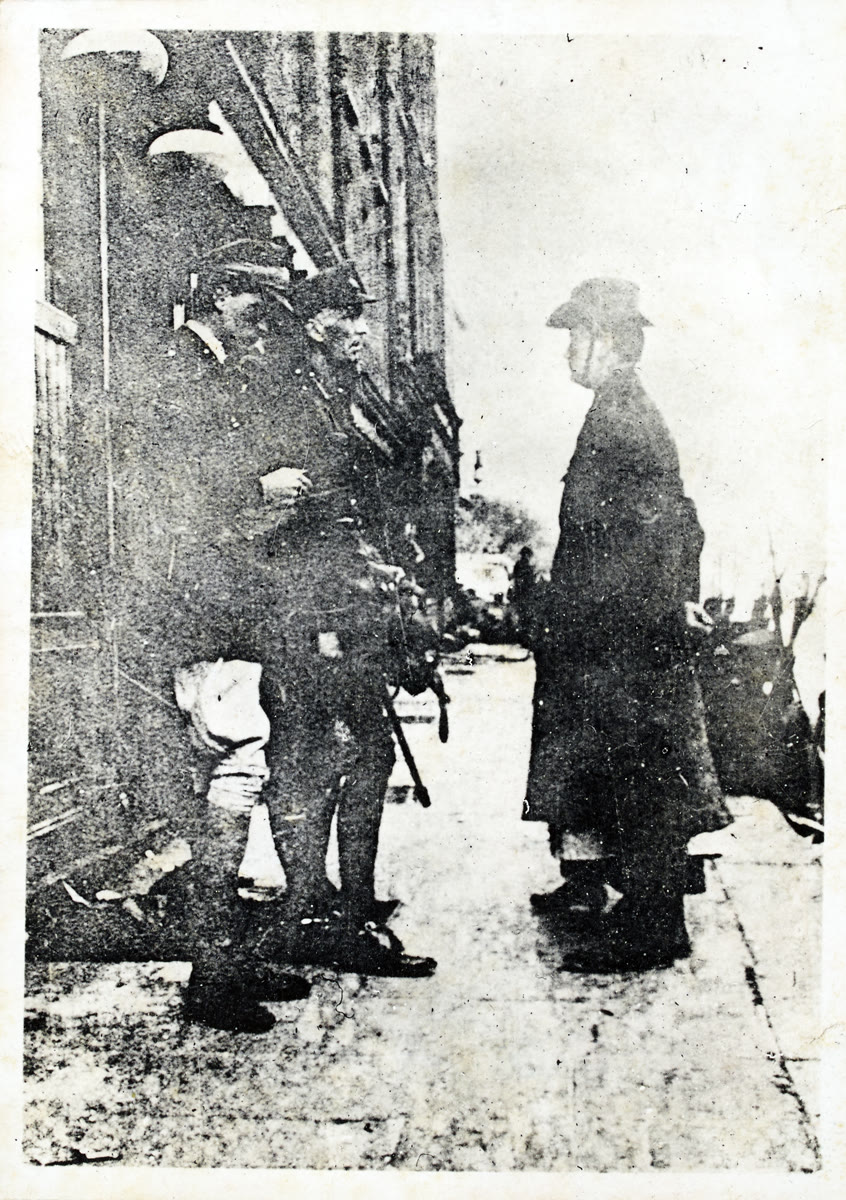
Patrick Pearse (right) surrenders to General William Lowe on 29 April 1916. The figure almost hidden behind Pearse is probably Elizabeth O’Farrell. National Library of Ireland, via Wikimedia Commons
The human cost
Glasnevin Trust’s 1916 Necrology, published in 2015, counts 485 people killed during the Rising or as a direct result, TheJournal.ie reported. Civilians were 54 per cent, roughly 260 people. The British Army lost 26 per cent of the total, the rebels 16 per cent, and the police the rest.
Almost one in five of the dead were under 19, and 40 were children. The worst day was Saturday 29 April, with 78 deaths, 45 of them civilians.
Some civilians were killed deliberately. The pacifist journalist Francis Sheehy-Skeffington, who had been trying to organise citizens against the looting, was arrested and shot in Portobello Barracks on the orders of Captain J. C. Bowen-Colthurst. Around North King Street, South Staffordshire troops killed several civilian men.
Unarmed men died at rebel hands too. On Monday, Volunteers near Mount Street fired on elderly home defence reservists, styled Georgius Rex and nicknamed the “Gorgeous Wrecks”, who carried rifles but no ammunition, killing or wounding several. Afterwards Pearse ordered his forces not to fire on anyone unarmed.
The executions
The British commander, General Sir John Maxwell, chose a hard line. Courts martial sat behind closed doors. Most of the death sentences they passed were commuted to prison terms, but 16 men were executed in all, 14 of them by firing squad in the Stonebreakers’ Yard at Kilmainham Gaol:
- 3 May: Patrick Pearse, Thomas Clarke and Thomas MacDonagh.
- 4 May: Joseph Plunkett, Edward Daly, Michael O’Hanrahan and Willie Pearse.
- 5 May: John MacBride.
- 8 May: Éamonn Ceannt, Michael Mallin, Seán Heuston and Con Colbert.
- 12 May: Seán Mac Diarmada and James Connolly.
The night before his execution, Plunkett married his fiancée, Grace Gifford, in Kilmainham, and his religious poem The Splendour of God reads differently in that light. Pearse’s The Wayfarer is said to date from his last days, and Francis Ledwidge mourned his friend in Lament for Thomas MacDonagh. Connolly was so badly wounded that he could not stand before the firing squad.
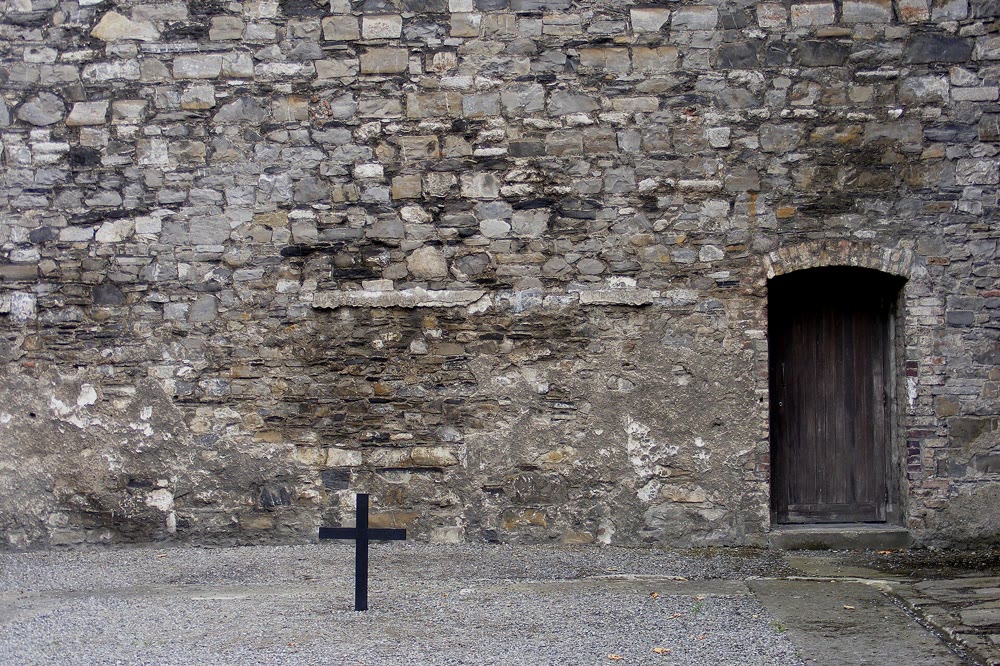
A black cross marks a place of execution in the yard at Kilmainham Gaol. Photo: Eweht, CC BY-SA 3.0, via Wikimedia Commons
The 14 were buried in a quicklime pit at Arbour Hill. Thomas Kent was shot in Cork on 9 May, after a gun battle at his family’s home in which a policeman was killed; in 2015 his remains were found at Cork Prison and given a state funeral. Roger Casement, the only one tried in public, was hanged for high treason at Pentonville Prison in London on 3 August 1916. His remains came home in 1965 for burial at Glasnevin.
How the executions changed Ireland
At first, much of the public was against the rebels, the GPO Museum notes. Some 80,000 Irishmen had joined the British Army in the war’s first year, and the Rising had wrecked the centre of Dublin.
The executions changed that. On 11 May the Irish Party’s John Dillon protested in the House of Commons that they were turning Irish opinion. The next day Prime Minister Asquith came to Dublin, and that morning Connolly and Mac Diarmada were shot. With Sheehy-Skeffington’s killing and its cover-up, Casement’s hanging and martial law, even moderate nationalists were angered, says the National Library.
Yeats caught the change in Easter, 1916, with its refrain “A terrible beauty is born.”
About 2,000 prisoners were held in jails and camps in Britain, such as Frongoch in Wales, which became schools for the next phase of the struggle. A British attempt to extend conscription to Ireland in 1918 won Sinn Féin still more support. In the December 1918 general election, it won 73 of Ireland’s 105 seats, and on 21 January 1919 the 27 of its MPs who could attend met in Dublin’s Mansion House as Dáil Éireann.
The War of Independence (1919 to 1921) followed, then the Anglo-Irish Treaty that created the Irish Free State, and a bitter Civil War (1922 to 1923). Ireland became a republic in 1949. Rising veterans including W. T. Cosgrave, Éamon de Valera and Seán Lemass went on to lead the state.
Where to see the Easter Rising in Dublin today
These details were checked in October 2026, but prices and hours change, so check before you go.
- GPO Museum: in the GPO on O’Connell Street, rebuilt and reopened in 1929. Monday to Saturday, 10:00 to 17:00 (last admission 16:00), closed Sundays and public holidays. Adults €15 online, €17 at the door. See the GPO Museum.
- Kilmainham Gaol: where the 14 were shot, now run by the OPW. Guided tours only, booking essential, adults €8. Heritage Ireland warns that kilmainhamgaolmuseum.ie is the only legitimate ticket site. Allow 90 minutes. It’s in my guide to things to do in Dublin.
- Arbour Hill: the grave of the 14, behind the National Museum at Collins Barracks, with the Proclamation carved on a granite wall. Guided tours on Fridays at 14:00, April to October.
- Glasnevin Cemetery: the Irish History Tour visits the graves of Markievicz, de Valera and Michael Collins. Casement lies here too.
- Pearse Museum: St Enda’s Park, Rathfarnham, where Pearse ran his school from 1910 to 1916.
- 1916 Children’s Commemorative Play Garden: St Audoen’s Park, Cook Street, Dublin 8, opened in 2019 for the 40 children.
Easter Rising FAQ
When was the Easter Rising?
From Easter Monday, 24 April, to Saturday, 29 April 1916. Some garrisons got the surrender order only on Sunday 30 April.
Why did the Easter Rising happen?
Its leaders wanted an independent Irish republic, won by force. Home Rule had been shelved for the First World War, and the IRB saw the war as its chance.
How many people died in the Easter Rising?
485, according to Glasnevin Trust’s 1916 Necrology. More than half were civilians, and 40 were children.
Who signed the 1916 Proclamation?
Thomas J. Clarke, Seán Mac Diarmada, Thomas MacDonagh, Patrick Pearse, Éamonn Ceannt, James Connolly and Joseph Plunkett. All seven were executed.
How many leaders were executed after the Easter Rising?
Sixteen: 14 at Kilmainham Gaol, Thomas Kent in Cork and Roger Casement in London.
Love this? Save it to your Pinterest board for later.
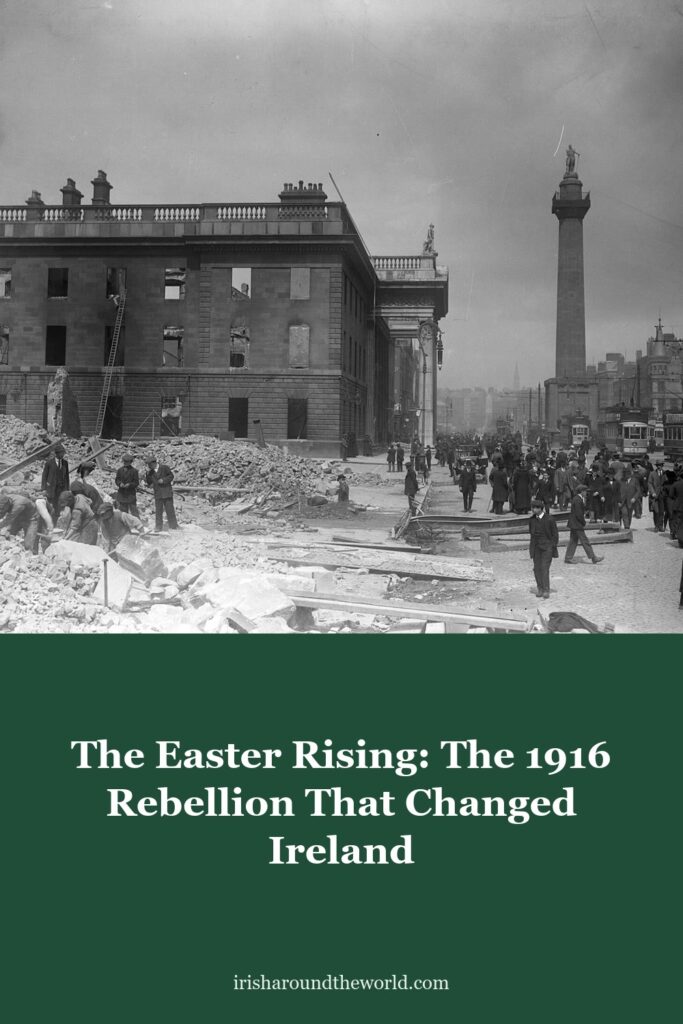
Pin image: Keogh Brothers Ltd., National Library of Ireland, no known copyright restrictions, via Wikimedia Commons.
A little bit of Ireland in your inbox every Friday ☘️
The free Weekly Dose of Irish: an Irish joke, a Celtic symbol, an Irish fact, a poem and the week’s best articles in one short email. Join 9,600+ readers.
Free. One short email every Friday. Unsubscribe any time.
More Irish history reading
- Easter, 1916 by W.B. Yeats: Meaning and Analysis
- The Irish Flag: The Incredible History And Story Behind The Tricolour
- The Wayfarer by Pádraig Pearse: The Poem He Wrote the Night Before His Execution
- I See His Blood Upon the Rose: Poem, Meaning and Plunkett’s Story
- Lament for Thomas MacDonagh by Francis Ledwidge: A Poem for a Fallen 1916 Leader
- Kilmainham Gaol: Dublin’s Rebel Prison, a Candlelit Wedding and the Stonebreakers’ Yard
Featured image: The burned-out shell of the GPO on Sackville Street (now O’Connell Street) after the Rising, with Nelson’s Pillar beyond, May 1916. Photo: Keogh Brothers Ltd., National Library of Ireland, no known copyright restrictions, via Wikimedia Commons.