
Kilmainham Gaol, Príosún Chill Mhaighneann in Irish, is a former Dublin prison that opened in 1796 and held its last prisoners in January 1924. Debtors, Famine-era thieves, children and convicts bound for Australia passed through it, along with Irish rebels from the 1790s to the Civil War. Fourteen leaders of the 1916 Rising were shot in its Stonebreakers’ Yard. Volunteers rescued the ruin in the 1960s, and the Office of Public Works now runs it as a museum, open by guided tour only.
On the night of 3 May 1916, a young artist named Grace Gifford stood in a prison chapel lit only by candles and married Joseph Plunkett, a sick young poet who had signed the Proclamation of the Irish Republic. Two soldiers were the witnesses. Within hours, Plunkett faced a firing squad in the prison yard.
That chapel is in Kilmainham Gaol, and the wedding is only one of its stories. For well over a century, the gaol held debtors, petty thieves, hungry Famine families, children and almost every generation of Irish rebels.
I’ve told Plunkett’s own story alongside his poem I See His Blood Upon the Rose. Here’s the whole gaol: its prisoners, the Stonebreakers’ Yard, the volunteers who saved it, and how to get a ticket.
Jump to:
- What is Kilmainham Gaol?
- The New Gaol of 1796
- Debtors, children and the Famine
- Rebels and prisoners, 1796 to 1883
- 1916: the Stonebreakers’ Yard
- Joseph Plunkett and Grace Gifford
- War of Independence and Civil War
- Saved by volunteers
- Kilmainham Gaol on screen
- Visiting Kilmainham Gaol
- Kilmainham Gaol FAQ
- More Irish history reading
What is Kilmainham Gaol?
Kilmainham Gaol is a former prison about 3.5 km west of Dublin city centre. Built as Dublin’s new county gaol, it took its first prisoners in 1796. The Office of Public Works (OPW) now runs it as a museum, and Heritage Ireland counts it among the biggest disused gaols in Europe.
Gaol is an old spelling of jail, pronounced the same way.
In Irish it’s Príosún Chill Mhaighneann (roughly PREE-soon hill WINE-yun; in Munster Irish the mh sounds closer to a v, so VINE-yun). Cill Mhaighneann means the church of Maighneann. The place-name scholar P. W. Joyce wrote in the 1800s that St Maighneann served there as bishop and abbot in the early 600s, and that the English-looking -ham ending crept in later.
The New Gaol of 1796
Building began in 1786 on Gallows Hill, near the old county gaol, and cost the Grand Jury of County Dublin £22,000. The architect was John Trail, and at first people called it the New Gaol.
Reformers such as John Howard wanted single cells and healthier prisons, so Kilmainham was built of limestone and granite on high ground, for drainage and fresh air. It was still grim. Prisoners used chamber pots in their cells, and the only heat and light came from rationed candles. Gas lighting arrived in the 1840s.
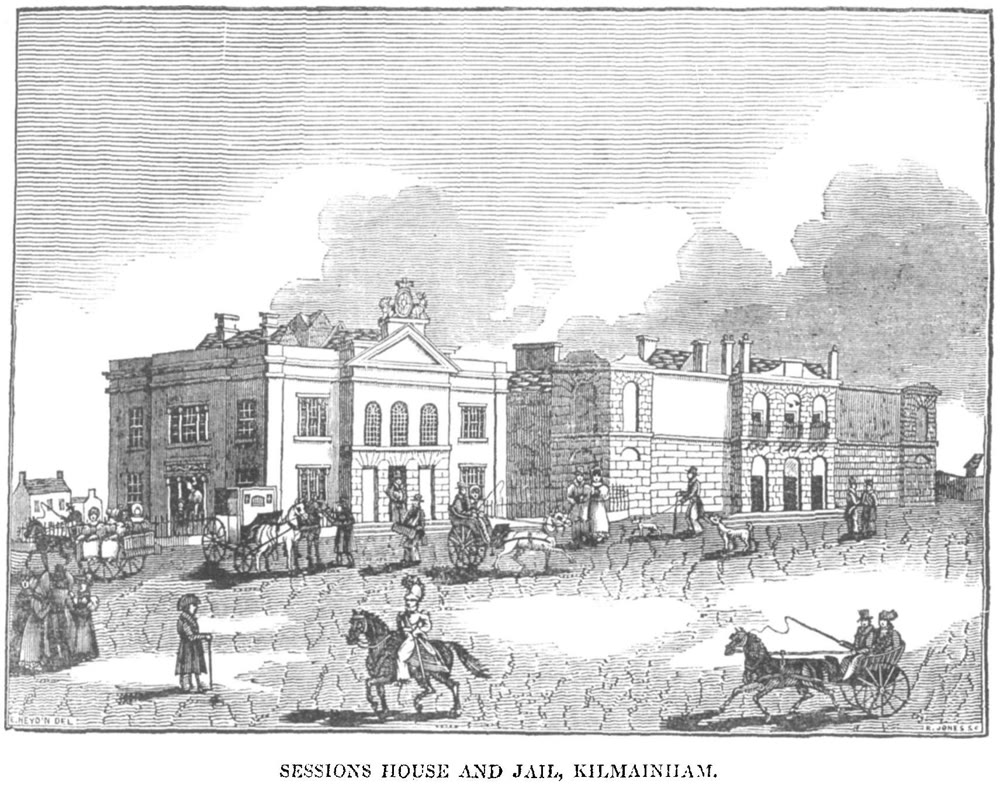
The Sessions House and Jail, Kilmainham, engraved by R. Jones after E. Heyd’n for the Dublin Penny Journal, 9 January 1836. Public domain, via Wikimedia Commons
Look up at the old front door. Above it, five carved serpents coil around each other. Some call them dragons, others demons or a hydra, and tradition says they stand for five crimes: murder, rape, theft, treason and piracy. Public executions took place right outside this door, says the museum, until the late 1800s.
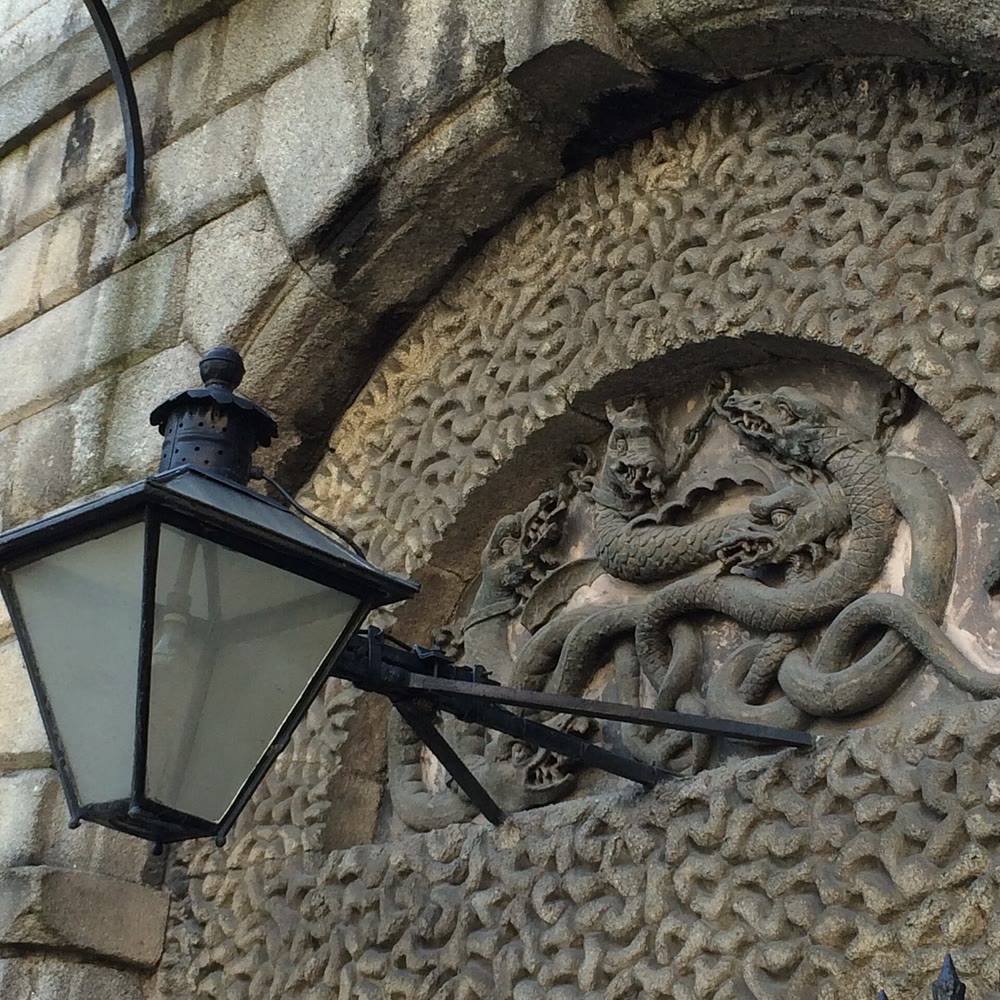
The carved serpents above the door of Kilmainham Gaol. Photo: Becky McReynolds, CC BY-SA 4.0, via Wikimedia Commons
In 1861 a new East Wing opened, designed by John McCurdy on the Panopticon idea: all 96 cells can be watched from one central point, under a huge skylight. The cell windows were set too high to see out of, to turn prisoners’ thoughts heavenward, or so the theory went.
Debtors, children and the Famine
Most prisoners were never rebels. When the gaol opened, half of them were debtors, often for tiny sums. Others were there for theft, assault, rape, murder, bigamy, illegal distilling or forging coins. Beggars and people with mental illness were locked up too.
Overcrowding meant that until the 1860s at least, says the museum, adults and children, men and women, were never fully separated. A mother with a baby under a year old often kept it with her. Children had their own small exercise yard, and those serving more than two weeks got a weekly lesson from the chaplain.
Overcrowding was worst during the Great Famine. Food theft soared, and some people broke the law just to be fed in prison. The Vagrancy Act of 1847, which made beggars liable to arrest, packed the gaol further. That year the Inspector General reported prisoners “obliged to lie on straw in the passages”, and fever and dysentery spread. Cells built for one held up to five.
Potatoes vanished from prison meals until 1855. A matron’s docket from 21 October 1849 sets out the day’s food for 92 women and 18 children. Breakfast was mostly stirabout (porridge) with milk; dinner was bread and milk. There’s more in my guide to the Irish Potato Famine.
Kilmainham was also a holding depot for convicts waiting to be shipped to Australia’s penal colonies. More than 4,000 passed through before the early 1850s. The museum still has the small black box in which one of them, John Sheahan of Kildimo, Co. Limerick, took all his belongings to Van Diemen’s Land, landing at Hobart in April 1843.
Rebels and prisoners, 1796 to 1883
The United Irishmen and Robert Emmet
Henry Joy McCracken, a Belfast United Irishman, was held from October 1796 to December 1797. After leading the 1798 rising in Co. Antrim, he was hanged that July.
Robert Emmet arrived in 1803. After his failed Dublin rising that July, he was caught while trying to see his fiancée, Sarah Curran. Convicted of high treason on 19 September, he gave his celebrated speech from the dock. He was executed on Thomas Street the next day, aged 25. His body was brought back to Kilmainham, and where he’s buried is still a mystery.
His servant and messenger, Anne Devlin, was held here too. Despite brutal treatment she refused to tell the soldiers where he was hiding, and she spent more than two years in prison.
Young Ireland and the Fenians
After the Young Ireland rising of 1848, William Smith O’Brien and Thomas Francis Meagher were held here. Both were sentenced to death, then transported instead to Van Diemen’s Land (Tasmania). Meagher escaped to America and led the Irish Brigade in the Civil War. Fenians were held in the new East Wing in the late 1860s.
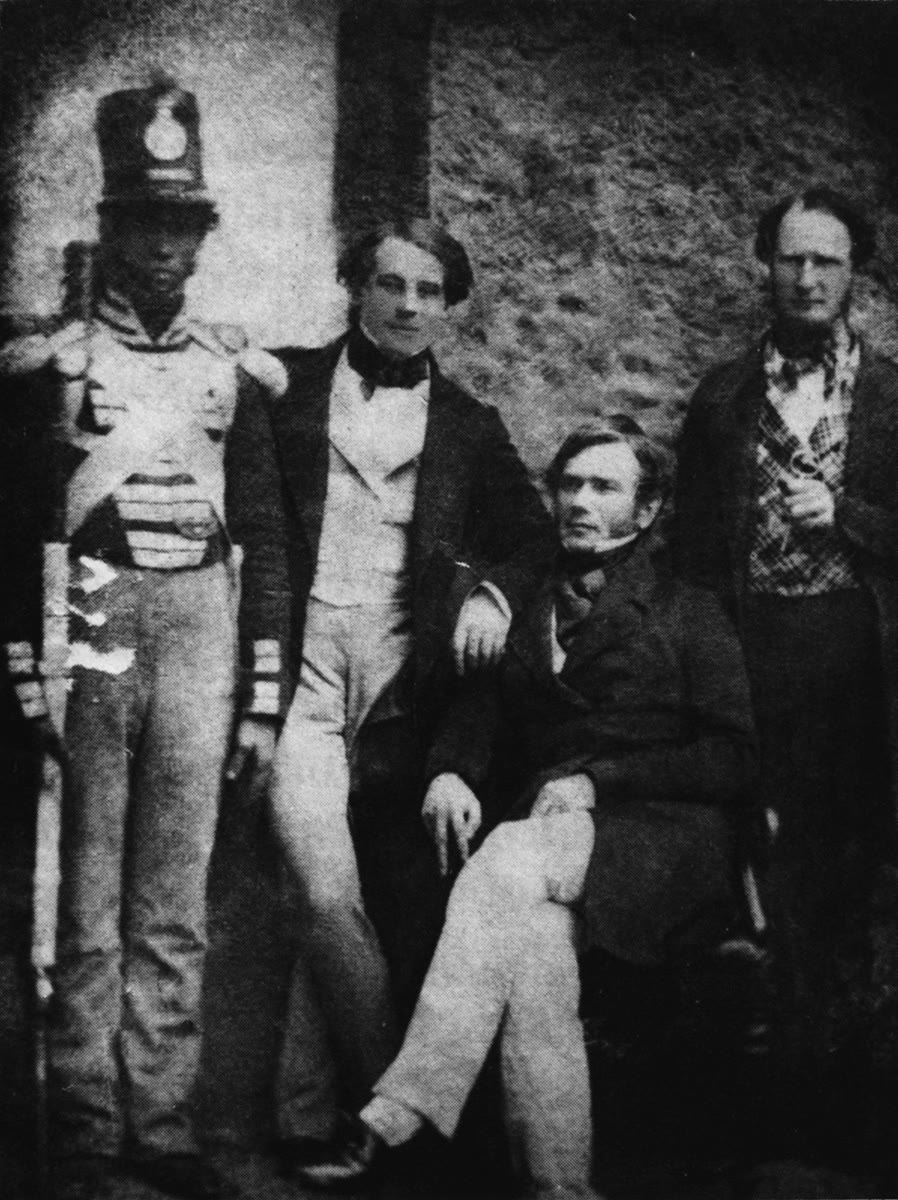
William Smith O’Brien (seated) and Thomas Francis Meagher with a soldier and a jailer, probably at Kilmainham Gaol, 1848. Daguerreotype attributed to Leon Gluckman. Public domain, via Wikimedia Commons
Parnell and the Kilmainham Treaty
Charles Stewart Parnell, the Irish nationalist leader, was arrested in October 1881 and held here for about six months. Unlike poorer inmates, he furnished several cells with his own things and saw visitors freely. Meanwhile, the Land League’s No-Rent Manifesto urged tenants to stop paying rent.
In April 1882 Prime Minister William Gladstone’s government opened talks with him. Under the informal deal that followed, known as the Kilmainham Treaty, the government would help tenants with their rent arrears and Parnell would use his influence against agrarian violence. He walked out on 2 May 1882.
Four days later, a secret society called the Invincibles stabbed the new Chief Secretary, Lord Frederick Cavendish, and the Under-Secretary, Thomas Henry Burke, to death in the Phoenix Park. Five Invincibles were hanged inside Kilmainham in 1883.
1916: the Stonebreakers’ Yard
In 1910 Kilmainham’s inmates were moved to Mountjoy, and the gaol closed a year later. The British Army took it over and, from 1914, used it as a barracks for recruits and a military prison.
That’s why the leaders of the Easter Rising ended up here. Most were court-martialled at Richmond Barracks after the surrender, sentenced to death and moved to Kilmainham, where some saw their families and wrote last letters. James Connolly, badly wounded, was held and tried at Dublin Castle.
Fourteen men faced firing squads in the Stonebreakers’ Yard, where prisoners on hard labour had once broken stones. The executions took place at dawn, says RTÉ’s Century Ireland:
- 3 May: Patrick Pearse, Thomas Clarke and Thomas MacDonagh
- 4 May: Joseph Plunkett, Edward Daly, Michael O’Hanrahan and Willie Pearse
- 5 May: John MacBride
- 8 May: Éamonn Ceannt, Michael Mallin, Seán Heuston and Con Colbert
- 12 May: James Connolly and Seán Mac Diarmada
Seven of them had signed the Proclamation. A 15th man, Thomas Kent, was shot in Cork on 9 May. Connolly was too badly wounded to stand. Fr Aloysius Travers, a Capuchin priest who sat beside him in the ambulance, recalled that he was in a chair when the order to fire was given.
Fr Aloysius had also spent Pearse’s last night with him and lent him a crucifix. Pearse scratched his initials, PMP (for Pádraig Mac Piarais), into it with a pin before handing it back. It’s in the museum’s collection, along with the rosary beads MacDonagh held when he was shot. Countess Constance Markievicz was held in the gaol that May too.
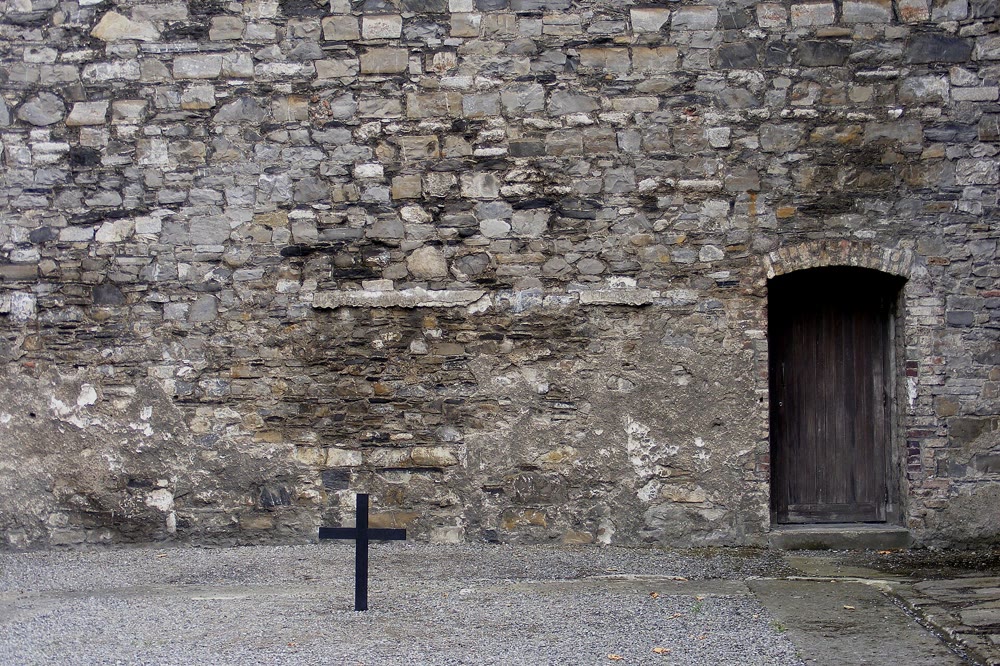
The Stonebreakers’ Yard at Kilmainham Gaol, where 14 leaders of the 1916 Rising were executed. Photo: Eweht, CC BY-SA 3.0, via Wikimedia Commons
The executions, followed by martial law, helped swing public opinion behind the rebels. W. B. Yeats named four of the dead in his poem Easter, 1916.
Joseph Plunkett and Grace Gifford
Grace Gifford, a Rathmines artist, had trained at the Dublin Metropolitan School of Art. She and Plunkett got engaged in December 1915 and planned to marry on Easter Sunday 1916. The Rising got in the way.
Once he was sentenced to death, Plunkett asked to marry her first. That Wednesday, 3 May, she bought a ring at a Grafton Street jeweller’s and went to the gaol that evening. Her sister Muriel’s husband, Thomas MacDonagh, had been shot in the Stonebreakers’ Yard that morning.
They married in the Catholic chapel by the light of prison candles. Fr Eugene McCarthy performed the ceremony, with two soldiers as witnesses. Plunkett’s handcuffs came off for the vows and went back on afterwards. Apart from their vows the couple weren’t allowed to speak, and they were never left alone. He was shot a few hours later, aged 28.
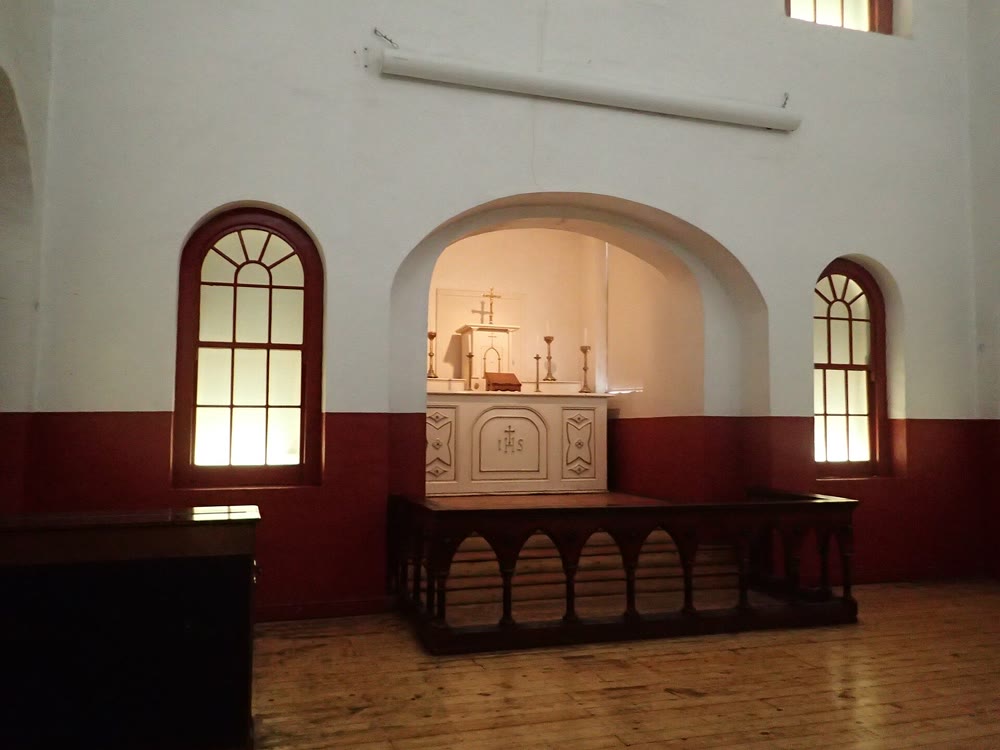
The Catholic chapel at Kilmainham Gaol, where Joseph Plunkett and Grace Gifford were married in 1916. Photo: Marathon, CC BY-SA 2.0, via Wikimedia Commons
The chapel’s wooden altar was made in 1882 by a prisoner, a Belfast carpenter named James Lalor. Plunkett’s poems found a wide audience after his death, among them The Splendour of God.
War of Independence and Civil War
Kilmainham became a military prison again in the War of Independence. In 1921 Ernie O’Malley, Simon Donnelly and Frank Teeling escaped from the West Wing. Prisoners smuggled in cameras to photograph prison life, and British Pathé filmed their release on 8 December 1921, after the Anglo-Irish Treaty.
The Treaty split the republican movement, and civil war broke out in June 1922. The new Free State Army filled Kilmainham with anti-Treaty prisoners, many of them recent comrades of their guards. On 17 November 1922, four young men, among them 18-year-old James Fisher, were shot inside the gaol. They were the first of the Free State’s official executions: 77 by the museum’s count, though the historian Breen Timothy Murphy counts 81.
Between November 1922 and December 1923, more than 600 women were imprisoned in Mountjoy, Kilmainham and a camp at the North Dublin Union. Many belonged to Cumann na mBan (KUM-un nuh MON), the republican women’s organisation. They went on hunger strike, painted mottos on their cell walls, and played rounders in the yards with a chair leg for a bat.
Grace Gifford Plunkett was among them in 1923. On a piece of wood taken from the cell where her husband spent his last night, she pencilled “This is Joseph Plunkett’s Cell”. Women from Carlow made a tricolour carrying the Cumann na mBan emblem, which later draped their coffins. The tricolour’s own story is in my history of the Irish flag.
The last prisoners arrived in October 1923, hunger strikers among them. Éamon de Valera, the anti-Treaty leader, was kept apart in the West Wing and played handball with the governor there. In early January 1924 he and the others were moved to Arbour Hill. Ernie O’Malley was left behind because of poor health. On 11 January he noted that he was alone in the gaol, and he soon went to hospital: the last man held in Kilmainham, according to an OPW exhibition reported by the Law Society Gazette. The official closing order came in 1929.
Saved by volunteers
After 1924 successive governments let the gaol fall into ruin, says the museum. For some, the memories were still too raw.
In June 1958 Lorcan Leonard wrote to the chairman of the Old IRA association asking for help to save it. He hoped to make the execution yard “the most holy spot in Ireland”. In May 1960 the volunteer Kilmainham Jail Restoration Society, which included veterans of the revolution, began work, aiming for the Rising’s 50th anniversary.
They cleared trees up to 30 feet tall, ivy, brambles, pigeons and rats. As many as 200 tradesmen worked unpaid on evenings and weekends, and money came from donations, government funding and film crews. In April 1966 President Éamon de Valera, himself a former prisoner, opened the new museum in the East Wing.
The volunteers kept working for 20 more years. In 1986 the gaol passed into state care under the OPW, and a new museum building opened in 1996. The gaol now gets more than 300,000 visitors a year, says the museum’s restoration history.
Kilmainham Gaol on screen
The OPW lists these productions among those filmed at the gaol:
- The Quare Fellow (1962)
- The Italian Job (1969)
- The Last Remake of Beau Geste (1977)
- In the Name of the Father (1993)
- Michael Collins (1996)
- The Escapist (2008)
- Rebellion, RTÉ’s 1916 drama series (2016)
Tourism Ireland adds The Wind That Shakes the Barley (2006), and says you might spot the Victorian East Wing in the prison scenes of Paddington 2 (2017). Two of these films made our readers’ top 10 of the best Irish movies of all time.
Visiting Kilmainham Gaol
These details were checked in October 2026, but check the official Kilmainham Gaol Museum site before you go.
- Guided tours only: about an hour, in English or Irish, then time in the museum. Allow about 90 minutes.
- Book early: tickets go on sale online 28 days ahead, at midnight Irish time, and popular slots sell out. Extra tickets and cancellations go online from 9:15am each day.
- Official sellers only: buy through kilmainhamgaolmuseum.ie or Heritage Ireland. Resale tickets won’t be honoured, and fake look-alike sites exist.
- Prices (2026): adult €8, senior €6, student €4, child aged 12 to 17 €4, family €20. Under-12s go free but still need a ticket.
- Opening: all year except 24 to 27 December. Closures at short notice do happen: the museum announced one for industrial action on 14 October 2026.
- Good to know: the tour isn’t recommended for under-6s, and buggies and large bags aren’t allowed. Part of it is outdoors, and the gaol is very cold in winter. Wheelchair users should email ahead to arrange a ground-floor tour.
Getting there
Dublin Bus route 60 leaves from Wellington Quay and Heuston Station; the G1 and G2 go from Spencer Dock and Wellington Quay. The nearest Luas stop is Suir Road, on the red line. The gaol has no car park, but the one at the Irish Museum of Modern Art (Royal Hospital Kilmainham) is five minutes’ walk away. For the rest of the city, see my guide to things to do in Dublin.
Kilmainham Gaol FAQ
When did Kilmainham Gaol close?
It stopped being a civilian prison in 1910, was used as a military prison from 1914, held its last prisoners in January 1924 and was officially closed in 1929.
Who was executed at Kilmainham Gaol?
Fourteen leaders of the 1916 Rising, shot in the Stonebreakers’ Yard between 3 and 12 May 1916. Five Invincibles were hanged there in 1883, and four young republicans were shot there on 17 November 1922.
Was Éamon de Valera the last prisoner?
Not quite. He was in the last group, moved to Arbour Hill in early January 1924. Ernie O’Malley, left behind because he was ill, was the last.
Love this? Save it to your Pinterest board for later.
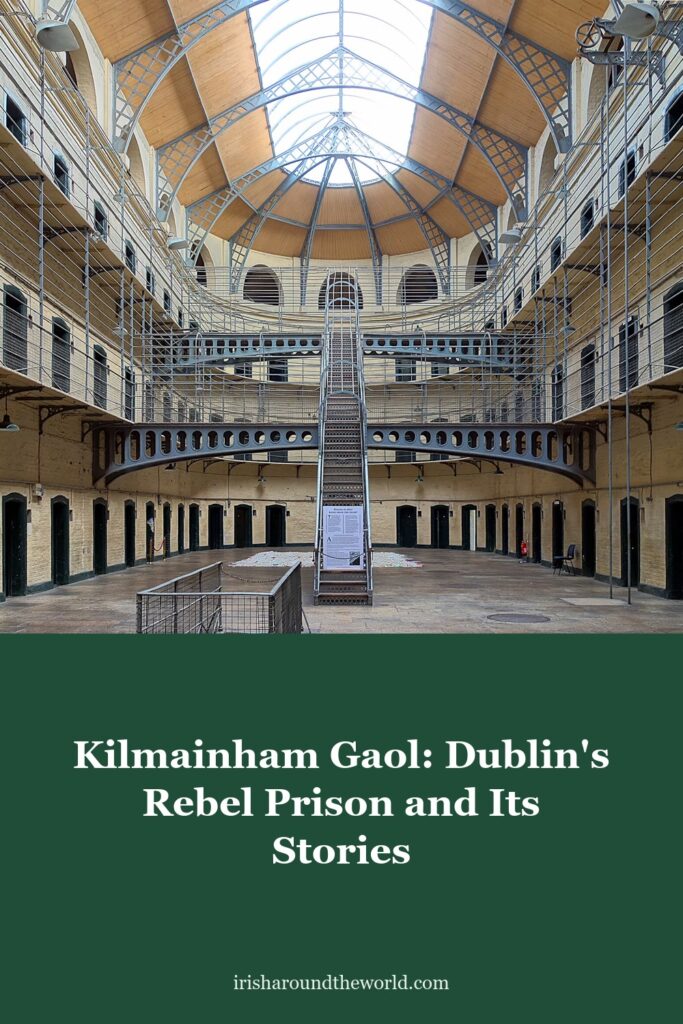
Pin image: Adapted from a photo by Velvet, CC BY-SA 3.0, via Wikimedia Commons.
A little bit of Ireland in your inbox every Friday ☘️
The free Weekly Dose of Irish: an Irish joke, a Celtic symbol, an Irish fact, a poem and the week’s best articles in one short email. Join 9,600+ readers.
Free. One short email every Friday. Unsubscribe any time.
More Irish history reading
- I See His Blood Upon the Rose: Poem, Meaning and Plunkett’s Story
- Easter, 1916 by W.B. Yeats: Meaning and Analysis
- The Irish Brigade in the Civil War: Meagher, the Fighting 69th and the Green Flags
- The Irish Potato Famine (An Gorta Mór): Ireland’s Great Hunger, 1845 to 1852
- Things to Do in Dublin: 12 Best Sights, Day Trips and Tips (2026)
- The Easter Rising: The 1916 Rebellion That Failed, Then Changed Ireland
Featured image: Kilmainham Gaol’s Victorian East Wing. Photo: Velvet, CC BY-SA 3.0, via Wikimedia Commons.