
“I See His Blood Upon the Rose” is a 12-line poem by Joseph Mary Plunkett, one of the seven signatories of the 1916 Proclamation. It sees Christ’s Passion everywhere in nature: his blood in the rose, his cross in every tree. It was in print by 1911, five years before the Rising, so it began as a religious poem.
Well, I think this week’s top Irish poem is the shortest one yet. But don’t be fooled by the shortness of this poem.
Twelve lines, three short verses. It has found its way into choir books and Good Friday services.
This poem comes in at number 22 on the top 100 Irish poems list.
Below is the full text, as it appears in the original books. Then what it means, when it was written, and the man who wrote it. His story includes a wedding in a prison chapel, by candlelight.
Jump to:
- The poem in full
- What it means, verse by verse
- When it was written
- Who was Joseph Mary Plunkett?
- Joseph Plunkett and Grace Gifford
- Why it is read at Easter
- Musical settings and readings
- The other poets of 1916
- FAQ
- More Irish poems
I See His Blood Upon the Rose: the poem in full
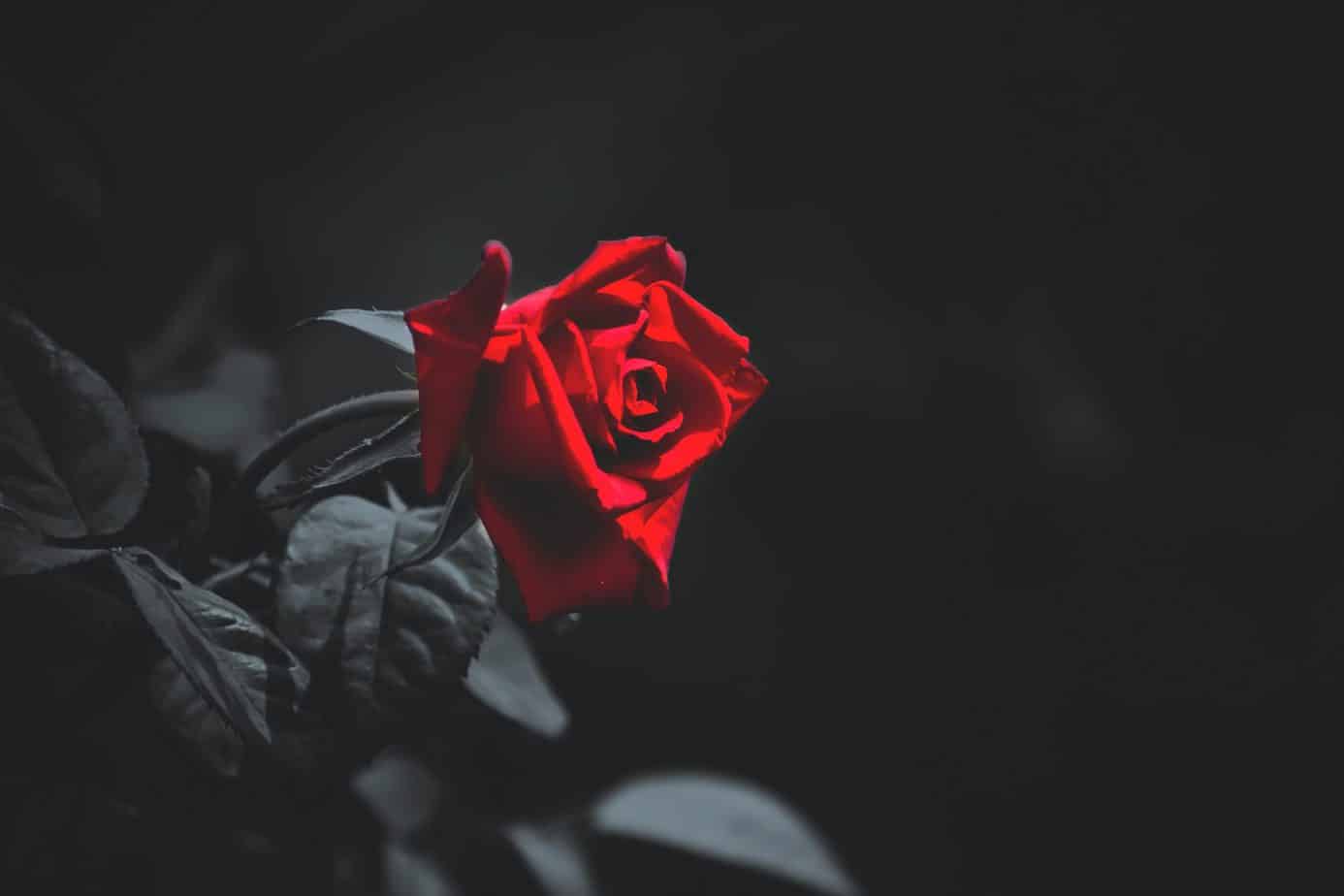

A single red rose, the image at the heart of Plunkett’s poem
I See His Blood Upon the Rose
by Joseph Mary PlunkettI see his blood upon the rose
And in the stars the glory of his eyes,
His body gleams amid eternal snows,
His tears fall from the skies.I see his face in every flower;
The thunder and the singing of the birds
Are but his voice—and carven by his power
Rocks are his written words.All pathways by his feet are worn,
His strong heart stirs the ever-beating sea,
His crown of thorns is twined with every thorn,
His cross is every tree.
This text follows the 1911 first edition and the 1916 collected Poems. In both, “his” is lower case inside the poem. Many websites capitalise it throughout, but Plunkett didn’t.
It’s also often misquoted as “I see the blood upon a rose”. It’s “his blood” and “the rose”.
What “I See His Blood Upon the Rose” means, verse by verse
The “he” of the poem is Christ. Plunkett never names him, and he doesn’t need to.
The poet sees Christ everywhere in nature. He sees the details of the crucifixion.
| Line | In plain English |
|---|---|
| Blood upon the rose | The red of the flower is the blood of the Passion. |
| Glory of his eyes | The stars are his eyes, shining down. |
| Body amid eternal snows | Mountain snow is his body, pure white. |
| Tears fall from the skies | Rain is his tears. Even the weather grieves. |
| Thunder and birdsong | Thunder is his loud voice, birdsong his gentle one. |
| Rocks are his written words | The rocks are scripture, carved by God. |
| Pathways by his feet are worn | Every road you walk, he walked first. |
| Crown of thorns, every thorn | Every thorn bush shares in his suffering. |
| His cross is every tree | Every tree stands for the wood of the cross. |
Verse one lays the words of Good Friday (blood, body, tears) over the whole of creation. Verse two is about hearing, and the rocks become words God carved himself.
Verse three gets heavier as it goes: feet, heart, crown of thorns, cross. Each verse ends on a short line, and this last one lands like a full stop.
Where the idea comes from
Seeing God in creation is an old Christian idea, and Plunkett knew the writers behind it.
His sister Geraldine wrote the foreword to his collected poems in 1916. She named his constant books as St John of the Cross, St Teresa, St Francis and John Tauler. She wrote that “their mark on his poetry is very plain.”
When was it written? Not in 1916
Plenty of websites get this wrong. They tie the poem to the Rising, or even to Plunkett’s last night in prison.
In fact it was in print by 1911, five years earlier. It appeared in his first book, The Circle and the Sword, published by Maunsel in Dublin.
The book was dedicated to Thomas MacDonagh, his friend and Irish teacher. According to Geraldine, Plunkett was in Algiers when it came out. MacDonagh chose the poems and saw the book through the press.
Geraldine said he wanted only a few poems from that book counted as his mature work. This was one of them. It was reprinted in his collected Poems after his death in 1916.
So the poem was written by a sick young man of 23 or younger, not a soldier facing a firing squad. Knowing what came later, though, it’s hard to read it the same way.
Who was Joseph Mary Plunkett?
Joseph Mary Plunkett was born in Dublin on 21 November 1887. He was the eldest son of Count George Noble Plunkett, who later became director of the National Museum.
He was sick from early childhood with glandular tuberculosis. He also had frequent bouts of pleurisy and pneumonia, and spent long stretches in bed. All that bed rest made him a huge reader.
He went to Belvedere in Dublin and to Stonyhurst in Lancashire. Between 1910 and 1912 he spent time in Italy, Algeria and Egypt.
Poet, editor, revolutionary
- 1913: he became editor of the Irish Review and turned it towards politics.
- November 1913: he was at the first meeting of the Irish Volunteers and sat on its provisional committee.
- 1914: he set up the Irish Theatre in Hardwicke Street with MacDonagh and Edward Martyn.
- 1915: by now in the IRB, he went to Germany to help Roger Casement look for arms. That May he joined the IRB’s Military Council.
He was the chief military planner of the Rising. He was also the youngest of the seven men who signed the Proclamation.
In early April 1916 he had major surgery on his neck. He was still in the GPO all through Easter week, wrapped in bandages.
After a court martial, he was shot early on the morning of 4 May 1916. He was 28. Edward Daly, Michael O’Hanrahan and Willie Pearse were executed the same morning.
In the Irish Times in 2016, his grand-niece Honor Ó Brolcháin called this poem “unquestionably his most celebrated poem”.
Joseph Plunkett and Grace Gifford
Grace Gifford was an artist and cartoonist from Rathmines who had studied under William Orpen. She was raised a Protestant and became a Catholic. Her sister Muriel was married to Thomas MacDonagh.
On the evening of 3 May 1916, hours before his execution, she and Joseph were married in the chapel of Kilmainham Gaol.
The OPW says Fr Eugene McCarthy of St James’s Parish conducted the ceremony by candlelight. Ó Brolcháin adds that the gas had been cut off.
Soldiers with fixed bayonets stood by. His handcuffs were taken off only for the vows. They were then separated.
Later that night, at about 2am, Grace was brought back to see him for ten minutes. Guards were present the whole time. As she later told the Bureau of Military History: “I was never left alone with him, even after the marriage ceremony.”
Seven years later, in 1923, Grace was held in Kilmainham herself.
See the wedding relics at Kilmainham
If you’re in Dublin, the chalice, ciborium and paten used at the wedding are on display at Kilmainham Gaol Museum.
They are on loan from St James’s Parish and the Archdiocese of Dublin, and sit in the “Last Words” section, the OPW announced in September 2026.
The song “Grace”
The ballad “Grace” is about the wedding, not the poem.
RTÉ Archives says brothers Frank and Seán O’Meara wrote it in 1985. Jim McCann sang it with the Dubliners on RTÉ that December. Rod Stewart later recorded it too.
Why it is read at Easter
Most of the images in the poem point to Good Friday. Blood, thorns, a crown, a cross.
That makes it a natural fit for Lent and Holy Week. Church choirs sing settings of it in that season, and it is sometimes read at Good Friday services.
It also turns up around 1916 commemorations, which fall at Easter too. The poem predates the Rising, but the timing makes the link hard to avoid.
Musical settings and readings
Here are the versions I know of:
- OCP, the American church music publisher, lists a choral setting for SATB choir and keyboard in its choral series.
- LibriVox volunteers recorded 12 free readings in March 2008. You can hear them on archive.org.
Other settings exist, but I couldn’t confirm them well enough to list here.
The other poets of 1916
Three signatories were poets. A fourth, Francis Ledwidge, makes a sharp contrast.
| Poet | Life | Worth reading |
|---|---|---|
| Patrick Pearse | Born 1879, founded St Enda’s school in 1908, executed 3 May 1916 | “The Mother” and “The Fool” |
| Thomas MacDonagh | Born 1878 in Cloughjordan, commanded at Jacob’s factory, executed 3 May 1916 | Through the Ivory Gate (1902), Lyrical Poems (1913) |
| Joseph Mary Plunkett | Born 1887, executed 4 May 1916 | The Circle and the Sword (1911), Poems (1916) |
| Francis Ledwidge | Served in the Royal Inniskilling Fusiliers, killed in Flanders in the summer of 1917 | His elegy for MacDonagh |
Ledwidge was serving in the British army when his friend MacDonagh was shot. His elegy opens “He shall not hear the bittern cry”. Just over a year later, Ledwidge was dead too.
For more of these writers, see my list of the 10 best Irish poets.
I See His Blood Upon the Rose: FAQ
Who wrote “I See His Blood Upon the Rose”?
Joseph Mary Plunkett (1887 to 1916), a Dublin poet who signed the 1916 Proclamation.
What does “I See His Blood Upon the Rose” mean?
The speaker sees Christ and his crucifixion everywhere in nature: in roses, stars, rain, rocks, the sea and every tree.
Was it written about the 1916 Rising?
No. It was in print by 1911, in Plunkett’s first book, The Circle and the Sword. That was five years before the Rising.
Why is it read on Good Friday?
Its images come straight from the Passion: blood, tears, a crown of thorns and a cross. Choral settings of it are published for Lent and Good Friday.
When did Joseph Plunkett marry Grace Gifford?
On the evening of 3 May 1916, in the chapel of Kilmainham Gaol. He was executed early the next morning.
How old was Joseph Plunkett when he died?
He was 28. He was the youngest of the seven signatories of the Proclamation.
More Irish poems and reading
- Ireland’s top 100 Irish poems
- The 10 best Irish poets
- 12 Irish love poems
- Irish quotes
- Irish surnames and where they come from
A little bit of Ireland in your inbox every Friday ☘️
The free Weekly Dose of Irish: an Irish joke, a Celtic symbol, an Irish fact, a poem and the week’s best articles in one short email. Join 9,600+ readers.
Free. One short email every Friday. Unsubscribe any time.
Antoin O'Faolain
Saturday 3rd of December 2022
Encapsulated in such a short, single stanza is the Person, the Passion and the Power of Christ. Such do stir our spirit and charge our hearts to love and serve Him. Go raibh mhath agat Joseph Mary Plunkett