
Colcannon is Irish mashed potato with kale or cabbage, butter, milk and scallions or onion. The name is usually traced to the Irish cál ceannann. In many Irish homes it was the Halloween dinner, with a ring, coin, button or thimble hidden inside to tell fortunes. This colcannon recipe serves 4 to 6 and takes about 45 minutes.
Somebody at the table is going to find the ring. That was the whole point of colcannon on Halloween night: a big dish of buttery mash and greens, with a fortune buried somewhere inside.
The recipe comes first, then the charms, the ghosts and the history. For the bread side of the tradition, see my barmbrack recipe.
Jump to:
- Colcannon recipe
- How to hide a charm safely
- Storing and reheating
- Colcannon at Halloween: the charms
- A plate for the dead and the fairies
- What is colcannon? The name and its history
- Colcannon vs champ
- Colcannon FAQ
- More Irish Halloween reading
Colcannon recipe
This is the everyday modern version, in metric and US measures. Older versions follow, from Theodora Fitzgibbon’s 1983 Irish Times recipe to the Wexford family one that folklorist Michael Fortune shared on RTÉ.
Prep: 15 minutes | Cook: 30 minutes | Serves: 4 as a main, 6 as a side
Ingredients
- 1kg (2¼ lb) floury potatoes, such as Rooster, Kerr’s Pink or Golden Wonder in Ireland, or russets in the US
- 250g (9 oz) curly kale, or ½ a small Savoy or green cabbage (about 400g, 14 oz)
- 4 to 6 scallions (spring onions, or green onions in the US), thinly sliced
- 200ml (a generous ¾ US cup) whole milk
- 100g (7 US tbsp, just under a stick) butter, plus extra to serve
- Salt, and white or black pepper
- Optional, for Halloween: a clean ring or coin, wrapped in a twist of baking paper (parchment)
Method
- Peel the potatoes and cut them into even, egg-sized chunks. Cover with cold salted water, bring to the boil and simmer for 15 to 20 minutes, until a knife slides in easily.
- Meanwhile, strip the kale from its tough stalks and chop it finely. For cabbage, cut out the core and shred the leaves.
- Melt a knob of the butter in a wide pan with 2 or 3 tablespoons of water. Add the greens, cover and cook over a medium-high heat for 4 to 6 minutes, stirring once or twice, until tender. Drain off any liquid.
- Bring the milk and scallions just to a simmer in a small pan, then turn off the heat.
- Drain the potatoes, return them to the hot pan and let them steam dry for a minute or two. Mash until smooth.
- Beat in the hot milk and scallions a little at a time, then most of the butter. Fold in the greens and season well. Add a splash more milk if it’s stiff.
- Pile it into a warm dish, press a hollow into the middle and drop in the last of the butter to melt. If you’re hiding a charm, add it now (see below) and tell everyone.
Tips
Floury, dry potatoes. Darina Allen’s colcannon in Simply Delicious 2 calls for “old” potatoes such as Golden Wonders or Kerr’s Pinks. Waxy potatoes turn gluey. In the US, use russets, or Yukon Golds for a denser mash. Use a masher or ricer, never a blender.
Kale or cabbage? Both are traditional. Fortune says many Dubliners grew up with curly kale in theirs, while in his native Wexford kale was mostly cattle feed and cabbage went in the pot.
Scallions in October? Fortune also notes that fresh scallions weren’t around in an Irish October in the old days. For an old-style version, soften a chopped onion or leek in the milk instead.
Variations
- Wexford colcannon: in Fortune’s family version, onions, parsnips and cabbage sit under the potatoes in one pot with a little water, steam together, and get mashed with butter and white pepper.
- Leeks and nutmeg: Theodora Fitzgibbon’s 1983 Irish Times version uses as much cabbage or kale as potato, simmers leeks in the milk and adds nutmeg or mace.
- Bacon or egg: stir through crisp bacon, or top it with a fried egg, as Fortune suggests.
- Vegan: use plant butter and unsweetened oat or soy milk.
- Colcannon cakes: shape cold leftovers into patties, dust with flour and fry in butter until golden.
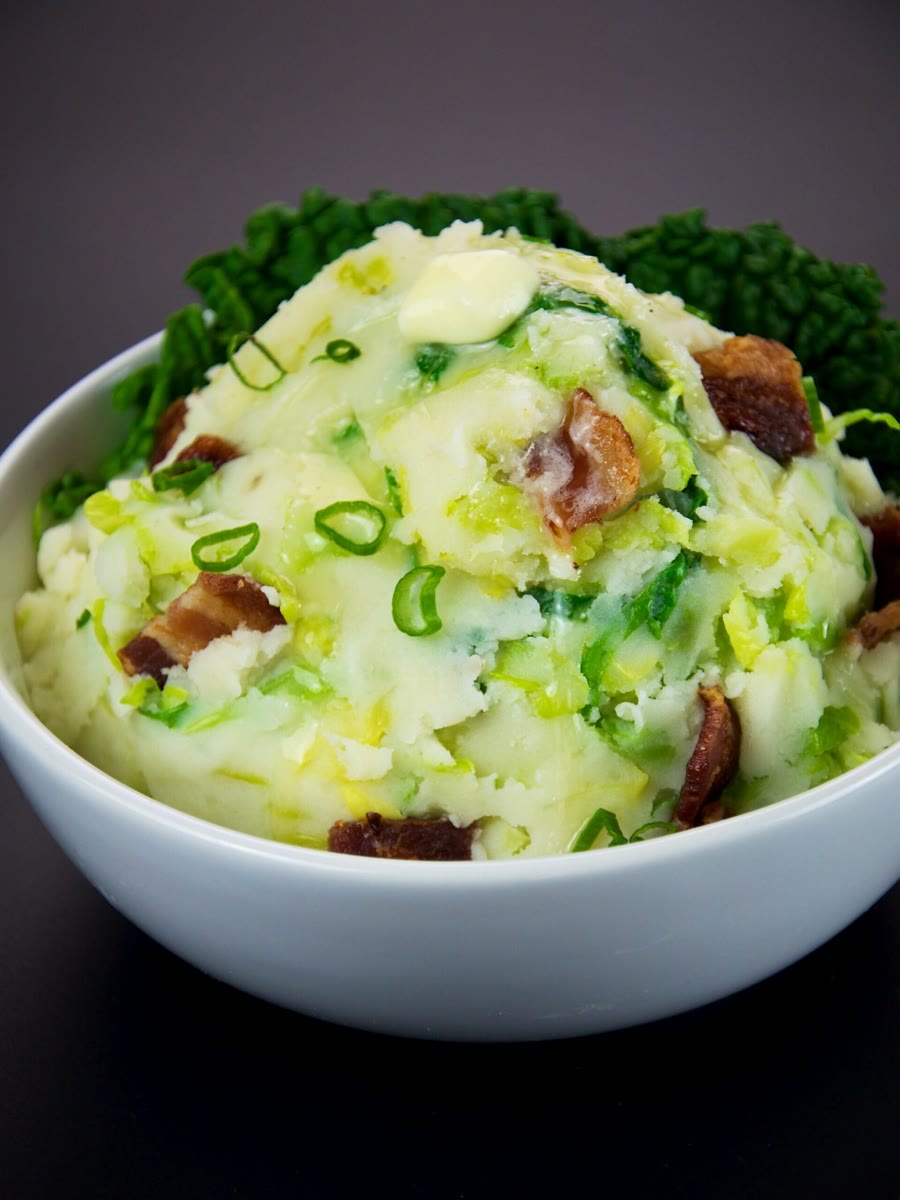
Colcannon with Savoy cabbage, scallions and bacon. Photo: TheCulinaryGeek, CC BY 2.0, via Wikimedia Commons
How to hide a charm in colcannon safely
Traditionally, the charms were often cooked inside the colcannon. Today, a little care removes most of the risk.
- Pick a sturdy charm: a plain metal ring or a coin, with no stones or loose parts, scrubbed in hot soapy water.
- Wrap it in a little parcel of baking paper or foil, twisted shut, so it’s easy to spot.
- Add it at the end, pushed into the dish just before serving, not boiled in the pot.
- Warn everyone before the first spoonful.
- Keep it away from small children. Serve them from a separate, charm-free bowl. The HSE lists coins and small jewellery among household choking risks for babies and children.
For zero risk, hide the charms under the plates instead.
Storing and reheating colcannon
Safefood advises getting leftovers into the fridge within two hours of cooking. The Food Safety Authority of Ireland says to eat them within 2 to 3 days and reheat them only once, to 70°C (158°F) or higher.
It freezes, though it turns a little watery. Penn State Extension says to use frozen mash within 2 to 4 weeks, and suggests freezing patties to fry in butter later.
Colcannon at Halloween: the ring, the coin and the button
Halloween is Oíche Shamhna (EE-ha HOW-na) in Irish, and in many homes the meal that night was colcannon. It turns up again and again in the Schools’ Collection, the folklore Irish schoolchildren gathered in 1937 to 1939, though Fortune notes it’s common in Leinster accounts and rare in Cork and Kerry ones.
In parts of Wexford and Kilkenny, Halloween was called Colcannon Night. An account from the Faythe, in Wexford town, calls 31 October both Colcannon Day and Cabbage Stump Night: after dinner, the boys gathered the leftover cabbage stumps and went hammering on doors.
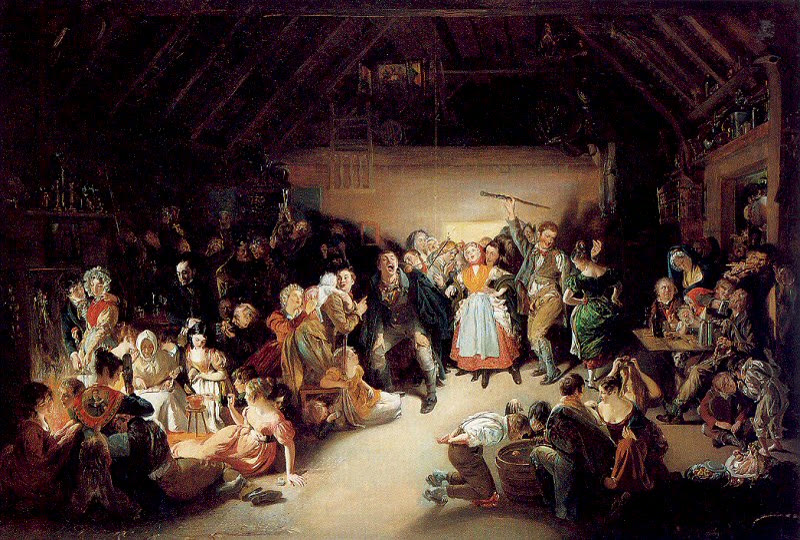
Snap-Apple Night, painted by Daniel Maclise in 1833 after a Halloween party he attended in Blarney, Co. Cork, in 1832. Public domain, via Wikimedia Commons
The ring was the main event. Whoever found it would marry, usually within the year, say accounts from Co. Meath and Co. Mayo. A ring in Irish is fáinne (FAWN-yeh). Other charms changed meaning from place to place:
- Baunreagh, Co. Carlow: a ring, a button and a half-crown. The half-crown meant you’d never be short of money, the button that you’d never marry.
- Loughanavally, Co. Westmeath: a ring, a threepenny bit for wealth and a bean for prosperity.
- Mell, Co. Louth: a ring, a thimble and a scrap of cloth. The thimble meant marrying a tailor, the cloth never marrying.
- Bunclody, Co. Wexford: a ring, a thimble and a medal. Again the thimble meant a tailor, and the medal becoming a nun.
The tailor is a surprise if you know the barmbrack lists, where a thimble usually means staying single. Máirtín Mac Con Iomaire, then a lecturer at the Dublin Institute of Technology, told Smithsonian magazine in 2018 that in colcannon a coin meant wealth, a rag poverty and a stick a spouse who would beat you, and that meanings varied by area.
In some places the ring moved from the colcannon to the brack. An account from Wilkinstown, Co. Meath, says it once went into the colcannon because bracks were unknown, and accounts from Cavan and Westmeath say the brack had taken over by the 1930s. The rest of the night, from turnip lanterns to snap apple, is in my guide to how the Irish invented Halloween.
More colcannon fortunes
In Duleek, Co. Meath, whoever peeled the potatoes for the colcannon tried to peel one in a single unbroken strip and hang it up: the first man through the door would marry the eldest girl.
You’ll often read online that girls hung a stocking of colcannon on the door handle to catch a husband. One Schools’ Collection account, from Dalgin, Co. Galway, has a dream charm instead: colcannon in your stocking on November night brings a dream of your future partner.
The door part does turn up, but with a cabbage. In Donore, Co. Meath, you hung the first cabbage you pulled behind the door, and the first person in would share your future spouse’s initials.
A plate for the dead and the fairies
Halloween was the eve of All Saints, with All Souls on 2 November, and many people believed the souls of the dead were abroad on these nights. So they left them supper.
- In Donore, Co. Meath, the poor souls got their own plate of colcannon, spoon and all, set outside on the window sill.
- In Enfield, Co. Roscommon, the Holy Souls got a bit of “cally” left out on the dresser, as they were believed to be out of Purgatory from seven on Halloween evening until noon the next day.
- In Donaghmoyne, Co. Monaghan, a plate was left for dead relatives on All Souls’ Eve, and a footprint in the hearth ashes next morning warned of a death within the year.
Other houses fed the fairies. In Lettera, Co. Galway, the first plate was kept for the fairies as they moved from their summer homes to their winter ones, with no salt on their share. In Mullagh, Co. Cavan, the leftovers went out on a plate with a dozen spoons. A Westmeath story has a woman near Delvin leaving colcannon on the fairy fort on feast nights.
And in Ballydaniel, Co. Kilkenny, a plate went outside the door on November night for the púca. In the morning the plate was empty, and people were sure the púca had eaten it.
What is colcannon? The name and its history
Colcannon is mashed potato with kale or cabbage, milk and butter. Some add parsnips, carrots or onions too.
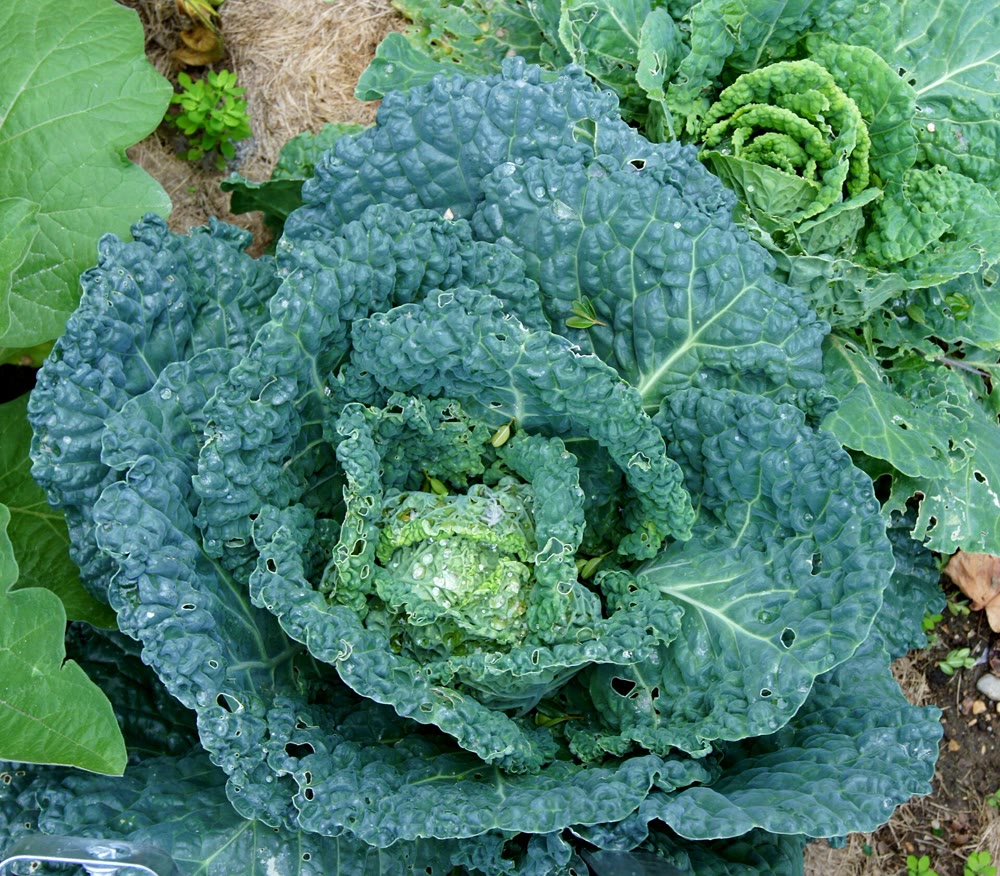
A Savoy cabbage in the vegetable garden of the Jardin des Plantes, Paris. Photo: Jebulon, public domain, via Wikimedia Commons
Where the name comes from
Ó Dónaill’s Irish-English dictionary gives the Irish for colcannon as cál ceannann (roughly kawl KYAN-un). Cál is kale or cabbage. Ceannann describes a white-faced animal, or something white-topped or speckled with white.
So the usual explanation is “white-headed cabbage”, the reading in Alan Davidson’s Oxford Companion to Food. Davidson also suggests the second half may come from Old Irish cainnenn, which the Dictionary of the Irish Language translates as garlic, leeks or possibly onion. Neither reading can be proven.
How old is colcannon?
The earliest description usually quoted comes from a Welshman. William Bulkeley, an Anglesey landowner, was in Dublin on Halloween 1735, and his diary, as quoted by Smithsonian, records a supper of roast mutton and “Coel Callen”: boiled cabbage, potatoes and parsnips mixed together. He called it “a Dish always had in this Kingdom on this night”.
Mac Con Iomaire told Smithsonian that colcannon had become a staple food by the mid-18th century. It married the old Irish taste for kale and cabbage to the newer potato.
It wasn’t only for Halloween. Accounts from Longford, Cavan and Clare describe colcannon made at harvest time or from the first new potatoes, mashed with milk and butter, often with no greens at all.
A Delvin, Co. Westmeath, account of the Famine years says people broke stones for fourpence a day and their meals. Later they worked for colcannon alone, and a notice offered the other choice: “Sixpence a day and no colcannon”.
The song “Colcannon”
“Colcannon” is also a much-loved Irish song about the dish. The Black Family, Mary Black and her siblings, recorded it on their first album in 1986. Smithsonian printed part of a version called “The Auld Skillet Pot”.
Colcannon vs champ: what’s the difference?
Colcannon has kale or cabbage mashed through it. Classic champ has scallions instead, beaten in with hot milk and butter, and it’s especially associated with Ulster.
The Dictionary of the Scots Language records champ in Ulster and Scotland as mashed potatoes, sometimes with milk and butter. A 1993 Ulster description it quotes has scallions in the mash, a spoon, a well of melting butter and buttermilk to drink.
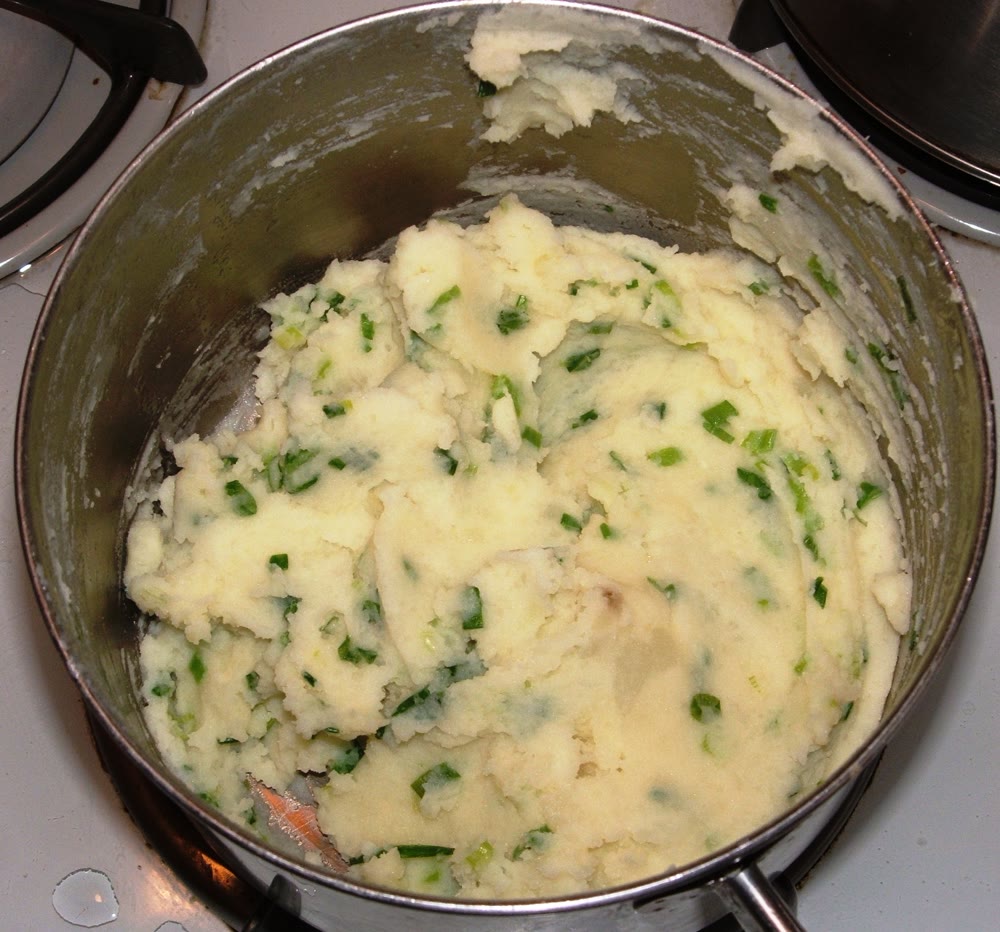
Champ: mashed potato with scallions, milk and butter. Photo: Glane23, CC BY-SA 3.0, via Wikimedia Commons
In the 1930s the names blurred. A Monaghan account calls the same plate of mash “champ”, “colcannon” or “cally”. Roscommon and Galway accounts say “cally”, as Fortune says Mayo did; Clare had “tump” and Donore, Co. Meath, “chop”. In Irish, mashed potato is brúitín (BROO-cheen).
The butter well is what they share. A Leitrim account describes children dipping each spoonful into the butter in the middle of the plate, until the last buttery bits were gone.
Colcannon FAQ
What is colcannon made of?
Floury potatoes mashed with milk and butter, mixed with cooked kale or cabbage, and usually flavoured with scallions, onion or leeks.
Why do Irish people eat colcannon at Halloween?
It was the Halloween meal in many Irish homes, recorded in Dublin as early as 1735. The eve of All Saints was also traditionally a church fast day, and colcannon needs no meat. In Lettera, Co. Galway, it also marked the end of the potato digging.
What does the ring in colcannon mean?
Tradition says whoever gets it will marry next, often within the year. A coin promised money and a button often meant staying single, though meanings changed from county to county.
Can you make colcannon ahead?
Yes. Reheat it, covered, in a low oven or a pan with a splash of milk until piping hot. Leftovers keep for 2 to 3 days in the fridge.
Love this? Save it to your Pinterest board for later.
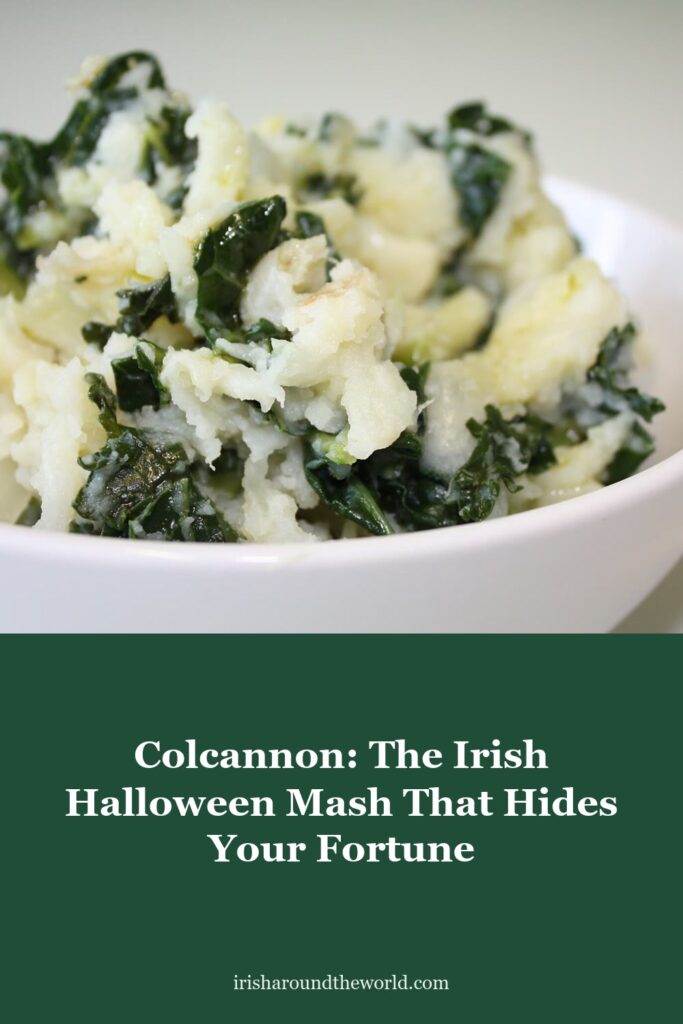
Pin image: Adapted from a photo by VegaTeam, CC BY 2.0, via Wikimedia Commons.
A little bit of Ireland in your inbox every Friday ☘️
The free Weekly Dose of Irish: an Irish joke, a Celtic symbol, an Irish fact, a poem and the week’s best articles in one short email. Join 9,600+ readers.
Free. One short email every Friday. Unsubscribe any time.
More Irish Halloween reading
- Samhain: The Night the Fairy Mounds Opened and How It Became Halloween
- Stingy Jack: The Irishman Who Tricked the Devil and Gave the Jack-o’-Lantern Its Name
- Bram Stoker: The Bedridden Dublin Boy Who Grew Up to Write Dracula
- Irish Halloween Games: Snap Apple, Burning Nuts and the Old Spells to See Your Future Spouse
- How the Irish Invented Halloween: Samhain, Turnip Lanterns, Barmbrack and the Best Festivals in Ireland
- Barmbrack Recipe: The Irish Halloween Bread That Predicts Your Future
- The Púca: Ireland’s Shape-Shifter and Why You Never Eat Blackberries After Halloween
- Fairy Forts and Fairy Trees: The Irish Places You Never Disturb
- Happy Halloween in Irish: Oíche Shamhna Shona (Plus 35 Spooky Irish Words)
- 90 Irish Halloween Jokes, Puns and Riddles That Are Scary Good
- The Irish Potato Famine (An Gorta Mór): Ireland’s Great Hunger, 1845 to 1852
Featured image: Colcannon made with kale, in a white bowl. Photo: VegaTeam, CC BY 2.0, via Wikimedia Commons.