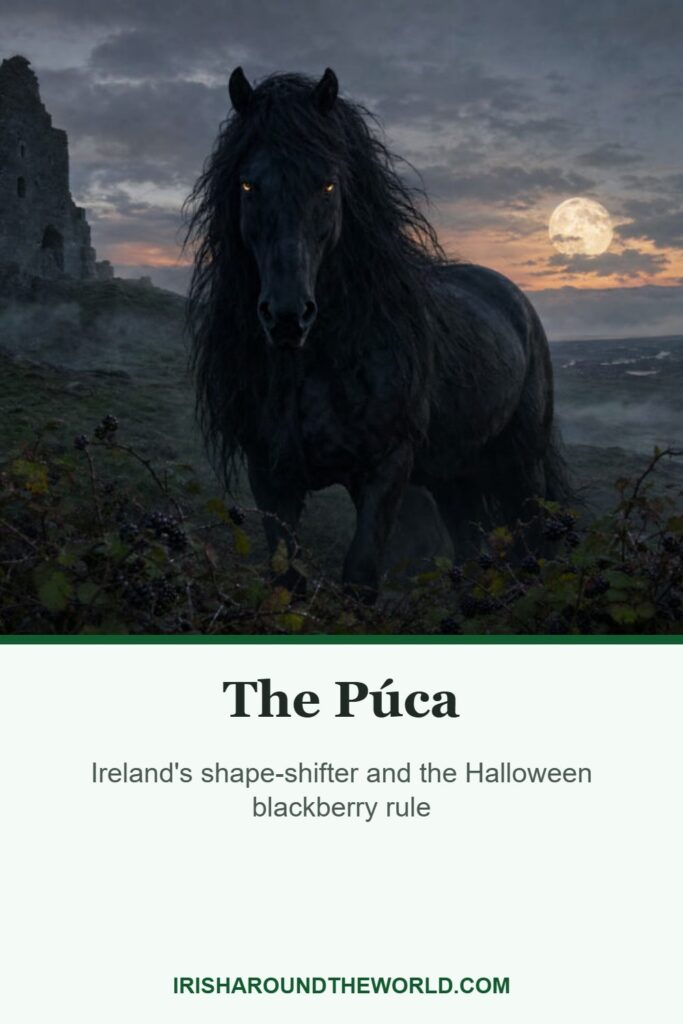
The púca (say it POO-kuh), also spelled pooka or phouka, is the shape-shifter of Irish folklore. The old collections record it as a dark horse, a goat, an ass, a bull or even an eagle, often carrying some poor soul on a wild night ride. It belongs to Samhain: after Halloween, the story goes, it spoils the blackberries. In some tales it is a menace, in others a helper.
A half-foolish piper in Dunmore, Co. Galway, could play only one tune. One night something with horns swept him onto its back and carried him to the top of Croagh Patrick. There, at a feast in the house of the Banshee, the old women greeted his mount as Púca na Samhna (POO-kuh nuh SOW-nuh), the Púca of November.
The piper came home with gold and a new set of pipes. The new pipes only screeched like geese, and by morning the gold was leaves. But his old pipes now played sweetly, and he was the best piper in Galway till the day he died. Douglas Hyde translated the tale from Irish, and Yeats printed it in his 1888 collection.
What is a púca (pooka)?
The púca, plural púcaí (POO-kee), is a solitary shape-shifting spirit. Ó Dónaill’s Irish dictionary glosses it as “hobgoblin, pooka, puck”. English writers spelled it pooka, phooka or phouka, depending on who was listening.
W. B. Yeats called it “essentially an animal spirit” in 1888. In 1892 he placed it in “the family of the nightmare” and doubted it had ever taken human form. Like the banshee and the Dullahan, it goes about alone rather than with the dancing fairy crowd.
What does the púca look like?
There’s no single answer. Yeats lists “now a horse, now an ass, now a bull, now a goat, now an eagle”. The Schools’ Collection of the 1930s, where Irish schoolchildren wrote down local lore for the National Folklore Collection, adds plenty more.
The black horse
The horse turns up most often. Keightley quotes a boy near Killarney who told Croker that pookas came as wild colts “with chains hanging about them”. At Ardgroom in west Cork, fishermen saw something like a horse run out of the water, pulling chains. In Kiltamagh, Co. Mayo, people said “chomh dubh leis an bpúca” (khoh DUV lesh un BOO-kuh), as black as the púca.
Goats, bulls, donkeys and stranger things
In Croker’s “The Crookened Back”, Peggy Barrett meets “something like a small black goat” with long wide horns. On May Eve it leaps onto her back as she walks home, and she can’t shake it off until she blesses herself three times at her own door. Her back stays crooked for life.
A Mayo school recorded a big red bull, and near Fermoy in north Cork it came “in the shape of a big donkey”. Yeats records a Kilkenny púca shaped like a fleece of wool. In the Schools’ Collection, Donegal had one like a big barrel, and Brosna in Kerry had a headless pig. Online lists add cats, hares and glowing golden eyes, but I haven’t found those in Croker, Yeats or Lady Wilde.
If you’d rather watch than read, this short video tells Paddy Ward’s ride and the blackberry rule in under 90 seconds.
The wild night ride
Yeats summed up the púca’s hobby in 1892: “His delight is to get a rider, whom he rushes with through ditches and rivers and over mountains.” It especially loves to plague a drunkard.
Paddy Ward over Uisneach
At Boher in Westmeath, a pupil recorded how Paddy Ward was dared one Halloween to walk round Killan graveyard. The Pooka knocked him down and soared off with him over Uisneach and, in Paddy’s opinion, “over every hill in Ireland”. It dropped him at his own door, and he didn’t leave his bed for three weeks.
Morty Sullivan at Ballyvourney
My own county has the grimmest one. In Croker’s “The Spirit Horse”, Morty Sullivan is on pilgrimage to St Gobnait’s at Ballyvourney when a red-eyed hag puts him on a jet-black horse. It bounds over precipices and torrents. The next morning pilgrims find him lying under a steep cliff, flung there by the Phooka.
How to tame a púca
In the stories that end well, you ride the púca harder than it rides you. At Firies, Co. Kerry, a man kept getting carried off and thrown into a clump of briars. One night he went out wearing spurs and worked them on the púca “until he was nearly dead”.
At Clonmore, Co. Carlow, a pooka, “half wolf & half pony”, guarded crocks of gold under a granite boulder. A jockey called Mark Mornin rode it to exhaustion while his friends dug, then made it kneel and promise never to take revenge.
Did Brian Boru ride the púca?
You’ll read all over the internet that Brian Boru was the only man ever to ride the púca, using a bridle made from three of its tail hairs. I can’t find that story in Croker, Yeats, Lady Wilde or Patrick Kennedy. The Carlow jockey has a better claim, because he has a source.
Is the púca good or evil?
Both, depending on who’s telling it. Croker wrote that Pouke or Phooka “means, in plain terms, the Evil One”. He added that “playing the puck” was Anglo-Irish for playing the devil.
Patrick Kennedy saw another side. In “The Kildare Pooka” (1866), an ass-shaped pooka did a big house’s kitchen work every night, as penance for being a lazy servant in life. The servants gave it a quilted frieze coat, and it was never seen again.
Lady Wilde called the Phouka “a friendly being” in 1887, one that helps the farmer if treated kindly. In her tale it first appears as a young bull. Later, as an old man in rags, it grinds a mill’s corn every night, and it leaves once it’s given a fine suit of clothes.
So the fairest answer is trickster. It frightens, it carries people off, and now and again it does the washing up.
The púca at Samhain
Yeats wrote that on November Eve “the pooka is abroad”, and that “November-day is sacred to the Pooka”. Samhain (SOW-in) is 1 November, and Oíche Shamhna (EE-huh HOW-nuh) is Halloween night. For the wider story, see how the Irish invented Halloween.
Pooka Night
In some places Halloween was simply Pooka Night. The Bracknagh school in Co. Offaly recorded that “The Pooka is out at Halloween”, and that on Pooka night gates and cart wheels were stolen and hidden. I suspect the pooka had help. In Clongorey, Co. Kildare, the Halloween guisers were even called “the puca boys”.
Why you don’t eat blackberries after Halloween
Yeats put it plainly in 1888: “After November Eve the blackberries are no longer wholesome, for the pooka has spoiled them.” Irish has a name for the culprit, púca na sméar (POO-kuh nuh SHMAIR). Ó Dónaill glosses it as “fruit-destroying pooka, herald of winter”.
How he spoils them
The Schools’ Collection can’t agree on the method. He spits on them in Mayo, Roscommon and Kildare, poisons them in Longford and crawls on them in Offaly. Keightley, who grew up in Leinster, remembered children being told that “the Pooka has dirtied on them”. I’ll leave that one there.
In 1938 Maureen Hayes, writing for Faythe school in Wexford, recorded the stakes. Eat them after November night and “the puca will carry you away”, over bushes, houses and mountains, and back in bed by morning.
The deadline moves
Halloween is the usual cut-off, but not everywhere. Castlepollard in Westmeath said 23 September, and Craanford in Wexford said Michaelmas, 29 September. In parts of Leitrim, Clare and Kildare, haws and sloes were off limits too.
The Craanford entry even gives the practical reason: the berries decay after Michaelmas, “hence the story of the Púca is told to the children”. A scary story beats any lecture.
What about the púca’s share?
Online you’ll see claims that reapers left part of the harvest as “the púca’s share”. I haven’t found it in Croker, Yeats or Lady Wilde. The nearest thing is from Bruree, Co. Limerick, where the late berries were “destroyed and reserved for the Good People”.
Púca places: Poulaphouca and Carrigaphooca
Logainm.ie, the Placenames Database of Ireland, says púcaí were thought to haunt hollows and especially pools. Poll an Phúca (pol un FOO-kuh), the púca’s hole or pool, is the most common type. Some “pooka” names come from the Anglo-Norman surname Pook instead.
Poulaphouca, on the Wicklow and Kildare border
Poulaphouca was a famous Liffey waterfall. G. N. Wright’s 1827 guide to Wicklow called it “Pol-a-Phuca, or the Daemon’s hole”. The ESB began flooding the valley for its hydro scheme in 1940, and the waterfall was much reduced. The reservoir is now known as the Blessington Lakes.
Carrigaphooca Castle, Co. Cork
Carraig an Phúca (KORR-ig un FOO-kuh), the púca’s rock, is a townland about 6 km west of Macroom. On the rock stands a five-storey tower house over the River Sullane. Heritage Ireland says Domhaill Mór MacCárthaig of Drishane built it in 1436.
Keightley listed Carrig-a-Phooka as a púca place back in 1850, and the OPW still says the rock “is believed to be haunted by a malicious ghost”. It’s an unguided National Monument on farmland, so check access with Heritage Ireland before you go. For more on my home county, here are some facts about Cork.
Pooka meaning: where does the word púca come from?
Púca is usually linked to Welsh pwca, Cornish bucca and Old English puca. Nobody agrees which way the word travelled.
The Oxford English Dictionary points to Scandinavian relatives such as Old Icelandic púki. Thomas Keightley thought the Irish word came from the English one. In 2017 Erin Sebo asked whether the Old English word might itself be Irish. Yeats’s idea that it comes from poc (PUK), a he-goat, was only a guess he reported.
And Shakespeare’s Puck? Croker noted that the commentators derived Puck from the “mischievous Pouke”. They’re related, but that doesn’t make Puck Irish.
Harvey and the púca in modern culture
The most famous pooka is a rabbit over six feet tall. Mary Chase’s play Harvey opened on Broadway on 1 November 1944, the púca’s own day, and won the 1945 Pulitzer Prize for Drama. Harvey is a pooka that almost nobody but his friend Elwood P. Dowd can see, and Elwood is fond of a drink, which Yeats would have understood. The 1950 film starred James Stewart, and Josephine Hull won the Oscar for Best Supporting Actress.
Flann O’Brien’s At Swim-Two-Birds (1939) has the Pooka MacPhellimey, “a member of the devil class”. Michael Hartnett’s poem Death of an Irishwoman mentions púcas too. Even the round red enemies in the 1982 arcade game Dig Dug are called Pookas.
The Púca Festival 2026
Yes, the festival named after our shape-shifter is running this year. It takes place from Thursday 29 October to Sunday 1 November 2026 in Trim and Athboy, Co. Meath.
Expect the Púca Procession in Trim on 30 October and the Samhain Fire at the Fairgreen in Athboy on 31 October. There are heritage tours of Tlachtga, the Hill of Ward, too. The Coronas play on the Friday, and The Waterboys close the festival on 1 November at the Púca Big Top in Trim. Check pucafestival.com for the full line-up and tickets.
Púca FAQ
What is a pooka?
A pooka, or púca in Irish, is a shape-shifting spirit of Irish folklore, usually a dark horse, goat, bull or ass. Say it POO-kuh. In placenames it softens to “phúca”, roughly FOO-kuh, as in Poll an Phúca.
Is the pooka good or evil?
It can be either. Croker said the name meant “the Evil One”. Lady Wilde and Patrick Kennedy recorded helpful púcaí that ground corn or did the kitchen work.
Why can’t you eat blackberries after Halloween?
According to tradition, the púca spoils them on November Eve by spitting on them, or worse. Some areas set the deadline earlier, at Michaelmas on 29 September. By then the berries are going soft anyway.
Is Harvey a pooka?
Yes. In Mary Chase’s 1944 play and the 1950 James Stewart film, Harvey is a pooka in the form of a giant rabbit that hardly anyone else can see.
When is the Púca Festival 2026?
It runs from 29 October to 1 November 2026 in Trim and Athboy, Co. Meath. Check pucafestival.com for tickets and the full programme.
More Irish folklore
- Samhain: The Night the Fairy Mounds Opened and How It Became Halloween
- Stingy Jack: The Irishman Who Tricked the Devil and Gave the Jack-o’-Lantern Its Name
- Irish Halloween Games: Snap Apple, Burning Nuts and the Old Spells to See Your Future Spouse
- How the Irish Invented Halloween: Samhain, Turnip Lanterns and Barmbrack
- What Is a Banshee? The Bean Sí, Her Cry, Her Comb and the Families She Follows
- The Dullahan: Ireland’s Headless Horseman
- Cat Sìth: The Fairy Cat of Scottish and Irish Folklore
- What the Heck Is a Selkie? Selkie Mythology
- Leprechauns in Irish Folklore
- 10 Haunted Places Around Ireland That You Have To Visit
Love this? Save it to your Pinterest board for later.
A little bit of Ireland in your inbox every Friday ☘️
The free Weekly Dose of Irish: an Irish joke, a Celtic symbol, an Irish fact, a poem and the week’s best articles in one short email. Join 9,600+ readers.
Free. One short email every Friday. Unsubscribe any time.