
Stingy Jack is the mean man of Irish folklore who outwitted the Devil, was barred from both Heaven and Hell, and now wanders the dark with a light. One of the earliest printed versions appeared in Dublin in 1836, and the name “Stingy Jack” was in print by 1851. Long before it meant a carved lantern, jack-o’-lantern was a name for the ghostly light over bogs. Irish children carved turnips (usually swedes); in America, emigrants traded them for pumpkins.
Every October, millions of Americans carve a pumpkin and call it a jack-o’-lantern. Most have heard the reason: an Irish drunk called Stingy Jack, a trick played on the Devil, and a coal from Hell carried in a hollowed-out turnip.
The real story is stranger. The Jack of Irish folklore wasn’t always stingy or a drunk, and in the oldest printed versions he carries no turnip at all. His light was a lantern, a burning wisp of straw, even a coal stuck on his nose.
I’ve told the bigger story of Samhain in how the Irish invented Halloween. This is the deep dive: where Stingy Jack comes from, how his tale changes from county to county, and how to carve a proper turnip lantern.
Jump to:
- Who was Stingy Jack?
- An early printed version: Mangerton, 1836
- How the story changes across Ireland
- Before the pumpkin: jack-o’-lantern as a ghost light
- The modern version, and the missing turnip
- Turnip lanterns: what the records show
- How the pumpkin took over in America
- How to carve a turnip lantern
- Stingy Jack FAQ
- More Irish Halloween reading
Who was Stingy Jack?
Stingy Jack is a character from a folktale told all over Ireland. The details shift with every teller, but the bones stay the same:
- Jack is a hard man: a mean farmer, a hard-drinking blacksmith or a tinker.
- Often a holy stranger, or even a fairy creature, grants him three wishes, and he wastes them on traps instead of asking for Heaven.
- When the Devil comes for his soul, Jack traps him and frees him only for a promise to leave him alone.
- Jack dies. Heaven won’t have him and Hell won’t let him in, so he wanders the earth with a light.
Folklorists know this as tale type 330, The Smith and the Devil, and dúchas.ie tags more than 200 stories collected by Irish schoolchildren in the late 1930s with its older label, 330A. It may be very old: a 2016 study in Royal Society Open Science, using family-tree methods borrowed from biology, argued that it goes back to the Bronze Age.
An early printed version: Mangerton, 1836
One of the earliest printed Irish versions appeared on 16 January 1836 in the Dublin Penny Journal, titled “Jack o’ the Lantern” and signed only “E. W.”
Walking home from a wake one October night, the writer and his uncle see a strange light start up by a stream that drains a bog. The uncle turns his coat (and his breeches) inside out, the old defence against being led astray, and next day tells the story.
Here Jack is a churlish farmer nobody likes. One night he finds a frail old man groaning at a river ford and takes him home to a warm bed. At dawn the old man is revealed as an angel and offers three wishes. Jack asks that anyone who breaks a bough off his sycamore, sits in his elbow chair or reaches into the box where he keeps his cobbling tools will stick fast. The angel sighs. Jack could have asked for Heaven.
Twenty years later the Devil’s messengers arrive. One sticks to the chair, one to the tool box, and Jack thrashes both with his flail. Then Satan comes in person, rising through Mangerton Mountain near Killarney, where, the writer says, the pool known as the Devil’s Punch Bowl now fills the shaft he came up through. On the icy road Jack begs a sycamore bough to lean on, and the Devil is caught. Jack beats him until sundown, breaking three flails, and frees him only when he swears never to come for Jack or let him into Hell.
So when Jack dies, Hell shuts its gates, Heaven is lost, and he must roam the world with a lantern until Judgment Day. E. W. calls it a legend “commonly believed by the peasantry in many districts of Ireland”.
The first Stingy Jack in print, 1851
In 1851 the Dublin poet Hercules Ellis put the same story into verse in The Rhyme Book, a collection he produced for the Great Exhibition. His “Romance of Jack O’Lantern” follows the 1836 tale closely, down to the sycamore, the flail and Mangerton.
It’s the earliest printed use of the name traced for this article. Ellis calls his churl “stingy John”, then Stingy Jack, and ends with the lantern naming him: “And, from its flame, he’s got the name / Of Jack O’Lantern now.”
How the story changes across Ireland
Between 1937 and 1939, schoolchildren all over Ireland wrote down stories from their elders for the Schools’ Collection, now online at dúchas.ie. Their Jack stories vary wildly:
- Co. Clare: at Cloghera, Christopher Fennessy, himself a smith, made St Patrick the stranger with the wishes. The Devil ends up in Jack’s purse as a mouse, and St Patrick later bars Jack from Heaven but gives him a lantern.
- Co. Cork: near Coachford, Jack traps the Devil with a sledgehammer, a súgán (straw-rope) chair and a half-crown in his purse. Turned away from Hell, he’s sent back with a burning coal on his nose.
- Co. Tipperary: near Bansha, the Devil throws Jack a lighted sop, a twist of straw, and tells him to go fooling people the way he fooled the Devil. November was his month.
- Co. Kerry: in an Irish-language account from Cahersiveen, Jack is too good for Hell and too bad for Heaven. He walks with a candle burning on his fingertip, and when it burns out he’ll be let into Heaven.
- Co. Offaly: at Clonfinlough, the Devil strikes Jack in the face, and the red mark is the light people see.
- Co. Galway: at Teernakill, in Irish, the púca grants the wishes. At Kilcoona the smith is Billy Cooper, the devils hand him a lit wisp, and he becomes Billy the Wisp.
- Co. Mayo: at Mallaranny, 99-year-old Maighréad Ní Mháille told her grandson of Liam the smith, sent off with a burning sop and orders to keep to the coasts of Ireland.
At Castlehacket, Co. Galway, Seáinín the smith brushes off every question about his soul with a fine Irish idiom: leave it ar an méar fhada (er un MAYR ODD-uh), on the long finger. It means putting something off indefinitely, exactly what Jack does with his salvation.
Irish speakers had their own names for him: Seáinín an Laindéir (SHAW-neen un LAN-jair), little Seán of the lantern, in Galway, and Liam an tSoip (LEE-um un TIP), Liam of the wisp, in Mayo. The dictionaries’ Irish for the jack-o’-lantern light is Seán na gealaí (shawn na GYAL-ee), literally Seán of the moon, or tine ghealáin (CHIN-eh YAL-awn). There are more in my guide to Happy Halloween in Irish.
Before the pumpkin: jack-o’-lantern as a ghost light
Before it meant a carved vegetable, jack-o’-lantern was a name for the ignis fatuus, or foolish fire: the faint, wandering lights once seen over bogs and marshes. Merriam-Webster‘s earliest record of the word, from 1667, is in that sense. Jack was the stock name for any ordinary fellow, so the light was simply a man with a lantern; in 17th-century Britain a night watchman could be a jack-o’-lantern too. Irish has the same picture: the Ó Dónaill dictionary lists Liam na sop, Will of the wisps, from sop, a twist of straw.
For Irish storytellers, the light was Jack, one of many night-time creatures to avoid. In the Schools’ Collection he looks like the light of your own house until it moves away. At Kinsale, Co. Cork, he came down to the shore to coax fishermen out of their boats. In Clonmel, a woman crossing a familiar field on November Eve to fetch apples followed his light and was kept wandering there all night.
The cure was the same in 1836 and a century later: turn your coat inside out. A pupil in Boston, Co. Clare, added a grim catch. If the wind changed while you were turning it, you would die on the spot.
Several 1930s accounts say Jack hadn’t been seen for years, or that belief in him was dying out. Science still can’t fully explain him: marsh gas, mostly methane, is the usual suspect, but what lights it is unproven. In 2025, Stanford chemist Richard Zare’s team filled water with tiny bubbles of methane and air and filmed sparks, which they called microlightning, between charged droplets, Smithsonian Magazine reported. Other chemists point out that sightings are now rare, perhaps partly because so many marshes and bogs have disappeared.
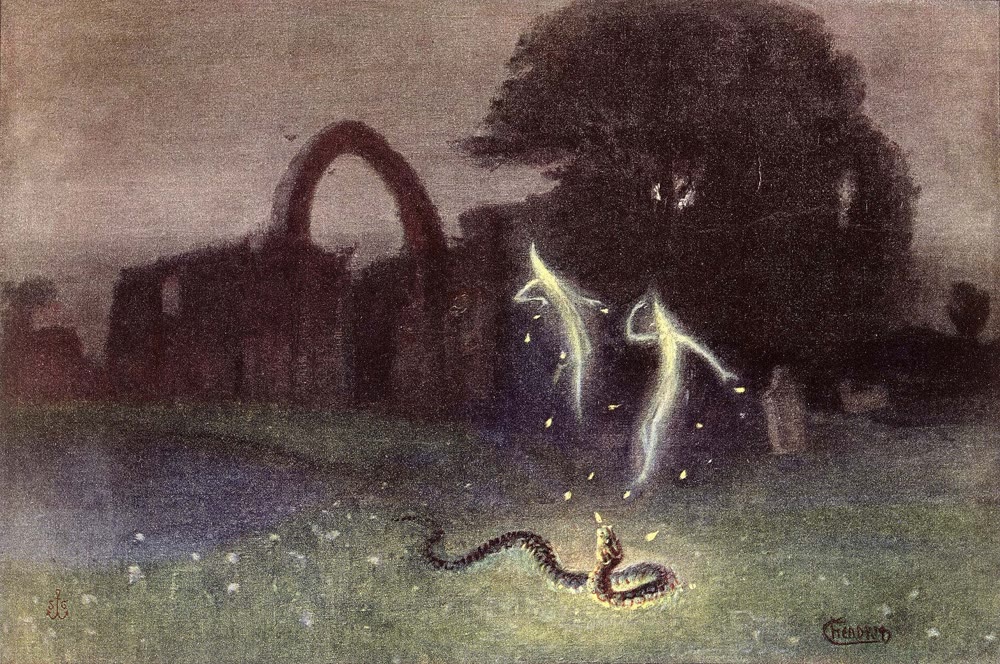
Will-o’-the-wisps in a painting by the German artist Hermann Hendrich (died 1931). Public domain, via Wikimedia Commons
The modern version, and the missing turnip
The version you’ll find on many Halloween websites runs like this: Jack talks the Devil into turning into a coin to pay for drinks, later traps him up a tree, and finally wanders with a coal from Hell inside a hollowed turnip. National Geographic’s retelling ends the same way, with an ember in a turnip lantern.
Most of those pieces are genuinely old. The coin trick turns up in the 1930s as a half-crown in Cork and Tipperary and a piece of gold in Galway, and the tree goes back to the sycamore of 1836. But none of the older Irish versions quoted here puts Jack’s coal inside a turnip.
The turnip seems to have joined later. In parts of Clare and Kilkenny in the 1930s, a carved turnip lantern was itself called a Jack o’ the Lantern or Jacky the Lantern. Once the name sat on the vegetable, the vegetable could slip into the tale. The National Museum of Ireland says the lanterns take their name from the folktale.
Turnip lanterns: what the records show
A face cut into a root vegetable was already a joke in Georgian London. A satirical print published there on 10 October 1792 shows five grown men recoiling in terror from a horned turnip face stuck on top of a signpost.
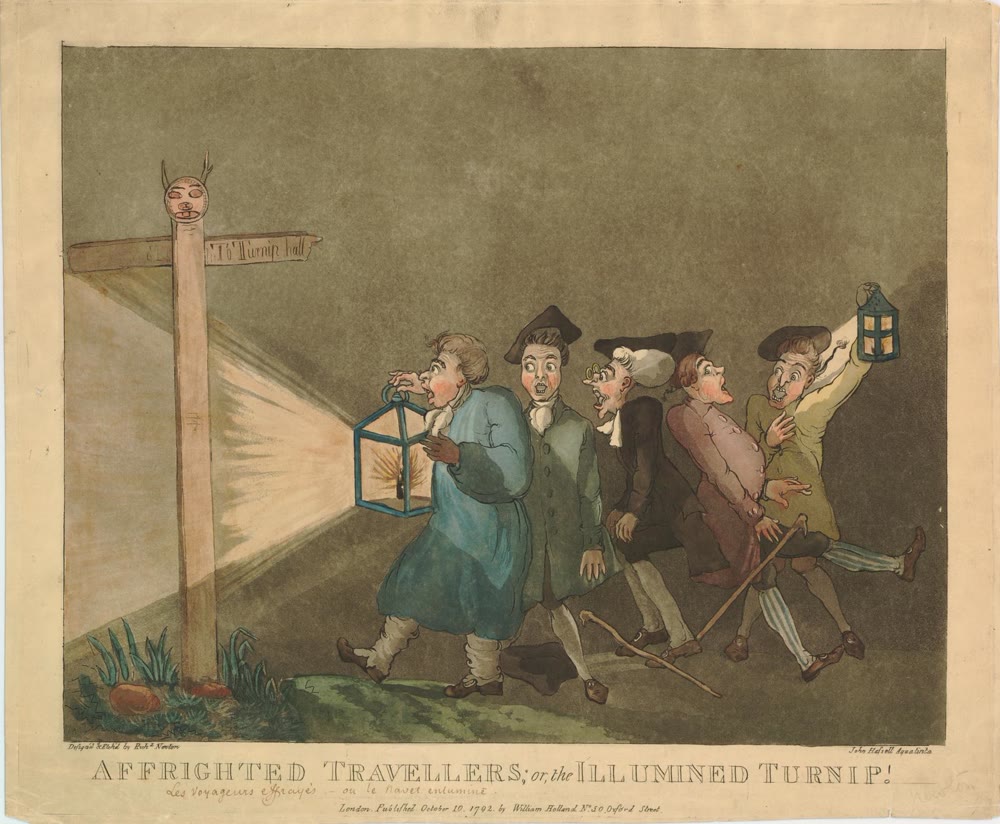
Affrighted Travellers; or, the Illumined Turnip! Etched by Richard Newton, aquatint by John Hassell, published by William Holland, London, 10 October 1792. British Museum, public domain, via Wikimedia Commons
An Irish “turnip” is usually the big purple-and-yellow swede (rutabaga in America), the Irish Times explains. In Irish it’s a tornapa (TUR-na-pa).
The 1930s school accounts are full of turnip lanterns, often filed under homemade toys:
- In Croaghan, Co. Donegal, boys cut a hole underneath for the candle and another on top for the smoke, then set the turnip on a whin bush on Hallow Eve.
- At Cree, Co. Offaly, children fitted red paper into one eye and blue into the other, then propped the turnip in a ditch on November Night.
- Near Newtown, Co. Kilkenny, the face got teeth made of little sticks, and the lantern was called Jacky the Lantern.
- At Knockjames, Co. Clare, a hollowed turnip was locally called a Jack o’ the Lantern, and boys once carried one around the hills at Christmas to scare people.
- At Newtowngore, Co. Leitrim, a mangold would do if there were no turnips, though it was too soft. The face went on a stick the height of a man, with a white sheet below it to make a ghost.
You’ll often read that turnip faces were meant to ward off Stingy Jack or evil spirits. The National Trust for Scotland says that of Scottish neep or tumshie lanterns, but the Irish school accounts mostly describe pranks, and the National Museum says its lanterns were lit on 31 October to scare people.
As my Halloween guide explains, a teacher near Fintown, Co. Donegal, donated a turnip lantern to the National Museum in 1943, and Eileen Barnes, the museum’s artist, cast it in plaster and painted it. The cast is catalogued as F1943.350. Clodagh Doyle of the museum’s Irish Folklife Division told Catholic News Service in 2017 that the teacher handed it over because nobody made that kind of lantern any more.
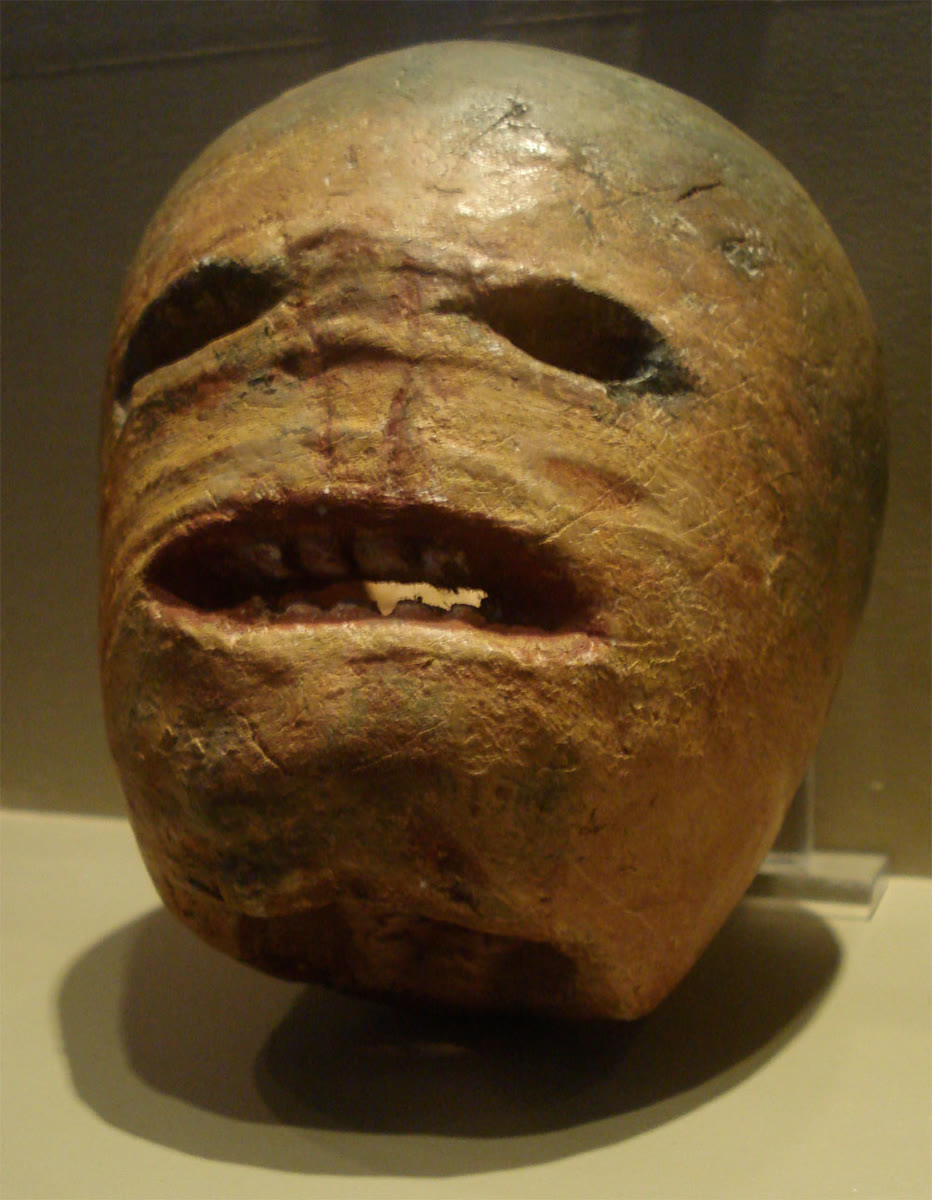
A traditional Irish turnip lantern from the early 20th century, displayed at the National Museum of Ireland, Country Life, Co. Mayo. Photo: Rannpháirtí anaithnid, CC BY-SA 3.0, via Wikimedia Commons
In 2017 the museum’s Country Life branch at Turlough Park, near Castlebar, Co. Mayo, had two turnip lanterns on show, and the ghost turnip is still listed as on display. Admission is free; check opening hours before you go.
How the pumpkin took over in America
The pumpkin is an American native, and Americans were cutting faces into pumpkins before anyone tied them to Halloween. In Nathaniel Hawthorne’s 1852 story “Feathertop”, a witch makes a scarecrow’s head from a withered pumpkin with eye holes and a slit of a mouth.
The historian Cindy Ott, author of Pumpkin: The Curious History of an American Icon, picks out “The Pumpkin Effigy”, an engraving in Harper’s Weekly of 23 November 1867, as probably the first picture of a jack-o’-lantern carved from a pumpkin. The article doesn’t mention Halloween, and, as Notre Dame’s library notes, it credits the English with the prank.
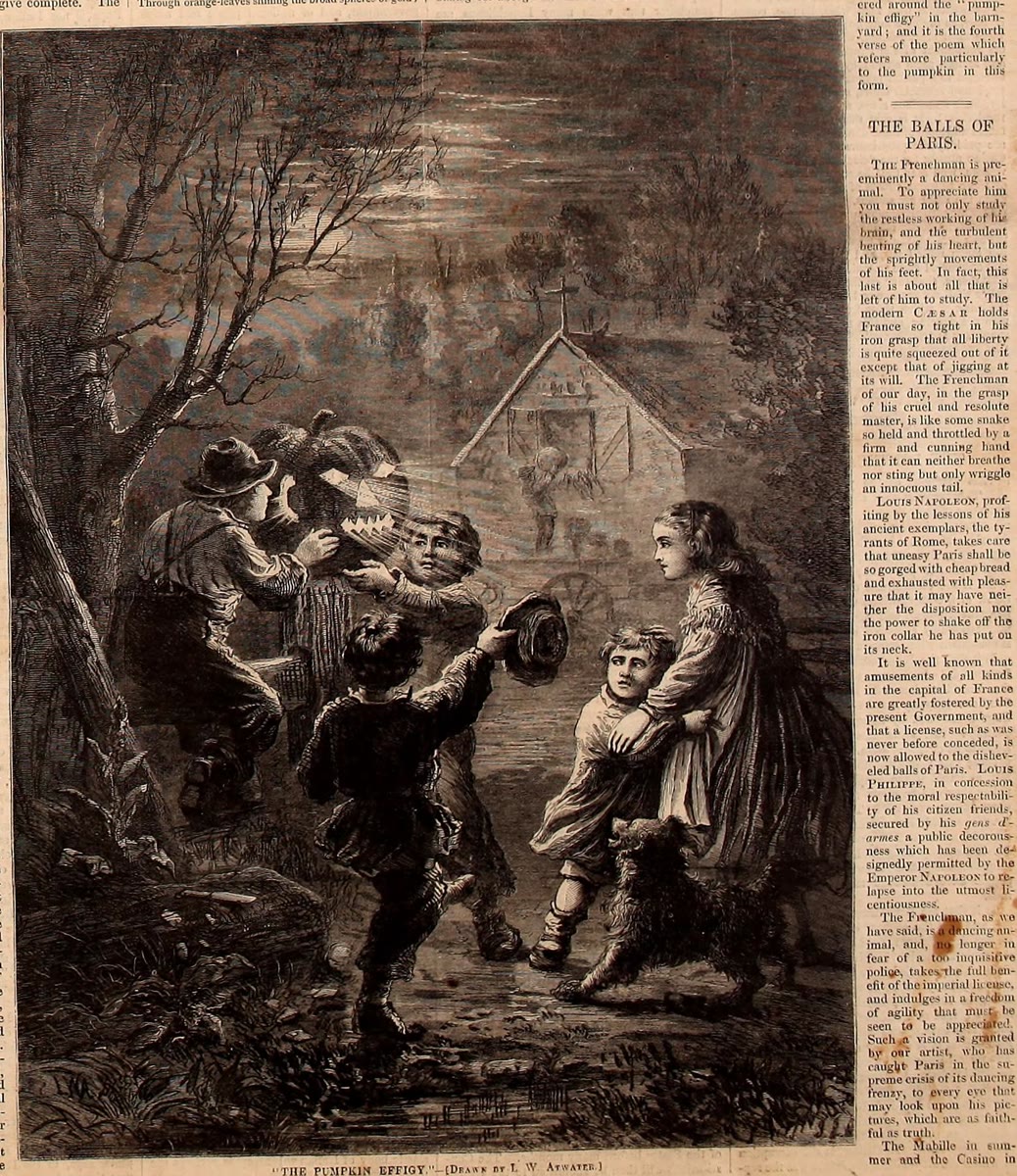
“The Pumpkin Effigy”, drawn by L. W. Atwater, Harper’s Weekly, 23 November 1867. Public domain, via Wikimedia Commons
As Irish emigrants poured in during the mid-1800s, Ott writes, Americans were turning Halloween into an evening of parlour games and spooky fun. Irish and Scottish newcomers brought their turnip lanterns and met a bigger, softer vegetable. Ott dates that meeting to the 19th century; nobody can name the year.
By the late 1930s the pumpkin was even finding its way back. A pupil in Ballinamore, Co. Leitrim, wrote that children there hollowed out a pumpkin at Halloween to frighten people on the road, explaining that a pumpkin is a bit like a turnip.
How to carve a turnip lantern
A turnip is harder to carve than a pumpkin, and far creepier. Take it slowly.
- Choose your turnip. Pick the biggest, heaviest swede you can find. If it won’t sit level, slice a thin piece off the bottom.
- Take off the lid. Cut a slice off the top, about 2 to 3 cm (an inch) down, and keep it. Cut a small hole in it later to let heat and smoke escape, as the Donegal boys did.
- Hollow it out. The National Trust for Scotland suggests marking a border about 3 cm in from the skin and gouging out the middle. Score the flesh into small squares with a knife tip, then lever them out with a sturdy spoon or melon baller.
- Draw the face. Sketch it with a pen. Triangles and slits are far easier in turnip than curves.
- Cut the features. Keep the turnip on a chopping board and cut away from your hand. Adults should do the knife work; children can draw and scoop. For a Kilkenny touch, push little sticks into the mouth as teeth.
- Light it. A battery tea light is safest, especially around children. With a real tea light, stand the lantern on a stable, non-flammable surface, keep the vented lid on and never leave it unattended.
- Eat the insides. Boil the scooped-out flesh and mash it with butter and plenty of pepper.
Then put the kettle on and cut a slice of barmbrack, the Halloween bread with a fortune baked inside.
Stingy Jack FAQ
Is Stingy Jack a real Irish legend?
Yes. A version was printed in Dublin in 1836, the name Stingy Jack was in print by 1851, and Irish schoolchildren recorded more than 200 related tales in the late 1930s.
What is Stingy Jack called in Irish?
Storytellers called him Seáinín an Laindéir or Liam an tSoip; dictionaries call the light Seán na gealaí (shawn na GYAL-ee).
Why is it called a jack-o’-lantern?
Jack meant any ordinary man, and by the 1660s jack-o’-lantern meant the wandering light over bogs. The name later passed to carved lanterns.
Did the Irish really carve turnips for Halloween?
Yes. School accounts from the 1930s describe it all over Ireland, and the National Museum holds a cast of a Donegal turnip lantern of a kind made around 1900. A mangold or a large potato sometimes stood in.
Love this? Save it to your Pinterest board for later.
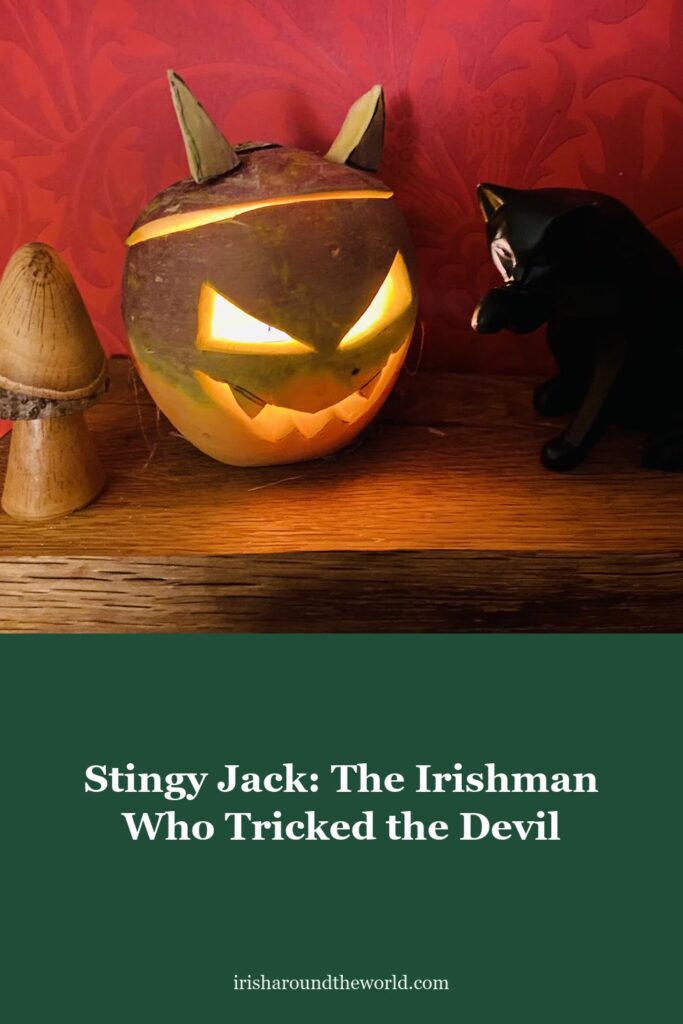
Pin image: Adapted from a photo by LornaMCampbell, CC BY-SA 4.0, via Wikimedia Commons.
A little bit of Ireland in your inbox every Friday ☘️
The free Weekly Dose of Irish: an Irish joke, a Celtic symbol, an Irish fact, a poem and the week’s best articles in one short email. Join 9,600+ readers.
Free. One short email every Friday. Unsubscribe any time.
More Irish Halloween reading
- Samhain: The Night the Fairy Mounds Opened and How It Became Halloween
- Bram Stoker: The Bedridden Dublin Boy Who Grew Up to Write Dracula
- Colcannon Recipe: The Irish Halloween Mash That Hides Your Fortune
- Irish Halloween Games: Snap Apple, Burning Nuts and the Old Spells to See Your Future Spouse
- How the Irish Invented Halloween: Samhain, Turnip Lanterns, Barmbrack and the Best Festivals in Ireland
- The Púca: Ireland’s Shape-Shifter and Why You Never Eat Blackberries After Halloween
- Irish Mythological Creatures: 23 Fairies, Monsters and Death Omens to Know
- Happy Halloween in Irish: Oíche Shamhna Shona (Plus 35 Spooky Irish Words)
- 15 Haunted Places in Ireland: Ghost Stories, Real History and How to Visit
- 90 Irish Halloween Jokes, Puns and Riddles That Are Scary Good
Featured image: A Scottish tumshie (turnip) lantern carved for Halloween 2022. Photo: LornaMCampbell, CC BY-SA 4.0, via Wikimedia Commons.